
DCT-350 · Lesson 5 of 12 · 23 min
Facilities review: safety, fire and physical security
Safety, fire protection and physical security together make up a large share of most facility exams, and they are the topics where a wrong answer on the job can hurt someone. This review covers the electrical safety rules a technician lives by, battery, lifting and liquid hazards, the fire detection and suppression systems in a data center, and the layers of physical security. As before, each section points back to the DCT lesson that taught it, and ends with the traps exam writers like to set.
Electrical safety: what a technician may and may not do
At Stonebridge, and on most exams, a data center technician is treated as an unqualified person for electrical work. That does not mean ignorant: it means the person has not been trained and authorized to work on or near exposed energized parts. A technician may read meters and displays, plug and unplug rack equipment, swap hot-pluggable parts and work inside closed equipment as the maker intends, but may not open energized panels, operate distribution breakers or bypass switches, or enter the restricted approach boundary (DCT-120 lessons 2 to 4).
Electrical safety programs follow NFPA 70E in the US. Both use the same ideas: put equipment in an electrically safe work condition (de-energized, locked, tested) whenever possible; if work must be done energized, justify it, plan it, and use the right boundaries and personal protective equipment.
Two approach boundaries protect against shock: the limited approach boundary, which unqualified people may not cross without an escort, and the restricted approach boundary, which only qualified people with the right protection may cross. The arc flash boundary is the distance at which an arc flash could cause a second-degree burn, which is an incident energy of 1.2 cal/cm². The label on SB-A2 in Hall A's electrical room reads 480 V, arc flash boundary 6 ft 2 in, 6.8 cal/cm² at 18 in, limited approach 3 ft 6 in, restricted approach 1 ft (DCT-120 lesson 3).
| PPE category | Minimum arc rating | Typical clothing |
|---|---|---|
| 1 | 4 cal/cm² | Arc-rated shirt and pants or coverall |
| 2 | 8 cal/cm² | Arc-rated shirt and pants or coverall, balaclava or hood |
| 3 | 25 cal/cm² | Arc flash suit system |
| 4 | 40 cal/cm² | Arc flash suit system |
Exam trap: a label's incident energy decides PPE when the label method is used. SB-A2's 6.8 cal/cm² needs clothing rated at least 6.8 cal/cm², which in practice means category 2 (8 cal/cm²) gear, not category 1. And PPE does not make anyone qualified: the boundaries and the authorization still apply.
Lockout
Lockout and tagout isolate energy before work. Each person working puts their own lock on the isolation point, or on a group lockbox, and removes only their own lock. The person in charge verifies zero energy with a tested meter (test before, test the circuit, test after). In DCT-120 lesson 4 the UPS-B2 module swap used a group lockbox: the electrician locked the isolation points, put the keys in the box, and each worker, including Jamal, added a personal lock to the box. Technicians usually take part as workers under someone else's lockout, not as the people who isolate electrical systems.
Batteries, lifting and liquids
- Lead-acid (VRLA) batteries give off hydrogen when overcharged and contain sulfuric acid; battery rooms need ventilation, eyewash stations and insulated tools. A failing cell may be found by smell or heat (DCT-120 lesson 5). Lithium-ion cabinets need off-gas detection and the maker's thermal runaway procedures.
- Lifting: Stonebridge's one-person lift limit is 50 lb; above that, use a server lift. A fully loaded AI rack can weigh around 3,300 lb, so routes, ramps and floor loadings must be checked before a move (DCT-120 lesson 7, DCT-130 lesson 4).
- Raised floors: open no more than two adjacent tiles, barrier any open tile, and never stand on the floor's understructure.
- Liquid cooling: shut branch valves and drain to drip trays before breaking a quick disconnect; pressure test after reconnecting; treat glycol as a slip and environmental hazard (DCT-120 lesson 10).
- Noise: hearing protection is required in Hall D, UPS rooms and the generator yard. The occupational limit is 90 dBA over 8 hours with a 5 dB exchange rate under OSHA, with an 85 dBA action level.
- ESD: wear a wrist strap with a built-in resistor of about 1 MΩ connected to the rack or a grounded mat when handling boards and memory (DCT-120 lesson 6).
Worked problem
Floor loading check
A GB200-class rack weighs about 3,300 lb and sits on a footprint of 24 in × 52 in. Hall A's raised floor is rated for about 205 lb/ft² distributed load. Could it go in Hall A?
Show solution
- Footprint area = 2 ft × 4.33 ft = 8.7 ft².
- Load = 3,300 / 8.7 = 380 lb/ft².
- That is about 1.9 times the rating, before any point loads from casters.
Answer: No. It needs a slab floor like Hall D, or engineered floor reinforcement.
Fire detection
Data centers detect fire early because smoldering electrical fires produce smoke long before flame. Common detectors are spot smoke detectors, very early warning aspirating smoke detection (VESDA-type systems that draw air through pipes to a sensitive detector), heat detectors in some spaces, and linear heat detection in cable trays. Detection is usually arranged so that one detector raises an alert and a second detector in the zone, or a higher alarm level, confirms the fire and starts the suppression sequence (DCT-120 lesson 11).
Suppression
Sprinklers are required in most buildings, and data halls usually use pre-action systems: the pipes are dry and fill with water only when detection confirms a fire, so a damaged pipe or sprinkler head does not flood the hall. A single-interlock system fills the pipes on detection; a double-interlock system needs both detection and a sprinkler head opening before water enters; a non-interlock system fills on either. Water is then discharged only from heads that have opened from heat.
Clean agent systems flood a room with a gas that puts out fire without damaging equipment. Halocarbon agents such as FK-5-1-12 and HFC-227ea remove heat; inert gases such as IG-541 lower the oxygen level. Each agent has a design concentration and a no-observed-adverse-effect level (NOAEL). For FK-5-1-12 a typical design is about 5.85 percent against a NOAEL of 10 percent; for HFC-227ea about 7.9 percent against 9 percent. Halocarbons discharge in about 10 seconds; inert gases over 60 to 120 seconds and reduce oxygen to about 12 to 14 percent.
Safety around discharge: when the pre-discharge alarm sounds, leave the room; do not hold the abort or hold switch unless trained and told to; never re-enter until the room has been ventilated and the fire department or the site's emergency lead allows it. Lockout of clean agent systems for work inside the protected space follows the site procedure.
# Fire and safety review checks
agents = {  # agent: (typical design %, NOAEL %)
    "FK-5-1-12": (5.85, 10.0),
    "HFC-227ea": (7.9, 9.0),
}
for name, (design, noael) in agents.items():
    margin = noael - design
    print(f"{name:<10} design {design:4.2f} %  NOAEL {noael:4.1f} %  margin {margin:4.2f} points")

def ppe_category(cal):
    for cat, rating in ((1, 4), (2, 8), (3, 25), (4, 40)):
        if cal <= rating:
            return cat
    return None   # above 40 cal/cm2: no category, work de-energized
for cal in (1.0, 6.8, 12.0, 45.0):
    cat = ppe_category(cal)
    print(f"{cal:5.1f} cal/cm2 -> " + (f"category {cat}" if cat else "no PPE category: de-energize"))

lift_limit_lb = 50
for item, lb in (("1U server", 40), ("2U GPU tray", 88), ("UPS battery module", 70)):
print(f"{item:<20} {lb} lb -> " + ("one person" if lb <= lift_limit_lb else "use a lift or two people"))FK-5-1-12 design 5.85 % NOAEL 10.0 % margin 4.15 points HFC-227ea design 7.90 % NOAEL 9.0 % margin 1.10 points 1.0 cal/cm2 -> category 1 6.8 cal/cm2 -> category 2 12.0 cal/cm2 -> category 3 45.0 cal/cm2 -> no PPE category: de-energize 1U server 40 lb -> one person 2U GPU tray 88 lb -> use a lift or two people UPS battery module 70 lb -> use a lift or two people
Physical security
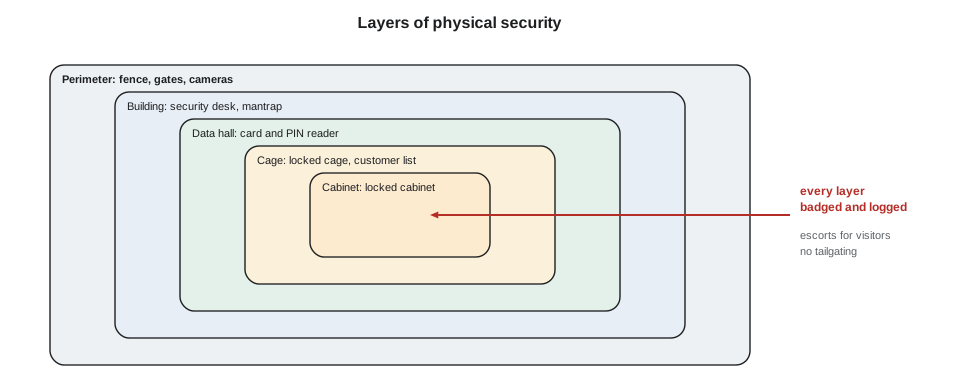
Physical security is built in layers, each one making it harder to reach the equipment without being seen and recorded (DCT-110 lesson 9):
- Perimeter: fencing, gates, vehicle barriers, lighting and cameras.
- Building: a staffed security desk, visitor registration with photo identification, and a mantrap or turnstile that lets one person through at a time.
- Data hall: card plus PIN or biometric readers, and cameras on every door.
- Cage and cabinet: locked customer cages and cabinets, with keys or combinations issued only through the customer's authorized list.
Procedures matter as much as hardware. Stonebridge's rules, enforced by Ike Adeyemi's team, are: no tailgating, so every person badges every door; visitors are escorted at all times in white space; remote hands requests are verified with two identity checks against the customer's authorized contact list (DCT-330 lesson 8); and equipment leaves the building only with a signed removal pass. Media leaves only after sanitization or destruction under chain of custody (DCT-130 lesson 11, DCT-310).
Exam traps on safety, fire and security
- PPE does not make a person qualified; boundaries still apply.
- Pick PPE rated at or above the label's incident energy; round up to the next category.
- Remove only your own lock; never ask someone else to remove theirs for you.
- A pre-action system's pipes are normally dry; double interlock needs two events.
- Clean agent safety depends on leaving promptly and not re-entering until cleared, regardless of the NOAEL margin.
- Holding a door for a colleague is tailgating, even if you know them.
Approach boundaries
Electrical safety standards (CSA Z462 in Canada, NFPA 70E in the US) define boundaries around exposed energized parts. The limited approach boundary is the distance inside which an unqualified person may go only when escorted by a qualified person. The restricted approach boundary is closer, and only qualified persons with the right PPE and a plan may cross it. The arc flash boundary is separate: it is the distance at which the incident energy from an arc flash falls to 1.2 cal/cm², the level that can cause a second-degree burn on bare skin. The arc flash label on the equipment gives these distances and the PPE required (DCT-120 lesson 4).
A technician at Stonebridge is not a qualified electrical worker, so the practical rules are simple: stay outside the limited approach boundary of any open energized equipment, never open covers on switchgear or panels, and treat the arc flash label as information about where not to stand. Exams often describe a technician asked to hold a light for an electrician working inside an open panel; the right answer is to decline unless trained, qualified and wearing the required PPE, and to report the request.
Worked problem
Reading a scenario against the boundaries
An arc flash label on a 480 V switchboard gives a limited approach boundary of 3 ft 6 in, a restricted approach boundary of 1 ft and an arc flash boundary of 5 ft. An electrician has the cover off. Where may an unescorted technician stand, and is the technician safe from arc flash at 4 ft?
Show solution
- Unescorted and unqualified: outside the limited approach boundary, so farther than 3 ft 6 in.
- At 4 ft the technician is outside the limited approach boundary but inside the arc flash boundary of 5 ft.
- Inside the arc flash boundary, arc-rated PPE is needed for the hazard on the label.
Answer: The technician must stand farther than 5 ft away, outside both boundaries, unless wearing the PPE the label requires. Being outside the shock boundary does not mean being outside the arc flash boundary.
Testing for absence of voltage
Lockout is not complete until the equipment has been proved dead. The qualified person tests for absence of voltage with a rated meter, checking the meter on a known live source before and after the test (live-dead-live), so that a faulty meter cannot give a false dead reading. A technician who is part of a group lockout applies their personal lock to the group box and may ask to see the verification, which is good practice and never an insult.
Detection in more detail
Data halls usually combine two kinds of smoke detection. Aspirating smoke detection draws air through sampling pipes to a very sensitive detector, giving the earliest warning of an overheating component, often long before visible smoke. Spot detectors on the ceiling and below the raised floor provide the confirmation that releases a suppression system. Many systems require two detectors, or two zones, to agree before releasing agent or opening a pre-action valve, which prevents a single faulty detector from causing a discharge. That two-step logic is called cross-zoning or a double-knock.
A typical aspirating system raises alerts in stages, such as alert, action, fire 1 and fire 2, with only the later stages linked to suppression. A technician who hears an early-stage alarm investigates with the desk, looking for a warm smell, a failing power supply or a contractor cutting or grinding without a hot work permit.
Clean agents and inert gases
Clean agent systems put out fires without leaving residue. Halocarbon agents such as HFC-227ea and FK-5-1-12 mainly absorb heat; inert gas systems such as IG-541 and IG-55 lower the oxygen level in the room to about 12 to 14 percent, which stops most fires but still allows people to breathe for a short evacuation. Both depend on the room holding the agent for a set time, so doors must close, and ducts and openings must be sealed or fitted with dampers. Room integrity is tested by a door fan test, and a technician who leaves a hole after cabling work, or wedges a door open, may stop the system from working.
Never re-enter a room after a discharge until the fire service or the site lead says it is safe; heat and decomposition products, and low oxygen after an inert gas discharge, can harm people even when no fire is visible.
Security beyond locks
Most security failures involve people rather than locks. Tailgating, where someone follows a badge holder through a door, is the most common, followed by social engineering: a caller who claims to be a customer's engineer, a visitor in a high-visibility vest who looks as if they belong, or an email asking for a floor map. The defenses are the habits taught in DCT-110: every person badges every door, visitors are escorted at all times, requests are verified through the customer's authorized list, and anything unusual is reported to the security desk at once. In an exam, the answer that challenges politely and reports is almost always better than the one that assumes good intent.
Common mistakes
MistakeChoosing category 1 PPE for a 6.8 cal/cm² label because the number is small.
InsteadCategory 1 is only 4 cal/cm²; use at least 8 cal/cm² gear.
MistakeEntering a clean agent room after discharge to check the equipment.
InsteadWait for ventilation and permission from the emergency lead or fire department.
MistakeLifting a 40 kg GPU tray alone because it is only a short distance.
InsteadAbove the 23 kg limit, use a lift or two people.
MistakeLetting a known customer through a door on your badge.
InsteadEvery person badges every door; tailgating defeats the access record.
Summary and key terms
- Technicians are unqualified persons for electrical work: no open energized panels, no switchgear operation, no restricted approach boundary.
- Boundaries: limited approach, restricted approach and the arc flash boundary at 1.2 cal/cm²; PPE categories 1 to 4 at 4, 8, 25 and 40 cal/cm².
- Personal locks, verified zero energy and group lockboxes control lockout.
- Detection is early and staged; pre-action sprinklers and clean agents protect data halls.
- Physical security is layered, and procedures such as no tailgating, escorts and identity checks are part of it.
- Unqualified person
- Someone not trained and authorized to work on or near exposed energized parts.
- Arc flash boundary
- The distance at which an arc flash could cause a second-degree burn (1.2 cal/cm²).
- Pre-action system
- A sprinkler system whose pipes stay dry until detection allows water in.
- NOAEL
- No-observed-adverse-effect level: the highest agent concentration with no observed harmful effect.
- Mantrap
- A small space with two interlocked doors that admits one person at a time.
- Tailgating
- Following someone through a controlled door without using your own credential.
Practice problems
Work each problem on paper first, then reveal the answer to check.
A label shows 11 cal/cm². Which PPE category is needed?
Show answer
Category 3 (25 cal/cm²), the first at or above 11.
What must happen before water enters a double-interlock pre-action system?
Show answer
Both a detection signal and a sprinkler head opening.
An inert gas system lowers oxygen to about what level?
Show answer
About 12 to 14 percent.
Name the five layers of physical security in this lesson.
Show answer
Perimeter, building, data hall, cage and cabinet.
Lesson quiz · 5 questions
Score 60% or more to complete this lesson.
Create a free account to save your progress, take quizzes and earn a certificate.