
CRE-401 · Lesson 8 of 12 · 34 min
Multiple channels, formats and platforms
Most growing creator companies expand beyond a single channel. They add short-form video, podcasts, newsletters, second-language channels, live streams, spin-off shows and sometimes entirely new brands. Expansion can reach new audiences, spread platform risk and make better use of content the team already produces. It can also stretch a small team too thin and dilute the brand. This lesson covers how to decide which formats and platforms to add, how to repurpose content efficiently, how to localize for new languages and markets, and how to judge whether an expansion is working.
Why expand?
There are four main reasons to add channels or formats:
- Reach: different platforms and formats reach different people. Short-form video attracts discovery; podcasts suit commuters; newsletters reach readers directly.
- Risk: spreading audience and revenue across platforms reduces exposure to any one algorithm or policy change.
- Efficiency: content made for one format can often be repurposed for others at low extra cost.
- Revenue: new formats unlock new revenue, such as podcast advertising, newsletter sponsorships, memberships or licensing.
The main reason not to expand is focus. Every new channel needs ongoing attention. A neglected channel can harm the brand more than having no channel at all.
Choosing formats and platforms
Before launching a new format, ask several questions. Does the audience you want spend time there? Does the format suit your content and talent? What will it cost in time and money each month? How will it earn revenue, directly or by feeding the core business? What does success look like after six and twelve months?
| Format | Main strengths | Typical revenue | Typical effort |
|---|---|---|---|
| Long-form video | Depth, watch time, strong sponsor value | Ads, sponsorships, memberships | High |
| Short-form video | Discovery, reach, fast testing of ideas | Creator funds, brand deals, traffic to other formats | Low to medium per piece, high volume |
| Podcast (audio or video) | Long listening time, loyal audience | Host-read ads, sponsorships, subscriptions | Medium |
| Newsletter | Owned audience, direct relationship | Sponsorships, paid subscriptions, product sales | Low to medium |
| Live streaming | Real-time community, high engagement | Tips, subscriptions, sponsorships | Medium, time-bound |
| Second-language channel | New markets with proven content | Ads, local sponsors | Medium |
Platform rules and revenue programs change often, so check current terms before building a plan around any one program. Creator funds and bonus programs, in particular, have been launched, changed and ended by several platforms over the years.
Hub and spoke: repurposing content
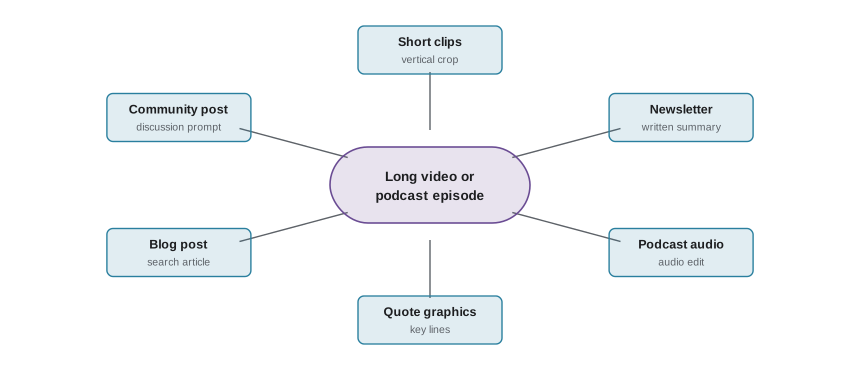
A common model treats one major piece of content as the hub and creates spokes from it. A long video or podcast episode can produce short clips, a newsletter, quote graphics, a blog post, a behind-the-scenes post and audiograms. Each spoke should be adapted to its platform rather than copied, since formats, aspect ratios, lengths and audience expectations differ.
Worked problem
Cost per piece with repurposing
A long video costs $3,000 to make. From it, the team produces 6 short clips at $80 each in extra editing, a newsletter issue at $150 and a podcast audio version at $200. What is the average cost per piece across all 9 pieces, compared with making each separately for an estimated $3,000 + 6 × $400 + $600 + $900?
Show solution
- Repurposed total: $3,000 + 6 × $80 + $150 + $200 = $3,830.
- Average per piece: $3,830 ÷ 9 ≈ $426.
- Separate total: $3,000 + $2,400 + $600 + $900 = $6,900.
- Saving: $6,900 − $3,830 = $3,070.
Answer: Repurposing produces 9 pieces for $3,830, about $426 each, saving roughly $3,070 compared with making them separately.
Short form and long form
Short-form video can grow reach quickly, but views on short-form platforms often earn far less revenue per view than long-form views, and short-form viewers may not follow a creator to longer content. Companies use short form in different ways: as a discovery funnel pointing to long-form content and owned channels, as a stand-alone business with high volume and brand deals, or as a testing ground for ideas that later become long-form episodes.
Worked problem
Comparing revenue per thousand views
A company's long-form videos earn an RPM (revenue per thousand views) of $6.50, and its shorts earn an RPM of $0.08. A shorts channel gets 20 million views a month. A long-form channel gets 1.2 million. Compare monthly ad revenue.
Show solution
- Shorts: 20,000,000 ÷ 1,000 × $0.08 = $1,600.
- Long form: 1,200,000 ÷ 1,000 × $6.50 = $7,800.
Answer: Despite many more views, shorts earn about $1,600 against $7,800 for long form. The shorts may still be valuable for discovery, brand deals or driving viewers to the main channel.
RPMs vary greatly by platform, niche, country of audience and season, so use your own analytics rather than averages from the internet.
Podcasts and newsletters
Podcasts and newsletters are popular expansions for creator companies because they deepen relationships with existing audiences. Podcasts can be audio-only, video, or both, and are distributed through several platforms at once. Newsletters give the company a direct line to its audience that no algorithm controls, which makes them strategically valuable even when they earn modest revenue.
Commercial email in the US must comply with CAN-SPAM: accurate headers and subject lines, a physical postal address, a clear way to opt out, and honoring opt-outs within 10 business days. Some states add rules, and text messaging falls under the TCPA, which requires prior consent.
Worked problem
Newsletter sponsorship value
A newsletter has 60,000 subscribers with a 42 % open rate. Sponsors pay a CPM of $35 based on opens. What can one sponsorship slot earn per issue, and per year with 2 issues a week?
Show solution
- Opens per issue: 60,000 × 0.42 = 25,200.
- Revenue per issue: 25,200 ÷ 1,000 × $35 = $882.
- Per year: $882 × 104 issues = $91,728.
Answer: About $882 per issue, or roughly $92,000 a year from one slot, if every issue is sold.
Localization and new markets
Successful content can often reach new audiences in other languages. Options range from subtitles and translated titles, through multi-language audio tracks on the same video, to separate channels with dubbed or locally hosted versions. Separate channels allow local branding and sponsors but split the audience. Multi-language audio tracks keep views on one channel and are simpler to manage.
Good localization goes beyond translation. Jokes, references, units, measurements, cultural norms and legal rules differ. Sponsored segments may not be allowed or may need different disclosures in other countries. Product claims allowed in one market may be prohibited in another.
For US companies, Spanish-language content is a natural first step, since tens of millions of people in the US speak Spanish at home. Localizing for Latin American markets may also mean adjusting for regional varieties of Spanish.
Worked problem
Is a dubbed channel worth it?
Dubbing a video into another language costs $600. The dubbed version is expected to earn 20,000 views in its first year at an RPM of $3.50, plus a share of a local sponsorship worth $200 per video. Does dubbing break even?
Show solution
- Ad revenue: 20,000 ÷ 1,000 × $3.50 = $70.
- Sponsorship share: $200.
- Total: $270, compared with a cost of $600.
Answer: No; each dubbed video loses about $330. Dubbing only the best performers, using cheaper methods or growing the localized audience first would be needed to make it pay.
Brand architecture
As a company adds channels, it must decide how they relate. A branded house uses one master brand across everything, such as one name with different shows. A house of brands runs separate brands with their own identities. Many creator companies use a mix: a master brand with clearly linked sub-brands. A branded house builds recognition and makes cross-promotion easy, but a mistake in one channel can hurt all of them. A house of brands spreads that risk and lets each brand target a different audience, but each brand needs its own investment.
Judging an expansion
Set clear goals and review dates before launching. For a new channel, goals might cover audience growth, engagement, revenue and the effect on the core channel. Decide in advance what result after six months would lead you to invest more, keep testing, change direction or stop. Without these criteria, struggling channels often linger for years, quietly consuming time.
Worked problem
Channel contribution after six months
A podcast launched six months ago costs $2,400 a month in production and staff time. It now earns $1,500 a month in sponsorships and is estimated to drive $500 a month in extra product sales contribution. Revenue has grown 15 % a month for the last three months. What is the current monthly contribution, and when might it break even if growth continues?
Show solution
- Current monthly benefit: $1,500 + $500 = $2,000.
- Current contribution: $2,000 − $2,400 = −$400 a month.
- Month 1 ahead: $2,000 × 1.15 = $2,300. Month 2 ahead: $2,300 × 1.15 ≈ $2,645.
Answer: It loses about $400 a month now but would pass break-even in about two months if growth continues, which supports continuing with a fresh review at that point.
Cannibalization and audience overlap
New channels and formats can compete with the core channel for the same audience's time. A shorts channel might draw viewers who would otherwise watch long videos; a podcast might replace some video views. Measure overlap where platforms allow, watch the core channel's metrics after launches, and ask the audience directly. Some cannibalization is acceptable if total reach and revenue grow.
Worked problem
Net effect of a launch
After launching a podcast, a company's long-form video revenue falls by $1,200 a month, while the podcast earns $3,000 a month in sponsorships and costs $1,500 a month to produce. What is the net monthly effect?
Show solution
- Podcast contribution: $3,000 − $1,500 = $1,500.
- Net effect: $1,500 − $1,200 = $300 a month.
Answer: The podcast adds only $300 a month once cannibalization is counted, much less than its $1,500 contribution suggests. The company should look for ways to reach new listeners rather than existing viewers.
Talent for new formats
Each format needs different skills: short-form editing is fast and punchy, podcast hosting needs conversational skill, newsletter writing needs strong prose, and live streaming needs comfort with improvisation. Expanding formats often means hiring or developing new talent, including new on-camera or on-mic hosts. Developing additional hosts also reduces key-person risk, a topic that returns in lesson 12.
Platform relationships
Larger creator companies often have contacts at platforms, such as partner managers, who share best practices, early access to features and help with problems. These relationships are valuable but do not replace following platform rules and diversifying. Keep records of policies and terms that affect the business, since they change often.
A practical way to manage several channels is a single content calendar that shows every planned piece across all platforms, with owners and dates. It reveals clashes, such as two big launches in the same week, and gaps, such as a newsletter with nothing to feature. It also makes it easier for the sales team to see which slots are available to sponsors and for the product team to line up launches with the content that will promote them. Review the calendar weekly and plan the main pieces at least a month ahead.
Common mistakes
MistakeLaunching on every platform at once.
InsteadChoose formats by audience fit, cost and revenue, and add them one at a time.
MistakeCopying the same content everywhere unchanged.
InsteadAdapt each spoke to its platform's format and expectations.
MistakeJudging short form by views alone.
InsteadCompare revenue per view and the effect on other channels.
MistakeTranslating without localizing.
InsteadAdapt references, claims, disclosures and units for each market.
MistakeLetting struggling channels linger.
InsteadSet success criteria and review dates before launch.
Summary and key terms
- Expansion can increase reach, spread risk, improve efficiency and add revenue, at the cost of focus.
- Choose formats by audience, fit, cost, revenue and clear success measures.
- Hub-and-spoke repurposing lowers the cost per piece of content.
- Short form often earns much less per view than long form but can drive discovery.
- Newsletters and podcasts deepen owned relationships with the audience.
- Localization adapts language, culture, claims and disclosures, not just words.
- Set success criteria and review dates for every new channel.
- Repurposing
- Adapting content made for one format into other formats.
- Hub and spoke
- A model in which one major piece of content produces many smaller pieces.
- RPM
- Revenue per thousand views, after platform share.
- Open rate
- The share of email recipients who open a message.
- Localization
- Adapting content for a different language, culture and market.
- Dubbing
- Replacing the original audio with speech in another language.
- Branded house
- A brand architecture using one master brand across products.
- House of brands
- A brand architecture with separate, independent brands.
- Creator fund
- A platform program that pays creators from a set pool of money.
- Discovery funnel
- Content designed to attract new viewers and direct them to other channels.
Practice problems
Work each problem on paper first, then reveal the answer to check.
500,000 views at an RPM of $4. Revenue?
Show answer
$2,000.
Newsletter of 40,000 with 50 % opens at a $30 CPM. Revenue per issue?
Show answer
$600.
Hub costs $2,000; five spokes cost $100 each. Average cost per piece?
Show answer
$2,500 ÷ 6 ≈ $417.
A channel costs $1,800 a month and earns $1,500. Monthly contribution?
Show answer
−$300.
Name two reasons to expand to new formats.
Show answer
Reach, risk, efficiency, revenue.
What is the main risk of a branded house?
Show answer
A mistake in one channel can hurt them all.
Why are newsletters strategically valuable?
Show answer
They give a direct, owned relationship with the audience.
Name two things localization changes besides language.
Show answer
Jokes, references, units, claims, disclosures, cultural norms.
What should you set before launching a new channel?
Show answer
Success criteria and a review date.
Which law governs commercial email?
Show answer
CAN-SPAM, plus the TCPA for texts.
Lesson quiz · 5 questions
Score 60% or more to complete this lesson.
Create a free account to save your progress, take quizzes and earn a certificate.