
CON-365 · Lesson 12 of 12 · 18 min
Capstone: a workforce and labor relations plan
As Elmwood moves into its final year, Calder Ridge has won its next major project: the Cedar Creek water treatment plant expansion, a $120 million job for a suburban city near Columbus. It includes a new filtration building, two concrete process tanks, a chemical building and extensive yard piping, built over 30 months while the existing plant keeps running. Part of the funding comes from a federally supported state revolving loan fund, which brings Davis-Bacon prevailing wage requirements, and the city's contract includes a community workforce schedule. Nadia has asked Grace and Luis to prepare a workforce and labor relations plan before mobilization, drawing on everything learned on Elmwood. This lesson walks through the plan, section by section, as a model for any project.
1. The labor framework
The plan starts by mapping which agreements and laws apply. Calder Ridge's carpenters and laborers will work under the area agreements; the process piping, electrical and instrumentation subcontractors are union shops under their own trades' agreements; and the site work subcontractor is a merit shop. Because the project is covered by the Davis-Bacon Act, every contractor and subcontractor must pay at least the prevailing wages and fringe benefits in the applicable wage determination for each classification, submit certified payroll weekly, and employ apprentices only as allowed by registered programs. The carpenters' area agreement expires about 18 months into the project, so the plan flags a possible bargaining disruption and schedules the main process tank pours before then where possible.
| Element | Cedar Creek |
|---|---|
| Own crews | Carpenters and laborers, area agreements |
| Major subcontractors | Process piping, electrical, instrumentation (union); site work (merit shop) |
| Public requirements | Davis-Bacon wages and certified payroll; community workforce goals: 15% registered apprentice hours, 10% local resident hours |
| Bargaining risk | Carpenters' area agreement expiry in month 18 |
| Existing plant operations | Shutdown windows limited to nights and weekends for tie-ins |
2. Workforce demand
From the bid schedule, Luis built labor curves for Calder Ridge's own trades and asked each major subcontractor for theirs. The combined plan shows a site peak of about 260 workers in months 12 to 16, when the process tanks, the filtration building superstructure and the yard piping overlap, and a long tail of mechanical, electrical and commissioning work. The plan levels Calder Ridge's carpenter demand by running the two process tanks in sequence with one forming crew rather than in parallel with two, which lowers the carpenter peak from about 70 to about 45 without delaying the critical path, because the filtration building controls the finish date.
# Cedar Creek: own-crew labor plan, cost with escalation, and community goals (illustrative)
trades = {
    # trade: (planned hours, package $/h today, share of hours after the month-18 increase)
    "carpenters": (118_000, 62.35, 0.35),
    "laborers":   (86_000, 51.10, 0.35),
}
increase = {"carpenters": 2.90, "laborers": 2.40}       # assumed package increase in month 18, $/h
payroll_pct = 0.10      # employer payroll costs on the package (illustrative)
total_hours = total_cost = 0
for t, (h, pkg, late) in trades.items():
    cost = h * (1 - late) * pkg + h * late * (pkg + increase[t])
    cost *= 1 + payroll_pct
    total_hours += h; total_cost += cost
    print(f"{t:11s} {h:8,d} h  loaded cost ${cost:12,.0f}")
print(f"own crews   {total_hours:8,d} h  loaded cost ${total_cost:12,.0f}")
project_trade_hours = 410_000                     # all employers, from the combined plan
for name, share in [("registered apprentice", 0.15), ("local resident", 0.10)]:
print(f"{name} goal: {share * project_trade_hours:,.0f} h across all employers ({share:.0%})")carpenters 118,000 h loaded cost $ 8,224,777 laborers 86,000 h loaded cost $ 4,913,524 own crews 204,000 h loaded cost $ 13,138,301 registered apprentice goal: 61,500 h across all employers (15%) local resident goal: 41,000 h across all employers (10%)
The cost figure feeds the project budget and the apprentice and community targets become hour targets for each employer, built into every subcontract. Grace also checked the escalation assumption against the bid: the bid had carried today's rates throughout, so the plan records a known exposure of more than $200,000 that the project team must manage through productivity and buyout savings.
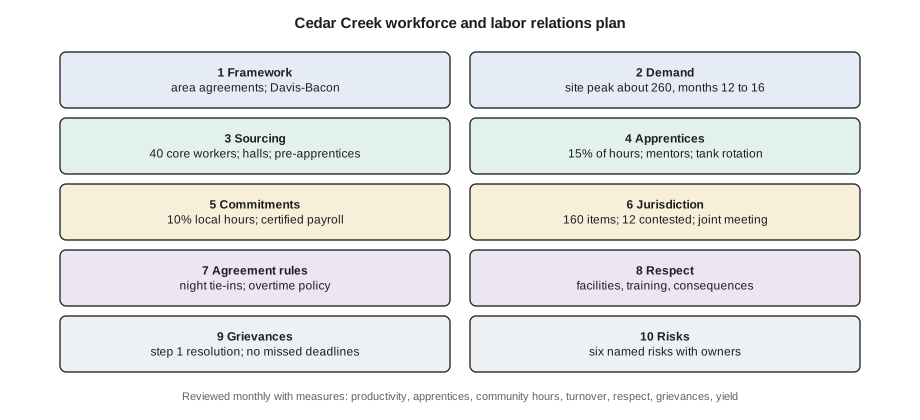
3. Sourcing and hiring
Calder Ridge will move about 40 of its core Elmwood workers to Cedar Creek as Elmwood winds down, matched through the monthly run-down meetings described in lesson 9. The remaining workers will come from the hiring halls, with name requests used for workers who performed well on Elmwood, and from a partnership with a local pre-apprenticeship program. Requests to the halls will be sized using the yields measured on Elmwood (about 76 percent from request to productive worker in week 1), and confirmed training will be required before dispatch where the agreement allows.
Onboarding follows the Elmwood model: contact before day 1, orientation, a named buddy, a week-one check-in and a month-one review. Because the existing plant is an operating water utility, orientation adds the owner's security and process safety rules, which take an extra half-day.
4. Apprenticeship and community commitments
The plan sets apprentice hours by crew and by period, so that crews stay within ratios and apprentices rotate through the work processes their logbooks require. Concrete process tanks are excellent training for carpenter apprentices because they combine curved forming, waterstops, embeds and tight tolerances; the plan assigns each apprentice to the tanks for at least three months. Each apprentice will have a named mentor, and mentors will attend Calder Ridge's mentor course before mobilization.
For the community workforce goals, Grace has met the process piping and electrical subcontractors, whose Elmwood numbers were below target on local hiring, and agreed on recruitment through the city's workforce development partner and a local pre-apprenticeship program. Reporting will be monthly, using the Elmwood template, with self-identification voluntary and confidential. Certified payroll for Davis-Bacon compliance will be collected weekly from every employer and checked against the wage determination before payment applications are approved.
5. Jurisdiction
Water treatment plants bring jurisdictional questions that Elmwood did not: who installs process equipment supports, who sets and grouts pumps, who installs fiberglass launders and weirs in the filters, who installs the chemical feed piping and containment, and who installs the precast tank covers. The plan lists 160 work items for the mark-up meetings, flags 12 as likely to be contested based on the assignment register and area practice, and schedules a joint meeting with the carpenters, millwrights, ironworkers and pipefitters on the contested items a month before they are needed.
6. Applying the agreements on site
The plan summarizes the rules supervisors will use daily: hours and overtime for each trade, rules for the night and weekend shifts needed for tie-ins to the existing plant, show-up pay, the weather notification procedure, and apprentice ratios. Because the tie-ins require night work, Luis met the stewards in advance to agree on how shifts would be scheduled and announced. The plan sets an overtime policy: overtime only for tie-ins, critical pours and specific recovery, approved by Luis, with no sustained overtime beyond two consecutive weeks without his review of productivity and fatigue.
7. Respect and inclusion
The respect program carries over from Elmwood: leadership messages at the kickoff, expectations at orientation, bystander training, facilities including women-only washrooms and properly fitting PPE, fair assignment checks in apprentice reviews, and consistent consequences. Because the site is remote from the main road and the existing plant's facilities are not available to contractors, the plan budgets for heated, lit and serviced washroom trailers near each work area and a cleaning schedule with posted records.
8. Discipline, grievances and relationships
Grace will keep a central discipline record and the grievance log, reviewed weekly with Luis. The plan sets a goal of resolving most grievances at step 1, settling clear errors within ten working days, and never missing a Calder Ridge deadline, a lesson from the overdue G-15 on Elmwood. Luis will meet the stewards weekly and the business representatives monthly. Calder Ridge will also invite the stewards to the monthly safety and workforce review, so that problems surface early.
9. Measures
The plan tracks a small set of measures monthly, chosen to show whether the workforce systems are working, not just whether the project is on budget.
# Cedar Creek workforce measures: targets and the first quarter's results (illustrative)
measures = [
    # (measure, target, actual, higher is better?)
    ("productivity factor, own crews", 1.00, 0.97, True),
    ("apprentice share of trade hours, all employers", 0.15, 0.13, True),
    ("priority-group share of trade hours", 0.10, 0.11, True),
    ("voluntary turnover in first 3 months", 0.10, 0.14, False),
    ("respect survey: would report without fear", 0.85, 0.82, True),
    ("grievances resolved at step 1", 0.70, 0.75, True),
    ("Calder Ridge grievance deadlines missed", 0, 0, False),
    ("week-1 yield from hall requests", 0.80, 0.78, True),
]
for name, target, actual, higher in measures:
    ok = actual >= target if higher else actual <= target
    fmt = (lambda v: f"{v:.0%}") if isinstance(target, float) and target < 1.5 and name != "productivity factor, own crews" else (lambda v: f"{v}")
print(f"{'on track' if ok else 'ACTION '} {name:46s} target {fmt(target):>5s} actual {fmt(actual):>5s}")ACTION productivity factor, own crews target 1.0 actual 0.97 ACTION apprentice share of trade hours, all employers target 15% actual 13% on track priority-group share of trade hours target 10% actual 11% ACTION voluntary turnover in first 3 months target 10% actual 14% ACTION respect survey: would report without fear target 85% actual 82% on track grievances resolved at step 1 target 70% actual 75% on track Calder Ridge grievance deadlines missed target 0 actual 0 ACTION week-1 yield from hall requests target 80% actual 78%
After the first quarter, five measures need action. Productivity on Calder Ridge's own crews is slightly below plan while the tank forming crew learns the curved forms; apprentice hours are below target because two subcontractors are still ramping up; early turnover is high, concentrated in the site work crews; the respect survey's reporting measure is slightly low; and the week-1 yield is just below target. Grace and Luis have a specific response for each, and the next quarter's numbers will show whether they worked. This is the point of the plan: not a document written once for the owner, but a set of commitments, routines and measures that the project team uses every month.
10. Risks and contingencies
The plan ends with a short register of workforce risks, each with an owner and a response prepared in advance.
| Risk | Response prepared |
|---|---|
| Disruption when the carpenters' area agreement expires | Critical pours scheduled earlier; materials stocked; owner informed in the schedule narrative |
| Shortage of pipefitters and electricians during the commissioning peak | Subcontractors' labor curves reviewed quarterly against their other commitments; early name requests |
| Fatigue from night tie-in work | Tie-in shifts limited in length and number; rest periods planned; supervisors trained to watch for fatigue |
| Apprentice targets missed by late-starting subcontractors | Targets in subcontracts; monthly reporting; pre-apprenticeship partner engaged early |
| Jurisdictional dispute over process equipment | Joint meeting on contested items a month ahead; assignment register updated |
| Loss of core workers to competing projects | Run-down matching from Elmwood; regular communication about the next projects |
Each risk is reviewed at the monthly workforce meeting. The register is short on purpose: a long list of generic risks is easy to write and easy to ignore, while six specific risks with named owners get attention.
Lessons carried forward
Looking back over Elmwood and ahead to Cedar Creek, Nadia summarized what Calder Ridge had learned about managing people on construction projects. Know which agreements and laws apply and plan around their dates. Prevent disputes rather than winning them: mark-up meetings, early conversations with stewards, and settling clear errors. Plan the workforce as carefully as the schedule, level it where possible, and treat overtime as a short-term tool. Treat apprentices as an investment and mentoring as part of the job. Make respect a site rule backed by facilities and consequences. Investigate before disciplining and apply rules consistently. And measure what matters, then act on it. None of these is complicated. What makes them hard is doing them every week, on every crew, when the schedule is under pressure.
Common mistakes
MistakeWriting a workforce plan only to satisfy an owner's tender requirement.
InsteadUse the plan monthly as a set of commitments, routines and measures.
MistakeIgnoring an agreement expiry that falls within the project.
InsteadFlag bargaining risk and schedule critical work around it.
MistakeSetting community targets for the project but not for each employer.
InsteadTurn targets into hour goals for each subcontractor and build them into subcontracts.
MistakeAssuming jurisdiction will be the same as on the last project.
InsteadIdentify new contested items early using the assignment register and area practice.
MistakeTracking only cost and schedule measures.
InsteadTrack productivity, apprentices, community hours, turnover, respect, grievances and hiring yield.
Summary and key terms
- A workforce and labor relations plan maps the framework, demand, sourcing, apprenticeship, community commitments, jurisdiction, agreement rules, respect, discipline and measures.
- Davis-Bacon wages and certified payroll, and agreement expiry dates, must be planned around.
- Labor curves from all employers drive the site peak; leveling own crews can cut peaks without delaying the critical path.
- Community and apprentice targets become hour goals for each employer.
- New project types bring new jurisdictional questions that should be settled before work starts.
- Overtime policy, night-shift arrangements and stewards' meetings are agreed in advance.
- A short set of monthly measures shows whether workforce systems are working.
- Workforce and labor relations plan
- A project document setting out how the workforce will be planned, sourced, trained, managed and measured under the applicable agreements and laws.
- Wage determination
- The schedule of prevailing wages and fringe benefits by classification for a Davis-Bacon project.
- Certified payroll
- Weekly payroll records certified by each contractor on a Davis-Bacon project.
- Site peak
- The highest number of workers on site in any period, across all employers.
- Contested item
- A work item likely to be claimed by more than one trade.
- Tie-in
- A connection of new work to an operating existing system, often requiring shutdowns and off-hours work.
- Measure
- A quantity tracked regularly against a target to show whether a system is working.
Practice problems
Work each problem on paper first, then reveal the answer to check.
Why did the plan run the two process tanks in sequence rather than in parallel?
Show answer
To level carpenter demand from about 70 to about 45 without delaying the critical path, which runs through the filtration building.
How many apprentice hours does the 15 percent target represent across the project?
Show answer
61,500 hours of the 410,000 planned trade hours.
Which measures needed action after the first quarter?
Show answer
The own-crew productivity factor, apprentice share, early turnover, the respect survey reporting measure, and week-1 yield.
Name three jurisdictional questions specific to a water treatment plant.
Show answer
Any three: process equipment supports, setting and grouting pumps, filter launders and weirs, chemical feed piping and containment, precast tank covers.
What lesson from Elmwood shaped the grievance goals?
Show answer
The overdue G-15 step 2 meeting: Calder Ridge set a goal of never missing its own deadlines.
Lesson quiz · 5 questions
Score 60% or more to complete this lesson.
Create a free account to save your progress, take quizzes and earn a certificate.