
CON-355 · Lesson 2 of 12 · 18 min
Due diligence, records and working with regulators
Lesson 1 described what the law requires of supervisors. This lesson is about showing that you did it. When something goes wrong on a site, the question that follows is not only what happened but what the people in charge did beforehand to prevent it. A supervisor who took every reasonable precaution, and can show it, is in a very different position from one who meant well but kept no record and did not follow up. The same habits also prevent most incidents in the first place, which is the real point.
What due diligence means
OSHA citations do not have a due diligence defense in the Canadian sense, but a similar idea runs through enforcement. An employer can defend a citation by showing unpreventable employee misconduct: that it had work rules designed to prevent the violation, communicated them to workers, took steps to discover violations and enforced the rules when they were broken. Whether a violation is classed as serious, willful or repeated, and how a controlling employer's care is judged under the multi-employer policy, also turns on what the employer and its supervisors knew and did. CON-305 introduced the personal side of this; this lesson focuses on what reasonable care looks like day to day for a superintendent or foreman, and how to show it.
Courts and regulators look at the same practical questions in both countries.
| Question | What a court or regulator looks for | Evidence a supervisor can keep |
|---|---|---|
| Did you know the hazard? | Hazards were identified before work started | Hazard assessments, pre-task plans, the site safety plan |
| Did you have rules and procedures? | Written safe work procedures existed for the hazard | Procedures, the fall protection plan, the excavation plan |
| Were workers trained? | Workers knew the procedure and had the skills | Orientation and training records, sign-offs |
| Did you supervise? | The supervisor checked the work and the controls | Daily log entries, inspection records, field observations |
| Did you enforce the rules? | Breaches were corrected and, where needed, disciplined consistently | Coaching notes, warnings, discipline records |
| Did you fix what you found? | Hazards were corrected promptly and checked | Corrective action log with dates and names |
| Did you learn? | Incidents and near misses led to changes | Investigation reports and the changes made |
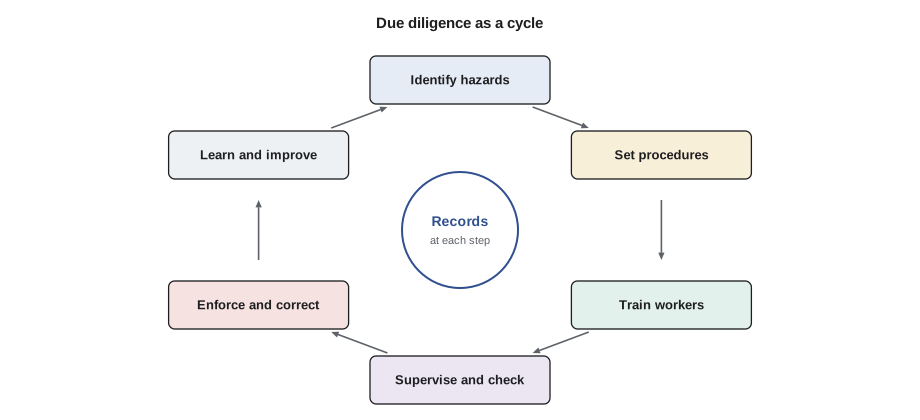
A day in the records
Due diligence is not a binder assembled after an incident. It is the record of ordinary supervision done every day. Here is what a normal Tuesday on Larkspur Commons leaves behind.
- 6:45. Omar walks the site before the crews arrive and records two findings on the inspection app: a missing toe board on the level 5 east scaffold bay and a pallet of sheathing stacked against a guardrail on level 4. Both are fixed before 7:30, and the corrective actions are closed with photographs.
- 7:00. Each foreman leads a pre-task planning session with their crew and the crew signs the plan. Ridgeline Framing's plan for level 5 lists the leading edge, the open stair shaft and wind gusts as hazards.
- 9:30. Dana sees a framer working at the leading edge with his lanyard clipped to his own harness ring rather than the anchor. He stops him, they talk about it, and Dana records a coaching conversation in his daily log. The framing foreman covers anchor points at the next morning's huddle.
- 13:00. A delivery driver reverses into the laydown area without a spotter. Omar stops the truck, reminds the driver of the site traffic plan and records the near miss.
- 15:30. Priya and Omar review the day's observations and update the corrective action log. One item, a damaged extension cord, is still open because the electrician is replacing it tomorrow; the cord has been tagged out of service.
None of these records took more than a few minutes. Together they show a supervisor who knew the hazards, checked the work, corrected problems, coached and followed up. If a worker had fallen at the stair shaft that afternoon, the investigation would have found a system that was working and a specific failure to examine, rather than an absence of supervision.
Writing records that hold up
Records help only if they are specific, timely and honest. Vague records ('site safe', 'talked to crew') prove very little; records written days later, or changed after an incident, can do more harm than having none. Thornbury's guidance for supervisors is short.
| Weak record | Strong record |
|---|---|
| Talked to crew about fall protection. | Level 5 huddle, 7:05, 8 framers (sign-in attached): anchor points on the east and north edges, no work within 2 m of the stair shaft without restraint. |
| Site inspected. OK. | 6:45 walk, levels 3 to 6 and laydown: 2 findings (toe board L5 east bay, sheathing on L4 guardrail), both corrected by 7:30, photos attached. |
| Worker warned. | 9:30, framer (Ridgeline) clipped to own D-ring at leading edge, L5 north. Stopped, explained, watched him re-anchor. Foreman informed. First occurrence; coaching only. |
| Fixed cord. | Damaged cord, L3 corridor, tagged out at 15:20; Ashgrove to replace by 10:00 Wednesday. |
Records should say who, what, where, when and what was done, in plain words, at the time. If a record turns out to be wrong, the right way to correct it is a dated note saying so, not an edit that hides the original. Distances and quantities should be written as they were, for example 6 ft from the edge, not 'close'.
Enforcement and fair discipline
Rules that are never enforced are not rules. A site where supervisors walk past unclipped lanyards is telling workers that the rule is optional, and a court will draw the same conclusion. But enforcement does not mean punishment first. Most breaches come from a gap in knowledge, equipment or planning, and are best handled by stopping the work, finding out why and fixing that. Thornbury uses a graduated approach.
| Step | When it applies | Example |
|---|---|---|
| Coach | First breach, no evidence it was deliberate, low or moderate risk | The framer clipped to his own D-ring; Dana explains and watches him re-anchor |
| Verbal warning, recorded | Repeat of a coached breach, or a breach of a rule the worker clearly knew | The same framer unclipped again two days later |
| Written warning | Further repeat, or a serious breach | A worker removes a guardrail section and leaves it open |
| Removal from site or suspension | Wilful or reckless breach of a life-saving rule, or repeated serious breaches | A worker defeats a lockout to save time |
Two principles keep enforcement fair. It must be consistent: the same breach gets the same response whether the worker is a favorite foreman's best hand or a new laborer. And the supervisor must look at their own part first. If the anchor points were not installed where the work was, the framer who clipped to his harness was solving a planning problem badly, and the response is to fix the planning. Subcontractor workers are disciplined by their own employers; Thornbury's role is to require the subcontractor to act and, for serious breaches, to remove the worker from the site under the subcontract terms.
When the regulator visits
OSHA inspections are either programmed, such as those under national and local emphasis programs for falls, trenching and other construction hazards, or unprogrammed, in response to fatalities and serious injuries, complaints and referrals. Construction is the most inspected industry, and fall protection in construction has topped OSHA's list of most frequently cited standards for many years.
When an inspector arrives on Larkspur Commons, Thornbury's procedure is the same whatever the reason for the visit.
- Greet the inspector, check identification and ask the purpose and scope of the visit.
- Call Dana (or Omar if Dana is away) and Priya; the superintendent accompanies the inspector.
- Invite the subcontractors whose work is involved; their supervisors should be present for their areas.
- Be courteous and truthful. Answer the questions asked; do not guess or speculate, and do not hide or alter anything.
- Take the same photographs and measurements the inspector takes, and note what was said.
- Correct any hazard identified immediately where possible, and record the correction.
After the inspection, OSHA may issue citations within six months, each with a classification (other-than-serious, serious, willful, repeat or failure to abate), a proposed penalty and an abatement date. The employer must post citations near the hazard, can request an informal conference with the area director, and can contest a citation by filing a notice of contest within 15 working days of receiving it, after which the case goes to the Occupational Safety and Health Review Commission. Abatement must still be certified for uncontested items. Willful violations that cause a worker's death can be prosecuted criminally, although such cases are rare.
| Classification | Maximum penalty for 2026 | Minimum |
|---|---|---|
| Other-than-serious | $16,550 | $0 |
| Serious | $16,550 per violation | $1,085 |
| Repeat | $165,514 per violation | $4,256 |
| Willful | $165,514 per violation | $11,823 |
| Failure to abate | $16,550 per day beyond the abatement date | Not applicable |
The penalties matter, but the bigger costs of a serious incident are the human ones and the disruption: a stopped site, a lost crew, an investigation and a reputation with owners who prequalify contractors on their safety records. The example below estimates penalty exposure only to show how quickly it adds up, not because penalties are the main reason to work safely.
# Illustrative penalty exposure after a fall protection inspection (simplified OSHA approach)
max_serious = 16_550
items = [  # (description, severity factor, probability factor)
    ("unprotected leading edge, level 5", 1.0, 1.0),
    ("missing guardrail at stair shaft", 1.0, 0.8),
    ("ladder not extended 3 ft above landing", 0.5, 0.6),
]
size_reduction = 0.10      # illustrative reduction for employer size
history_reduction = 0.0    # no reduction if cited for serious violations in the past 5 years
total = 0
for d, sev, prob in items:
    p = max_serious * sev * prob * (1 - size_reduction) * (1 - history_reduction)
    total += p
    print(f"{d}: {p:,.0f}")
print(f"proposed total {total:,.0f}")
print(f"if the first item were classed willful: up to {165_514:,} for that item alone")unprotected leading edge, level 5: 14,895 missing guardrail at stair shaft: 11,916 ladder not extended 3 ft above landing: 4,468 proposed total 31,280 if the first item were classed willful: up to 165,514 for that item alone
The numbers are illustrative, but the lesson is real: a handful of fall protection findings can cost tens of thousands of dollars, and the classification, which depends on what supervisors knew and did, matters as much as the hazard itself.
Supervisors and the investigation after an incident
After a serious incident, regulators interview supervisors. A supervisor may have their own interests at stake as well as the employer's, and in a serious case may want independent legal advice. Thornbury's guidance is to be truthful, to describe what you know rather than what you assume, to provide the records that exist, and never to create or change a record after the fact. Lesson 8 covers incident reporting and the company's own investigation.
Common mistakes
MistakeTreating due diligence as paperwork assembled after an incident.
InsteadDue diligence is the record of ordinary supervision done every day: hazards identified, workers trained, work checked, problems fixed.
MistakeWriting vague records such as 'site safe' or 'talked to crew'.
InsteadRecord who, what, where, when and what was done, in plain words, at the time.
MistakeWalking past a breach of a safety rule to avoid conflict.
InsteadStop the work and respond, starting with coaching, because unenforced rules are not rules.
MistakeDisciplining a worker without checking whether the plan or equipment caused the breach.
InsteadLook at your own part first; fix planning, equipment or training gaps before blaming the worker.
MistakeArguing with an inspector or guessing at answers.
InsteadBe courteous and truthful, answer what is asked, document the visit and correct hazards immediately.
Summary and key terms
- OSHA citations turn on what the employer knew and did; unpreventable employee misconduct is a defense only where rules were communicated, monitored and enforced.
- Due diligence and reasonable care are shown by hazards identified, procedures in place, training, supervision, enforcement, correction and learning.
- Good records are specific, timely and honest; corrections are dated notes, not hidden edits.
- Enforcement is graduated and consistent, and starts with the supervisor checking their own part.
- During a regulator's visit, the superintendent accompanies the inspector, answers truthfully, documents and corrects.
- OSHA citations carry classifications and penalties up to $16,550 for serious and $165,514 for willful or repeat violations in 2026, and can be contested within 15 working days.
- Unpreventable employee misconduct
- A defense to an OSHA citation requiring proof that rules were established, communicated, monitored and enforced.
- Serious violation
- A violation where there is a substantial probability that death or serious harm could result.
- Willful violation
- A violation committed with intentional disregard of, or plain indifference to, the law.
- Contesting a citation
- Filing the employer's written notice of contest, which challenges a citation, a penalty or an abatement date, within 15 working days.
- Abatement
- Correction of a cited hazard by the date set in the citation.
- Graduated enforcement
- A consistent sequence of responses to breaches, from coaching to removal from site.
Practice problems
Work each problem on paper first, then reveal the answer to check.
Rewrite 'Talked to crew about fall protection' as a strong record.
Show answer
For example: level 5 huddle, 7:05, eight framers signed in; anchor points on the east and north edges reviewed; no work near the stair shaft without restraint.
A framer clipped to his own D-ring for the first time. What response fits Thornbury's approach?
Show answer
Coaching: stop the work, explain, watch him re-anchor and record the conversation, after checking that anchors were available.
Who should accompany an inspector on Larkspur Commons?
Show answer
The superintendent, with the safety coordinator and the supervisors of any subcontractors whose work is involved.
How long does an employer have to contest an OSHA citation?
Show answer
Fifteen working days from receiving the citation.
Why must records never be changed after an incident?
Show answer
Altered records destroy credibility and can be an offense; corrections must be dated notes showing the original.
Lesson quiz · 5 questions
Score 60% or more to complete this lesson.
Create a free account to save your progress, take quizzes and earn a certificate.