
CON-340 · Lesson 3 of 12 · 28 min
Construction management for fee
In construction management for fee, the owner hires a construction manager as a professional adviser and agent, much as it hires an architect. The construction manager brings construction knowledge into the design phase, estimates and schedules the work as the design develops, divides the work into trade packages, runs the bidding for those packages on the owner's behalf, and then coordinates and administers the trade contractors during construction. The owner holds the trade contracts directly and pays the construction manager a fee for its services. The construction manager does not guarantee the cost of the work. That is the essential difference from construction management at risk, the subject of lesson 4.
The method has many names. In the United States it is usually called agency construction management, CM-as-adviser (CMa) or CM for fee; in Canada it is often called construction management for services, after the CCDC 5A contract. Program management and owner's representative services overlap with it: a program manager may oversee many projects for an owner, and an owner's representative may advise on a project without coordinating the trades.
How agency construction management is organized
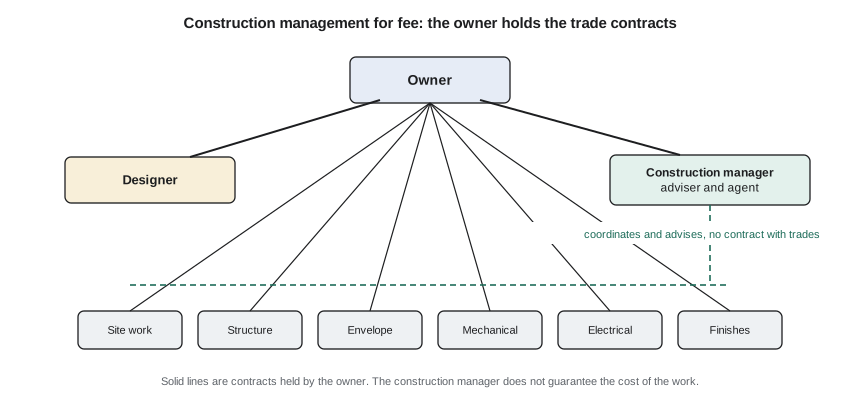
The owner holds a contract with the designer, a contract with the construction manager, and a separate contract with each trade contractor, sometimes twenty or more on a large building. The construction manager has no contract with the trades; it acts on the owner's behalf in procuring and managing them, within authority the owner delegates. Because the owner holds the trade contracts, it also holds the risk that their combined cost exceeds the budget, the risk of coordination failures between trades, and the risk of a trade defaulting.
| Phase | Construction manager services (typical) |
|---|---|
| Pre-design and schematic design | Budget validation, site and logistics review, master schedule, delivery and packaging strategy, market analysis |
| Design development | Detailed estimates, constructability and value analysis, long-lead identification, phasing plans |
| Construction documents | Estimates at 50 % and 90 % or 95 %, bid package definition and scopes, prequalification of trades, bidding and award recommendations |
| Construction | Coordination of trades, site management, schedule, safety coordination, cost reporting, change management, payment recommendations |
| Closeout | Commissioning coordination, deficiencies, closeout documents, warranty administration |
Why owners choose it
Construction management for fee gives the owner construction expertise early without giving up control of the trade contracts or paying for the construction manager to carry cost risk.
| Advantage | How it helps |
|---|---|
| Early construction input | Estimates, schedules and constructability advice shape the design before it is fixed. |
| Fast-tracking | Trade packages can be bid and started in sequence as the design for each is finished. |
| Transparency | The owner sees every trade price and pays the construction manager an agreed fee; there is no hidden markup on the work. |
| Adviser loyalty | The construction manager acts for the owner and has no profit motive on trade costs. |
| Competition on trades | Each package is bid competitively, often widening access for local and smaller firms. |
Universities, hospitals, governments and experienced developers with strong internal project teams often use it for complex buildings, renovations of occupied facilities and programs of many related projects. It is especially useful when the owner wants close control and has the staff to make decisions quickly and to carry the trade contracts.
The risks the owner keeps
The method's weakness is the flip side of its transparency: the owner carries the risks a general contractor would otherwise carry.
| Risk retained by the owner | Why it matters |
|---|---|
| Total cost of the work | There is no guaranteed price; if trade bids come in high, the owner pays or cuts scope. |
| Coordination between trades | Delays and disruption caused by one trade to another are claims against the owner, who holds both contracts. |
| Trade default | If a trade contractor fails, the owner deals with the default, the surety and the replacement. |
| Gaps between packages | Work left out of every package must be bought by the owner, often late and at a premium. |
| Schedule | The construction manager manages the schedule but usually does not guarantee it. |
The construction manager is generally liable only if it fails to meet its professional standard of care. If its estimate at 90 % design is wrong because trade prices rose unexpectedly, the owner pays; if it is wrong because the construction manager was careless, the owner may have a claim, but proving negligence in an estimate is hard. Owners who choose the method for its transparency should understand that they are self-insuring the cost of the work.
Paying the construction manager
Construction managers for fee are usually paid in two parts. A preconstruction fee covers services during design, often a lump sum or hourly rates up to a cap. A construction-phase fee covers coordination and management during construction, either as a percentage of the cost of the work or as a fixed fee, plus reimbursable costs for site staff and general conditions items, which are sometimes themselves a fixed sum or capped.
# Comparing construction manager fee structures on a $72 million civic building (illustrative)
pct_fee = 0.032          # percentage of the cost of the work
fixed_fee = 2_300_000    # lump-sum construction-phase fee
precon = 420_000         # preconstruction fee (same in both)
for cost in (68_000_000, 72_000_000, 78_000_000):
    a = precon + pct_fee * cost
    b = precon + fixed_fee
    print(f"Cost of work {cost:>11,}: percentage fee total {a:>10,.0f}   fixed fee total {b:>10,.0f}")
# break-even cost at which the two structures give the same fee
print(f"Break-even cost of work: {fixed_fee / pct_fee:,.0f}")Cost of work 68,000,000: percentage fee total 2,596,000 fixed fee total 2,720,000 Cost of work 72,000,000: percentage fee total 2,724,000 fixed fee total 2,720,000 Cost of work 78,000,000: percentage fee total 2,916,000 fixed fee total 2,720,000 Break-even cost of work: 71,875,000
A percentage fee rises as the cost of the work rises, which can look like a reward for overruns, although in practice a construction manager's reputation and future work depend on controlling cost. A fixed fee removes that apparent conflict but must be adjusted if the scope changes substantially, which needs a clear definition of the scope the fee covers. Many owners use a fixed fee with an adjustment only for owner-directed scope changes above a threshold, and some add an incentive tied to meeting the budget or schedule.
Worked problem
Building up a construction-phase fee from staffing
A construction manager proposes site staffing for a 24-month construction phase: project manager full time at $16,500 per month (all-in cost), superintendent full time at $15,000, assistant superintendent for 18 months at $11,000, project coordinator full time at $8,500, and safety coordinator for 20 months at $9,500. It adds 12 % for home office overhead and 6 % profit on the total of staff and overhead. What fee and reimbursable total does this imply?
Show solution
- Staff: PM 24 × 16,500 = 396,000; superintendent 24 × 15,000 = 360,000; assistant 18 × 11,000 = 198,000; coordinator 24 × 8,500 = 204,000; safety 20 × 9,500 = 190,000.
- Total staff cost: 396,000 + 360,000 + 198,000 + 204,000 + 190,000 = $1,348,000.
- Home office overhead: 0.12 × 1,348,000 = $161,760; subtotal $1,509,760.
- Profit: 0.06 × 1,509,760 = $90,586; total about $1,600,346.
Answer: About $1.60 million. Whether site staff are reimbursed separately or included in the fee must be clear, or the owner may pay for them twice.
Packaging and sequencing the trades
One of the construction manager's most valuable tasks is dividing the work into trade packages and deciding when each is bid. Good packaging creates enough competition for each package, matches local trade capabilities, avoids gaps and overlaps through a responsibility matrix (CON-330 lesson 2), and puts long-lead and early-start packages first. On a fast-tracked project the construction manager might bid demolition and excavation at 30 % design, structure at 60 %, and finishes at 100 %, so that the building rises while its interior is still being designed.
# Bid sequencing for a fast-tracked civic building (months from start of design; illustrative)
packages = [  # (package, design % needed, months to bid and award, months of work before next trade can follow)
    ("Demolition and site preparation", 30, 1.5, 2),
    ("Excavation and shoring",          35, 1.5, 3),
    ("Foundations and structure",       60, 2.0, 7),
    ("Building envelope",               75, 2.0, 5),
    ("Mechanical and electrical",       90, 2.0, 10),
    ("Interior finishes",              100, 2.0, 6),
]
design_months = 14
for name, pct, bid, dur in packages:
    ready = pct / 100 * design_months
    print(f"{name:32} design ready at month {ready:4.1f}; award by month {ready + bid:4.1f}")
print("Under design-bid-build, all packages would wait until month", design_months, "plus bidding.")Demolition and site preparation design ready at month 4.2; award by month 5.7 Excavation and shoring design ready at month 4.9; award by month 6.4 Foundations and structure design ready at month 8.4; award by month 10.4 Building envelope design ready at month 10.5; award by month 12.5 Mechanical and electrical design ready at month 12.6; award by month 14.6 Interior finishes design ready at month 14.0; award by month 16.0 Under design-bid-build, all packages would wait until month 14 plus bidding.
Each early package bought before the design is complete carries a risk that later design decisions will change it, so early packages should be ones whose scope is genuinely settled: site work, foundations designed with allowance for later changes, and long-lead equipment whose performance is known. The construction manager's job is to advise the owner which packages can safely go early and which should wait.
Standard contracts
| Purpose | Canada | United States |
|---|---|---|
| Owner and construction manager (services only) | CCDC 5A-2025 Construction Management Contract for Services | AIA C132-2019 (owner and CM as adviser); CMAA A-1 (owner and CM); ConsensusDocs 830 |
| Owner and trade contractor on a CM project | CCDC 17-2025 Stipulated Price Contract between Owner and Trade Contractor for Construction Management Projects | AIA A132-2019 (owner and contractor, CMa edition) with A232-2019 general conditions; CMAA A-2 |
| Owner and designer on a CM project | RAIC Document Six adapted | AIA B132-2019 (owner and architect, CMa edition) |
In the United States, the AIA's CMa family was updated in 2019, and CMAA (the Construction Management Association of America) publishes its own family of agency CM contracts, which many public owners and universities use or adapt. ConsensusDocs also publishes owner and CM agreements in its 800 series.
When agency CM goes wrong
The method fails most often when an owner chooses it for its control and transparency but does not have the staff to carry the trade contracts and make decisions. Delays in decisions, late responses to trade questions, and disputes between trades that the owner must resolve all land on the owner's desk. A second failure mode is a construction manager that behaves like an adviser during design but lacks the field authority to coordinate twenty independent trade contractors who owe it nothing contractually. A third is scope gaps between packages, discovered when the last trade is being bid and the money is gone.
Worked problem
Gap between packages
On a construction-management-for-fee project, the owner awarded separate packages for drywall and for doors, frames and hardware. Neither package included installing the hollow metal door frames in drywall partitions. The work involves 210 frames at $95 each to install. The construction manager negotiates a change with the drywall contractor at $115 per frame because the partitions are already partly built and the work is now out of sequence. What did the gap cost compared with including it in a package at bid time?
Show solution
- Cost if included at bid: 210 × 95 = $19,950.
- Cost as a change: 210 × 115 = $24,150.
- Premium for the gap: 24,150 − 19,950 = $4,200, plus any delay or disruption.
Answer: At least $4,200, paid by the owner, because the owner holds the trade contracts. A responsibility matrix issued with every package prevents this.
Common mistakes
MistakeAssuming the construction manager guarantees the cost of the work.
InsteadUnder CM for fee the owner holds the trade contracts and the cost risk.
MistakeChoosing agency CM without owner staff to manage many contracts.
InsteadAssess owner capacity; the owner must decide quickly and carry the trade contracts.
MistakePaying site staff in both the fee and the reimbursables.
InsteadDefine exactly what the fee covers and what is reimbursed.
MistakeBidding early packages whose design is not settled.
InsteadRelease early only packages whose scope is stable, and allow for later changes.
MistakeSplitting packages without a responsibility matrix.
InsteadAssign every item to exactly one package before bidding.
Summary and key terms
- In construction management for fee, the construction manager is the owner's adviser and agent and does not guarantee the cost of the work.
- The owner holds a contract with each trade contractor and carries cost, coordination, default and gap risks.
- The method brings construction expertise into design and allows fast-tracking through sequenced trade packages.
- Construction managers are paid a preconstruction fee and a construction-phase fee, as a percentage or a fixed sum, plus reimbursables.
- Good packaging and bid sequencing are central to the construction manager's value.
- CCDC 5A and CCDC 17 (2025) in Canada and the AIA CMa and CMAA families in the United States are the main forms.
- The method fails when the owner lacks capacity or the construction manager lacks field authority.
- Construction management for fee
- Delivery in which a construction manager advises the owner and the owner holds the trade contracts.
- Agency CM
- Another name for construction management for fee, emphasizing the manager acts as the owner's agent.
- Trade contractor
- A contractor holding a direct contract with the owner for one package of work on a CM project.
- Preconstruction services
- Estimating, scheduling, constructability and planning services during design.
- Construction-phase fee
- The fee paid to the construction manager for managing construction.
- Reimbursable costs
- Costs the owner pays at cost, such as site staff or temporary facilities, as defined in the contract.
- Bid package
- A defined portion of the work bid separately.
- Standard of care
- The level of skill and care a reasonably competent professional would exercise.
- Program management
- Management of a group of related projects for an owner.
- Owner's representative
- An adviser who represents the owner on a project without holding or coordinating trade contracts.
Practice problems
Work each problem on paper first, then reveal the answer to check.
Who holds the trade contracts under construction management for fee?
Show answer
The owner.
Does the construction manager for fee guarantee the cost of the work?
Show answer
No; it is liable only for failing to meet its standard of care.
A 3 % fee on a $50 million cost of work: how much is the fee?
Show answer
$1.5 million.
At what cost of work do a 2.5 % fee and a $1.75 million fixed fee give the same fee?
Show answer
$70 million.
Name three risks the owner keeps under agency CM.
Show answer
Total cost of the work, coordination between trades, trade default, gaps between packages, schedule.
Why might an owner prefer a fixed fee to a percentage fee?
Show answer
It removes the appearance that the construction manager benefits from higher costs.
Which packages are good candidates for early release in a fast-track?
Show answer
Settled scopes such as demolition, site work, foundations and long-lead equipment.
Which AIA document is the owner and CM-as-adviser agreement?
Show answer
AIA C132-2019.
What is a common failure of agency CM?
Show answer
The owner lacks staff to manage many trade contracts and make decisions quickly.
How does a responsibility matrix help on a CM project?
Show answer
It assigns every item to one package so there are no gaps or overlaps between trade contracts.
Lesson quiz · 5 questions
Score 60% or more to complete this lesson.
Create a free account to save your progress, take quizzes and earn a certificate.