
CIV-470 · Lesson 8 of 12 · 19 min
Bridge scour
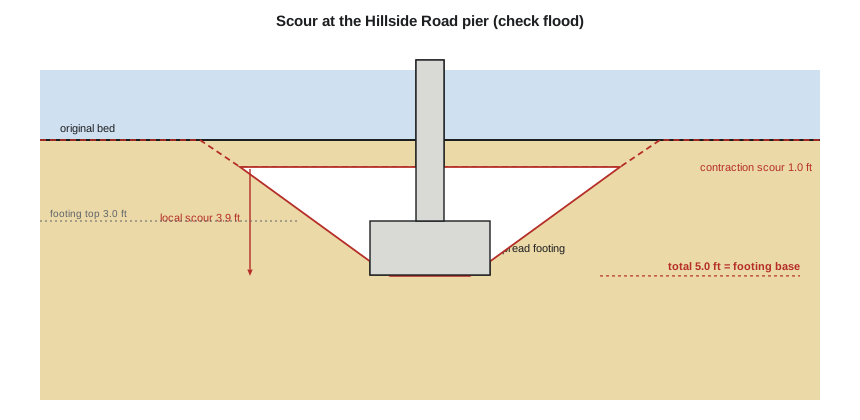
More bridges over water are lost to scour than to any other cause. Floods remove the bed material from around piers and abutments, the foundations lose support, and a bridge that carried traffic in the morning collapses at the height of the flood, often with little visible warning. The 1964 drawings of the Hillside Road bridge show the pier on a spread footing 2 ft thick, its top 3 ft below the original bed, founded on sandy gravel. Lesson 7 showed that the bridge passes the 100-year flood with adequate clearance; this lesson asks whether its foundations survive it.
Components of scour
Total scour at a bridge is the sum of three parts, assessed separately and added. Long-term bed elevation change is the gradual aggradation or degradation of the stream bed over years and decades, caused by changes in the watershed, the channel or the sediment supply, such as dams, gravel mining, channel straightening or urbanization. Contraction scour is the general lowering of the bed across the bridge opening during a flood, because the narrowed opening carries the flow at higher velocity than the natural channel. Local scour is the deep, localized removal of material around piers and abutments, caused by the vortices that form as flow is obstructed. A fourth effect, lateral migration of the channel, can bring the main flow against a pier or abutment that was originally on the floodplain.
Clear-water and live-bed scour
Scour behaves differently depending on whether the approaching flow is moving bed material. In clear-water scour, the bed upstream is at rest, so no sediment enters the scour hole to replace what is removed, and the hole deepens slowly toward an equilibrium. In live-bed scour, the upstream flow carries bed material into the hole, and the depth fluctuates around an equilibrium as bedforms pass. The test compares the mean approach velocity with the critical velocity for the bed material, which for coarse sediment can be estimated from
Clear-water scour reaches its maximum when the approach velocity is just at the critical velocity, and the maximum depth of local scour is slightly larger than the live-bed equilibrium depth. Gravel-bed streams like Kestrel Creek are often in clear-water conditions at their bridges, because the gravel moves only in large floods.
Contraction scour
For clear-water conditions, contraction scour proceeds until the bed shear stress in the opening falls to the critical value for the bed material. The depth after scour \(y_2\) is
with \(W\) the bottom width of the opening less the piers, and the contraction scour is \(y_2\) minus the existing depth. For live-bed conditions, Laursen's equation relates the depths in the opening and upstream to the ratio of widths and discharges, raised to a power that depends on whether the bed material moves as bedload or in suspension. FHWA's Evaluating Scour at Bridges, known as HEC-18, whose fifth edition of 2012 has long been the North American standard, sets out both methods with their coefficients and limits, together with the companion HEC-23 on countermeasures.
Local scour at piers
A pier splits the approaching flow. Water dives down the upstream face, forms a horseshoe vortex that wraps around the base of the pier and digs the scour hole, while wake vortices shed from the sides carry material away downstream. HEC-18's pier scour equation, developed at Colorado State University, captures the main factors:
where \(a\) is the pier width, \(y_1\) and \(Fr_1\) the depth and Froude number just upstream of the pier, \(K_1\) a nose shape factor (1.0 for round noses, 1.1 for square), \(K_2\) a factor for the angle of attack, which rises steeply if the flow strikes the pier at an angle, and \(K_3\) a factor for bed condition, 1.1 for a plane bed or small dunes. Scour depths of 1.5 to 2.4 times the pier width are typical; HEC-18 caps \(y_s/a\) at 2.4 for round-nosed piers aligned with the flow at Froude numbers up to 0.8. Ice and debris rafts lodged against a pier effectively widen it, and HEC-18 gives methods to account for them.
Abutment scour
Scour at abutments depends on how much floodplain flow the abutment and its embankment block, the shape of the abutment and whether it sits in the main channel or on the floodplain. Older empirical equations often overpredicted it badly; current methods from research sponsored by NCHRP treat abutment scour as an amplified contraction scour near the abutment. The usual protection is a riprap apron and a riprap-armored spill-through slope, and at Hillside Road both abutments sit on the floodplain behind modest embankments, with the left one already armored.
In the United States, the National Bridge Inspection Standards require each bridge over water to be evaluated for scour; bridges rated scour critical must have a plan of action that sets out monitoring, closure triggers and countermeasures. HEC-18 recommends risk-based design floods for scour, with the 100-year flood or larger for design and a rarer flood as a check. The team uses the 100-year flood of 494 cfs for design and a check flood of 689 cfs, about the 200-year flood, for the Hillside Road assessment.
# Hillside Road bridge: contraction and pier scour (HEC-18 equations) and riprap at the pier
from math import sqrt
UNITS = "US"
SI = UNITS == "SI"
g = 9.81
D50 = 0.004                    # bed material, m (sandy gravel)
cases = {"design flood": (14.0, 1.35), "check flood": (19.5, 1.62)}   # (Q m3/s, depth at the bridge m)
W1, W2 = 12.0, 8.4             # upstream bed width, bed width in the opening less the pier, m
a = 0.60                       # pier width, m; round nose, aligned with the flow
f = (lambda x: f"{x:.2f} m", lambda v: f"{v:.2f} m/s") if SI else (lambda x: f"{x/0.3048:.2f} ft", lambda v: f"{v/0.3048:.2f} ft/s")
for name, (Q, y) in cases.items():
    V1 = Q / (W1 * y)
    Vc = 6.19 * y ** (1 / 6) * D50 ** (1 / 3)                    # critical velocity for the bed material
    regime = "live-bed" if V1 > Vc else "clear-water"
    if regime == "live-bed":
        y2 = y * (W1 / W2) ** 0.64                               # Laursen, Q1 = Q2, k1 about 0.64
    else:
        y2 = (0.025 * Q ** 2 / ((1.25 * D50) ** (2 / 3) * W2 ** 2)) ** (3 / 7)
    yc = max(0.0, y2 - y)
    V = Q / (W2 * y); Fr = V / sqrt(g * y)
    K1, K2, K3 = 1.0, 1.0, 1.1
    ys = 2.0 * K1 * K2 * K3 * a ** 0.65 * y ** 0.35 * Fr ** 0.43
    print(f"{name}: approach V {f[1](V1)} against critical {f[1](Vc)} -> {regime}")
    print(f"   contraction scour {f[0](yc)}, pier scour {f[0](ys)} (ys/a = {ys/a:.1f}), total at the pier {f[0](yc + ys)}")
# riprap at the pier (HEC-23 form), velocity in the opening at the design flood
V = 14.0 / (W2 * 1.35)
Kp, Ss = 1.5, 2.65                  # round-nosed pier
D50r = 0.692 * (Kp * V) ** 2 / ((Ss - 1) * 2 * g)
print(f"\nPier riprap D50 = 0.692 (K V)^2 / ((Ss - 1) 2g) = {f[0](D50r)}; place {f[0](2 * a)} out from the pier face, at least three D50 thick")design flood: approach V 2.84 ft/s against critical 3.39 ft/s -> clear-water contraction scour 0.32 ft, pier scour 3.61 ft (ys/a = 1.8), total at the pier 3.94 ft check flood: approach V 3.29 ft/s against critical 3.49 ft/s -> clear-water contraction scour 1.00 ft, pier scour 3.95 ft (ys/a = 2.0), total at the pier 4.95 ft Pier riprap D50 = 0.692 (K V)^2 / ((Ss - 1) 2g) = 0.24 ft; place 3.94 ft out from the pier face, at least three D50 thick
Reading the results
At both floods the main-channel approach velocity, 2.8 and 3.3 ft/s, is below the critical velocity of about 3.4 ft/s for the sandy gravel, so scour is clear-water. Contraction scour is small, 0.3 ft at the design flood and 1.0 ft at the check flood, because the opening is only modestly narrower than the channel. Local scour dominates: 3.6 ft at the design flood and 4.0 ft at the check flood, 1.8 to 2.0 times the 2 ft pier width. Total scour at the pier is 3.9 ft at the design flood, which exposes the footing top at 3 ft and removes the material beside it, and 5.0 ft at the check flood, which reaches the base of the footing at 5 ft. The bridge is rated scour critical.
A spread footing undermined at its edges can tilt or settle suddenly, and the scour hole is deepest exactly when the flood is highest and inspection is hardest. The result does not mean the bridge will fail in the next flood, since long-term degradation is not yet included and clear-water holes take time to develop, but it is not acceptable for a structure that carries the only access road and a water main.
Worked problem
Pier scour by the HEC-18 equation
A round-nosed pier 3 ft wide, aligned with the flow, stands in water 7.9 ft deep moving at 5.2 ft/s over a plane bed. Find the local scour depth.
Show solution
- \[Fr_1 = \frac{5.2}{\sqrt{32.2 \times 7.9}} = 0.326\]
- \[\frac{y_s}{a} = 2.0(1.0)(1.0)(1.1)\Big(\frac{7.9}{3}\Big)^{0.35}(0.326)^{0.43} = 2.2(1.403)(0.617) = 1.90\]
- \[y_s = 1.90 \times 3 = 5.7\ \text{ft}\]
Answer: Local scour of about 5.7 ft, just under twice the pier width; a skewed approach of 15° would raise it by roughly half.
Countermeasures
Scour countermeasures fall into three groups. Monitoring countermeasures detect scour before failure: inspection after floods, fixed instruments such as sonar or tilt sensors, and a plan of action that closes the bridge when the water reaches a trigger level. Hydraulic countermeasures reduce the attack or armor the bed: riprap aprons at piers and abutments, articulated concrete blocks, guide banks that straighten the flow into the opening, and spurs or vanes that turn the flow away from a vulnerable bank. Structural countermeasures strengthen the foundation: underpinning a spread footing with micropiles, extending it deeper, or replacing the bridge with one founded below the scour depth.
Riprap at a pier is sized by HEC-23's version of Isbash's relation, \(D_{50} = 0.692\,(KV)^2/\big((S_s-1)2g\big)\), with \(K = 1.5\) for round-nosed and 1.7 for square-nosed piers, placed in a layer at least three times \(D_{50}\) thick, extending at least two pier widths out from the pier face, on a filter. At Hillside Road the computed size is only about 0.24 ft, so the team specifies a class with a 10 in. median size, which resists ice and is easier to place correctly.
| Measure | Effect | Role in the plan |
|---|---|---|
| Inspection after floods and a plan of action | detects scour; closes the bridge at a trigger stage | immediately |
| Riprap apron on a filter around the pier | armours the bed against local scour | within two years |
| Survey of the bed each spring | tracks long-term degradation | ongoing |
| Single-span replacement founded on piles below scour depth | removes the pier from the channel | at the end of the bridge's life |
Monitoring does not fix the problem, but it buys time safely. The plan of action for Hillside Road names who watches the creek gauge during floods, the water level at which the bridge is inspected and the level at which it is closed, the detour route, and how the co-op is told so that it can isolate the water main crossing if needed. After each flood above the trigger, the bed around the pier is probed or surveyed and the result recorded.
Practical points
- Add long-term, contraction and local scour; assess each separately.
- Decide first whether the approach flow is clear-water or live-bed.
- Find the foundation type and depth from drawings or investigation; unknown foundations need special treatment.
- Include ice and debris rafts and skewed flow, which can greatly increase pier scour.
- Treat riprap as a countermeasure that needs a filter, inspection and replacement after floods.
Common mistakes
MistakeComputing only local scour at a pier.
InsteadAdd contraction scour and long-term bed change.
MistakeIgnoring the angle of attack.
InsteadSkewed flow against a long pier can double the scour depth.
MistakePlacing riprap without a filter.
InsteadFine bed material washes out through the stones and the apron settles into the hole.
MistakeAssuming a bridge that has survived past floods is safe.
InsteadScour holes can deepen in a single rarer flood; past floods may not have reached the design scour.
Summary and key terms
- Total scour is the sum of long-term bed change, contraction scour and local scour at piers and abutments.
- Clear-water scour occurs when the approach flow does not move the bed; live-bed scour when it does.
- HEC-18 gives the standard contraction and pier scour equations; HEC-23 the countermeasures.
- At Hillside Road, total scour at the pier is 3.9 ft at the design flood and 5.0 ft at the check flood, reaching the footing.
- Countermeasures include monitoring and a plan of action, riprap aprons and structural strengthening or replacement.
- A scour-critical bridge needs monitoring at once, even if replacement is years away.
- Contraction scour
- General lowering of the bed across a constricted opening during a flood.
- Local scour
- Deep removal of bed material around a pier or abutment by vortices.
- Clear-water scour
- Scour in which the approaching flow carries no bed material into the scour hole.
- Live-bed scour
- Scour in which the approaching flow transports bed material.
- Horseshoe vortex
- The vortex that wraps around the base of a pier and digs the scour hole.
- Scour critical
- A bridge whose foundations are judged unstable for the assessed scour conditions.
- Plan of action
- A documented procedure for monitoring and closing a scour-critical bridge during floods.
- Countermeasure
- A measure that monitors, controls or prevents scour at a bridge.
Practice problems
Work each problem on paper first, then reveal the answer to check.
Find the critical velocity for 0.013 ft gravel in water 4.4 ft deep.
Show answer
\(V_c = 11.17(4.4)^{1/6}(0.013)^{1/3} = 3.4\) ft/s.
A square-nosed pier 4 ft wide has \(y_1/a = 2\) and \(Fr_1 = 0.25\), on a plane bed with no skew. Find \(y_s\).
Show answer
\(y_s/a = 2.0(1.1)(1.0)(1.1)(2)^{0.35}(0.25)^{0.43} = 2.42(1.274)(0.551) = 1.70\); \(y_s = 6.8\) ft.
Why does a debris raft on a pier increase scour?
Show answer
It acts as a wider pier, increasing the obstruction and the strength of the vortices.
Size pier riprap for a round-nosed pier with an approach velocity of 6.6 ft/s.
Show answer
\(D_{50} = 0.692(1.5 \times 6.6)^2/(1.65 \times 64.4) = 0.64\) ft.
Lesson quiz · 5 questions
Score 60% or more to complete this lesson.
Create a free account to save your progress, take quizzes and earn a certificate.