
CIV-470 · Lesson 7 of 12 · 19 min
Bridge hydraulics
Upstream of the operations center, Kestrel Creek passes under Hillside Road, a rural road that carries the co-op's water main and is the only access to a dozen homes. The bridge was built in 1964: two concrete spans with a single round-nosed pier in the channel, a clear opening of 30 ft between the abutments, and its low chord 8.5 ft above the bed. The master plan asks whether the bridge is hydraulically adequate, whether it raises flood levels upstream, and, in lesson 8, whether its foundations are safe from scour. Bridges differ from culverts in that the flow usually runs as an open channel beneath them, and their effect on the river is felt mainly as backwater upstream and as scour around their supports.
How a bridge affects the flow
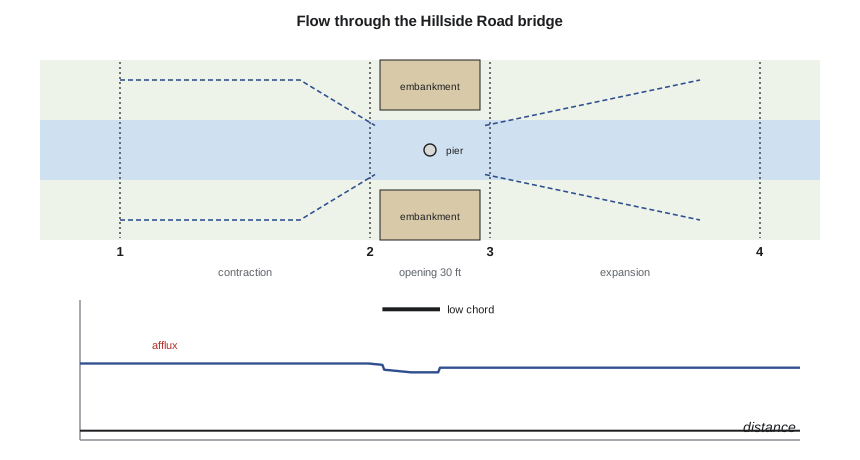
A bridge is usually narrower than the floodplain it crosses. Approach embankments block the overbank flow, which must turn and converge into the opening; piers occupy part of the opening; and at very high flows the water may touch the low chord, turning the opening into a sluice gate, or overtop the deck and embankments, adding weir flow. The result is a rise in water level upstream of the bridge, called backwater or afflux, and a concentration of flow, with higher velocities, in the opening.
Engineers describe the flow with four cross-sections. Section 1 lies upstream where the flow is not yet affected by the contraction; sections 2 and 3 lie just upstream and just downstream of the bridge; section 4 lies downstream where the flow has expanded back to its natural width. The flow contracts between 1 and 2 over a distance of roughly one times the average width of the obstruction, and expands between 3 and 4 over roughly four times that distance, with losses in both.
Methods of analysis
Three approaches are widely used for low flow, when the water stays below the low chord. The energy method applies the energy equation between the sections, adding friction and contraction and expansion losses expressed as coefficients times the change in velocity head, commonly about 0.3 for contraction and 0.5 for expansion at bridges. The momentum method balances forces and momentum through the opening, including the drag on the piers. Empirical pier formulas, the most famous by Yarnell from tests in the 1930s, estimate the backwater from piers alone:
where \(K\) is a pier shape coefficient, about 0.9 for semicircular ends and 1.25 for square ones, \(Fr_3\) the Froude number downstream, \(\alpha\) the fraction of the opening blocked by piers and \(y_3\) the downstream depth. The equation applies to piers in otherwise unobstructed flow; the abutment contraction is handled by the energy method.
When the water reaches the low chord, pressure flow begins, with the opening acting as a sluice gate or orifice; when it overtops the road, weir flow over the deck and embankments is added. Modern practice computes all of these in a one-dimensional model such as the U.S. Army Corps of Engineers' HEC-RAS, which offers the energy, momentum, Yarnell and other methods and reports the highest backwater, or in a two-dimensional model when the floodplain flow is complex. The calculations in this lesson are the hand versions of what those models do.
In the United States, bridge hydraulics follow the AASHTO LRFD Bridge Design Specifications, FHWA's hydraulic design guidance for bridges and the state department of transportation's drainage manual. Federally funded crossings must also meet the floodplain rules in 23 CFR 650, and any bridge in a mapped floodway must show no increase in the base flood elevation, or obtain a map revision. The design flood depends on the road's class; the 100-year flood is common for bridges, with rarer floods checked for scour.
Clearance, ice and debris
The low chord should sit above the design flood level with clearance for floating ice and debris, which can otherwise strike the superstructure or block the opening and cause a sudden rise. On northern streams, break-up ice and woody debris are the main concerns, and clearances of 1 to 3 ft are typical, set by the road authority. Piers should be aligned with the flow, rounded at their noses and, where ice is heavy, given sloping cutwaters that bend ice sheets upward and break them. Multiple piers close together trap debris; a single span is always preferable where it is affordable.
# Hillside Road bridge over Kestrel Creek: backwater from the pier and the abutment contraction
from math import sqrt
UNITS = "US"
SI = UNITS == "SI"
g = 9.81
Q = 14.0                       # 100-year flow at the bridge, m3/s
y3 = 1.35                      # depth just downstream (normal depth in the reach below), m
b_open = 9.0                   # clear opening between abutments, m
a_pier = 0.60                  # width of the single round-nosed pier, m
b_appr = 40.0                  # effective flow width of the approach floodplain section, m
V3 = Q / (b_open * y3); Fr3 = V3 / sqrt(g * y3)
alpha = a_pier / b_open
K = 0.9                        # Yarnell pier shape coefficient, semicircular nose and tail
dy_pier = K * Fr3 ** 2 * (K + 5 * Fr3 ** 2 - 0.6) * (alpha + 15 * alpha ** 4) * y3
f = (lambda x: f"{x:.3f} m", lambda v: f"{v:.2f} m/s") if SI else (lambda x: f"{x/0.3048:.2f} ft", lambda v: f"{v/0.3048:.2f} ft/s")
print(f"Velocity under the bridge {f[1](V3)}, Froude number {Fr3:.2f}, pier blockage {alpha:.1%}")
print(f"Yarnell backwater from the pier: {f[0](dy_pier)}")
# energy method for the contraction: solve the approach depth so that energy balances with losses
y1 = y3
for _ in range(100):
    V1 = Q / (b_appr * y1); Vb = Q / ((b_open - a_pier) * y3)
    loss = 0.3 * abs(Vb ** 2 - V1 ** 2) / (2 * g) + 0.5 * abs(Vb ** 2 - V3 ** 2) / (2 * g)
    y1_new = y3 + V3 ** 2 / (2 * g) + loss - V1 ** 2 / (2 * g)
    if abs(y1_new - y1) < 1e-6: break
    y1 = y1_new
print(f"Approach velocity {f[1](V1)}, velocity in the opening {f[1](Vb)}")
print(f"Contraction and expansion losses {f[0](loss)}; afflux upstream of the bridge {f[0](y1 - y3)}")
low_chord = 2.60               # low chord above the bed at the bridge, m
ws = y3 + max(dy_pier, y1 - y3)
clear = low_chord - ws
print(f"Water surface at the upstream face {f[0](ws)} above the bed; clearance to the low chord {f[0](clear)}")
for need in ((1.0, "1.0 m for ice and debris"), ) if SI else ((0.9144, "3 ft for ice and debris"), ):
print(f"Required clearance {need[1]}: {'met' if clear >= need[0] else 'NOT met'}")Velocity under the bridge 3.78 ft/s, Froude number 0.32, pier blockage 6.7% Yarnell backwater from the pier: 0.02 ft Approach velocity 0.80 ft/s, velocity in the opening 4.05 ft/s Contraction and expansion losses 0.09 ft; afflux upstream of the bridge 0.30 ft Water surface at the upstream face 4.73 ft above the bed; clearance to the low chord 3.80 ft Required clearance 3 ft for ice and debris: met
Reading the results
At the 100-year flow of 494 cfs the downstream depth is 4.4 ft, the velocity through the opening is about 3.8 ft/s and the Froude number is 0.32, a typical subcritical bridge flow. The pier blocks 6.7 % of the opening and adds only 0.02 ft of backwater by Yarnell's formula. The abutments matter more: the floodplain flow, spread over about 130 ft upstream at only 0.8 ft/s, must squeeze into the 30 ft opening, and the energy method gives an afflux of about 0.3 ft. The water surface at the upstream face is then 4.7 ft above the bed, leaving 3.8 ft of clearance under the 8.5 ft low chord, above the 3 ft the road authority requires for ice and debris.
Hydraulically, the 1964 bridge is adequate: the backwater is small, the clearance is sufficient and the road does not overtop in the design flood. That conclusion is only half the assessment. The velocity concentrated in the opening and around the pier is what scours the bed, and many bridges that are hydraulically adequate have failed because their foundations were undermined. Lesson 8 takes up that question with the same flows.
Worked problem
Yarnell backwater for a two-pier bridge
A bridge with two square-nosed piers each 3 ft wide crosses a channel 66 ft wide. The downstream depth is 6.6 ft and the discharge 2,120 cfs. Estimate the pier backwater.
Show solution
- \[V_3 = \frac{2{,}120}{66 \times 6.6} = 4.87\ \text{ft/s} \qquad Fr_3 = \frac{4.87}{\sqrt{32.2 \times 6.6}} = 0.334\]
- \[\alpha = \frac{2 \times 3}{66} = 0.091 \qquad K = 1.25\]
- \[\Delta y = 1.25(0.112)\big(1.25 + 0.558 - 0.6\big)\big(0.091 + 0.0010\big)(6.6) = 0.10\ \text{ft}\]
Answer: About 0.1 ft of backwater: piers alone rarely raise levels much unless they block a large part of the opening or collect debris.
Skewed crossings and two-dimensional flow
The hand methods assume the flow approaches the bridge square to its opening. Many crossings are skewed, with the road crossing the stream at an angle, so the effective opening normal to the flow is narrower than the span, the piers present their length rather than their width to the flow, and eddies form behind the upstream abutment. Where the floodplain is wide, as at Hillside Road, the overbank flow may also run along the embankment for some distance before turning into the opening, concentrating velocity and scour at the abutment toe. Two-dimensional models, which solve the depth-averaged flow equations on a mesh of the terrain, show these patterns directly and are increasingly used for bridges on wide floodplains, at skewed crossings and wherever flow divides between the bridge and a relief opening or the road overtops.
For the Hillside Road study the team runs a small two-dimensional model of the reach as a check. It confirms the one-dimensional afflux within a few centimeters, and shows the strongest velocities along the toe of the right embankment, where the overbank flow turns into the opening. That location goes on the list for lesson 8's abutment scour check and for riprap at replacement.
The bridge hydraulics report
A bridge hydraulics report records what the structural designers and approval agencies need: the design and check floods and how they were derived; the water levels upstream and downstream, the afflux and the velocities in the opening; the clearance to the low chord and the allowance for ice and debris; the scour depths and the foundation level that resists them; the countermeasures; and the effect of the bridge on flood levels and on the regulated floodplain. It also records the assumptions, such as the roughness values and the downstream water level, so that a later review can repeat the analysis.
Replacement options
Although the existing bridge passes the design flood, it is 60 years old and the master plan looks ahead to its replacement. The design options are a like-for-like two-span bridge, a single span that removes the pier from the channel, and a longer single span that also opens part of the floodplain on the left bank. Removing the pier eliminates the pier scour problem of lesson 8 and the debris trap it creates; lengthening the span reduces the afflux further and lowers velocities, at greater cost. The team's comparison favors a single span of 60 ft, with the abutments set back behind riprap-protected spill-through slopes.
| Option | Opening (ft) | Pier in channel | Afflux at Q100 | Comment |
|---|---|---|---|---|
| Existing two-span (1964) | 30 | yes | 0.3 ft | adequate hydraulically; scour to check |
| Like-for-like replacement | 30 | yes | 0.3 ft | keeps the debris and scour issues |
| Single span | 40 | no | about 0.13 ft | removes pier scour |
| Single span, wider | 60 | no | about 0.07 ft | recommended at replacement |
Practical points
- Define the four sections and let the contraction and expansion lengths reflect the floodplain width.
- Compute backwater by more than one method and use the higher result for design.
- Check clearance for ice and debris above the design flood level.
- Treat the bridge and its approach embankments together; the embankments cause most of the contraction.
- Remember that an adequate waterway can still have unsafe foundations; always check scour.
Common mistakes
MistakeApplying Yarnell's formula to the abutment contraction.
InsteadYarnell covers piers; use the energy or momentum method for the abutments.
MistakeIgnoring the floodplain flow approaching the bridge.
InsteadBlocked overbank flow is often the main cause of backwater.
MistakeSetting the low chord just above the design water level.
InsteadAdd clearance for ice, debris and uncertainty.
MistakeAssuming a bridge with small backwater is safe.
InsteadHigh velocities in the opening can still scour the foundations.
Summary and key terms
- Bridges contract the flow, causing backwater upstream and higher velocities in the opening.
- Flow is analyzed between four sections with contraction and expansion losses.
- The energy and momentum methods and Yarnell's pier formula are used for low flow; pressure and weir flow apply at high flows.
- The Hillside Road bridge raises the 100-year level by about 0.3 ft and leaves 3.8 ft of clearance.
- Clearance for ice and debris and pier shape matter on northern streams.
- A single span at replacement removes the pier from the channel and reduces scour.
- Afflux
- The rise in water level upstream of a bridge or other constriction.
- Low chord
- The lowest point of a bridge superstructure over the waterway.
- Contraction loss
- Energy lost as flow converges into a constriction, expressed as a coefficient times the change in velocity head.
- Pressure flow
- Flow through a bridge opening when the water surface reaches the low chord.
- Yarnell equation
- An empirical formula for the backwater caused by bridge piers.
- Spill-through abutment
- An abutment with a sloping embankment face extending into the waterway.
- Cutwater
- The shaped upstream nose of a pier, which can break ice and reduce drag.
- Freeboard (bridge)
- The vertical clearance between the design flood level and the low chord.
Practice problems
Work each problem on paper first, then reveal the answer to check.
A round-nosed pier (\(K = 0.9\)) blocks 8 % of an opening with \(Fr_3 = 0.40\) and \(y_3 = 5.9 ft\). Find the backwater.
Show answer
\(\Delta y = 0.9(0.16)(1.10)(0.0806)(5.9) = 0.075\) ft.
The velocity in a bridge opening is 4.9 ft/s and on the approach 1.0 ft/s. Estimate the contraction loss with a coefficient of 0.3.
Show answer
\(0.3(4.9^2 - 1.0^2)/(2 \times 32.2) = 0.107\) ft.
Why are multiple closely spaced piers undesirable on a stream with woody debris?
Show answer
Debris lodges across the gaps, blocking the opening, raising the water level and increasing scour.
What happens to the flow when the water surface reaches the low chord?
Show answer
The opening acts as a sluice gate or orifice (pressure flow), and if the road overtops, weir flow is added.
Lesson quiz · 5 questions
Score 60% or more to complete this lesson.
Create a free account to save your progress, take quizzes and earn a certificate.