
CIV-470 · Lesson 5 of 12 · 18 min
Stormwater management: detention, retention and low impact development
Conveying runoff away quickly, as the yard sewer does, solves one problem and creates others. Paved land produces more runoff, sooner and dirtier, than the forest and pasture it replaced. Downstream, peak flows rise, channels erode, baseflow falls because less water soaks in, and sediment, metals, nutrients, oils and road salt reach the creek. Stormwater management tries to keep the receiving water close to its pre-development behavior. In CIV-370 the team sized the operations center pond to hold the 100-year peak below its pre-development value. This lesson adds the other objectives, water quality, erosion control and runoff volume, and the low impact development practices that address them close to the source.
Four objectives
Modern stormwater criteria address four things. Flood control limits post-development peak flows to pre-development values for a range of storms, usually up to the 100-year, so that development does not worsen flooding downstream; CIV-370's pond meets this objective. Erosion control limits how often and how long the flows that move channel sediment occur, typically by holding the runoff from a moderate storm, often about 1 in. of rain, and releasing it slowly over a day or two (extended detention). Water quality control removes a target fraction of the pollutants, measured traditionally by total suspended solids (TSS), because many other pollutants travel attached to particles. Volume control keeps a share of the runoff on site by infiltration, evapotranspiration or reuse, restoring some of the natural water balance and baseflow.
Minnesota's Construction Stormwater General Permit, issued by the MPCA under the Clean Water Act, requires permanent stormwater treatment for projects that create new impervious surface, with a water quality volume of 1 inch of runoff from the new impervious surface. The Minimal Impact Design Standards (MIDS), adopted by many Minnesota cities, set a performance goal of retaining on site 1.1 inches of runoff from impervious surfaces, with a flexible sequence of alternatives for sites with tight soils, bedrock or contamination: a 0.55 inch goal, then a phosphorus removal goal, then off-site retention. The Minnesota Stormwater Manual gives the design guidance.
Ponds: wet, dry and extended detention
Ponds remain the workhorses of stormwater management. A wet pond keeps a permanent pool of water between storms; incoming runoff displaces the pool, and particles settle during the days or weeks it stays. The permanent pool volume largely sets the removal, and a forebay at each inlet traps the coarse sediment where it can be removed. Above the permanent pool, the active storage holds the extended detention volume, released over 24 to 48 hours through a small orifice, and above that the flood storage that CIV-370's outlet structure controls. Dry ponds hold no permanent pool and remove less, but suit sites where a permanent pool is unsafe or would warm a cold-water stream. Constructed wetlands are wet ponds with shallow vegetated zones, offering more treatment and habitat for more land.
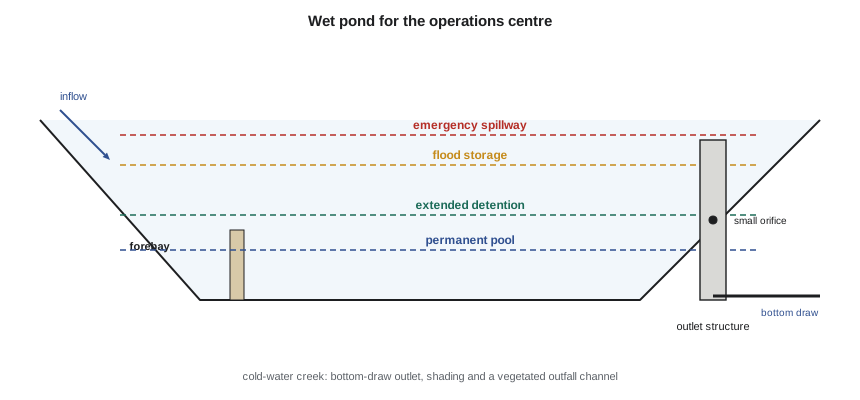
Cold-water streams such as Kestrel Creek need extra care. A wet pond warms in summer, and its overflow can raise the stream temperature above what brook trout tolerate. Designs for these streams use bottom-draw outlets, which release cooler water from the bottom of the pool, shading, shallow infiltration practices upstream of the pond, and outfalls that discharge into a vegetated channel rather than directly into the creek.
Low impact development
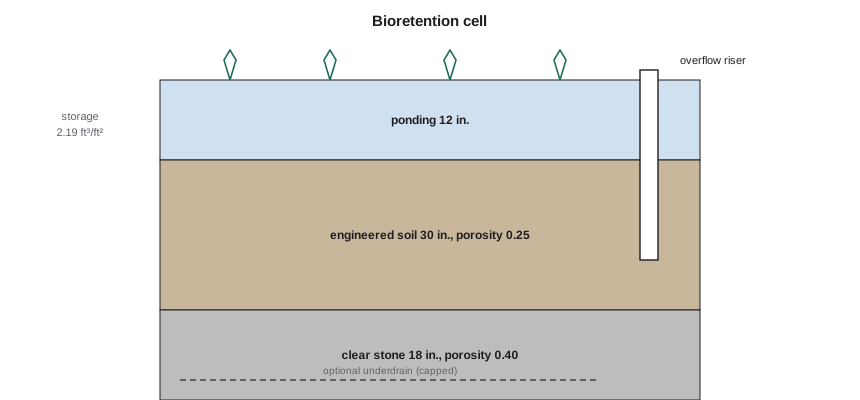
Low impact development (LID), also called green infrastructure, treats and retains runoff near where it falls, through many small practices instead of one pond at the end of the pipe. Bioretention cells and rain gardens are shallow depressions with engineered soil and plants, often over a stone reservoir and an underdrain. Permeable pavements let rain pass through the surface into a stone base. Infiltration trenches and chambers store water underground. Enhanced swales slow and filter flow. Green roofs retain rain and return it by evapotranspiration. Rainwater harvesting stores roof runoff for use, such as vehicle washing.
Each practice is sized to hold the volume target in its storage, which is the ponding depth plus the voids in the soil and stone layers, and to drain that volume within a set time, typically 24 to 72 hours, so that it is ready for the next storm and so that standing water does not breed mosquitoes:
where \(d_p\) is the ponding depth, \(d_s\) and \(d_g\) are the depths of the soil and stone layers, \(n_s\) and \(n_g\) their porosities and \(f\) the design infiltration rate of the native soil. The design infiltration rate is measured in the field by infiltration tests at the depth of the practice, then reduced by a safety factor, commonly 2.5 or more, because rates measured on test day overstate long-term performance as the soil clogs.
# Operations site: water quality storage, low impact development sizing and a treatment train
UNITS = "US"
SI = UNITS == "SI"
A_ha, imp = 7.5, 0.55                  # site area and impervious fraction after the phase 3 works
Aimp = A_ha * imp
if SI:
    # storage per hectare for a wet pond giving enhanced (80 % TSS) protection, by imperviousness
    table = [(0.35, 140), (0.55, 190), (0.70, 225), (0.85, 250)]   # m3/ha, from the 2003 provincial manual's table (illustrative use)
    for (x0, y0), (x1, y1) in zip(table, table[1:]):
        if x0 <= imp <= x1: per_ha = y0 + (y1 - y0) * (imp - x0) / (x1 - x0)
    print(f"Wet pond water quality storage: {per_ha:.0f} m3/ha x {A_ha} ha = {per_ha*A_ha:,.0f} m3 "
          f"(of which extended detention 40 m3/ha = {40*A_ha:.0f} m3)")
    target = 25.0                      # 90th-percentile event depth for the LID volume target, mm (illustrative)
    vol = target / 1000 * Aimp * 1e4
    print(f"LID volume target: {target:.0f} mm on {Aimp:.2f} ha of impervious surface = {vol:,.0f} m3")
else:
    wqv = 1.0 / 12 * Aimp * 2.471 * 43560          # 1 in. from new impervious surface (construction permit)
    mids = 1.1 / 12 * Aimp * 2.471 * 43560         # 1.1 in. retained on site (MIDS goal)
    vol = mids * 0.0283168
    print(f"Water quality volume, 1 in. from {Aimp*2.471:.1f} ac of impervious surface: {wqv:,.0f} ft3")
    print(f"Volume retention goal, 1.1 in.: {mids:,.0f} ft3 ({mids/43560:.2f} acre-ft)")
# bioretention cells: ponding + soil + stone storage, drained by infiltration into the sand
pond, soil, stone, por_s, por_g = 0.30, 0.75, 0.45, 0.25, 0.40   # m, porosities
store_per_m2 = pond + soil * por_s + stone * por_g
f = 15.0                               # design infiltration rate of the native sand, mm/h (after a safety factor)
area = vol / store_per_m2
drain_h = (store_per_m2 * 1000) / f
if SI:
    print(f"Bioretention stores {store_per_m2:.3f} m3 per m2 -> {area:,.0f} m2 of cells; drains in {drain_h:.0f} h")
else:
    print(f"Bioretention stores {store_per_m2/0.3048:.2f} ft3 per ft2 -> {area/0.0929:,.0f} ft2 of cells; drains in {drain_h:.0f} h")
print(f"Cell area is {area/(Aimp*1e4):.1%} of the impervious area it serves")
# treatment train: long-term TSS removal of practices in series
train = [("oil-grit separators", 0.50), ("bioretention (volume not infiltrated)", 0.60), ("wet pond", 0.80)]
remain = 1.0
for name, eff in train:
    remain *= (1 - eff)
print(f" after {name:38s} {1 - remain:5.1%} of TSS removed")Water quality volume, 1 in. from 10.2 ac of impervious surface: 37,000 ft3 Volume retention goal, 1.1 in.: 40,700 ft3 (0.93 acre-ft) Bioretention stores 2.19 ft3 per ft2 -> 18,585 ft2 of cells; drains in 44 h Cell area is 4.2% of the impervious area it serves after oil-grit separators 50.0% of TSS removed after bioretention (volume not infiltrated) 80.0% of TSS removed after wet pond 96.0% of TSS removed
Reading the results
With 55 % of its 18.5 acres impervious, the operations center needs a water quality volume of 1 inch from the 10.2 acres of impervious surface, about 37,000 ft³, and the city's MIDS-based ordinance asks for 1.1 inches to be retained, about 40,700 ft³ or 0.93 acre-ft. The compact sand under the eastern half of the site infiltrates at a design rate of 0.6 in./h, so bioretention cells with 12 in. of ponding over 30 in. of soil and 18 in. of stone hold 2.19 ft³ per square foot and drain in about 44 hours. About 18,600 ft², 4.2 % of the impervious area they serve, meets the retention goal.
The treatment train in the last part of the code multiplies the fractions passing each practice, giving 96 % removal of TSS. That simple product overstates the real result: each practice removes the coarse particles first, so the water reaching the next one carries finer particles that are harder to remove. Designers credit trains conservatively, often using the removal of the best single practice plus a modest allowance for the others.
Worked problem
Bioretention for the staff parking lot
The staff parking lot has 1.48 acres of pavement. A bioretention cell has 10 in. of ponding, 24 in. of soil with porosity 0.25 and 12 in. of stone with porosity 0.40, over sand with a design infiltration rate of 0.6 in./h. Size it for 1.1 in. of runoff from the pavement and find the drain time.
Show solution
- Volume to retain: \((1.1/12) \times 1.48 \times 43{,}560 = 5{,}910\ \text{ft}^3\).
- \[\text{Storage depth} = 10 + 0.25(24) + 0.40(12) = 20.8\ \text{in.} = 1.73\ \text{ft}\]
- \[A_{\text{cell}} = \frac{5{,}910}{1.73} = 3{,}410\ \text{ft}^2 \qquad t_{\text{drain}} = \frac{20.8\ \text{in.}}{0.6\ \text{in./h}} = 35\ \text{h}\]
Answer: A cell of about 3,400 ft², roughly 5 % of the pavement, retains the goal and drains within the 48-hour limit.
Cold climates, salt and hotspots
Northern sites test LID. Soils freeze, though bioretention cells with well-drained media often keep some infiltration through winter; snowmelt delivers large volumes over frozen ground in spring; snow is stored on parking lots and dumped on the practices; and road salt raises chloride in runoff. No stormwater practice removes chloride: it passes through ponds and soil into groundwater and streams, where it harms aquatic life. The only effective control is applying less salt, through better equipment, calibration, anti-icing and training.
The operations center is itself a salt user: its salt shed and the trucks' loading apron are stormwater hotspots. Runoff from them must not go to infiltration practices, which would carry the salt to the aquifer. The plan drains the apron to a separate lined swale and a holding tank whose water is reused as brine, and the city's maintenance staff take the MPCA's Smart Salting training to cut application rates.
| Objective | Practice at the operations center | Target |
|---|---|---|
| Flood control | pond outlet structure (CIV-370) | post ≤ pre peak to the 100-year |
| Erosion control | extended detention in the pond | 1 in. held 24–48 h |
| Water quality | forebay, wet pond, oil-grit separators | water quality volume of 1 in. |
| Volume control | bioretention cells, permeable parking | 1.1 in. retained (MIDS) |
| Salt | separate apron drainage, brine reuse, training | reduce application |
Maintenance decides whether stormwater works keep performing. Forebays fill and must be cleaned out every few years; ponds lose permanent pool volume to sediment over decades; bioretention cells clog at their surface and need the top layer replaced; permeable pavements need vacuum sweeping; and plants need weeding and replacement after salt damage. The plan assigns each practice to the city's maintenance program with inspection intervals, and the design provides access for the equipment that will do the work.
Practical points
- State all four objectives, flood, erosion, quality and volume, and match a practice to each.
- Measure infiltration at the depth of the practice and apply a safety factor.
- Keep runoff from salt storage, fueling and loading areas out of infiltration practices.
- Protect cold-water streams from warm pond discharges with bottom-draw outlets and shading.
- Plan maintenance from the start: forebays fill, cells clog and plants need care.
Common mistakes
MistakeMeeting the peak-flow criterion and assuming the stream is protected.
InsteadErosion, quality and volume objectives need their own practices.
MistakeSizing infiltration practices from a textbook infiltration rate.
InsteadTest on site at the practice depth and divide by a safety factor.
MistakeMultiplying removals of practices in series at face value.
InsteadEach practice removes coarse particles first; credit trains conservatively.
MistakeExpecting stormwater practices to remove road salt.
InsteadChloride passes through; reduce salt at the source.
Summary and key terms
- Stormwater management addresses flood control, erosion control, water quality and runoff volume.
- Wet ponds treat by settling in a permanent pool and provide extended detention and flood storage above it.
- Low impact development retains and treats runoff near the source in many small practices.
- The operations center needs a 37,000 ft³ water quality volume and retains about 40,700 ft³ in 18,600 ft² of bioretention.
- Practices are sized from their storage per unit area and checked for a drain time of one to three days.
- Cold climates bring frozen soils, snowmelt and salt; salt can only be controlled at the source.
- Extended detention
- Temporary storage of a moderate storm released slowly, usually over 24 to 48 hours, to protect channels from erosion.
- Permanent pool
- The water held in a wet pond between storms, in which particles settle.
- Forebay
- A small basin at a pond inlet that traps coarse sediment.
- Low impact development
- Small, distributed practices that retain and treat runoff close to where it falls.
- Bioretention
- A planted depression with engineered soil, and often a stone reservoir, that stores, filters and infiltrates runoff.
- Total suspended solids
- The mass of particles suspended in water, used as a surrogate for many pollutants.
- Treatment train
- A sequence of practices through which runoff passes.
- Hotspot
- An area, such as fueling or salt storage, whose runoff carries high pollutant loads.
Practice problems
Work each problem on paper first, then reveal the answer to check.
A wet pond receives runoff from 30 acres that is 70 % impervious; the quality storage requirement is the 1 in. water quality volume. Find the storage.
Show answer
\((1/12)(0.70 \times 30)(43{,}560) = 76{,}230\) ft³.
A cell has 12 in. of ponding, 24 in. of soil (porosity 0.25) and no stone, over soil with a design infiltration rate of 0.4 in./h. Find its storage depth and drain time.
Show answer
\(12 + 6 = 18\) in.; drain time 45 h.
Two practices remove 50 % and 70 % of TSS. What does the simple series calculation give, and why is it optimistic?
Show answer
\(1 - 0.5 \times 0.3 = 85\%\); the second practice receives finer particles than the first and removes a smaller fraction of them.
Why should runoff from a salt storage apron not be sent to an infiltration practice?
Show answer
Chloride is not removed and would be carried into the groundwater.
Lesson quiz · 5 questions
Score 60% or more to complete this lesson.
Create a free account to save your progress, take quizzes and earn a certificate.