
CIV-280 · Lesson 7 of 12 · 25 min
Drinking water treatment: an overview
Drinking water treatment turns river, lake or groundwater into water that is safe and pleasant to drink, and keeps it that way all the way to the customer's tap. The aim is not sterile water but water free of pathogens in numbers that could cause illness, low in harmful chemicals, clear, and without unpleasant taste or odor. This lesson gives an overview of how that is done: the multi-barrier approach, the conventional treatment train for surface water, the treatment of groundwater, membranes and ultraviolet light, disinfection and the CT concept, disinfection by-products, distribution systems and the residuals that treatment leaves behind. The upper-year course on water and wastewater treatment designs each process in detail; here the goal is to understand what each step does and to make first sizing calculations.
Willowbend's raw water intake and reservoir job includes a new treatment plant for the city, sized for 40,000 m³/d on an average day and 60,000 m³/d on a peak day. Nadia's task is a preliminary layout: which processes, how many basins and filters, and whether the chlorine contact tank provides enough disinfection.
The multi-barrier approach
No single treatment step is perfect, so drinking water protection relies on several independent barriers, each of which reduces risk. The barriers begin at the source, with protection of watersheds and wellhead areas from sewage, manure and spills. Treatment provides physical removal of particles and microorganisms by coagulation, sedimentation and filtration, then inactivation by disinfection. A protected distribution system keeps treated water from being recontaminated, with a disinfectant residual, pressure maintained at all times and backflow prevention. Monitoring, trained and certified operators, and emergency plans tie the barriers together. Walkerton and Flint both showed what happens when several barriers fail at once.
Sources of water
Surface water from rivers, lakes and reservoirs is plentiful but carries particles, natural organic matter, algae and microorganisms, and its quality changes with seasons and storms. Prairie rivers carry heavy silt loads after snowmelt and can be very warm and algae-rich in late summer. Groundwater is usually clear, cool and of steady quality, but it may contain dissolved minerals such as iron, manganese, hardness, arsenic or uranium, and shallow wells can be contaminated by nitrate or bacteria. Groundwater under the direct influence of surface water, such as wells beside a river, must be treated like surface water because it can carry protozoa.
The conventional treatment train
Most surface water plants use the same sequence of steps, often called conventional treatment:
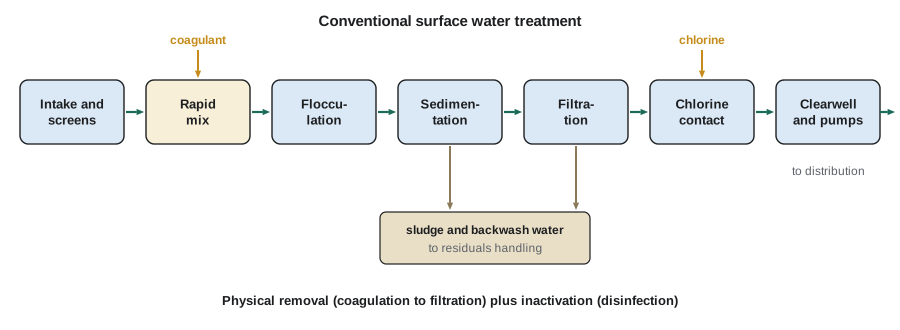
| Step | What it does | Typical design values |
|---|---|---|
| Screening | Removes fish, debris and ice at the intake | Bar and traveling screens |
| Coagulation (rapid mix) | A coagulant such as alum or ferric chloride neutralizes the negative charges on fine particles | Seconds to a minute of intense mixing |
| Flocculation | Gentle mixing makes destabilized particles collide and grow into flocs | 20 to 40 minutes |
| Sedimentation | Flocs settle to the bottom of a basin | Overflow rate about 20 to 60 m³/m²·d; 2 to 4 h detention |
| Filtration | Sand, anthracite or both trap remaining particles and pathogens | About 5 to 15 m/h; backwashed every day or two |
| Disinfection | Chlorine or other disinfectants inactivate pathogens | Designed by CT; residual maintained in distribution |
Natural particles, from clay to bacteria, are tiny and carry negative surface charges that make them repel one another, so they would take days or years to settle on their own. Coagulants such as aluminum sulfate (alum), ferric chloride or polyaluminum chloride supply positive charges and form sticky hydroxide precipitates that sweep particles together. The right dose depends on the raw water and is found with jar tests, in which samples are dosed and stirred in a row of beakers to see which dose gives the clearest water. Coagulation also removes much of the natural organic matter that would otherwise form disinfection by-products.
Alum reacts with the water's alkalinity as it forms aluminum hydroxide. Each milligram of commercial alum consumes about 0.5 mg of alkalinity as CaCO₃, so a soft, poorly buffered water may need lime or soda ash to keep the pH in the range where coagulation works best.
Worked problem
Coagulant and alkalinity
Jar tests show that the river water needs 30 mg/L of alum on an average day. How much alum does the plant use each day at 40,000 m³/d, and how much alkalinity does it consume?
Show solution
- \[\text{Alum} = 30\ \text{g/m}^3 \times 40\,000\ \text{m}^3/\text{d} = 1\,200\ \text{kg/d}\]
- \[\text{Alkalinity consumed} = 30 \times 0.5 = 15\ \text{mg/L as CaCO}_3\]
Answer: The plant uses about 1.2 metric tons of alum a day. The river's alkalinity is usually above 150 mg/L as CaCO₃, so losing 15 mg/L is not a concern, but in a soft-water region it might be.
Sedimentation
In an ideal settling basin, a particle is removed if it settles to the floor before the water carrying it reaches the outlet. The analysis, due to Allen Hazen in 1904, shows that removal depends not on the basin's depth or detention time but on its surface area. Particles settling faster than the overflow rate, the flow divided by the basin surface area, are completely removed:
The overflow rate has units of velocity, often written as m³/m²·d or m/h. Real basins perform worse than ideal ones because of turbulence, density currents and short-circuiting, so designers use conservative overflow rates and provide several basins so that one can be taken out of service for cleaning.
Filtration
Rapid granular filters are beds of sand, or anthracite over sand, about one meter deep. Water flows down through the bed, and particles are caught by straining, settling and attachment within the pores, not just on the surface. As the filter collects particles, head loss rises and eventually particles begin to break through, so the filter is backwashed by pumping clean water up through the bed to fluidize it and wash out the trapped solids. The filtration rate, or hydraulic loading rate, is the flow divided by the filter area. Filtered water turbidity is monitored continuously on every filter, because turbidity spikes can signal that pathogens are getting through. Slow sand filters, which run at much lower rates and rely on a biological layer on the sand surface, still serve some small communities.
Membranes, ultraviolet light and groundwater treatment
Membrane filtration forces water through thin polymer sheets or hollow fibers with tiny pores. Microfiltration and ultrafiltration remove particles, bacteria and protozoa, and ultrafiltration also removes most viruses; nanofiltration and reverse osmosis also remove dissolved salts, hardness, nitrate and many organic chemicals, at the cost of more energy and a concentrated reject stream that must be disposed of. Ultraviolet (UV) light damages the genetic material of microorganisms so they cannot reproduce; it is especially effective against Cryptosporidium and Giardia, which resist chlorine, but leaves no residual, so it is paired with chlorine. Groundwater treatment is often simpler: iron and manganese are oxidized with air, chlorine or potassium permanganate and filtered out; hardness is removed by lime softening or ion exchange; nitrate by ion exchange or reverse osmosis; and arsenic by adsorption or coagulation. The farming town from lesson 5 would most likely use oxidation and greensand or manganese dioxide filtration.
Disinfection and the CT concept
Disinfection inactivates the pathogens that remain after physical treatment. Chlorine is by far the most common disinfectant because it is effective, cheap and leaves a residual that continues to protect water in the distribution system. When chlorine is added to water it forms hypochlorous acid (HOCl), which dissociates to hypochlorite ion (OCl⁻) with a pKa of about 7.5; hypochlorous acid is the stronger disinfectant, so chlorine works better at lower pH. Chlorine combined with ammonia forms chloramines, weaker disinfectants that persist longer and form fewer by-products, and many large systems use them for the distribution residual. Ozone and chlorine dioxide are powerful alternatives used for primary disinfection or taste and odor control.
As lesson 4 showed, disinfection depends on the product of disinfectant concentration and contact time. Regulators publish tables of the CT, in mg·min/L, needed for a given log inactivation of Giardia or viruses at each temperature and pH. Because real tanks short-circuit, the contact time used is T10, the time for 10 percent of a tracer to pass, which is estimated from the theoretical detention time with a baffling factor:
| Baffling condition | Baffling factor (T10/T) | Example |
|---|---|---|
| Unbaffled | 0.1 | Mixed tank with no baffles, open inlet and outlet |
| Poor | 0.3 | Single inlet and outlet baffle |
| Average | 0.5 | Some intra-basin baffles |
| Superior | 0.7 | Serpentine baffles |
| Perfect (plug flow) | 1.0 | Pipeline flow |
Under the EPA's Surface Water Treatment Rules, systems must achieve at least 3-log (99.9 percent) removal or inactivation of Giardia and 4-log (99.99 percent) of viruses, and the Long Term 2 Enhanced Surface Water Treatment Rule requires additional Cryptosporidium treatment for sources with higher measured oocyst levels. Well-operated conventional filtration earns credit for much of the removal, and disinfection supplies the rest.
Worked problem
Is the contact tank big enough?
Filtration is credited with 2.5-log Giardia removal, so disinfection must supply 0.5-log. At 5 °C and pH 7.5 with a free chlorine residual of 1.0 mg/L, the regulator's table requires a CT of about 30 mg·min/L for 0.5-log Giardia. The proposed contact tank holds 900 m³ with average baffling. Check it at the peak-day flow of 60,000 m³/d.
Show solution
- \[Q_{\text{peak}} = 60\,000/1\,440 = 41.7\ \text{m}^3/\text{min}\]
- \[T = 900/41.7 = 21.6\ \text{min} \qquad T_{10} = 0.5 \times 21.6 = 10.8\ \text{min}\]
- \[CT = 1.0 \times 10.8 = 10.8\ \text{mg·min/L} < 30\]
Answer: The tank provides only about a third of the required CT. Nadia could raise the chlorine residual, but that increases by-products; instead she proposes serpentine baffles (factor 0.7) and a larger tank of 2,000 m³, which gives T₁₀ = 0.7 × 2,000/41.7 = 33.6 min and CT = 34 mg·min/L, enough with a small margin.
# Preliminary sizing for a 40,000 m3/d plant (60,000 m3/d peak)
Q_avg, Q_peak = 40000.0, 60000.0          # m3/d
v_o = 40.0                                 # sedimentation overflow rate, m3/m2.d
filt_rate = 10.0                           # filtration rate, m/h
A_sed = Q_peak / v_o
print(f"Sedimentation area at peak flow: {A_sed:.0f} m2 -> 3 basins of {A_sed / 3:.0f} m2")
A_filt = Q_peak / 24 / filt_rate
n = 6
print(f"Filter area: {A_filt:.0f} m2 -> {n} filters of {A_filt / n:.0f} m2")
print(f"  with one filter backwashing, rate in others = {Q_peak / 24 / (A_filt * (n - 1) / n):.1f} m/h")
for V, BF in ((900, 0.5), (2000, 0.7)):
    T10 = BF * V / (Q_peak / 1440)        # minutes
print(f"Contact tank {V} m3, baffling {BF}: T10 = {T10:.1f} min, CT at 1.0 mg/L = {T10:.1f} mg.min/L")Sedimentation area at peak flow: 1500 m2 -> 3 basins of 500 m2 Filter area: 250 m2 -> 6 filters of 42 m2 with one filter backwashing, rate in others = 12.0 m/h Contact tank 900 m3, baffling 0.5: T10 = 10.8 min, CT at 1.0 mg/L = 10.8 mg.min/L Contact tank 2000 m3, baffling 0.7: T10 = 33.6 min, CT at 1.0 mg/L = 33.6 mg.min/L
The program confirms the layout: three sedimentation basins of about 500 m² each, six filters of about 42 m² each, and a well-baffled contact tank of 2,000 m³. Note the check with one filter out of service for backwashing; the remaining filters must handle the full flow at a rate that is still acceptable, here 12 m/h.
Disinfection by-products
Chlorine reacts with natural organic matter to form trihalomethanes, haloacetic acids and other by-products, some of which are linked to cancer and other health effects after long exposure. The best control is to remove organic matter before chlorination by enhanced coagulation, granular activated carbon or membranes, and to move the point of chlorination after filtration. Engineers must never compromise disinfection to lower by-products, because the microbial risk of inadequate disinfection is far greater and more immediate than the chemical risk of by-products.
Distribution systems
Treated water travels to customers through pumps, reservoirs, towers and hundreds of kilometers of pipe. Distribution systems must keep pressure positive at all times, because low pressure lets contaminated groundwater enter through leaks and lets backflow occur from customers' plumbing. Water that sits too long in oversized mains or tanks loses its residual, warms up and grows bacteria and biofilm, a problem called water age. Old cast-iron mains break during deep frosts, and lead service lines release lead into the water of older homes. Utilities manage these risks with residual monitoring, flushing, corrosion control treatment, cross-connection control and long-term pipe renewal.
Residuals
Treatment produces waste streams: sludge from sedimentation basins, spent backwash water, concentrate from membranes and spent media. Water plant sludge consists mainly of the coagulant precipitate plus the solids removed from the river. It is usually thickened, dewatered and sent to landfill or land application, and backwash water is often recycled to the head of the plant after settling. Returning untreated residuals to a river is no longer acceptable in most places, so residuals handling is a significant part of plant design and cost.
Common mistakes
MistakeSizing a sedimentation basin by depth or detention time alone.
InsteadIdeal removal depends on the overflow rate Q/A; area is the key dimension.
MistakeUsing the theoretical detention time in a CT calculation.
InsteadUse T₁₀, estimated from a tracer test or with a baffling factor.
MistakeChecking CT at average flow.
InsteadCheck at peak hourly or peak daily flow, when detention time is shortest.
MistakeRaising chlorine doses to fix every problem.
InsteadHigher doses form more by-products; improve organic removal and contact tank hydraulics first.
Summary and key terms
- Drinking water protection uses multiple barriers from source to tap.
- Conventional treatment is coagulation, flocculation, sedimentation, filtration and disinfection.
- Ideal settling removal depends on the overflow rate Q/A_s; filters are sized by hydraulic loading rate.
- Membranes, UV light and groundwater processes such as oxidation and ion exchange address specific problems.
- Disinfection is designed with CT = C × T₁₀, checked at peak flow, to meet log-removal targets.
- By-products are minimized by removing organic matter, never by compromising disinfection; distribution systems need positive pressure and a residual.
- Coagulation
- Destabilizing fine particles with a chemical so they can stick together.
- Flocculation
- Gentle mixing that makes destabilized particles collide and form larger flocs.
- Overflow rate
- The flow divided by the surface area of a settling basin.
- Backwash
- Reversing flow through a filter to clean out trapped particles.
- CT
- The product of disinfectant concentration and effective contact time, in mg·min/L.
- T10
- The time for 10 percent of a tracer to pass through a tank, used as the effective contact time.
- Log removal
- The base-ten logarithm of the ratio of influent to effluent organism counts.
- Water age
- The time water spends in the distribution system after treatment.
Practice problems
Work each problem on paper first, then reveal the answer to check.
A settling basin is 12 m wide and 48 m long and treats 25,000 m³/d. What is its overflow rate?
Show answer
\(25\,000/576 = 43\) m³/m²·d.
A plant filters 30,000 m³/d at 8 m/h. What total filter area is needed?
Show answer
\(30\,000/24/8 = 156\) m².
What percentage of organisms remains after a 4-log reduction?
Show answer
0.01 percent.
A contact tank of 1,200 m³ with a baffling factor of 0.3 receives 2,500 m³/h. With 1.5 mg/L of free chlorine, what CT does it provide?
Show answer
\(T = 28.8\) min, \(T_{10} = 8.6\) min, CT = 13 mg·min/L.
Why is UV light paired with chlorine rather than used alone in a municipal system?
Show answer
UV leaves no residual to protect water in the distribution system.
Why must groundwater under the direct influence of surface water be filtered?
Show answer
It can carry protozoa such as Giardia and Cryptosporidium from the surface water.
Lesson quiz · 5 questions
Score 60% or more to complete this lesson.
Create a free account to save your progress, take quizzes and earn a certificate.