
CIV-280 · Lesson 1 of 12 · 22 min
Environmental engineering and sustainability
Environmental engineers protect people from the environment and the environment from people. They design the water treatment plants that make river water safe to drink, the sewers and treatment plants that return used water to rivers without harming them, the landfills and recycling systems that handle solid waste, and the controls that keep smokestacks and tailpipes from fouling the air. They also predict what a new highway, mine or factory will do to the air, water, soil and living things around it, and help decide whether and how it should be built. This course introduces the whole field: the chemistry and mass balances that every calculation rests on, the quality of water and air and how it is measured and regulated, the treatment of drinking water and wastewater, the management of solid and hazardous waste, and the environmental assessment of projects.
The examples follow Willowbend Environmental, an invented consulting firm in Sioux Falls, South Dakota, on the Big Sioux River. Nadia Okoro is an engineer intern who joined the firm after graduating in civil engineering. She works with Martin Lefebvre, a senior environmental engineer, and Joy Kwan, who runs the firm's small laboratory. This term Willowbend has five jobs: an upgrade of the city's wastewater treatment plant and its discharge to the river, a nitrate problem in the wells of a nearby farming town, leachate from a closed municipal landfill, an air permit for a new asphalt plant, and the environmental review of a new raw water intake and reservoir. Each lesson uses one or more of these jobs.
Where the field came from
Environmental engineering grew out of sanitary engineering, the nineteenth-century work of supplying clean water and removing sewage from crowded cities. In 1854 the physician John Snow traced a London cholera outbreak to a single contaminated pump on Broad Street, one of the founding stories of epidemiology. Cities soon learned that filtering and later chlorinating drinking water cut deaths from typhoid and cholera dramatically. Through the twentieth century, industrial growth added new problems: rivers so polluted they caught fire, smog that killed thousands in London in 1952, acid rain falling on lakes far from the smokestacks, and toxic waste buried in places such as Love Canal in New York. Each crisis brought new laws and new engineering, and the field widened from water and sewage to air, waste, soil, groundwater and whole ecosystems.
American experience shaped the field too. The Cuyahoga River fire in Cleveland in 1969 became a symbol of industrial pollution and helped lead to the Clean Water Act of 1972. In Flint, Michigan, a 2014 switch of water source without proper corrosion control released lead from old service lines into the drinking water of a city of about 100,000 people. Flint showed that treatment, distribution, monitoring and public trust are one system, and it pushed new federal rules on lead service lines.
What environmental engineers do
The work falls into a few broad areas, and most engineers move between several of them during a career:
| Area | Typical projects | Main tools |
|---|---|---|
| Water supply | Source protection, treatment plants, distribution systems | Water chemistry, hydraulics, process design |
| Wastewater | Sewers, treatment plants, biosolids, effluent permits | Microbiology, mass balances, reactor design |
| Air quality | Emission inventories, permits, control equipment, dispersion modeling | Gas laws, meteorology, combustion |
| Solid and hazardous waste | Landfills, recycling, composting, contaminated sites | Geotechnics, hydrogeology, chemistry |
| Environmental assessment | Impact studies for roads, mines, dams and pipelines | Ecology, regulation, consultation |
| Sustainability and climate | Life-cycle assessment, greenhouse gas accounting, adaptation | Inventories, modeling, economics |
Environmental engineers work for consulting firms like Willowbend, for municipalities and utilities that own treatment plants, for industry, and for the governments that write and enforce the rules. Many are licensed professional engineers, because the public relies on their designs and judgments for health and safety. The work is intensely practical: the answer to most questions is a number with units, such as a concentration in milligrams per liter, a load in kilograms per day or a removal efficiency in percent, and that number must be compared with a guideline, standard or permit limit.
Sustainability
The most widely quoted definition of sustainable development comes from the 1987 report of the World Commission on Environment and Development, often called the Brundtland report: development that meets the needs of the present without compromising the ability of future generations to meet their own needs. Engineers usually think about sustainability in three linked parts, sometimes called the triple bottom line: environmental (resources, emissions, ecosystems), social (health, equity, community) and economic (cost over the whole life of the project). A design that is cheap to build but costly to run, or that solves a water problem by creating an air problem, is not sustainable.
The United Nations Sustainable Development Goals, adopted in 2015, set targets that environmental engineers work toward directly, such as clean water and sanitation (goal 6), affordable and clean energy (goal 7), sustainable cities (goal 11) and climate action (goal 13). Professional engineering codes of ethics in both Canada and the United States now ask engineers to consider the environment and sustainability alongside public safety.
Life-cycle thinking
Every product and structure has a life: raw materials are extracted, processed and transported; the product is manufactured, built, used and maintained; and at the end it is reused, recycled or disposed of. Life-cycle assessment (LCA) adds up the inputs (energy, water, materials) and outputs (emissions, wastes) over all these stages and translates them into impacts such as climate change, smog formation, acidification or water use. The international standards ISO 14040 and ISO 14044 set out the four phases of an LCA: goal and scope definition, inventory analysis, impact assessment and interpretation.
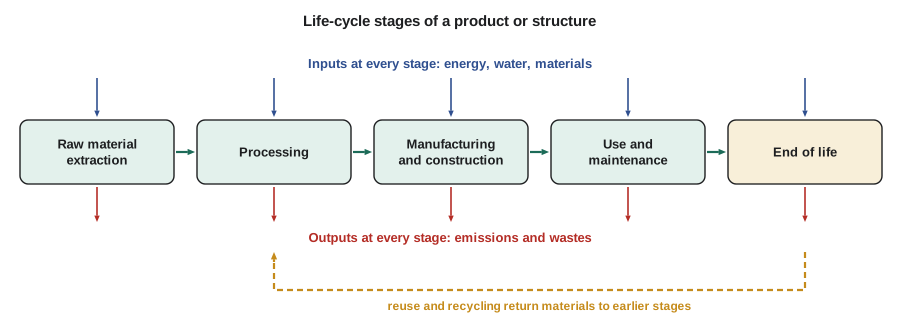
Life-cycle thinking often changes the answer. A wastewater plant that uses a lot of electricity for aeration may have a larger carbon footprint than one that recovers biogas, even if both meet the same effluent limits. A water main made of one material may be cheaper to install but need replacement sooner than another. The functional unit, the quantity of service being compared, such as one cubic meter of treated water or one metric ton of waste managed, makes comparisons fair.
Units and concentrations
Environmental work uses a small set of units constantly, and many mistakes come from mixing them up. In water, concentrations are usually given as mass per volume, in milligrams per liter (mg/L) or micrograms per liter (µg/L). Because a liter of dilute water has a mass of almost exactly one kilogram, 1 mg/L is very nearly one part per million by mass (ppm), and 1 µg/L is very nearly one part per billion (ppb). In air, the same terms mean something different: ppm and ppb in air are parts by volume, which for gases equals parts by moles, and they must be converted to micrograms per cubic meter with the gas laws (lesson 9). In soil and sediment, concentrations are mass per dry mass, in milligrams per kilogram.
The second key idea is the load, or mass flow rate: the mass of a substance passing a point per unit time. A treatment plant permit often limits both the concentration in the effluent and the load to the river, because a small concentration in a very large flow can still deliver a large mass. The load is simply the flow times the concentration, with care over units:
The factor of 10⁻³ appears because 1 mg/L is the same as 1 g/m³, and there are 1,000 g in a kilogram. If the flow is in cubic meters per second, multiply by 86,400 seconds per day as well, giving the convenient factor of 86.4: a flow of 1 m³/s carrying 1 mg/L delivers 86.4 kg/d.
Worked problem
Daily load from a treatment plant
The Sioux Falls wastewater plant discharges an average of 30,000 m³/d of treated effluent containing 2.5 mg/L of total phosphorus. What is the daily phosphorus load to the Big Sioux River, and what is it in metric tons per year?
Show solution
- \[\dot{m} = 30\,000\ \text{m}^3/\text{d} \times 2.5\ \text{g/m}^3 = 75\,000\ \text{g/d} = 75\ \text{kg/d}\]
- \[75\ \text{kg/d} \times 365\ \text{d} = 27\,375\ \text{kg} \approx 27.4\ \text{t per year}\]
Answer: The plant sends about 75 kg of phosphorus to the river every day, or about 27 metric tons a year. Lowering the effluent to 0.5 mg/L would cut the load by 80 percent, to 15 kg/d.
Nadia uses a short program for loads, because the plant has several outfalls and the flows change by season. The same calculation works for any substance once the units are consistent.
# Daily loads (kg/d) from flow and concentration
streams = [
    ("Plant effluent",   30000, 2.5),     # name, flow m3/d, total phosphorus mg/L
    ("Storm outfall A",   4200, 0.40),
    ("Upstream river", 1.21e6, 0.08),
]
for name, q, c in streams:
    load = q * c / 1000            # mg/L = g/m3, so q*c is g/d
    print(f"{name:16s} Q = {q:>9,.0f} m3/d  C = {c:4.2f} mg/L  load = {load:6.1f} kg/d")
total = sum(q * c / 1000 for _, q, c in streams)
print(f"Total phosphorus load: {total:.1f} kg/d")Plant effluent Q = 30,000 m3/d C = 2.50 mg/L load = 75.0 kg/d Storm outfall A Q = 4,200 m3/d C = 0.40 mg/L load = 1.7 kg/d Upstream river Q = 1,210,000 m3/d C = 0.08 mg/L load = 96.8 kg/d Total phosphorus load: 173.5 kg/d
The result shows something that surprises many students: the upstream river, with the lowest concentration, carries the largest load, simply because its flow is so large. Managing a river's phosphorus means looking at every source in the watershed, including farm runoff, not only the treatment plant at the end of the pipe.
Laws, guidelines and standards
In the United States, Congress passed most of the major environmental statutes in the 1970s and 1980s: the National Environmental Policy Act (1970), the Clean Air Act (major amendments 1970, 1977 and 1990), the Clean Water Act (1972), the Safe Drinking Water Act (1974), the Resource Conservation and Recovery Act (1976) and the Comprehensive Environmental Response, Compensation, and Liability Act, or Superfund (1980). The Environmental Protection Agency (EPA) writes regulations under these laws, and most states run the permit programs themselves under delegated authority, often with rules at least as strict as the federal ones. In South Dakota, Willowbend's permits come from the state environmental agency acting under EPA-approved programs.
Three words are used carefully. A guideline or objective is a recommended value that is not enforceable by itself. A standard is a value set by a government body, which may or may not be legally binding depending on the law behind it. A permit limit or license condition is the enforceable number written for a particular facility, often stricter than the general standard because of local conditions such as a small receiving river. Engineers design to the permit, check against the standards and keep an eye on guidelines that are likely to become standards later.
Risk and the precautionary principle
Many environmental decisions are about risk: the probability that harm will occur and how severe it would be. Health-based drinking water and air quality values are usually derived from studies of the dose that causes harm, divided by safety factors to allow for uncertainty and sensitive people. For substances believed to cause cancer at any dose, regulators often set a level that corresponds to a small lifetime risk, such as one additional case in 100,000 or a million people. Where the science is uncertain but the possible harm is serious or irreversible, the precautionary principle says that lack of full certainty should not be a reason to postpone cost-effective measures. Engineers do not usually set these values, but they need to understand where they come from and how much margin they contain.
Common mistakes
MistakeTreating ppm in air the same as ppm in water.
InsteadIn water ppm is by mass (1 mg/L); in air it is by volume and must be converted with the gas laws.
MistakeComparing concentrations when the question is about loads.
InsteadA large flow at a low concentration can deliver more mass than a small flow at a high concentration; compute Q × C.
MistakeForgetting the factor 86.4 when the flow is in m³/s.
Instead1 m³/s at 1 mg/L is 86.4 kg/d.
MistakeTreating a guideline as a permit limit.
InsteadGuidelines are advisory; the enforceable number is the one in the permit or regulation.
Summary and key terms
- Environmental engineering grew from sanitary engineering into the protection of water, air, land and ecosystems.
- Sustainability balances environmental, social and economic outcomes over the whole life of a project.
- Life-cycle assessment follows inputs and outputs from extraction to end of life, using a functional unit for fair comparison.
- In water, 1 mg/L ≈ 1 ppm and 1 µg/L ≈ 1 ppb; in air, ppm and ppb are by volume.
- Load equals flow times concentration; 1 m³/s at 1 mg/L is 86.4 kg/d.
- Guidelines are advisory, standards are set by governments, and permit limits are the enforceable numbers for a facility.
- Sustainable development
- Development that meets present needs without compromising the ability of future generations to meet their own needs.
- Life-cycle assessment
- A method that adds up the resource use and emissions of a product or service over its whole life and translates them into impacts.
- Functional unit
- The quantity of service on which a life-cycle comparison is based.
- Load
- The mass of a substance passing a point per unit time, equal to flow times concentration.
- Guideline
- A recommended value that is not legally enforceable by itself.
- Permit limit
- An enforceable limit written for a particular facility.
- Precautionary principle
- The idea that uncertainty should not delay cost-effective action against serious or irreversible harm.
- Multi-barrier approach
- Protecting drinking water through several independent safeguards from source to tap.
Practice problems
Work each problem on paper first, then reveal the answer to check.
A river flows at 25 m³/s and carries 0.12 mg/L of total phosphorus. What is the load in kg/d?
Show answer
\(25 \times 0.12 \times 86.4 = 259\) kg/d.
Convert 0.8 µg/L of a pesticide in water to ppb and ppm.
Show answer
About 0.8 ppb, or 0.0008 ppm.
A plant's permit allows 20 kg/d of ammonia nitrogen. If the effluent flow is 32,000 m³/d, what effluent concentration meets the load limit?
Show answer
\(20\,000\ \text{g/d} / 32\,000\ \text{m}^3/\text{d} = 0.63\) mg/L or less.
Name the four phases of an LCA under ISO 14040.
Show answer
Goal and scope definition, inventory analysis, impact assessment and interpretation.
Why might a design that meets every effluent limit still be unsustainable?
Show answer
It may use excessive energy or chemicals, shift pollution to air or land, or cost too much to operate over its life.
What is the difference between a standard and a permit limit?
Show answer
A standard is a general value set by a government; a permit limit is the enforceable number for one facility, often stricter because of local conditions.
Lesson quiz · 5 questions
Score 60% or more to complete this lesson.
Create a free account to save your progress, take quizzes and earn a certificate.