
CIV-241 · Lesson 5 of 12 · 22 min
Weathering and soil formation
Rocks formed deep in the Earth are out of equilibrium at the surface. Exposed to air, water, temperature changes and living things, they break down by weathering. Weathering produces the loose materials that engineers call soil, and it weakens the upper part of the rock beneath. Understanding weathering helps an engineer predict how deep to excavate to reach sound rock, how a cut slope will degrade over decades, why rock-head levels can be wildly irregular, and why soils formed in place behave differently from soils that were transported and deposited.
Physical (mechanical) weathering
Physical weathering breaks rock into smaller pieces without changing its minerals. The main processes are:
- Frost wedging: water entering cracks expands by about 9 percent when it freezes, prying the rock apart. Repeated freeze–thaw cycles are the dominant weathering process in cold climates and on mountain slopes, producing talus aprons of angular fragments below cliffs.
- Unloading (stress release): when overlying rock is removed by erosion or excavation, the rock expands and develops sheet joints parallel to the surface. Exfoliation domes in granite are a spectacular example, and stress relief fractures can open in the walls of deep excavations.
- Thermal expansion and contraction: daily heating and cooling stresses grains with different expansion coefficients, mainly important in deserts and on dark rock surfaces.
- Salt crystallization: salts growing in pores exert pressures that break apart porous stone, a problem for masonry and for rocks in arid and coastal environments.
- Wetting and drying (slaking): clay-rich rocks such as shales and mudstones swell and shrink as they absorb and lose water and break down into chips and mud.
- Biological action: roots growing in cracks, and burrowing animals, open the rock.
Chemical weathering
Chemical weathering changes minerals into new ones that are stable at the surface, usually clay minerals, iron oxides and dissolved ions. Water is the essential agent, and rates increase with temperature and rainfall. The main reactions are:
- Dissolution: some minerals dissolve completely. Calcite dissolves in water made slightly acidic by carbon dioxide from the air and soil, which is how limestone caves and karst form. Gypsum and halite dissolve much faster.
- Hydrolysis: silicate minerals such as feldspar react with water and hydrogen ions to form clay minerals and release soluble ions. The conversion of feldspar to kaolinite is the classic example and the reason granite weathers to a sandy, clayey residual soil.
- Oxidation: iron in minerals such as biotite, pyroxene and pyrite combines with oxygen, producing reddish-brown iron oxides and weakening the mineral structure. The oxidation of sulfides also produces acid that accelerates other weathering.
- Hydration: some minerals take up water into their structure, such as anhydrite becoming gypsum, often with an increase in volume.
Minerals weather at different rates. In general, minerals that crystallized at high temperature, such as olivine and calcium plagioclase, are least stable at the surface, while quartz, which forms late and at low temperature, is the most resistant common mineral. This sequence, known as the Goldich stability series, explains why sands are mostly quartz and why basalt weathers faster than granite in the same climate.
| Factor | Effect on weathering |
|---|---|
| Climate | Warm, wet climates favor deep chemical weathering; cold climates favor frost action; arid climates weather slowly |
| Rock type | Mineral stability, porosity and grain size control susceptibility |
| Discontinuities | Joints and faults let water in; weathering penetrates deepest along fractures |
| Topography | Steep slopes shed weathered material; flat, well-drained uplands accumulate deep profiles |
| Time | Older surfaces have deeper profiles; recently glaciated surfaces have thin ones |
| Biology | Roots, organisms and organic acids accelerate both physical and chemical weathering |
Weathering profiles and grades
Weathering usually decreases with depth, producing a weathering profile from completely decomposed material at the surface to fresh rock below. Because weathering penetrates along joints, the profile is rarely uniform. Corestones of fresh rock may remain within weathered material, and the boundary between soil and rock, called rock head, can vary by many meters over short distances. Engineers describe weathered rock using standard grades.
| Grade | Term | Description |
|---|---|---|
| I | Fresh | No visible sign of weathering; perhaps slight discoloration on major joint surfaces |
| II | Slightly weathered | Discoloration on joint surfaces and near them |
| III | Moderately weathered | Less than half the rock is decomposed or disintegrated to soil; fresh or discolored rock remains as a continuous framework or corestones |
| IV | Highly weathered | More than half the rock is decomposed or disintegrated to soil |
| V | Completely weathered | All rock material is decomposed to soil, but the original rock structure is still largely intact |
| VI | Residual soil | All rock converted to soil; the rock structure and fabric are destroyed |
The grades matter for design because strength, stiffness and permeability change dramatically across them. A foundation on grade III rock may need to be designed as on a soil, a cut slope in grade IV material behaves like a dense soil with relict joints, and the transition zone between grades V and III often transmits large volumes of water. Drill logs should record the weathering grade along with other descriptions, and excavation contracts in deeply weathered rock often need careful definitions of what counts as rock for payment.
Residual and transported soils
Soils are divided by origin into residual soils, which formed in place by weathering of the underlying rock, and transported soils, which were moved by gravity, water, wind or ice and deposited elsewhere.
Residual soils are common in warm, humid regions that have not been glaciated, such as the southeastern United States, where weathering profiles tens of meters deep develop on granite and metamorphic rocks. Residual soils grade downward into weathered rock, often retain relict joints and foliation that can act as slip surfaces, and can have unusual properties, such as high void ratios with surprisingly high strength from cementation.
Transported soils are classified by their transporting agent: colluvium (moved downslope by gravity), alluvium (deposited by rivers), lacustrine soils (deposited in lakes), marine soils (deposited in the sea), aeolian soils (deposited by wind, such as loess and dune sand) and glacial soils (deposited by ice and meltwater). Each agent sorts and shapes particles differently, producing characteristic grain size distributions, layering and properties. Lesson 6 looks closely at glacial and postglacial deposits, which dominate the northern half of the continent.
Across the northern United States, the glaciers stripped away much of the pre-existing soil and weathered rock during the last glaciation, leaving glacial deposits at the surface. South of the glacial limit, deep residual soils are common. In the Piedmont region from Virginia to Alabama, for example, residual soils called saprolite may extend tens of meters above fresh rock. Eastern Washington was largely beyond the main ice sheet but was swept by enormous glacial outburst floods and blanketed by wind-blown loess, which forms the fertile Palouse hills south of Spokane.
Pedogenic soil horizons
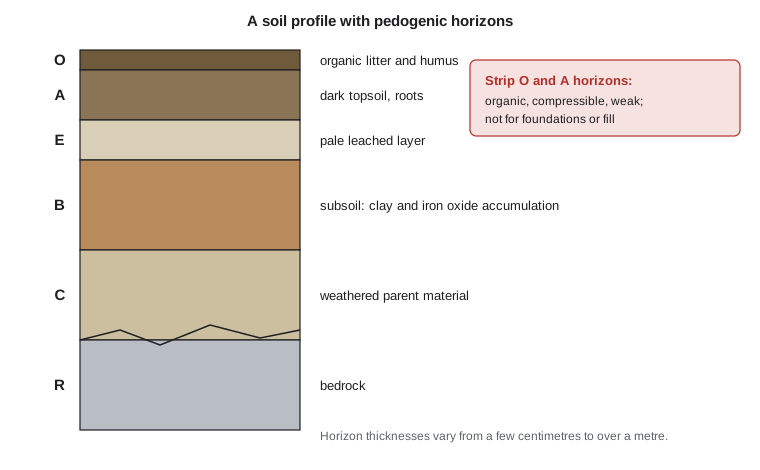
Soil scientists and agronomists describe the upper meter or two of the ground as a soil profile with layers called horizons, formed by organic activity and the downward movement of water. The O horizon is surface organic matter; the A horizon is dark topsoil mixed with humus; the E horizon, where present, is a leached, pale layer; the B horizon is the subsoil, where clay, iron oxides or carbonates leached from above accumulate; and the C horizon is weathered parent material grading into unweathered material or rock. For engineers, the key points are that topsoil (O and A horizons) is compressible, organic and unsuitable for foundations or fill, and must be stripped; and that B horizons can be clay-enriched or cemented.
Soils as three-phase materials
Whatever its origin, a soil is an assembly of solid particles with voids filled by water, air or both. Engineering descriptions of soil therefore start with phase relationships: how the total volume and mass divide among solids, water and air. These relationships appear in every geotechnical report, and a few definitions cover most needs.
Here \(w\) is the water content, \(e\) the void ratio, \(n\) the porosity and \(S\) the degree of saturation. Two further relations link them to density: \(S e = w G_s\), where \(G_s\) is the specific gravity of the solids (typically 2.65 to 2.75 for mineral soils), and the bulk density \(\rho = \rho_w G_s (1 + w)/(1 + e)\). Weathering generally increases void ratio and water content as minerals decompose to clay and pore space opens, which is why weathered materials are weaker and more compressible.
Worked problem
Phase relationships for a residual soil sample
A tube sample of completely weathered granite (grade V) has a bulk density of 1.82 Mg/m³ (113.6 lb/ft³) and a water content of 24 percent. The specific gravity of the solids is 2.68. Find the dry density, void ratio, porosity and degree of saturation.
Show solution
- Dry density removes the water from the bulk density:
- \[\rho_d = \frac{\rho}{1 + w} = \frac{1.82}{1.24} = 1.468\ \text{Mg/m}^3\]
- Void ratio from the dry density:
- \[e = \frac{G_s \rho_w}{\rho_d} - 1 = \frac{2.68 \times 1.00}{1.468} - 1 = 0.826\]
- Porosity and degree of saturation:
- \[n = \frac{0.826}{1.826} = 0.452 \qquad S = \frac{w G_s}{e} = \frac{0.24 \times 2.68}{0.826} = 0.78\]
Answer: Dry density 1.47 Mg/m³, void ratio 0.83, porosity 45 percent and saturation 78 percent. A fresh granite has a porosity of around 1 percent, so weathering has opened up a very large void space.
# Phase relationships across a weathering profile
Gs = 2.68
rho_w = 1.00  # Mg/m3

samples = [  # (grade, bulk density Mg/m3, water content)
    ("V  completely weathered", 1.82, 0.24),
    ("IV highly weathered",     1.95, 0.17),
    ("III moderately weathered", 2.30, 0.06),
    ("II slightly weathered",   2.58, 0.012),
]
print("grade                      rho_d   e     n     S")
for grade, rho, w in samples:
    rho_d = rho / (1 + w)
    e = Gs * rho_w / rho_d - 1
    n = e / (1 + e)
    S = min(1.0, w * Gs / e)
print(f"{grade:26s} {rho_d:5.2f} {e:5.3f} {n:5.3f} {S:5.2f}")grade rho_d e n S V completely weathered 1.47 0.826 0.452 0.78 IV highly weathered 1.67 0.608 0.378 0.75 III moderately weathered 2.17 0.235 0.190 0.68 II slightly weathered 2.55 0.051 0.049 0.63
How quickly does weathering act?
Weathering rates span many orders of magnitude, and the relevant question for an engineer is whether weathering will change a material significantly within the design life. For massive granite or quartzite, the answer is almost always no: a few millimeters of surface change over centuries is irrelevant to a foundation. For shales, mudstones and some volcanic tuffs, the answer may be yes within weeks or months of exposure. Gypsum can dissolve fast enough to enlarge cavities within decades when fresh water flows through it, and pyritic rocks can begin to oxidize and expand within a few years of being placed in a building's subgrade.
Tombstones and old masonry buildings provide useful natural experiments. Marble headstones in humid cities lose their inscriptions within a century or two, while granite headstones of the same age look almost new. For engineered structures, the equivalent evidence comes from inspecting old cuts and quarries in the same rock: a twenty-year-old cut in the same formation tells you more about long-term slope behavior than any laboratory test on fresh core.
Weathering of excavated slopes and surfaces
Weathering continues after construction. Rock cuts in shale and weak sandstone ravel and recede, with small falls and slumps that fill ditches and threaten traffic. Cut slopes in fractured rock loosen as frost and roots open joints, so rockfall frequency often increases for some years after excavation. Exposed shale foundation grades can soften within hours if wetted, so specifications often require a protective concrete blinding layer immediately after excavation. Embankments built of weak shale fragments can settle as the fragments slake into soil over years. Good design anticipates these changes with appropriate slope angles, benches, drainage, protective coatings, and maintenance plans.
Common mistakes
MistakeAssuming rock head is flat between boreholes.
InsteadWeathering penetrates along joints and can leave corestones and deep troughs; expect variability and investigate where it matters.
MistakeTreating a completely weathered rock as rock because it still shows rock structure.
InsteadGrade V material is a soil in strength terms, even though its relict fabric remains and may control sliding.
MistakeUsing topsoil as fill or leaving it under foundations.
InsteadStrip organic O and A horizons; they are compressible and weak.
MistakeLeaving an exposed shale subgrade unprotected overnight.
InsteadProtect weak rock immediately with blinding or cover; it can soften and swell when wetted.
Summary and key terms
- Physical weathering breaks rock apart by frost, unloading, temperature change, salt growth, slaking and roots.
- Chemical weathering converts minerals by dissolution, hydrolysis, oxidation and hydration; quartz is the most resistant common mineral.
- Weathering profiles grade from residual soil to fresh rock and are described by grades I to VI.
- Residual soils form in place; transported soils are colluvial, alluvial, lacustrine, marine, aeolian or glacial.
- Glaciation stripped older weathered material from most of Canada and the northern United States, so soils there are young.
- Phase relationships (water content, void ratio, porosity, saturation) quantify how weathering opens up void space.
- Weathering
- The physical and chemical breakdown of rock at or near the Earth’s surface.
- Hydrolysis
- A chemical reaction with water that converts silicate minerals to clay minerals.
- Rock head
- The surface of rock beneath soil or weathered material.
- Corestone
- A rounded block of fresher rock surrounded by more weathered material.
- Residual soil
- Soil formed in place by weathering of the underlying rock.
- Colluvium
- Soil and rock debris moved downslope by gravity.
- Void ratio
- The volume of voids divided by the volume of solids.
- Degree of saturation
- The fraction of the void volume filled with water.
Practice problems
Work each problem on paper first, then reveal the answer to check.
Why does frost wedging dominate weathering in cold regions?
Show answer
Water expands about 9 percent on freezing, and repeated freeze–thaw cycles pry cracks open.
Which common mineral is most resistant to chemical weathering, and why does that matter?
Show answer
Quartz; it survives to dominate sands and most coarse soils.
A soil has \(w = 30\%\), \(G_s = 2.70\) and is saturated. What is its void ratio?
Show answer
\(e = wG_s/S = 0.30 \times 2.70 = 0.81\).
Describe grade V weathered rock.
Show answer
Completely weathered: all decomposed to soil, but the original rock structure is still largely intact.
Name four agents that transport soils.
Show answer
Gravity, rivers, wind and glaciers (also lakes and the sea as depositional settings).
Why must topsoil be stripped before placing fill?
Show answer
It is organic, compressible and weak, and would cause settlement and instability.
Lesson quiz · 5 questions
Score 60% or more to complete this lesson.
Create a free account to save your progress, take quizzes and earn a certificate.