
CIV-241 · Lesson 3 of 12 · 22 min
Igneous, sedimentary and metamorphic rocks
A rock is a naturally occurring aggregate of one or more minerals, or of natural glass or organic matter. Geologists group rocks into three families by how they formed: igneous rocks crystallize from molten material, sedimentary rocks form from the debris or chemical precipitates of other rocks, and metamorphic rocks form when existing rocks are transformed by heat, pressure and fluids. For an engineer, the name of a rock is useful mainly as a shorthand for its likely strength, durability, layering, permeability and problems. A granite, a shale and a limestone of the same size behave very differently in a cut slope, a tunnel or a foundation, and knowing the family and the name gives you a first prediction before any testing.
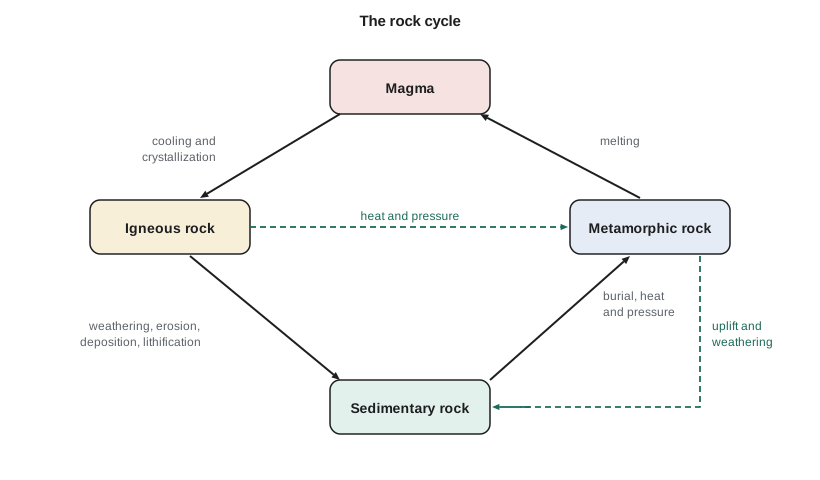
The rock cycle
The three families are linked by the rock cycle. Magma cools to form igneous rock. Igneous rock exposed at the surface weathers and erodes; the sediment is transported, deposited, buried and cemented into sedimentary rock. Deep burial or mountain building heats and squeezes rocks into metamorphic rock, and enough heat can melt them back into magma. Any rock can follow many paths through the cycle, and the processes run at rates from years for erosion of soft deposits to hundreds of millions of years for burial and uplift.
Igneous rocks
Igneous rocks are classified by texture, which reflects how fast the melt cooled, and by composition, which reflects which minerals crystallized. Intrusive (plutonic) rocks cooled slowly at depth and have coarse grains visible to the eye. Extrusive (volcanic) rocks cooled quickly at or near the surface and are fine-grained or glassy; some contain gas holes called vesicles, and pyroclastic rocks are made of fragments blown out of volcanoes.
| Composition | Main minerals | Coarse-grained (intrusive) | Fine-grained (extrusive) |
|---|---|---|---|
| Felsic (silica-rich) | Quartz, potassium feldspar, sodium plagioclase, some mica | Granite | Rhyolite |
| Intermediate | Plagioclase, amphibole, some biotite | Diorite | Andesite |
| Mafic (silica-poor) | Calcium plagioclase, pyroxene, olivine | Gabbro | Basalt |
| Ultramafic | Olivine, pyroxene | Peridotite | Rare at the surface |
Fresh, massive igneous rocks such as granite, diorite, gabbro and basalt are among the strongest construction materials, with unconfined compressive strengths often above 100 MPa. Their problems usually come from discontinuities and weathering rather than from the intact rock. Granite can weather in place to a deep, sandy residual soil with corestones of fresh rock, which makes rock-head levels highly irregular. Columnar basalt is broken by cooling joints into polygonal columns that can topple from cut faces. Volcanic sequences often contain weak layers of ash (tuff), weathered flow tops, buried soils and vesicular zones that are far more permeable and weaker than the dense flow interiors.
Eastern Washington is underlain by the Columbia River Basalt Group, a huge stack of lava flows erupted roughly 17 to 6 million years ago. Each flow has a dense interior broken into columns and an upper zone that is often vesicular, rubbly or weathered, and some flows are separated by sedimentary interbeds. The dense interiors make excellent foundations and quarry rock, while the flow tops and interbeds are the main aquifers in the region and can be weak zones in cuts. Granite and metamorphic rocks are also found around Spokane, beneath and beside the basalts.
Sedimentary rocks
Sedimentary rocks cover about three quarters of the continental surface, though they form only a thin veneer over igneous and metamorphic basement. They are classified as clastic, made of fragments of other rocks, or chemical and biochemical, made of minerals precipitated from water, often with the help of organisms.
Clastic rocks are named by grain size. Conglomerate and breccia contain gravel-sized clasts, rounded in conglomerate and angular in breccia. Sandstone is made of sand-sized grains, most often quartz, held together by a cement of silica, calcite or iron oxide; the type and amount of cement largely determine its strength. Siltstone and mudstone are made of silt and clay; when a fine-grained rock splits readily along closely spaced bedding planes it is called shale.
Chemical and biochemical rocks include limestone, made mostly of calcite, often from shells and skeletal debris; dolostone, made of dolomite; chert, made of microcrystalline silica; evaporites such as rock salt and gypsum, which precipitate when seawater or lake water evaporates; and coal, made of compressed plant material.
| Rock | Composition or grain size | Typical engineering behavior |
|---|---|---|
| Sandstone | Sand-sized grains, cemented | Strength depends on cement; often a good aquifer; may be abrasive |
| Shale and mudstone | Clay and silt | Weak, may slake and soften when wetted and dried; may swell; low permeability; slide-prone along bedding |
| Conglomerate | Rounded gravel in finer matrix | Variable; matrix controls strength |
| Limestone | Calcite | Strong when fresh but soluble; karst cavities; good aggregate if sound |
| Dolostone | Dolomite | Similar to limestone, less soluble |
| Gypsum and rock salt | Evaporite minerals | Soluble within engineering time; subsidence; gypsum attacks concrete |
| Coal | Carbonized plant matter | Weak; old mine workings cause subsidence |
Sedimentary rocks are typically layered. Bedding planes, where deposition paused or changed, are surfaces of weakness and often of higher permeability. Thin clay or bentonite seams within a sequence can be extremely weak, especially if they have been sheared by earlier movement, and many large landslides in sedimentary rocks slide along such seams. Shales and mudstones may look strong in a fresh core but break down within days or weeks of exposure to wetting and drying, a process called slaking. Engineers test this with the slake durability test and protect exposed shale faces and foundation subgrades promptly.
Much of the interior United States is underlain by flat-lying sedimentary rocks, from the Paleozoic limestones and shales of the Midwest to the Cretaceous shales of the northern Great Plains. Limestone regions such as central Kentucky, Tennessee, Missouri and Florida are known for karst. In the Northeast and Midwest, glacial deposits cover much of the bedrock. In eastern Washington, sedimentary rocks are found mainly as interbeds within the basalt and as younger basin fills.
Metamorphic rocks
Metamorphism changes a rock's minerals and texture without melting it. Heat and pressure cause new minerals to grow, and directed pressure aligns platy and elongated minerals into a parallel fabric called foliation. Metamorphic rocks are classified first by whether they are foliated.
Foliated rocks form a series of increasing metamorphic grade. Slate forms from shale at low grade and splits into thin, flat sheets along slaty cleavage. Phyllite has a silky sheen from fine mica. Schist has visible mica flakes and splits easily along its foliation, making it strongly anisotropic. Gneiss, at high grade, shows light and dark mineral bands and is much stronger and less fissile than schist.
Non-foliated rocks form when the minerals are equidimensional or the pressure was uniform. Marble forms from limestone or dolostone and, like its parent, is soluble. Quartzite forms from quartz sandstone and is one of the hardest, most durable and most abrasive rocks known. Hornfels forms by contact metamorphism next to intrusions and is dense and strong.
The key engineering issue with foliated rocks is anisotropy. Strength, stiffness and permeability parallel to the foliation may be a fraction of the values across it. A schist slope dipping out of a cut along its foliation can fail where the same rock dipping into the slope would stand steeply. Talc, chlorite and graphite schists are especially weak. Serpentinite, formed by the alteration of ultramafic rocks, is often sheared, slippery, and may contain naturally occurring asbestos.
Rock strength and simple properties
For preliminary assessment, engineers estimate rock strength from field tests and standard descriptions before laboratory testing. The unconfined compressive strength (UCS) of intact rock ranges from less than 1 MPa for very weak mudstones to more than 250 MPa for quartzite and fresh basalt. Field estimates use simple tests: whether the rock can be peeled with a knife, scratched, broken by hand, or needs one or many hammer blows. The point load test, which squeezes a core or lump between two cones, gives an index that correlates roughly with UCS and is quick enough to run on many samples in the core shed.
| Strength description | Approximate UCS (MPa) | Field identification |
|---|---|---|
| Extremely weak | 0.25–1 | Indented by thumbnail |
| Very weak | 1–5 | Crumbles under firm hammer blows; can be peeled by a knife |
| Weak | 5–25 | Can be peeled by a knife with difficulty; shallow indentation by hammer point |
| Medium strong | 25–50 | Cannot be scraped by knife; breaks with a single firm hammer blow |
| Strong | 50–100 | Needs more than one hammer blow to break |
| Very strong | 100–250 | Needs many hammer blows |
| Extremely strong | Over 250 | Can only be chipped with the hammer |
Two other simple properties appear in almost every rock description: unit weight and porosity. Most common rocks have unit weights of about 25 to 28 kN/m³; porous sandstones and weathered rocks are lighter, and mafic rocks heavier. Porosity, the volume of voids as a fraction of total volume, ranges from under 1 percent for fresh granite to 30 percent or more for poorly cemented sandstone and chalk. High porosity generally means lower strength, higher permeability and greater susceptibility to frost damage.
Worked problem
Point load index and rock strength
A 54 mm diameter core of sandstone from the hospital site fails in a diametral point load test at a load of 7.8 kN. Estimate the point load strength index and the approximate unconfined compressive strength, using a commonly quoted conversion factor of 22 for this rock type.
Show solution
- For a diametral test, the equivalent core diameter is the core diameter. The point load index is the load divided by the square of the diameter:
- \[I_s = \frac{P}{D_e^{2}} = \frac{7800\ \text{N}}{(54\ \text{mm})^{2}} = 2.67\ \text{MPa}\]
- The size correction to a 50 mm reference diameter is:
- \[I_{s(50)} = I_s \Big(\frac{D_e}{50}\Big)^{0.45} = 2.67 \times (1.08)^{0.45} = 2.77\ \text{MPa}\]
- Estimate UCS using the conversion factor:
- \[\sigma_c \approx 22 \times 2.77 = 61\ \text{MPa}\]
Answer: The point load index is about 2.8 MPa and the estimated UCS about 60 MPa, a strong rock. The conversion factor varies widely between rock types, so laboratory UCS tests should confirm it for design.
# Point load index and estimated UCS for a set of core tests
import math

tests = [  # (rock, core diameter mm, failure load kN)
    ("sandstone", 54, 7.8),
    ("sandstone", 54, 6.9),
    ("mudstone",  54, 1.1),
    ("basalt",    63, 21.5),
]
K = 22  # site-specific conversion factor should be confirmed by UCS tests

def descr(ucs):
    for limit, name in [(1, "extremely weak"), (5, "very weak"), (25, "weak"), (50, "medium strong"),
                        (100, "strong"), (250, "very strong")]:
        if ucs < limit:
            return name
    return "extremely strong"

for rock, d, p in tests:
    i_s = p * 1000 / d**2
    i_s50 = i_s * (d / 50) ** 0.45
    ucs = K * i_s50
print(f"{rock:10s} Is(50) = {i_s50:5.2f} MPa UCS ~ {ucs:5.0f} MPa ({descr(ucs)})")sandstone Is(50) = 2.77 MPa UCS ~ 61 MPa (strong) sandstone Is(50) = 2.45 MPa UCS ~ 54 MPa (strong) mudstone Is(50) = 0.39 MPa UCS ~ 9 MPa (weak) basalt Is(50) = 6.01 MPa UCS ~ 132 MPa (very strong)
The size correction matters because smaller cores give slightly higher indices than larger ones. Standard practice corrects every result to the 50 mm reference size before comparing tests or converting to UCS. Point load tests are also run axially and on irregular lumps, with an equivalent diameter calculated from the specimen dimensions, which makes the test useful on broken core that could never be trimmed for a laboratory UCS test.
Rock as a construction material
Rock is excavated not only to make room for structures but also to be used: as riprap for erosion protection, as armor stone on breakwaters, as crushed aggregate for concrete and pavements, and as rockfill in embankments and dams. Each use needs durability as well as strength. Riprap and armor stone must resist freeze–thaw cycles, wetting and drying, and abrasion by waves and ice without splitting along hidden seams. Common acceptance tests include the specific gravity and absorption of the stone, soundness tests that simulate freezing or salt crystallization, abrasion tests such as the Los Angeles or micro-Deval tests, and visual inspection for cracks, bedding planes and weathering. Dense igneous rocks, quartzite and sound limestone generally perform well; shales, poorly cemented sandstones and weathered or micaceous rocks often fail within a few winters.
Common mistakes
MistakeJudging a shale's long-term behavior from a fresh core.
InsteadTest slake durability and protect exposed shale; many shales soften quickly when wetted and dried.
MistakeAssuming a strong rock type guarantees a stable slope.
InsteadDiscontinuities, weak seams and weathering usually control stability more than intact strength.
MistakeIgnoring foliation direction in schist and slate.
InsteadStrength and stiffness can differ greatly parallel and perpendicular to foliation; orientation relative to the cut matters.
MistakeUsing a single point-load conversion factor for every rock.
InsteadThe factor varies with rock type; calibrate it against laboratory UCS tests.
Summary and key terms
- Rocks are grouped as igneous, sedimentary and metamorphic, linked by the rock cycle.
- Igneous rocks are classified by texture (intrusive or extrusive) and composition (felsic to ultramafic); fresh igneous rock is usually strong.
- Sedimentary rocks are clastic or chemical; shales slake and slide on bedding and clay seams, while limestones and evaporites dissolve.
- Metamorphic rocks are foliated (slate, phyllite, schist, gneiss) or non-foliated (marble, quartzite, hornfels); foliation makes rock anisotropic.
- Intact rock strength is estimated in the field from simple tests and quickly measured with the point load test.
- Discontinuities, weathering and weak layers usually matter more than the rock name alone.
- Intrusive rock
- An igneous rock that crystallized slowly at depth, with coarse grains.
- Extrusive rock
- An igneous rock that cooled quickly at or near the surface, with fine grains or glass.
- Clastic rock
- A sedimentary rock made of fragments of pre-existing rocks.
- Bedding
- Layering in sedimentary rock formed during deposition.
- Slaking
- The breakdown of weak rocks such as shale on repeated wetting and drying.
- Foliation
- A planar fabric in metamorphic rock formed by aligned minerals.
- Unconfined compressive strength
- The axial stress at failure of an unconfined cylindrical specimen.
- Point load index
- A strength index from loading a rock specimen between two cones.
Practice problems
Work each problem on paper first, then reveal the answer to check.
What is the difference between granite and rhyolite?
Show answer
They have similar felsic compositions, but granite is coarse-grained (intrusive) and rhyolite fine-grained (extrusive).
Why are shale slopes often less stable than their fresh core strength suggests?
Show answer
Shales slake and soften on exposure, and bedding planes and clay seams form weak sliding surfaces.
Name the metamorphic rock formed from limestone and one engineering concern about it.
Show answer
Marble; it is soluble and can develop karst.
A 50 mm core fails at 5.0 kN in a diametral point load test. What is \(I_{s(50)}\)?
Show answer
\(5000/50^2 = 2.0\) MPa; no size correction is needed at 50 mm.
What does anisotropy mean for a schist?
Show answer
Its strength, stiffness and permeability depend on direction, being lowest parallel to the foliation.
Which rock family covers most of the continental surface?
Show answer
Sedimentary rocks, although they are a thin cover over igneous and metamorphic basement.
Lesson quiz · 5 questions
Score 60% or more to complete this lesson.
Create a free account to save your progress, take quizzes and earn a certificate.