
CIV-241 · Lesson 2 of 12 · 22 min
Minerals and their identification
Rocks are made of minerals, and many engineering properties of rock and soil trace back to the minerals present. Quartz makes sand hard and durable; mica makes a schist split easily; calcite dissolves slowly in acidic groundwater and creates caves; smectite clay swells when wet and shrinks when dry; pyrite oxidizes and expands, heaving floor slabs and attacking concrete. A civil engineer does not need to identify hundreds of minerals, but should recognize the dozen or so that make up most rocks and soils and know which ones signal trouble.
What a mineral is
A mineral is a naturally occurring, inorganic solid with a definite chemical composition, or a limited range of compositions, and an ordered internal arrangement of atoms called a crystal structure. Glass is not a mineral because its atoms are not ordered; ice in a glacier is technically a mineral; coal is not, because it is organic. Each mineral's composition and crystal structure determine its physical properties, which is why simple physical tests can identify minerals in the field.
About eight chemical elements make up nearly all of the Earth's crust by mass. Oxygen and silicon together account for about three quarters, followed by aluminum, iron, calcium, sodium, potassium and magnesium. It follows that the most common minerals are silicates, built from silicon–oxygen tetrahedra: a small silicon atom surrounded by four oxygen atoms. The way the tetrahedra link together, as isolated units, single or double chains, sheets or three-dimensional frameworks, controls much of a silicate's behavior.
| Silicate structure | Example minerals | Typical behavior |
|---|---|---|
| Isolated tetrahedra | Olivine, garnet | Hard, dense, no cleavage; olivine weathers fairly quickly |
| Single chains | Pyroxene | Two cleavages near 90°; dark, dense |
| Double chains | Amphibole (hornblende) | Two cleavages near 60° and 120°; dark |
| Sheets | Micas (muscovite, biotite), clay minerals, chlorite, talc | One perfect cleavage; soft, platy; weak planes in rock |
| Frameworks | Quartz, feldspars | Hard; quartz very resistant to weathering, feldspars weather to clay |
Physical properties used for identification
Minerals are identified in hand specimen by a combination of properties. No single test is decisive; the art is to use several together.
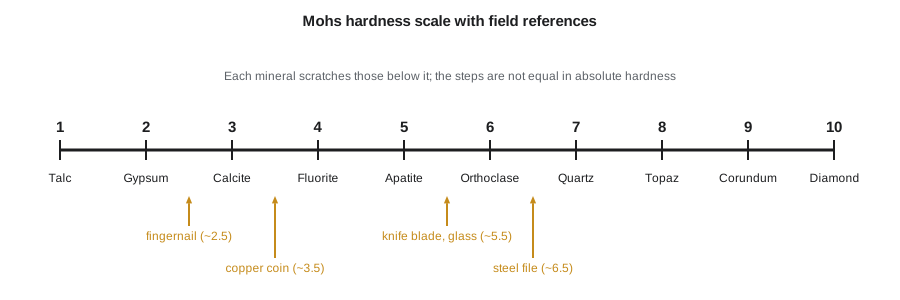
- Hardness: resistance to scratching, measured on the Mohs scale from 1 (talc) to 10 (diamond). The scale is relative, not linear: corundum at 9 is far more than one step harder than topaz at 8. In the field, a fingernail is about 2.5, a copper coin about 3.5, a steel knife blade or nail about 5.5, and window glass about 5.5. A mineral that scratches glass is harder than about 5.5; quartz scratches glass easily, calcite does not.
- Cleavage and fracture: cleavage is the tendency to break along smooth planes controlled by weak bonds in the crystal structure. Micas have one perfect cleavage and peel into thin sheets; feldspars have two cleavages at about 90°; calcite has three cleavages not at right angles, so it breaks into rhombs. Minerals without cleavage break by fracture, such as the curved, shell-like conchoidal fracture of quartz.
- Luster: the way the surface reflects light, described as metallic, glassy (vitreous), pearly, silky, greasy or earthy.
- Color and streak: color is the most obvious property but often the least reliable, because small impurities change it. Streak, the color of the powder made by rubbing the mineral on unglazed porcelain, is more consistent. Hematite may look black, silver or red, but its streak is always reddish brown.
- Specific gravity: the density relative to water. Most common silicates are about 2.6 to 3.0; metallic minerals such as pyrite (about 5.0) and galena (about 7.5) feel noticeably heavy.
- Reaction with dilute acid: calcite fizzes vigorously in cold dilute hydrochloric acid; dolomite fizzes only weakly, or only when powdered. This simple test distinguishes limestone from dolostone and from quartz-rich rocks in the field.
- Crystal form and other properties: some minerals grow in characteristic shapes, such as cubic pyrite or six-sided quartz prisms. Magnetite is magnetic; halite tastes salty; some clays become slippery and sticky when wet.
The rock-forming minerals
Roughly a dozen minerals make up the bulk of common rocks. Knowing them, and their engineering significance, covers most practical needs.
| Mineral | Hardness | Key features | Engineering significance |
|---|---|---|---|
| Quartz | 7 | Glassy, no cleavage, conchoidal fracture | Hard and durable; makes abrasive rock; some forms react with cement alkalis |
| Feldspars (orthoclase, plagioclase) | 6 | Two cleavages near 90°, pink, white or gray | Most abundant mineral group; weathers to clay |
| Micas (muscovite, biotite) | 2.5–3 | One perfect cleavage, thin elastic sheets | Weak planes in schist; reduces soil compaction quality |
| Amphibole and pyroxene | 5–6 | Dark, two cleavages | Common in dark igneous rocks; generally sound |
| Olivine | 6.5–7 | Olive green, glassy, granular | Weathers quickly near the surface |
| Calcite | 3 | Three cleavages (rhombic), fizzes in acid | Soluble; forms karst; limestone aggregate |
| Dolomite | 3.5–4 | Like calcite but fizzes weakly | Less soluble than calcite; some dolomitic rocks react with cement |
| Gypsum | 2 | Scratched by fingernail | Soluble; attacks concrete as sulfate; can form cavities |
| Clay minerals | 1–2 | Earthy, too fine to see grains | Control plasticity, swelling and strength of fine soils |
| Pyrite | 6–6.5 | Brassy, metallic, cubic crystals, greenish-black streak | Oxidizes to acid and sulfate; heave and concrete attack |
| Hematite and magnetite | 5–6.5 | Red-brown streak; magnetite is magnetic | Iron staining; dense aggregates |
Clay minerals
Clay minerals deserve special attention because they dominate the behavior of fine-grained soils and weak rocks. They are sheet silicates formed mostly by the chemical weathering of feldspars, micas and volcanic glass. Individual particles are tiny plates, usually less than 2 micrometers across, with large surface areas and electrically charged surfaces that attract water. Three groups matter most.
- Kaolinite has strongly bonded layers, little ability to absorb water between them, and low plasticity. It is relatively stable and forms in warm, well-drained weathering environments.
- Illite has layers held by potassium ions. It is the most common clay mineral in many glacial and marine clays and has moderate plasticity.
- Smectite, including montmorillonite, has weakly bonded layers that let water enter between them. Smectite soils have very high plasticity, swell greatly when wetted and shrink and crack when dried, and have low residual shear strength. Bentonite, a smectite-rich clay formed from altered volcanic ash, is used for drilling mud and slurry walls precisely because it swells and seals.
The Cretaceous shales of the northern Great Plains, such as the Pierre Shale, contain abundant smectite. They are responsible for expansive soils that damage foundations and pavements across parts of Colorado, Wyoming, the Dakotas and Montana, and for slow landslides on shale slopes. Expansive clays are also widespread in Texas and other southern states, where they are among the most costly geologic hazards to light structures. In contrast, the glacial lake clays of the Spokane area are mainly finely ground rock flour with illite and are more prone to consolidation settlement than to swelling.
Minerals that cause engineering problems
A short list of minerals causes a disproportionate share of trouble.
- Sulfide minerals, especially pyrite and the more reactive pyrrhotite, oxidize when exposed to air and water. The reaction produces sulfuric acid and sulfate, and the new sulfate minerals take up more volume than the original. Pyritic shales placed as fill beneath floor slabs have heaved buildings, and pyrrhotite in concrete aggregate has caused serious deterioration of house foundations in eastern Canada and in Connecticut.
- Soluble minerals, such as halite, gypsum and anhydrite, and to a lesser extent calcite and dolomite, can dissolve and leave voids. Gypsum dissolves much faster than limestone and can create cavities within the life of a structure. Anhydrite takes up water to become gypsum, expanding as it does.
- Swelling clays, mainly smectites, cause heave and pressures large enough to lift light buildings.
- Reactive silica, including opal, chalcedony, chert and strained or microcrystalline quartz, reacts with the alkalis in cement paste in the alkali–silica reaction, producing an expansive gel that cracks concrete.
- Asbestiform minerals, such as chrysotile and some amphiboles, occur naturally in some serpentinites and other rocks. Excavating them can release fibers, so sites in these rocks need dust control and worker protection.
- Mica in large amounts makes soils hard to compact and gives low strength along foliation in schists.
Worked problem
Specific gravity and identification
Marcus finds a heavy, brassy, cubic mineral in a core of dark shale from the reservoir site. A small cleaned piece weighs 12.6 g in air and 10.1 g when suspended in water. Estimate its specific gravity and identify the likely mineral. What does its presence mean for the project?
Show solution
- Specific gravity is the weight in air divided by the weight of an equal volume of water. The loss of weight in water equals the weight of the displaced water:
- \[G = \frac{W_{air}}{W_{air} - W_{water}} = \frac{12.6}{12.6 - 10.1} = \frac{12.6}{2.5} = 5.0\]
- A specific gravity near 5.0, brassy metallic luster and cubic crystals indicate pyrite.
- Pyrite in shale means the excavated material may produce acid and sulfate when exposed. It should not be used as fill under slabs, and buried concrete may need sulfate-resistant binder.
Answer: Specific gravity about 5.0: pyrite. Test the shale for sulfur content before reusing it and specify concrete for sulfate exposure.
Priya keeps a small identification key in Python for the field team. It does not replace experience, but it reminds a junior engineer which tests separate look-alike minerals.
# Simple field identification helper for common minerals
minerals = {
    "quartz":    {"H": 7.0, "SG": 2.65, "acid": "none",   "cleavage": "none",  "lustre": "glassy"},
    "feldspar":  {"H": 6.0, "SG": 2.6,  "acid": "none",   "cleavage": "two",   "lustre": "glassy"},
    "calcite":   {"H": 3.0, "SG": 2.71, "acid": "strong", "cleavage": "three", "lustre": "glassy"},
    "dolomite":  {"H": 3.5, "SG": 2.85, "acid": "weak",   "cleavage": "three", "lustre": "glassy"},
    "gypsum":    {"H": 2.0, "SG": 2.32, "acid": "none",   "cleavage": "one",   "lustre": "glassy"},
    "muscovite": {"H": 2.5, "SG": 2.8,  "acid": "none",   "cleavage": "one",   "lustre": "pearly"},
    "pyrite":    {"H": 6.3, "SG": 5.0,  "acid": "none",   "cleavage": "none",  "lustre": "metallic"},
}

def candidates(scratches_glass, acid, lustre, sg=None):
    out = []
    for name, p in minerals.items():
        if scratches_glass != (p["H"] > 5.5):
            continue
        if acid != p["acid"] or lustre != p["lustre"]:
            continue
        if sg is not None and abs(sg - p["SG"]) > 0.3:
            continue
        out.append(name)
    return out

print("Hard, glassy, no fizz:", candidates(True, "none", "glassy"))
print("Soft, glassy, strong fizz:", candidates(False, "strong", "glassy"))
print("Hard, metallic, SG 5.0:", candidates(True, "none", "metallic", sg=12.6 / (12.6 - 10.1)))Hard, glassy, no fizz: ['quartz', 'feldspar'] Soft, glassy, strong fizz: ['calcite'] Hard, metallic, SG 5.0: ['pyrite']
Minerals in soils
Soils inherit their minerals from the rocks they came from, filtered by weathering and transport. Resistant minerals survive: quartz dominates most sands because it is hard, has no cleavage and barely reacts chemically, while feldspars and dark ferromagnesian minerals break down during long transport and weathering. Glacial soils are an exception, because glaciers grind rock mechanically without much chemical weathering. Glacial tills and rock flour therefore contain fresh feldspar, mica, carbonate and even some sulfide grains that would not survive in a deeply weathered tropical soil. This explains why many Canadian and northern US tills fizz in acid: they contain ground-up limestone and dolostone picked up by the ice.
The clay-size fraction of a soil, particles finer than about 2 micrometers, is not always made of clay minerals. Glacial rock flour can be clay-sized quartz and feldspar with little plasticity, while a small percentage of smectite can make a soil highly plastic. That is why engineers classify fine soils by their plasticity (the Atterberg limits) rather than by grain size alone, and why a geologist's description of the source rocks helps predict how a fine soil will behave.
Identifying minerals in practice
In the field and core shed, mineral identification uses a hand lens (10× magnification), a steel knife or nail, a streak plate, a small bottle of dilute hydrochloric acid and a magnet. The geologist looks first at the overall rock, then at individual grains, noting color, luster, cleavage and hardness, and testing with acid. Where identification matters for design, for example in assessing aggregate reactivity, sulfide content or clay mineralogy, laboratory methods are used. Thin sections viewed under a polarizing microscope reveal mineral grains and their textures; X-ray diffraction identifies clay minerals and other fine crystals; and chemical tests measure sulfur and sulfate contents.
Concrete aggregate sources in the United States are evaluated for alkali reactivity and other deleterious materials using ASTM test methods, including petrographic examination under ASTM C295 and the reactivity tests referenced by ASTM C1778. After the damage to foundations in north-central Connecticut, the state introduced requirements and guidance for testing aggregate for pyrrhotite. The geologist's mineral identification is the starting point for deciding which laboratory tests are needed.
Common mistakes
MistakeIdentifying a mineral by color alone.
InsteadUse hardness, cleavage, luster, streak and acid reaction together; color varies with impurities.
MistakeAssuming all clays behave alike.
InsteadSmectite clays swell and have low residual strength; kaolinite and illite clays are far less active.
MistakeReusing excavated shale as structural fill without checking it.
InsteadTest for sulfides and swelling minerals first; pyritic shale fill has heaved many slabs.
MistakeThinking the Mohs scale is linear.
InsteadIt is an order of scratching; hardness differences between adjacent numbers are uneven.
Summary and key terms
- Minerals are natural inorganic crystalline solids; their composition and structure control their properties.
- Silicates dominate the crust; their tetrahedra link as isolated units, chains, sheets or frameworks.
- Hardness, cleavage, luster, streak, specific gravity and acid reaction identify common minerals in hand specimen.
- Quartz, feldspars, micas, calcite, dolomite, amphiboles, pyroxenes and clay minerals make up most rocks and soils.
- Clay minerals control fine soil behavior; smectites swell strongly and have low residual strength.
- Problem minerals include sulfides, soluble salts and gypsum, swelling clays, reactive silica, asbestiform minerals and abundant mica.
- Mineral
- A naturally occurring inorganic crystalline solid with a definite composition.
- Silicate
- A mineral built on silicon–oxygen tetrahedra; the most abundant mineral group.
- Mohs scale
- A relative scale of mineral hardness based on which minerals scratch which.
- Cleavage
- The tendency of a mineral to split along planes of weak bonding.
- Streak
- The color of a mineral in powdered form.
- Smectite
- A group of swelling clay minerals, including montmorillonite.
- Pyrite
- Iron sulfide; oxidizes to produce acid and sulfate.
- Alkali–silica reaction
- A reaction between reactive silica in aggregate and alkalis in cement that forms an expansive gel.
Practice problems
Work each problem on paper first, then reveal the answer to check.
A mineral scratches glass, has no cleavage and does not react with acid. What is it most likely to be?
Show answer
Quartz.
How can you tell calcite from dolomite in the field?
Show answer
Calcite fizzes strongly in cold dilute acid; dolomite fizzes weakly or only when powdered.
A sample weighs 30.0 g in air and 18.9 g in water. What is its specific gravity?
Show answer
\(30.0/(30.0 - 18.9) = 2.70\), consistent with calcite.
Why is smectite a concern for foundations?
Show answer
It swells on wetting and shrinks on drying, causing heave and cracking, and has low residual strength.
Name two minerals that can attack or damage concrete.
Show answer
Pyrite or pyrrhotite (sulfate and expansion) and reactive silica (alkali–silica reaction); gypsum also supplies sulfate.
Which silicate structure gives one perfect cleavage?
Show answer
Sheet silicates, such as micas and clay minerals.
Lesson quiz · 5 questions
Score 60% or more to complete this lesson.
Create a free account to save your progress, take quizzes and earn a certificate.