
CISSP-160 · Lesson 2 of 12 · 26 min
Thinking like a manager and risk advisor
Ask anyone who has passed the CISSP for one piece of advice and most will say the same thing: think like a manager. It sounds vague, but it describes something specific. The exam is written for a security professional who advises a business, sets direction and makes sure the right things happen, not for the technician who personally does every task. Many items offer one answer that a skilled engineer would naturally choose and another that a responsible security leader would choose. The second is usually correct.
This lesson makes the idea concrete. It sets out the priorities behind the manager's mindset, shows the patterns of answer that the mindset tends to favor and reject, and works through examples where Tomás's engineering instincts and Hannah's governance instincts lead them to different answers. None of this replaces knowing the content. A candidate who does not know what a key escrow agent is cannot reason their way to the right answer about one. But once two answers both look technically possible, the mindset is often what separates them.
What the exam means by a manager
The word 'manager' on this exam does not mean a person with a large team or a particular job title. It means someone who takes responsibility for outcomes, works through people and processes, and keeps the organization's goals in view. A CISSP holder is expected to be able to explain a risk to a board, write or approve policy, choose among controls on the basis of cost and benefit, and know when to involve legal, human resources, audit or senior management. Technical depth matters, but it is in service of those decisions.
That explains a pattern that frustrates technical candidates. When an item describes a breach, a misconfiguration or a failed control, the correct answer is often not the most technically clever fix. It is the step that gets the right people involved, follows the established process, protects people and evidence, or addresses the root cause in policy and governance. Fixing the server yourself may well be part of the eventual response, but it is rarely what the question means by the best, first or most important action.
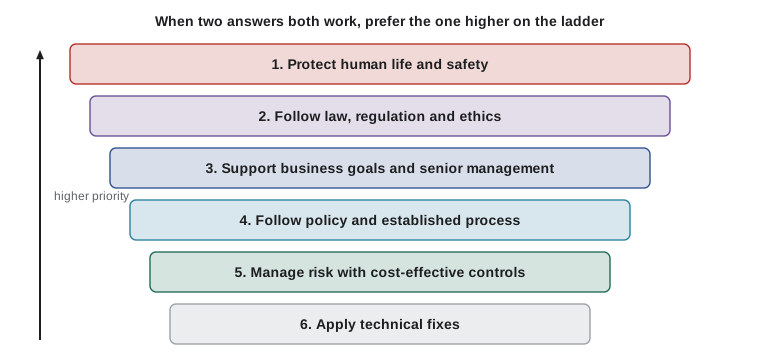
The manager's priorities
Experienced instructors describe the mindset as an order of priorities. It is not an official ISC2 list, but it matches the reasoning behind the outline and the earlier courses in this track. When several answers seem right, the one that serves a higher priority usually wins.
| Priority | What it means in a question | Where the track taught it |
|---|---|---|
| 1. Human life and safety | People come before data, systems and money, every time. | CISSP-114 physical security, CISSP-116 incident response |
| 2. Law, regulation and ethics | Never break the law or the Code of Ethics to solve a problem, even with good intentions. | CISSP-110 legal and regulatory issues, lesson 9 of this course |
| 3. Business goals and senior management | Security exists to support the mission; senior management owns risk decisions. | CISSP-110 governance |
| 4. Policy and process | Follow the established process (change control, incident response, approvals) rather than improvising. | CISSP-116 operations, CISSP-110 policy framework |
| 5. Risk-based, cost-effective controls | A control should cost less than the risk it reduces and fit the organization's risk appetite. | CISSP-110 risk management |
| 6. Technical fixes | Necessary, but usually carried out under the higher priorities, not instead of them. | Domains 3, 4, 5, 7, 8 |
The first priority is absolute. If an item describes a fire in the data center, a gas leak or a physical threat to staff, the right answer gets people to safety, even if it means losing data or leaving systems running unattended. Fail-safe and fail-secure decisions follow the same rule: a door that must let people escape in an emergency fails open, even though that weakens physical security for a moment. Any answer that puts data ahead of a person is wrong.
The second priority is nearly as firm. Hacking back at an attacker, reading an employee's private communications without authority, ignoring a regulator's breach notification deadline or bending the truth to an auditor are all wrong, however attractive the short-term result. The exam often makes the unlawful option look efficient, which is exactly the test. Lesson 9 shows how the Code of Ethics settles conflicts between duties.
Senior management owns risk
One idea from CISSP-110 appears in more questions than almost any other: senior management is ultimately responsible for security and owns risk decisions. The security professional identifies, measures and explains risk, recommends treatment options and implements what is decided. The decision to accept, avoid, transfer or mitigate a significant risk belongs to the business owner and, for the largest risks, to senior management or the board.
That leads to a recognizable answer pattern. When an item asks what a security manager should do after finding a significant risk that the business does not want to fund, the best answer is usually to document the risk, explain it clearly to the appropriate owner and obtain a formal decision, which may be a documented risk acceptance. Implementing an unfunded control anyway, escalating to a regulator over management's head, or quietly ignoring the risk are all weaker. The security professional advises; the owner decides; the decision is recorded.
Worked problem
Tomás and the unfunded firewall upgrade
Tomás discovers that the firewalls protecting Ridgeline's card-processing network will reach end of support in six months, after which no security patches will be issued. The infrastructure director says there is no budget this year. What should Tomás do FIRST? (A) Use spare budget from his own team to buy replacements. (B) Document the risk, estimate its impact and present it to the system owner for a decision. (C) Report the issue to the card brands as a compliance failure. (D) Configure stricter rules on the old firewalls and close the issue.
Show solution
- Identify the decision being made: funding a significant risk treatment.
- Recall who owns that decision: the business owner or senior management, not the engineer.
- Option A bypasses governance and budget authority. Option C goes outside the organization before management has decided. Option D is a technical step that may help but does not address the end of support or the decision.
- Option B gives the owner the information needed and leads to a recorded decision.
Answer: B. The security professional quantifies and communicates the risk so that the appropriate owner can decide, and the decision is documented.
Process beats improvisation
The fourth priority explains another large family of questions. Organizations have processes for change, incident response, access approval, vendor onboarding and much else, and those processes exist for good reasons: they ensure review, segregation of duties, communication and an audit trail. When an item describes a situation that an established process covers, the best answer usually follows the process, even if a faster shortcut exists.
Change management is the classic case. An engineer who spots a misconfiguration on a production server should raise a change, have it reviewed and schedule it, not log in and fix it on the spot. The exception is an emergency, and even then the organization's emergency change procedure applies, with the change documented and reviewed afterwards. The same logic applies in incident response: follow the plan, notify the incident response team and preserve evidence, rather than wiping and rebuilding the affected system straight away.
| Situation | Engineer's instinct | Manager's answer |
|---|---|---|
| A misconfigured production server | Log in and fix it now | Raise a change request and follow change control |
| Malware found on a laptop | Wipe and reinstall immediately | Isolate, follow the incident response plan, preserve evidence |
| A user asks for urgent access to payroll data | Grant it because the manager is on holiday | Follow the access approval process; use the documented delegate |
| A new cloud service is needed by Friday | Sign up with a company card | Engage vendor risk, procurement and the data owner |
| Auditors find a missing control | Quietly add the control and say it was always there | Acknowledge the finding, agree a remediation plan with the owner |
Hannah finds this part easy. Tomás does not. In his diagnostic, he missed four items in which he chose to fix something directly. Each time, the item contained a phrase such as 'according to policy', 'the change advisory board' or 'the incident response plan' that pointed to the process answer. Recognizing those phrases is part of lesson 4's reading routine.
Cost, value and proportion
The fifth priority brings in the economics of security from CISSP-110. A control is justified when it reduces risk by more than it costs, and the organization's risk appetite sets how much residual risk is acceptable. An answer that spends a fortune to protect something of little value is wrong, and so is an answer that leaves a critical asset exposed to save a small sum. Proportion matters.
Questions in this family often give numbers: an asset value, an exposure factor, an annual rate of occurrence and the annual cost of a proposed control. Lesson 10 practices the arithmetic. Other questions test the idea without numbers, for example by asking which factor matters most when choosing a control. The answer is usually the value of the asset or the risk reduced, not the newest technology or what a competitor uses.
Proportion also applies to people. The exam favors answers that use the least privilege needed, collect the least data needed and impose the least disruption needed. A response that shuts down the entire company network because one workstation shows suspicious activity is usually out of proportion; isolating the workstation is not.
What the manager does not do
It helps to recognize the answers that the mindset tends to reject. These are not absolute rules, and you must still read each item carefully, but they are wrong far more often than they are right.
| Answer pattern | Why it is usually wrong |
|---|---|
| Act alone, outside your authority | Decisions belong to owners and management; acting alone breaks governance. |
| Retaliate or hack back | Usually unlawful and unethical, and can harm innocent third parties. |
| Skip the process because it is urgent | Emergency procedures exist; use them rather than no process. |
| Destroy or alter evidence to restore service faster | Evidence may be needed for legal action, insurance and lessons learned. |
| Pick the most technical or newest tool | The best control fits the risk, the asset value and the organization. |
| Blame or punish users first | Fix the process and awareness; discipline follows policy and due process. |
| Keep problems hidden from management | Management must know about significant risk to make decisions. |
Look at how often the wrong answers would be quick. Speed is not a priority on the ladder. That does not mean the exam favors slow bureaucracy; it favors actions that are both effective and responsible. When an emergency truly requires speed, the plan already says who can act and how, and that is the answer.
When technical answers are correct
The mindset can be overused. Not every item is a governance question in disguise. Many items in Domains 3, 4, 5 and 8 simply test whether you know which protocol, algorithm, model or technique fits a requirement. If an item asks which encryption mode provides authenticated encryption, the answer is a mode such as Galois/Counter Mode, not 'consult senior management'. Reserve the manager's priorities for items where several options are technically possible and the question asks what you should do, recommend or do first.
A good test is to ask what kind of decision the item describes. If it is a decision about what is true or which technique fits, answer from knowledge. If it is a decision about what a person in a security role should do, apply the ladder. Hannah, who sometimes overcorrects toward governance, misses items in which the stem plainly asks for a technical control. Her rule of thumb is to read the last sentence of the item first: 'Which control...' points to knowledge; 'What should the security manager do...' points to the mindset.
Worked problem
Two items, two kinds of answer
Item 1: A developer needs to store user passwords so that a stolen database cannot be easily reversed. Which approach is BEST? Item 2: A developer tells the security manager that the login service stores passwords with an outdated hash. What should the security manager do FIRST?
Show solution
- Item 1 asks which technique fits. Answer from knowledge: a slow, salted password hashing function designed for passwords, as CISSP-117 taught.
- Item 2 asks what the manager should do. The issue is a known weakness in a production system.
- The manager's first step is to assess the risk and engage the system owner so that remediation is prioritized and tracked through change management, rather than rewriting code personally.
Answer: Item 1 is a knowledge question with a technical answer. Item 2 is a mindset question: assess and report the risk to the owner and drive remediation through the proper process.
Building the habit
The mindset is a habit, and habits come from practice. For the next ten weeks, Hannah and Tomás will tag every practice item they get wrong with one of three causes: did not know the content, misread the question, or chose the technical answer when the manager's answer was expected. Tomás's third category starts large; by week 6 it is almost empty. Lesson 11 turns this tagging into a full error log.
# Tally practice-item errors by cause to see which habit to work on
errors = [
    ("D1", "mindset"), ("D7", "mindset"), ("D3", "content"), ("D1", "misread"),
    ("D6", "mindset"), ("D8", "content"), ("D4", "content"), ("D7", "mindset"),
    ("D2", "misread"), ("D5", "content"), ("D1", "mindset"), ("D6", "content"),
]
causes = {}
for domain, cause in errors:
    causes[cause] = causes.get(cause, 0) + 1
total = len(errors)
for cause, n in sorted(causes.items(), key=lambda kv: -kv[1]):
print(f"{cause:<8} {n:>2} {n / total:5.0%} " + "#" * n)mindset 5 42% ##### content 5 42% ##### misread 2 17% ##
Tomás's first tally shows that mindset errors are tied with content gaps as the largest causes in his early practice. That is good news, because a habit can change faster than a knowledge gap can close. For each mindset error he writes one sentence: which priority on the ladder the correct answer served.
Common mistakes
MistakeChoosing the answer in which you personally fix the problem straight away.
InsteadPrefer the answer that involves the owner, follows the process and addresses the root cause.
MistakeTreating every item as a governance question.
InsteadWhen the item asks which technique or control fits, answer from technical knowledge.
MistakePutting data or systems ahead of people in an emergency.
InsteadHuman life and safety always come first.
MistakeImplementing a control that management declined to fund.
InsteadDocument the risk and obtain a formal, recorded decision from the owner.
MistakePicking the unlawful but effective option.
InsteadLaw, regulation and the Code of Ethics outrank effectiveness.
Summary and key terms
- The CISSP rewards the reasoning of a security leader who advises the business, not a technician who fixes everything personally.
- A useful order of priorities is: life and safety; law and ethics; business goals and senior management; policy and process; cost-effective risk treatment; technical fixes.
- Senior management owns risk decisions; the security professional measures, explains and recommends, and the decision is documented.
- Established processes such as change control and incident response should be followed, including their emergency procedures.
- Controls should be proportionate to the value of the asset and the risk reduced.
- When the item asks which technique fits, answer from knowledge rather than from the mindset.
- Manager's mindset
- Reasoning as a security leader responsible for outcomes, working through people, process and governance.
- Risk owner
- The person accountable for a risk and for deciding how it is treated.
- Risk acceptance
- A documented decision by an authorized owner to live with a risk rather than treat it further.
- Emergency change
- A change made urgently under a defined procedure and reviewed afterwards.
- Proportionality
- Choosing controls and responses whose cost and disruption fit the risk.
Practice problems
Work each problem on paper first, then reveal the answer to check.
In an emergency, what always comes first?
Show answer
Protecting human life and safety.
Who owns the decision to accept a significant risk?
Show answer
The business owner or senior management, not the security professional.
An engineer sees a misconfiguration on a production server. What should happen?
Show answer
A change request should be raised and change control followed.
Why is hacking back almost always the wrong answer?
Show answer
It is usually unlawful and unethical and may harm innocent parties.
How can you tell whether an item needs the manager's mindset or a technical answer?
Show answer
Read the final sentence: if it asks what a person should do, apply the mindset; if it asks which technique fits, answer from knowledge.
A proposed control costs more each year than the expected annual loss it prevents. Is it justified on cost grounds?
Show answer
No; a control should cost less than the risk it reduces, unless law or another factor requires it.
Lesson quiz · 5 questions
Score 60% or more to complete this lesson.
Create a free account to save your progress, take quizzes and earn a certificate.