
CISSP-116 · Lesson 6 of 12 · 27 min
Incident management II: containment, recovery, communication and lessons learned
Once an incident has been detected and its severity set, the organization faces a series of decisions under pressure: how to limit the damage, when and how to remove the cause, how quickly to restore service, what to tell staff, customers, partners and regulators, and how to learn from what happened. These decisions are rarely purely technical. Isolating a system may stop an intruder but also halt production; restoring quickly may destroy evidence; communicating early builds trust but risks stating facts that later prove wrong. This lesson treats each stage as a management decision with trade-offs that the incident manager must surface to the right people.
In NIST SP 800-61r3 these activities fall under the Respond and Recover functions of CSF 2.0, with lessons learned feeding improvement across every function. In ISO/IEC 27035-1 they are the respond and learn lessons phases. The CISSP outline calls them response, mitigation, reporting, recovery, remediation and lessons learned. Legal and regulatory reporting obligations are important enough to have their own lesson (Lesson 8); here they appear only as one of several communication streams.
Containment decisions
Containment limits the spread and impact of an incident while the organization works out what happened. It buys time. Typical containment options include isolating affected systems from the network, disabling compromised accounts or forcing credential resets, blocking malicious addresses or domains, suspending a vulnerable service, restricting data transfers, and increasing monitoring. Short-term containment is often followed by longer-term containment, such as moving services to clean infrastructure, while eradication is planned.
Choosing a containment strategy means weighing several factors that the plan should name in advance: potential damage and theft of resources; the need to preserve evidence; service availability and business impact; the time and resources needed; how effective the strategy is likely to be; and how long the solution will last. The decision to take a revenue-generating or safety-related system offline belongs to the business owner or executive sponsor, informed by security's assessment. The incident manager's job is to put the options and their consequences in front of that person quickly and clearly.
| Containment option | Benefit | Business or investigative cost |
|---|---|---|
| Isolate affected hosts from the network | Stops spread from those hosts | Users of those systems stop working; volatile evidence may be lost if systems are powered off |
| Disable or reset compromised accounts | Removes the adversary's access path | May alert the adversary; affected staff locked out |
| Block external addresses and domains | Cuts communication with known infrastructure | Adversary may switch infrastructure; risk of blocking legitimate services |
| Shut down a service or site | Strong, immediate protection | Direct revenue, customer and possibly safety impact |
| Monitor without immediate action | Learn full scope before acting | Ongoing exposure; needs legal and executive approval |
Timing matters. Acting on one compromised account while others remain unknown can alert an adversary, who may then cause more damage or hide. In serious incidents responders therefore try to understand scope before acting, then contain all known footholds together. Where an adversary is extorting the organization or data is actively leaving, the balance shifts toward immediate action. These are judgment calls that the plan cannot fully script, which is why practiced decision makers matter.
# Weigh containment options against agreed criteria (scores 1 = poor, 5 = good; synthetic)
criteria = {'stops_damage': 0.35, 'preserves_evidence': 0.15, 'keeps_service': 0.30, 'speed': 0.20}
options = {
    'isolate 14 file servers now':        {'stops_damage': 5, 'preserves_evidence': 3, 'keeps_service': 1, 'speed': 5},
    'block outbound to known addresses':  {'stops_damage': 3, 'preserves_evidence': 5, 'keeps_service': 5, 'speed': 5},
    'reset all admin credentials':        {'stops_damage': 4, 'preserves_evidence': 4, 'keeps_service': 3, 'speed': 3},
    'monitor for 24 h, then act':         {'stops_damage': 1, 'preserves_evidence': 5, 'keeps_service': 5, 'speed': 1},
}
ranked = sorted(options.items(), key=lambda kv: -sum(criteria[c] * kv[1][c] for c in criteria))
for name, s in ranked:
    total = sum(criteria[c] * s[c] for c in criteria)
    print(f'{total:4.2f}  {name}')
print('Note: scores inform the decision; the business owner approves service-affecting actions.')4.30 block outbound to known addresses 3.50 isolate 14 file servers now 3.50 reset all admin credentials 2.80 monitor for 24 h, then act Note: scores inform the decision; the business owner approves service-affecting actions.
The weighted model does not make the decision; it makes the trade-offs visible. In this example a combination is likely: block outbound traffic and reset administrator credentials at once, while the business decides whether to isolate file servers. Recording the options considered and the reasons for the chosen course is important later, when regulators, insurers or courts ask whether the organization acted reasonably.
Eradication and recovery at a process level
Eradication removes the cause of the incident: the adversary's access, any unauthorized software or accounts, and the vulnerability or misconfiguration that allowed entry. Recovery restores systems and services to normal operation and confirms that they are functioning securely. In practice, eradication and recovery are often combined by rebuilding affected systems from trusted images and restoring data from clean backups, rather than trying to clean systems in place, because it is difficult to be sure that a compromised system has been fully cleaned.
From a management perspective, recovery needs a plan with priorities. Systems should be restored in the order set by the business impact analysis (Lesson 9), with dependencies such as identity services, network infrastructure and backups themselves restored first. Each restored system should be checked against its baseline, patched, have credentials rotated and be monitored closely for signs of re-compromise. Backups must be checked to ensure they predate the compromise; restoring an infected backup reintroduces the problem. Recovery is also the moment to remediate root causes: if the incident began with an unpatched internet-facing system, the patching gap across all similar systems must be closed, not just on the one that was compromised.
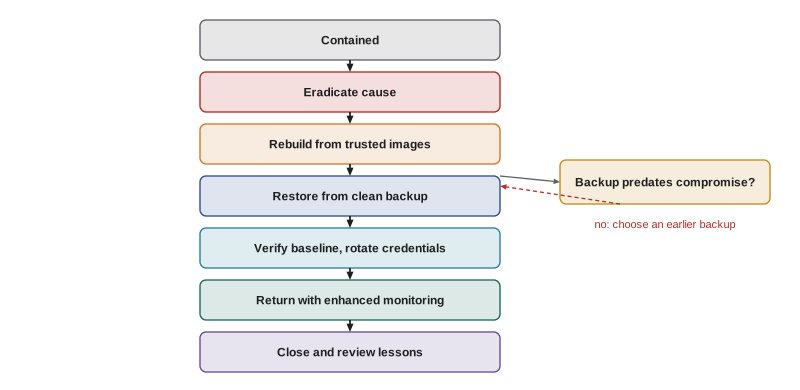
The decision to declare an incident closed should also be deliberate. Criteria might include no new indicators for an agreed period, all affected systems rebuilt or verified, credentials rotated, root causes remediated or tracked, notifications completed and the post-incident review scheduled. Closing too early, under pressure to return to normal, is a common cause of repeat incidents.
Communication during an incident
Communication is one of the most consequential and least practiced parts of incident response. An incident typically has several audiences, each needing different information at a different pace: the response team, executives and the board, employees, customers, partners and suppliers, insurers, regulators, law enforcement and, for larger incidents, the media. The plan should name who is authorized to speak to each audience and require that external statements be reviewed by legal and communications staff.
| Audience | What they need | Typical owner |
|---|---|---|
| Response team | Facts, tasks, decisions and timeline in a secure channel | Incident manager |
| Executives and board | Business impact, options, decisions needed, regulatory exposure | CISO with executive sponsor |
| Employees | What to do or avoid, who to contact, no speculation | Internal communications |
| Customers and affected individuals | What happened, what data, what they should do, what the organization is doing | Communications with legal and privacy |
| Regulators | Required content within required time | Privacy officer and legal |
| Insurer | Prompt notice per policy terms | Risk management or legal |
| Law enforcement | Facts and evidence as agreed with counsel | Legal and incident manager |
| Media | Approved statement | Communications lead only |
Several practical rules apply. Use out-of-band communication when there is any chance the adversary can read corporate email or chat; many organizations keep a backup channel for exactly this reason. Separate facts from assumptions in every update, and date-stamp updates so readers know what was known when. Avoid speculating about attribution or about the volume of data affected until it is confirmed. Involve counsel early: in both Canada and the United States, communications prepared at the direction of counsel for the purpose of legal advice may be protected by solicitor-client or attorney-client privilege, but courts look closely at whether the main purpose was legal advice, and forensic reports prepared for business purposes have been ordered disclosed in US litigation.
US organizations should also remember that statements to individuals, state attorneys general and federal regulators must be accurate and consistent; public companies must also avoid misleading investors, which is why disclosure committees are often involved in incident communication.
Ransom and extortion decisions
Extortion incidents, in which an adversary encrypts systems or threatens to publish stolen data unless paid, force especially difficult decisions. The plan should set out in advance who decides whether payment will be considered and what must be checked first: whether backups allow recovery without payment, whether payment would be legal (for example, payments to sanctioned persons are prohibited under Canadian sanctions law and US OFAC regulations), what insurers require, and what law enforcement advises. Government agencies in both countries, including CCCS in Canada and the FBI, discourage payment because it funds criminal activity and does not guarantee recovery or deletion of data. Some US reporting rules, discussed in Lesson 8, require ransom payments to be reported. The best defense against having to make this decision is preparation: tested, isolated backups and a rehearsed recovery plan.
Lessons learned and continuous improvement
Every significant incident should end with a post-incident review, held soon enough that memories are fresh, typically within two weeks. The review should be blameless in tone: the goal is to understand how the organization's systems, processes and decisions allowed the incident to happen and to unfold as it did, not to find a person to punish. Useful questions include: What happened, and when, according to the confirmed timeline? What went well? What was harder than it should have been? Where did detection, escalation or communication break down? What would we do differently? What changes will we make, who owns them, and by when?
The output is an action plan whose items are tracked like any other risk treatment: updated playbooks, new detection rules, configuration changes, training, contract changes with suppliers, and sometimes investment requests. NIST SP 800-61r3 emphasizes that these improvements apply across all CSF functions; an incident may reveal a governance gap (unclear authority), an identification gap (unknown asset), a protection gap (missing multi-factor authentication), a detection gap or a recovery gap. Metrics from incidents, such as time to detect, time to contain and the proportion of action items closed on time, show whether the program is improving.
# Track post-incident action items and show on-time closure by function (synthetic)
items = [
    ('Govern', 'Clarify authority to isolate plant systems', True),
    ('Identify', 'Add 37 unmanaged servers to inventory', True),
    ('Protect', 'Enforce MFA on remote access for contractors', True),
    ('Protect', 'Remove local admin rights from finance laptops', False),
    ('Detect', 'Alert on mass file renames on file servers', True),
    ('Detect', 'Forward VPN logs to SIEM', False),
    ('Respond', 'Add out-of-band contact list to plan', True),
    ('Recover', 'Test restore of ERP database quarterly', True),
]
from collections import Counter
total, on_time = Counter(), Counter()
for fn, text, ok in items:
    total[fn] += 1
    on_time[fn] += ok
for fn in ['Govern', 'Identify', 'Protect', 'Detect', 'Respond', 'Recover']:
    print(f'{fn:9s} {on_time[fn]}/{total[fn]} closed on time')
print(f'Overall {sum(on_time.values())}/{len(items)} = {sum(on_time.values())/len(items):.0%}')Govern 1/1 closed on time Identify 1/1 closed on time Protect 1/2 closed on time Detect 1/2 closed on time Respond 1/1 closed on time Recover 1/1 closed on time Overall 6/8 = 75%
Worked problem
Deciding whether to shut down an online store
During a holiday weekend, responders find that a script on the checkout page of an online store is sending card data to an unknown address. The store earns about $40,000 an hour. The e-commerce director asks whether the site can stay up while the problem is fixed.
Show solution
- Assess impact: card data of every customer checking out is exposed; this is ongoing harm to customers and a payment card industry obligation.
- Present options: take checkout offline now; switch checkout to the payment processor's hosted page if one exists; or leave it running while fixing (unacceptable while theft continues).
- Recommend the fastest option that stops the theft: hosted payment page if ready within minutes, otherwise take checkout offline.
- Have the director (business owner) approve, and record the decision and reasons.
- Preserve evidence of the malicious script, notify the payment processor and counsel, then plan eradication and notification.
Answer: Stop the ongoing theft immediately through the least disruptive option that works, with the business owner's documented approval; revenue loss does not justify continuing harm to customers.
Common mistakes
MistakeContaining one compromised account while others are still unknown, alerting the adversary.
InsteadUnderstand scope where possible and contain known footholds together, unless active harm requires immediate action.
MistakeLetting the security team decide alone to shut down a revenue system.
InsteadPresent options and consequences to the business owner, who approves service-affecting actions.
MistakeCleaning compromised systems in place and trusting the result.
InsteadRebuild from trusted images and restore from backups verified to predate the compromise.
MistakeUsing corporate email to coordinate when it may be compromised.
InsteadUse a pre-arranged out-of-band channel.
MistakeSpeculating publicly about attribution or data volumes.
InsteadShare confirmed facts, separate assumptions and date-stamp updates.
MistakeSkipping the post-incident review once service is back.
InsteadHold a blameless review and track action items to closure.
Summary and key terms
- Containment limits damage and buys time; options trade protection against business impact and evidence.
- Service-affecting containment decisions belong to the business owner, informed by security.
- Eradication and recovery usually mean rebuilding from trusted images and restoring from verified clean backups in business priority order.
- Incidents should be closed against defined criteria, not under pressure.
- Communication has many audiences with different needs; use authorized spokespeople and out-of-band channels.
- Extortion decisions need advance rules on authority, legality, insurer and law enforcement input.
- Blameless post-incident reviews produce tracked actions across all CSF functions.
- Containment
- Actions that limit the spread and impact of an incident.
- Eradication
- Removal of the cause of the incident, including adversary access and the exploited weakness.
- Recovery
- Restoration of systems and services to secure normal operation.
- Remediation
- Correction of the root causes that allowed the incident.
- Out-of-band communication
- A channel separate from systems that may be compromised.
- Post-incident review
- A structured, blameless review of an incident to identify improvements.
- Blameless review
- A review focused on systems and processes rather than individual fault.
- Closure criteria
- Agreed conditions that must be met before an incident is declared closed.
- Extortion incident
- An incident in which an adversary demands payment, for example to restore access or not to publish data.
- Privilege
- Legal protection for certain communications with counsel made for the purpose of legal advice.
Practice problems
Work each problem on paper first, then reveal the answer to check.
What is the purpose of containment?
Show answer
To limit the spread and impact of an incident and buy time for investigation and eradication.
List three factors in choosing a containment strategy.
Show answer
Any three of potential damage, evidence preservation, service availability, resources, effectiveness and duration.
Who should approve taking a revenue-generating system offline?
Show answer
The business owner or executive sponsor, informed by security.
Why rebuild rather than clean a compromised system?
Show answer
It is hard to be sure a compromised system is fully clean.
What must be checked about a backup before restoring it after a compromise?
Show answer
That it predates the compromise and is clean.
Give two closure criteria for an incident.
Show answer
For example, no new indicators for an agreed period and all affected systems rebuilt with credentials rotated.
Why use out-of-band communication?
Show answer
The adversary may be able to read corporate email or chat.
What legal issue must be checked before any ransom payment?
Show answer
Whether payment is legal, for example under sanctions law, along with insurer and law enforcement input.
What tone should a post-incident review have?
Show answer
Blameless, focused on systems and processes.
How should lessons-learned actions be managed?
Show answer
As tracked risk treatments with owners and due dates.
Lesson quiz · 5 questions
Score 60% or more to complete this lesson.
Create a free account to save your progress, take quizzes and earn a certificate.