
CISSP-115 · Lesson 9 of 12 · 32 min
Audits and compliance assessments
An audit is the most formal kind of assessment. It asks whether an organization meets a defined set of criteria, it is performed by someone independent of the activity being examined, and it ends in an opinion or report that others rely on. Customers rely on a supplier's audit report instead of inspecting the supplier themselves; boards rely on internal audit to tell them whether management's controls work; regulators rely on certifications and attestations to decide where to focus. Sub-domain 6.5 of the outline, conduct or facilitate security audits, expects a security professional to understand the types of audit, plan for them, support auditors and act on their results.
This lesson explains internal, external and third-party audits, the main attestation and certification schemes a security manager meets, how an audit engagement runs, and how to prepare an organization so that audits are a confirmation of good practice rather than a scramble for evidence. Country maps cover the professional standards and government programs that differ between Canada and the United States.
Types of audit
Audits are often classified by who performs them and who relies on them. A first-party audit is an internal audit: the organization examines itself, usually through an internal audit function that reports to the board's audit committee to preserve independence from management. A second-party audit is performed by a customer or partner on a supplier, often under a right-to-audit clause in the contract. A third-party audit is performed by an independent external body, such as a certification body or a public accounting firm, and produces a report or certificate that many parties can rely on.
| Type | Performed by | Relied on by | Example |
|---|---|---|---|
| First-party (internal) | Internal audit or an independent internal team | Board, audit committee, management | Annual audit of access management against policy |
| Second-party | A customer or partner | That customer | A bank audits its payment processor under the contract |
| Third-party | An independent external firm or certification body | Customers, regulators, the public | ISO/IEC 27001 certification, SOC 2 report, PCI DSS assessment |
Independence is the thread that runs through all three. An auditor must not audit their own work or work they are responsible for, and should report to someone other than the people being audited. The Institute of Internal Auditors' Global Internal Audit Standards, which took effect in January 2025, require internal audit to be positioned so it can operate free from interference, with a functional reporting line to the board. The exam often tests this: when an option has the security team audit the controls it designed and runs, look for a more independent alternative.
Service organization reports
When an organization outsources a function, such as payroll, cloud hosting or customer support, it remains accountable for the controls around that function. Service organization control reports let the service provider demonstrate its controls once to many customers. The scheme is defined by professional accounting standards, and the reports come in types that the exam expects you to distinguish.
In the United States, the AICPA's attestation standards (SSAE 18 and later clarified standards) govern these reports. A SOC 1 report, under AT-C section 320, covers controls relevant to user entities' internal control over financial reporting and is used by customers' financial auditors, including for Sarbanes-Oxley compliance. A SOC 2 report covers controls relevant to security, availability, processing integrity, confidentiality and privacy, assessed against the Trust Services Criteria (2017, with points of focus revised in 2022). A SOC 3 report is a short, general-use summary of a SOC 2 engagement that can be published.
| Report | Subject | Typical audience |
|---|---|---|
| SOC 1 | Controls relevant to customers' financial reporting | Customers' management and financial auditors |
| SOC 2 | Controls for security, availability, processing integrity, confidentiality and privacy | Customers, prospects, regulators, under non-disclosure |
| SOC 3 | A general-use summary of a SOC 2 engagement | The public, marketing |
| Type I | Fairness of the description and suitability of control design at a point in time | A first look, for a new service or new controls |
| Type II | Design and operating effectiveness over a period, usually 6 to 12 months | Customers who need assurance that controls worked over time |
Reading a SOC 2 Type II report is a practical skill. Check the period covered and whether it is recent; the scope (which systems, locations and Trust Services categories); the auditor's opinion and whether it is qualified; any exceptions found in testing and management's responses; the subservice organizations, such as a cloud provider underneath the vendor, and whether they are included or carved out; and the complementary user entity controls, which are controls the vendor expects you, the customer, to operate. A vendor's report is not assurance for controls it assigns to you.
Worked problem
Reading a vendor's SOC 2 report
A procurement team receives a SaaS vendor's SOC 2 Type II report covering January to December of last year, with an unqualified opinion. The report carves out the cloud hosting provider and lists exceptions in user access reviews in two quarters. It also lists complementary user entity controls, including that customers must review their own users' access to the service. What should the security manager conclude and do?
Show solution
- The opinion is unqualified and the period is recent enough, which is positive.
- The carve-out means the hosting provider's controls are not covered; obtain the hosting provider's own SOC 2 report.
- The access review exceptions are a known weakness; ask the vendor how they were remediated and whether a bridge letter covers the months since the period ended.
- The complementary user entity controls are the organization's responsibility; assign an owner to review user access to the service quarterly.
- Record the assessment and any residual risk in the vendor risk register.
Answer: The report gives useful but incomplete assurance: obtain the carved-out provider's report, follow up the exceptions with a bridge letter, and operate the customer controls the vendor relies on.
ISO/IEC 27001 certification
ISO/IEC 27001 specifies requirements for an information security management system (ISMS): a governed, risk-based system for managing security, with policies, risk assessment and treatment, a Statement of Applicability listing the Annex A controls and their status, internal audit, management review and continual improvement. The 2022 edition reorganized Annex A into 93 controls in four themes (organizational, people, physical and technological), and the transition period for certificates issued against the 2013 edition ended on 31 October 2025.
Certification is performed by a certification body accredited by a national accreditation body, which in Canada is typically the Standards Council of Canada and in the United States the ANSI National Accreditation Board (ANAB). The initial audit has two stages. Stage 1 reviews documentation and readiness, including the scope, the risk assessment and the Statement of Applicability. Stage 2 evaluates whether the ISMS is implemented and effective, through interviews, observation and evidence sampling. A certificate is valid for three years, with surveillance audits at least annually and a recertification audit before expiry. Nonconformities found in audits are classified as major or minor and must be corrected through documented corrective actions.
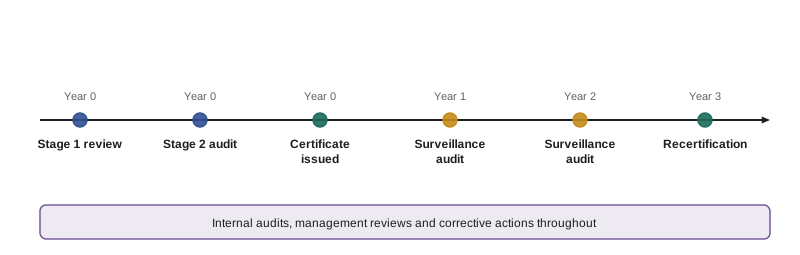
A certificate states that an ISMS meets the standard's requirements for a defined scope. It does not certify that every control is strong, and the scope may cover only part of an organization. When relying on a supplier's certificate, check the scope statement, the certification body and its accreditation, the issue and expiry dates, and ask for the Statement of Applicability to see which controls are included.
PCI DSS assessments
The Payment Card Industry Data Security Standard applies to organizations that store, process or transmit payment card data. Version 4.0.1, published in June 2024, is the current version; the requirements that were future-dated in version 4.0 became mandatory on 31 March 2025. Depending on transaction volume and the card brands' rules, an organization validates compliance either through an assessment by a Qualified Security Assessor (QSA), producing a Report on Compliance, or through a self-assessment questionnaire. Either way, an Attestation of Compliance summarizes the result.
PCI DSS contains some of the most specific testing requirements in any common framework, which makes it a good reference for what regular testing looks like in practice. Requirement 11 requires internal vulnerability scans at least every three months and after significant changes; external scans at least every three months by an Approved Scanning Vendor (ASV); internal and external penetration testing at least every 12 months and after significant changes, following a defined methodology; and testing of segmentation controls, at least every 12 months for merchants and every six months for service providers, if segmentation is used to reduce scope. Requirement 10 governs audit logging and log review.
| Activity (PCI DSS v4.0.1 requirement 11) | Minimum frequency | Who performs |
|---|---|---|
| Internal vulnerability scans | Every three months and after significant change | Qualified internal staff or third party |
| External vulnerability scans | Every three months and after significant change | Approved Scanning Vendor for quarterly scans |
| Internal and external penetration tests | Every 12 months and after significant change | Qualified internal resource or third party, organizationally independent |
| Segmentation testing | Every 12 months; every 6 months for service providers | Qualified, independent tester |
| Detection of unauthorized wireless access points | Every three months | Organization |
Government cloud assessment programs
Governments assess cloud services before departments may use them for sensitive information, and these programs are often required of vendors that sell to the public sector.
In the United States, the Federal Risk and Authorization Management Program (FedRAMP) standardizes security assessment of cloud services used by federal agencies, with independent assessment by accredited third-party assessment organizations. In 2025 FedRAMP launched FedRAMP 20x to move from document-heavy reviews toward automated, continuously validated key security indicators. Industry reports from 2026 describe a consolidated 2026 rule set that renames authorization as certification and replaces the Low, Moderate and High baselines with classes, with transition deadlines running into 2027 and 2028 (as reported in October 2026; confirm the current rules at fedramp.gov before relying on them).
Financial reporting controls
Security controls also appear in audits of financial reporting, because financial systems depend on IT general controls: access to systems and data, change management, and operations such as backup and job scheduling. Weaknesses in these controls can undermine the reliability of financial statements, so auditors test them.
In the United States, section 404 of the Sarbanes-Oxley Act requires management of public companies to assess internal control over financial reporting, and section 404(b) requires the external auditor of larger companies to attest to it under PCAOB standards (AS 2201). IT general controls over financially significant systems are therefore tested every year, and deficiencies can be reported as significant deficiencies or material weaknesses.
Running an audit engagement
From the auditee's side, an audit follows a predictable path. Planning agrees the objectives, criteria, scope, period, timetable and evidence requests. Fieldwork collects evidence through interviews, document inspection, observation and testing. Findings are discussed with management as they arise so that facts can be confirmed. The draft report sets out findings, risk ratings and recommendations, and management adds responses with actions, owners and dates. The final report goes to the governing body. Follow-up confirms that actions were completed.
Worked problem
Preparing for a first SOC 2 Type II audit
A growing software company has promised a large customer a SOC 2 Type II report within a year. It has never had a formal audit. How should the security manager plan?
Show solution
- Choose the Trust Services categories in scope; security is required, and availability and confidentiality are common additions.
- Run a readiness assessment against the criteria to find gaps, and remediate them before the observation period starts.
- Consider a Type I report first to confirm design, then a Type II observation period of at least six months.
- Assign control owners and build evidence collection into normal work, using automated evidence where possible.
- Engage a licensed CPA firm early to agree scope, period and evidence expectations, and set the timeline so the report is issued before the customer deadline.
Answer: Do a readiness assessment and remediation, optionally a Type I, then a Type II observation period of at least six months with evidence built into daily operations.
Good preparation means that evidence already exists because the controls are part of normal work: tickets for changes, records of access reviews, logs of backup restores. A central evidence repository, mapped to control frameworks, lets one set of evidence serve several audits. Many organizations use a common control framework that maps ISO/IEC 27001, SOC 2, PCI DSS and regulatory requirements to a single set of internal controls, so that each control is tested once and the result reused.
Worked problem
An auditor finding the security team disputes
An internal auditor reports that 12 % of firewall rules have no documented business owner or justification. The network team says the rules are all needed. How should the disagreement be handled?
Show solution
- The criterion is the firewall standard, which requires an owner and justification for every rule; the finding is about compliance with that criterion.
- Management can accept the finding and agree to document owners and remove unneeded rules, or provide evidence that the auditor missed.
- If management disagrees, the report records management's response and the audit committee decides; management cannot simply remove the finding.
- Agree a remediation plan with dates, and a follow-up review.
Answer: Respond with evidence or an action plan; disputed findings are recorded with management's view for the governing body, not deleted.
Common mistakes
MistakeHaving the security team audit controls it designed and operates.
InsteadUse internal audit or another independent party for audits.
MistakeTreating a SOC 2 Type I report as proof that controls operated over the year.
InsteadType I covers design at a point in time; Type II covers operation over a period.
MistakeIgnoring carved-out subservice organizations and complementary user entity controls.
InsteadObtain reports for carved-out providers and operate the controls assigned to you.
MistakeAssuming an ISO/IEC 27001 certificate covers the whole organization.
InsteadCheck the certificate scope and the Statement of Applicability.
MistakeScrambling for evidence when an audit is announced.
InsteadBuild evidence into normal operations and keep a mapped evidence repository.
MistakeDeleting findings management disagrees with.
InsteadRecord management's response and let the governing body decide.
Summary and key terms
- Audits are independent, formal assessments against criteria that end in reports others rely on.
- First-party audits are internal, second-party audits are by customers, third-party audits are by independent bodies.
- SOC 1 covers financial reporting controls, SOC 2 covers the Trust Services Criteria, and SOC 3 is a public summary.
- Type I reports cover design at a point in time; Type II reports cover operating effectiveness over a period.
- ISO/IEC 27001 certification uses stage 1 and stage 2 audits, a three-year certificate and annual surveillance.
- PCI DSS v4.0.1 sets explicit testing frequencies for scanning, penetration testing and segmentation.
- Governments assess cloud services through national programs, and financial reporting audits test IT general controls.
- First-party audit
- An audit an organization performs on itself, usually by internal audit.
- Second-party audit
- An audit a customer or partner performs on a supplier.
- Third-party audit
- An audit by an independent external body whose results many can rely on.
- SOC 2
- A report on a service organization's controls against the Trust Services Criteria.
- Type II report
- A report on the design and operating effectiveness of controls over a period.
- Complementary user entity controls
- Controls a service provider expects its customers to operate.
- Carve-out
- Excluding a subservice organization's controls from a service organization report.
- Bridge letter
- A service provider's statement covering the time between a report period and the present.
- Statement of Applicability
- The ISO/IEC 27001 document listing Annex A controls and their status.
- Attestation of Compliance
- The PCI DSS summary document confirming the result of a compliance assessment.
Practice problems
Work each problem on paper first, then reveal the answer to check.
What makes an audit different from other assessments?
Show answer
It is formal, performed independently against defined criteria, and ends in an opinion or report others rely on.
Who performs a second-party audit?
Show answer
A customer or partner auditing a supplier.
What does a SOC 1 report cover?
Show answer
Controls relevant to customers' financial reporting.
How does a Type II report differ from a Type I report?
Show answer
Type II tests operating effectiveness over a period; Type I covers design at a point in time.
What is a bridge letter for?
Show answer
To cover the gap between the end of a report period and the present.
What happens in an ISO/IEC 27001 stage 1 audit?
Show answer
Review of documentation and readiness, including scope, risk assessment and Statement of Applicability.
How long is an ISO/IEC 27001 certificate valid?
Show answer
Three years, with surveillance audits at least annually.
How often does PCI DSS require external vulnerability scans?
Show answer
At least every three months, by an Approved Scanning Vendor, and after significant changes.
How often must service providers test segmentation under PCI DSS?
Show answer
At least every six months.
What is a common control framework?
Show answer
A single set of internal controls mapped to several standards so each is tested once and reused.
Lesson quiz · 5 questions
Score 60% or more to complete this lesson.
Create a free account to save your progress, take quizzes and earn a certificate.