
CISSP-101 · Lesson 2 of 12 · 26 min
ISC2 and the security credential landscape
The CISSP does not exist in isolation. It is one of a family of credentials offered by ISC2, and it competes and overlaps with credentials from other bodies such as ISACA, CompTIA, GIAC and the cloud and technology vendors. Understanding this landscape helps you decide whether the CISSP is the right credential for your goals, which other credentials might come before or after it, and how employers and contracts are likely to read each one. This lesson describes ISC2 as an organization, explains how its credentials fit together, compares the CISSP with its main alternatives and shows how credentials are recognized in hiring and procurement.
ISC2 as an organization
ISC2 was founded in 1989 by a group of professional associations that wanted a vendor-neutral, standardized way to certify information security professionals. It is a non-profit membership association, and holders of its credentials become members. It develops exams, sets experience and ethics requirements, manages endorsement and continuing education, runs an online community and conferences, publishes research such as its annual cybersecurity workforce study and advocates for the profession. It also operates a charitable foundation, the Center for Cyber Safety and Education, which provides scholarships and public education.
ISC2 is governed by a board of directors elected by members. Its exams are delivered through Pearson VUE test centers around the world. Exam content is written and reviewed by volunteer subject matter experts who hold the credential, guided by psychometricians, and is based on a job task analysis: a periodic survey of practitioners that identifies the tasks they actually perform and the knowledge those tasks require. The results of the job task analysis are published as the exam outline, which lists the domains, their weightings and the topics within each. The current CISSP outline took effect on 15 April 2024.
Vendor neutrality and accreditation
Two features distinguish ISC2 credentials from many others. The first is vendor neutrality. The CISSP does not test any particular product. Questions refer to concepts, standards and generic technologies, such as firewalls, multifactor authentication or public key infrastructure, rather than to a specific vendor's configuration screens. This makes the credential portable across employers and technologies, though it also means candidates must translate their product experience into general principles.
The second is accreditation. The CISSP is accredited by the ANSI National Accreditation Board (ANAB) as conforming to ISO/IEC 17024, the international standard for bodies that certify persons. To maintain accreditation, ISC2 must show that its exam is valid and reliable, that the content reflects a current job task analysis, that it treats candidates fairly and consistently, that it manages conflicts of interest and that it has processes for complaints, appeals and maintaining certification. Accreditation is one reason governments and large organizations are willing to rely on the credential.
The ISC2 credential family
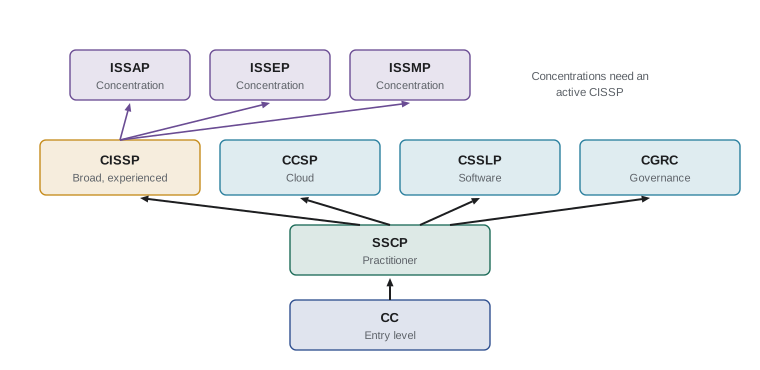
ISC2 offers credentials at several levels. At entry level, Certified in Cybersecurity (CC) covers foundational concepts and has no experience requirement. At practitioner level, the Systems Security Certified Practitioner (SSCP) targets hands-on administrators and analysts with one year of experience. The CISSP sits at the experienced level. Alongside it are specialist credentials: the Certified Cloud Security Professional (CCSP) for cloud security, the Certified Secure Software Lifecycle Professional (CSSLP) for secure development, the Certified in Governance, Risk and Compliance (CGRC) for authorization and compliance work (it replaced the older Certified Authorization Professional, CAP). Beyond the CISSP, three concentrations deepen specific areas: the Information Systems Security Architecture Professional (ISSAP), the Information Systems Security Engineering Professional (ISSEP) and the Information Systems Security Management Professional (ISSMP). Each concentration requires an active CISSP and two years of experience in the concentration area.
| Credential | Level | Typical experience | Focus |
|---|---|---|---|
| CC | Entry | None required | Foundational security concepts |
| SSCP | Practitioner | One year | Operations and administration |
| CISSP | Experienced | Five years (one-year waiver possible) | Broad security program design and management |
| CCSP | Experienced | Five years IT including three in security and one in cloud | Cloud security |
| CSSLP | Experienced | Four years in the software development life cycle | Secure software |
| CGRC | Experienced | Two years | Governance, risk and compliance |
| ISSAP / ISSEP / ISSMP | Concentration | Active CISSP plus two years in the area | Architecture, engineering or management |
Note that the CCSP outline was revised with effect from August 2026, an example of how often outlines change. Always check the current outline for any ISC2 credential you plan to take.
How the CISSP compares with other credentials
Employers often list the CISSP alongside other credentials as alternatives, and candidates often wonder which to pursue. The most common comparisons are with ISACA's Certified Information Security Manager (CISM) and Certified Information Systems Auditor (CISA), CompTIA's Security+ and CASP+ (renamed SecurityX), and GIAC's technical certifications.
The CISM, from ISACA, is focused on security management and governance: information security governance, risk management, program development and incident management. It requires five years of experience, at least three of them in security management. It is narrower than the CISSP but deeper on management. Many people hold both. The CISA is an audit credential for people who audit, control and assure information systems; it suits internal and external auditors. The CompTIA Security+ is an entry-level credential widely used as a first step and as a baseline in government roles. GIAC certifications, linked to SANS training, test specific technical skills such as incident handling, penetration testing or forensics, often with open-book exams and, for some, hands-on components.
| Credential | Body | Main audience | Breadth vs depth |
|---|---|---|---|
| CISSP | ISC2 | Experienced practitioners, architects and managers | Very broad, management-aware |
| CISM | ISACA | Security managers and leaders | Narrower, deeper on governance and program management |
| CISA | ISACA | IT auditors and assurance professionals | Focused on audit and control |
| Security+ | CompTIA | Entry-level practitioners | Broad foundations |
| GIAC (various) | GIAC | Technical specialists | Deep in one technical area |
| Vendor cloud security | AWS, Microsoft, Google | Cloud engineers | Deep in one platform |
None of these is simply better than another. They signal different things. A security architect at a bank might hold the CISSP and a cloud vendor credential. A security manager moving into governance might add the CISM. An auditor might pair the CISA with the CISSP to show both audit discipline and security breadth. When choosing, look at the job postings for roles you want in the next three to five years and note which credentials appear most often.
Recognition in hiring and procurement
In the United States, recognition is more formal in the federal space. DoD Manual 8140.03 sets up the Cyber Workforce Qualification Program, under which credentials such as the CISSP qualify personnel for particular work roles; defense contractors in those roles must meet the requirements. Federal agencies often specify credentials in job announcements and contracts, and some states do the same. Outside government, regulated sectors such as finance and health care commonly list the CISSP in hiring criteria. The NICE Workforce Framework for Cybersecurity, maintained by NIST, defines work roles and competencies that employers map credentials to.
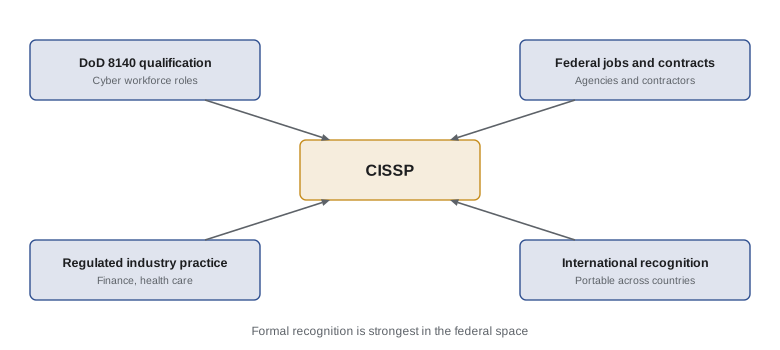
Internationally, the CISSP is recognized in many countries, and in some it is mapped to national qualification frameworks. For example, in the United Kingdom it has been benchmarked against the Regulated Qualifications Framework at a level comparable to a master's degree. Such mappings can be useful when working abroad, but they do not turn the CISSP into an academic degree.
Thinking about return on investment
Earning the CISSP takes time and money: study materials or a course, the exam fee, possibly a retake and then annual fees and continuing education. A simple way to think about whether it pays off is to estimate the expected benefit and the payback period. If you expect the credential to raise your income or open a promotion, weigh that by how likely it is and compare it with the total cost.
Worked problem
A rough payback estimate
Priya estimates her total first-year cost for the CISSP at US$2,100 (study materials US$350, exam US$749, a practice exam subscription US$100, an expected 15 % chance of a retake costing US$749, and the first annual maintenance fee US$135, rounded). She thinks there is a 50 % chance the credential helps her win a promotion worth US$8,000 a year. What is her expected first-year benefit and payback period?
Show solution
- Expected annual benefit = 0.50 × 8,000 = US$4,000.
- Check the cost: 350 + 749 + 100 + 0.15 × 749 + 135 = 350 + 749 + 100 + 112 + 135 = US$1,446; Priya's US$2,100 includes some extra margin for her study time and books, which is reasonable.
- Payback period = cost ÷ expected annual benefit = 2,100 ÷ 4,000 ≈ 0.53 years, or about six months.
- Even if the promotion probability were only 20 %, the expected benefit would be US$1,600 a year and the payback period about 1.3 years.
Answer: Expected benefit is about US$4,000 a year, giving a payback period of roughly six months; the investment still pays back within about 1.3 years even under a pessimistic estimate.
Such estimates are rough, and the most important benefits, such as broader knowledge and confidence, are hard to measure. But the exercise helps you decide whether to pay yourself, ask your employer for support or delay until the credential matters more for your plans.
In the United States, many employers reimburse certification costs under tuition assistance policies. Veterans may be able to use GI Bill benefits to reimburse licensing and certification test fees, subject to Department of Veterans Affairs rules. Work-related education expenses are treated differently for employees and the self-employed under federal tax law, so check current IRS guidance or ask a tax professional before assuming any tax benefit.
Choosing between credentials in practice
A practical way to decide among credentials is to gather evidence rather than opinions. Collect twenty or thirty job postings for roles you would like to hold in three to five years, from the employers and regions where you want to work. Note which credentials each posting requires, which it prefers and which it does not mention. Then look at the profiles of people already doing those jobs, for example on professional networking sites, and note which credentials they hold and in what order they earned them. Patterns usually emerge quickly. Postings for security architects and managers in large organizations tend to mention the CISSP most often, sometimes alongside the CISM or a cloud credential; postings for hands-on analysts and engineers tend to emphasize technical certifications and practical skills.
It also helps to think about sequence. Credentials build on one another. The knowledge gained preparing for an entry-level or practitioner credential makes CISSP study easier, and a technical credential earned after the CISSP can deepen a specialty that the CISSP covers only broadly. Some credentials appear on ISC2's approved list for the one-year experience waiver, so holding one before the CISSP may reduce the experience you need. Finally, consider maintenance. Each credential carries its own continuing education and fee requirements, and holding many credentials can become expensive and time-consuming. A focused set of two or three well-chosen credentials is usually more valuable than a long list.
| Goal in three to five years | Credentials often seen in postings |
|---|---|
| Security operations center lead | CISSP, GIAC incident handling credentials, vendor security tools |
| Cloud security architect | CISSP, CCSP, cloud vendor security credentials |
| Governance, risk and compliance manager | CISSP, CISM, CGRC, CISA |
| Application security lead | CISSP, CSSLP, secure coding and testing credentials |
| Chief information security officer | CISSP, CISM, management education |
Membership brings practical benefits that matter to working professionals. ISC2 members can join local chapters, attend the annual Security Congress and regional events at member rates, use free and discounted professional development courses to earn continuing education credits, read research such as the annual Cybersecurity Workforce Study and take part in volunteer programs, including exam item writing and community outreach. Many candidates first meet the colleague who later endorses them through a local chapter, which is a good reason to get involved before you sit the exam.
ISC2 also contributes to public policy discussions about the cybersecurity workforce in many countries. Its workforce research is widely quoted, but like any organization that benefits from demand for its credentials, it has an interest in the findings. Reading such research critically, and comparing it with independent sources such as government labor market data, is a habit worth building.
Common mistakes
MistakeAssuming one credential is best for everyone.
InsteadMatch the credential to the roles you want and the job postings for them.
MistakeExpecting the CISSP to test specific products.
InsteadTranslate product experience into vendor-neutral principles.
MistakeUsing an old exam outline.
InsteadCheck the outline's effective date on the ISC2 website.
MistakeConfusing the CISM and CISA.
InsteadCISM is for security managers; CISA is for auditors.
MistakeAssuming certification costs are tax-deductible.
InsteadCheck current tax guidance or ask a professional.
Summary and key terms
- ISC2 is a non-profit membership association founded in 1989 that awards the CISSP.
- Exam content is based on a job task analysis and published as an exam outline; the current CISSP outline took effect on 15 April 2024.
- The CISSP is vendor-neutral and accredited to ISO/IEC 17024 by ANAB.
- ISC2 offers CC, SSCP, CISSP, CCSP, CSSLP, CGRC and three CISSP concentrations.
- The CISM suits security managers, the CISA auditors, Security+ beginners and GIAC technical specialists.
- Recognition comes through hiring policies, contracts and, in the US federal space, DoD 8140.
- A simple expected-benefit and payback estimate helps decide when to invest.
- Vendor-neutral
- Not tied to any particular product or supplier.
- Exam outline
- Published list of domains, weightings and topics for an exam.
- ANAB
- ANSI National Accreditation Board, which accredits certification bodies.
- CC
- ISC2 Certified in Cybersecurity, an entry-level credential.
- SSCP
- Systems Security Certified Practitioner, an ISC2 practitioner credential.
- CCSP
- Certified Cloud Security Professional, an ISC2 cloud credential.
- Concentration
- An advanced specialization available to active CISSPs.
- CISM
- ISACA's Certified Information Security Manager credential.
- CISA
- ISACA's Certified Information Systems Auditor credential.
- Payback period
- Time for expected benefits to repay the cost of an investment.
Practice problems
Work each problem on paper first, then reveal the answer to check.
When was ISC2 founded?
Show answer
1989.
What is a job task analysis used for?
Show answer
To identify the tasks and knowledge that form the exam outline.
When did the current CISSP exam outline take effect?
Show answer
15 April 2024.
Name the three CISSP concentrations.
Show answer
ISSAP, ISSEP and ISSMP.
What does vendor neutrality mean for exam preparation?
Show answer
You must understand general principles, not product screens.
Which credential suits an IT auditor best?
Show answer
The CISA.
Who delivers ISC2 exams?
Show answer
Pearson VUE.
What does ISO/IEC 17024 accreditation require of ISC2?
Show answer
A valid, fair and consistent certification process based on a job task analysis.
With a 25 % chance of a US$6,000 benefit and US$1,500 cost, what is the payback period?
Show answer
1,500 ÷ 1,500 = 1 year.
What is the entry-level ISC2 credential?
Show answer
Certified in Cybersecurity (CC).
Lesson quiz · 5 questions
Score 60% or more to complete this lesson.
Create a free account to save your progress, take quizzes and earn a certificate.