
CINE-230 · Lesson 8 of 12 · 25 min
Telescopic cranes, cable cams and remote systems
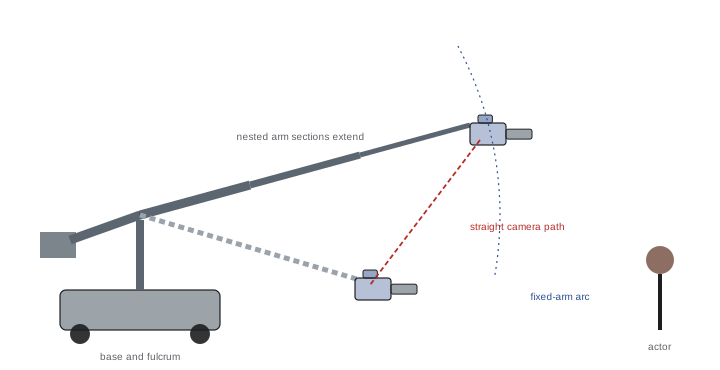
A conventional crane can rise, fall and swing, but its arm length is fixed during a shot, so the camera always moves on an arc. Telescopic cranes add a fourth dimension: the arm extends and retracts during the move, letting the camera travel in straight lines through space, push toward a subject from high above, or follow action without the arc of a fixed arm. Combined with stabilized remote heads, telescopic cranes have become standard tools for features, series, commercials, sport and live events. This lesson covers telescopic cranes and how they work, operating crews and roles, typical moves, cable-suspended camera systems, other remote systems such as track-mounted and pole cameras, planning and safety for large remote systems, and the practicalities of time, transport and cost.
How telescopic cranes work
A telescopic crane has an arm made of nested sections that slide inside each other, driven by motors and cables or belts so that the arm extends or retracts smoothly while the crane is moving. The best-known system is the Technocrane, developed in the 1980s by Horst Burbulla, and the name is often used generically, though other manufacturers make similar cranes. Typical systems range from compact cranes extending to a few meters up to large cranes extending to 15 m or more, mounted on dedicated wheeled bases or on vehicles. A remote head, often stabilized, sits at the end of the arm. As the arm telescopes, its counterbalance must change, because the camera's distance from the fulcrum changes; telescopic cranes manage this with counterweights that move automatically or with designs that keep the arm balanced through its range. Extension speed and acceleration are controlled by a technician, usually with a handwheel or joystick, while grips swing and boom the arm.
The telescopic crane crew
Operating a telescopic crane is a team effort:
- The crane technician sets up, balances and maintains the crane and operates the telescoping, usually supplied by the rental company.
- Grips swing and boom the arm and move the base, coordinated by the key grip or crane grip.
- The camera operator works the remote head with wheels, pan bars or joystick from a station near the base.
- The focus puller controls focus, iris and zoom with a wireless lens control system, often from their own monitor.
- Assistants and DITs manage cables, power, video and data.
The crew rehearses moves to coordinate extension, boom, swing and head moves, often using agreed counts or cues. Because the camera can travel fast and far, everyone must know the planned path and the safety zone.
What telescopic cranes can do
Telescopic cranes enable moves that would be difficult or impossible with other tools:
- Straight-line pushes from high and wide to close, such as moving down and in from above a crowd to a single face.
- Following actors through space while keeping the camera at a constant distance, by telescoping as they move.
- Moving through windows, over obstacles or into spaces where a dolly or person cannot go.
- Rapid repositioning between setups without moving the base, saving time on set.
- Low-to-high moves over water, terrain or set pieces.
- Sports and live event coverage, sweeping over fields and stages.
Because the arm can extend while booming and swinging, the camera can trace almost any path within its reach envelope, and combined with a remote head, the shot can become a single fluid gesture. Some systems can record and repeat moves, providing motion control capability.
Worked problem
Reach and height of a telescopic crane
A telescopic crane has its fulcrum 1.8 m above the ground and an arm that extends from 4 m to 9 m in front of the fulcrum. For a shot that starts with the arm at 9 m extension and 35° above horizontal, then retracts to 4 m while lowering to 0° (horizontal), where does the camera start and end relative to the fulcrum?
Show solution
- Start: horizontal reach 9 cos 35° ≈ 7.4 m; height 1.8 + 9 sin 35° ≈ 1.8 + 5.2 = 7.0 m.
- End: horizontal reach 4 m; height 1.8 m.
- The camera travels from about 7.4 m out and 7 m high to 4 m out and 1.8 m high.
- The path is close to straight if extension and boom are coordinated, unlike the arc of a fixed arm.
Answer: From about (7.4 m, 7.0 m) to (4 m, 1.8 m) in reach and height, along an approximately straight path.
Cable-suspended camera systems
Cable cameras suspend the camera from cables, allowing it to fly over large areas. Point-to-point cable cams run a camera dolly along one or two cables strung between two anchors, for long, fast moves over fields, rivers, ski slopes or crowds. Multi-point systems, such as Spidercam and Skycam used in stadiums, suspend the camera from four or more cables attached to winches at high points around a venue, allowing it to move in three dimensions anywhere within the space under computer control. Cable systems carry stabilized remote heads and are operated by a pilot, who controls the camera's position, and a camera operator, who controls the framing. They require engineering of anchor points, cable tensions and loads, extensive rigging time and strict exclusion zones beneath the cables, and are used for sports, concerts, large events and some features.
| System | Movement | Strengths | Constraints |
|---|---|---|---|
| Telescopic crane | Boom, swing, extend, travel | Fluid 3D moves within reach | Base space, transport, crew |
| Point-to-point cable cam | Along a line between anchors | Long, fast, over obstacles | Anchors, tension, clearance |
| Multi-point cable system | Anywhere in a 3D volume | Stadium-scale coverage | Engineering, winches, exclusion zones |
| Track-mounted remote camera | Along a rail | Repeatable, fast, sport | Fixed path |
| Pole or mast camera | Height with pan and tilt | High viewpoints quickly | Wind, stability |
Other remote camera systems
Many other systems carry remote heads. Track-mounted remote cameras, running on rails beside sports fields, swimming pools and racetracks, follow athletes at high speed. Pole cameras and masts raise cameras several meters high for overhead views of crowds or traffic. Wall, ceiling and rail rigs in studios support remote heads for game shows, news and live events. Robotic camera systems in studios move pedestals and heads under computer control. Underwater remote systems and specialized rigs serve specific environments. Drones, unmanned aircraft, can carry stabilized cameras almost anywhere outdoors, subject to aviation regulations and safety (CINE-410 covers drone operations in depth).
Planning large remote systems
Telescopic cranes and cable systems are expensive and time-consuming to set up, so they must be planned carefully. Planning considerations include:
- The move: path, speed, reach and height, ideally designed in previsualization or with floor plans showing the reach envelope.
- Access: whether the crane can reach the set and fit through doors, gates and roads; telescopic cranes may arrive on trailers and need ramps or lifts.
- Ground and floor loading: base weights can exceed one metric ton, requiring load-spreading pads and engineering checks on decks or floors.
- Power and cabling for motors, heads and video.
- Crew and rental: specialist technicians and the length of the rental.
- Time: setup, balancing and rehearsal can take hours, so scheduling several shots with the same rig helps.
- Safety: exclusion zones, wind limits, power lines and emergency procedures.
Productions often reserve large remote systems for specific days or sequences where they bring the most value.
Safety for remote systems
Remote systems move heavy equipment quickly, sometimes over people. Specific risks include collisions between the camera or arm and actors, crew or set; failure of cables, anchors or rigging; equipment falling from height; wind loads; and electrical hazards. Safety measures include rigging and anchors designed and inspected by qualified people; exclusion zones under cable systems and around crane swing and extension envelopes; soft limits programmed into crane and cable systems; safety meetings before complex moves; rehearsals at reduced speed; spotters who can call stops; wind monitoring; and keeping actors at safe distances or using stand-ins until moves are proven. Operators and technicians should be trained and experienced with the specific system.
Telescopic cranes on location and in studios
On location, telescopic cranes are often mounted on wheeled bases that travel on track or dance floor, or on vehicles for moving shots. Typical uses include sweeping shots over city streets, landscapes and crowds, moves that track with actors along a street while rising and extending, and shots that push through doorways or windows. In studios, telescopic cranes are used for elaborate sequences on large sets, for musical performances and for virtual production, where their precise, recordable movement can drive real-time backgrounds. Because they combine reach and speed, telescopic cranes can save time by covering several angles from one base position, repositioning the camera between takes simply by extending, swinging and booming the arm.
Balancing telescopic cranes
As a telescopic arm extends, the camera moves farther from the fulcrum, increasing the moment on the front; as it retracts, the moment decreases. Telescopic crane designs compensate automatically, keeping the arm balanced throughout its travel, but they still need to be balanced for the specific camera package at the start of the day, using the manufacturer's procedures. Payloads are limited by extension: the longer the arm, the lighter the maximum payload. Crews must check the payload chart for the planned extension and package before rigging.
Cable cams over landscapes
Point-to-point cable cams are used for shots over terrain where cranes and drones are impractical or prohibited: across rivers and canyons, along ski runs, over forest canopies, and above sports fields and racetracks. The system consists of a main cable or pair of cables tensioned between anchors, a carriage carrying the stabilized camera head, and a drive system, often a separate cable and winch, that pulls the carriage along. Speeds can be high, so braking distances and end stops are critical. Anchors may be trees, structures, vehicles or purpose-installed ground anchors, chosen and checked by riggers, and the sag of the cable under load must be calculated so that the camera clears obstacles and people.
Drones as an alternative
Drones have taken over many shots that once required cranes, cable cams or helicopters, offering low cost, quick setup and great freedom of movement outdoors. They have limitations: payload and flight time limit camera packages, wind and weather restrict operations, and aviation regulations restrict where and how drones may fly, especially near people, airports and controlled airspace. Indoor and close-to-actor shots may be safer with cranes or cable systems. CINE-410 covers drone regulations and operations in Canada and the United States.
Cost and value
Large remote systems are expensive, but they can deliver images that define a film's visual identity and save time by covering complex action efficiently. Producers weigh the rental, crew, transport and setup time against the value of the shot and the alternatives, such as drones, visual effects or simpler moves. A well-planned day with a telescopic crane that covers several key shots can be more economical than several days of conventional setups.
Rehearsing remote system moves
Large remote moves are rehearsed in stages: first a dry run without actors at slow speed to check the path, clearances and soft limits; then with stand-ins at increasing speed; then with actors once timing is reliable. Each rehearsal is reviewed on playback, and any change to the path or speed is communicated to everyone involved. Recording successful moves, where the system allows it, makes later takes more consistent.
Clear records of each remote setup, including base positions, arm extensions and head settings, help the crew rebuild a shot for pickups and give visual effects teams the data they need.
Common mistakes
MistakeTreating a telescopic crane like a fixed jib.
InsteadDesign moves using extension for straight paths.
MistakeBooking a large crane without checking access.
InsteadSurvey roads, doors, ground and floors in advance.
MistakeUnderestimating setup and rehearsal time.
InsteadSchedule several shots per rig and plan with previs.
MistakeAllowing people under cable systems during moves.
InsteadEnforce exclusion zones.
MistakeRehearsing fast moves at full speed near actors.
InsteadRehearse slowly with stand-ins and spotters.
Summary and key terms
- Telescopic cranes extend and retract during moves, allowing straight paths.
- Crews include a technician, grips, operator and focus puller.
- Reach and height follow L cos α and h₀ + L sin α.
- Cable cams fly cameras along lines or through 3D volumes.
- Track, pole, studio robotic and drone systems carry remote heads.
- Large systems need planning for moves, access, loads, power and time.
- Safety relies on rigging, exclusion zones, soft limits and rehearsal.
- Telescopic crane
- Crane whose arm extends and retracts during shots.
- Technocrane
- A well-known brand of telescopic crane.
- Crane technician
- Specialist who sets up and operates crane functions.
- Reach envelope
- Space the camera can reach from a base position.
- Cable cam
- Camera suspended from cables.
- Point-to-point system
- Cable cam running between two anchors.
- Multi-point system
- Cable system moving in three dimensions.
- Pilot
- Operator controlling a cable or drone camera's position.
- Exclusion zone
- Area kept clear for safety.
- Previsualization
- Planning shots with digital or physical mock-ups.
Practice problems
Work each problem on paper first, then reveal the answer to check.
What does a telescopic crane add to a fixed jib?
Show answer
Extension and retraction during the shot.
Who operates the telescoping?
Show answer
The crane technician.
Reach of an 8 m arm at 30°?
Show answer
About 6.9 m horizontally.
Height of an 8 m arm at 30° with a 2 m fulcrum?
Show answer
6 m.
Name two telescopic crane moves.
Show answer
Straight push from high, following at constant distance, through windows.
How does a multi-point cable system move?
Show answer
Winches on several cables move it in 3D.
Name two other remote systems.
Show answer
Track cameras, pole cameras, robotic studio heads, drones.
Why check floor loading?
Show answer
Bases can weigh over a metric ton.
Name three planning factors.
Show answer
Move, access, loads, power, crew, time, safety.
Name two remote-system safety measures.
Show answer
Exclusion zones, soft limits, spotters, slow rehearsals.
Lesson quiz · 5 questions
Score 60% or more to complete this lesson.
Create a free account to save your progress, take quizzes and earn a certificate.