
CINE-210 · Lesson 4 of 12 · 24 min
Depth of field, hyperfocal distance and focus
A lens focuses perfectly at only one distance. Objects in front of and behind that plane are rendered progressively less sharp, but within a certain range the blur is small enough to look sharp. That range is the depth of field, and controlling it is one of the cinematographer's most powerful storytelling tools: shallow depth of field isolates a face and directs attention, while deep focus shows relationships across the frame. This lesson covers the circle of confusion, the factors that control depth of field, the depth of field equations, the hyperfocal distance, near and far limits and their asymmetry, depth of field across formats, depth of focus at the sensor, using depth of field calculators, and creative uses of shallow and deep focus.
The circle of confusion
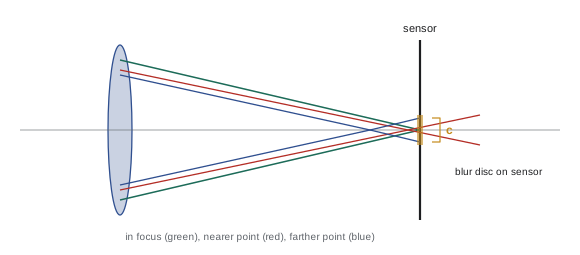
A point in the scene that is not exactly in focus is imaged not as a point but as a small blur disc. If the disc is small enough, the eye cannot distinguish it from a point at normal viewing conditions, and the point appears sharp. The largest acceptable disc diameter is the circle of confusion, \(c\). Its value depends on the format and the intended viewing conditions: a traditional figure for 35 mm film and Super 35 is about 0.025 mm, and for full frame about 0.03 mm, derived from what looks sharp on a print or screen viewed at a normal distance. For large screens and high-resolution delivery, where audiences can see finer detail, cinematographers and focus pullers often use smaller values, such as 0.015 to 0.02 mm, giving more conservative, shallower depth of field estimates. Depth of field is therefore not a physical boundary but a perceptual judgment based on assumptions.
What controls depth of field
Depth of field depends on four factors:
- Aperture: smaller apertures (higher f-numbers) give deeper depth of field; opening up makes it shallower.
- Focus distance: depth of field increases rapidly with distance; close subjects have very shallow depth of field.
- Focal length: at the same distance and stop, longer lenses give shallower depth of field.
- Circle of confusion: a stricter standard gives shallower calculated depth of field.
For a given framing, focal length and distance are linked: to keep the subject the same size, a longer lens must be farther away. At the same framing and f-number, depth of field is roughly the same for any focal length at moderate distances, although the background blur looks different because of perspective and magnification. This is why "long lenses have shallow depth of field" is true at a fixed distance but misleading when comparing equal framings.
The depth of field equations
The hyperfocal distance \(H\) is a key quantity:
For a lens focused at distance \(s\), the near and far limits of acceptable sharpness are approximately:
When \(s\) equals or exceeds \(H\), the far limit extends to infinity. Total depth of field is \(D_{\text{far}} - D_{\text{near}}\). All distances are measured from the focal plane, marked on cinema cameras by a symbol on the body, and must use consistent units.
Worked problem
Depth of field for a close-up
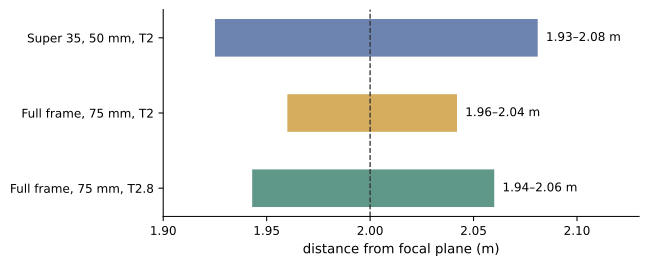
A focus puller is working with a 50 mm lens at T2 (assume f/2) on Super 35, with \(c = 0.025\) mm, focused on an actor at 2 m (2000 mm). What are the near and far limits?
Show solution
- Hyperfocal: \(H \approx 50^2 / (2 \times 0.025) + 50 = 2500 / 0.05 + 50 = 50{,}050\) mm, about 50 m.
- Near: \(D_n = 50{,}050 \times 2000 / (50{,}050 + 1950) \approx 1925\) mm.
- Far: \(D_f = 50{,}050 \times 2000 / (50{,}050 - 1950) \approx 2081\) mm.
- Total depth of field: about 156 mm, roughly 7.5 cm in front and 8 cm behind the focus point.
Answer: Sharp from about 1.93 m to 2.08 m, a total of about 16 cm: enough for a face, but not if the actor moves much.
The hyperfocal distance
Focusing at the hyperfocal distance gives the greatest possible depth of field for a given lens and stop: everything from half the hyperfocal distance to infinity is acceptably sharp. A 25 mm lens at f/5.6 on Super 35 with \(c = 0.025\) mm has a hyperfocal distance of about 4.5 m, so focusing at 4.5 m keeps everything from about 2.25 m to infinity acceptably sharp. Hyperfocal focusing is useful for wide shots, landscapes, run-and-gun documentary work and action where precise focus pulling is impossible. With modern high-resolution capture and large screens, hyperfocal settings based on traditional circles of confusion may look slightly soft at infinity on close inspection, so many cinematographers use a stricter circle or focus slightly beyond the hyperfocal point.
| Lens (Super 35, c = 0.025 mm) | T2 | T2.8 | T4 | T5.6 | T8 |
|---|---|---|---|---|---|
| 18 mm | 6.5 m | 4.6 m | 3.3 m | 2.3 m | 1.6 m |
| 25 mm | 12.5 m | 8.9 m | 6.3 m | 4.5 m | 3.1 m |
| 35 mm | 24.5 m | 17.5 m | 12.3 m | 8.8 m | 6.2 m |
| 50 mm | 50 m | 35.8 m | 25 m | 17.9 m | 12.5 m |
Near and far: the asymmetry
At normal distances, depth of field extends further behind the focus point than in front of it; a common rule of thumb is about one third in front and two thirds behind, though this varies with distance. At close distances, the split approaches half and half, as in the example above. At distances approaching the hyperfocal, the far limit extends rapidly toward infinity. Focus pullers use this asymmetry: when two actors stand at different distances, focusing slightly closer than the midpoint between them, toward the nearer actor, can bring both within the depth of field. Depth of field also falls off gradually rather than abruptly; objects just outside the calculated limits look only slightly soft.
Depth of field across formats
Larger formats produce shallower depth of field for the same framing and f-number, because they require longer focal lengths to frame the same view and use larger circles of confusion in proportion. As CINE-201 explained, matching depth of field across formats requires scaling the f-number by the crop factor: a shot at T2.8 on Super 35 has similar depth of field to T4 on full frame. This makes large-format cameras attractive for shallow-focus looks and challenging for focus pullers, and it explains why small-format cameras, such as 16 mm film and small sensors, make deep focus easier.
Depth of focus
Depth of field is measured in front of the lens. Depth of focus is its counterpart behind the lens: the tolerance in the position of the sensor or film relative to the image plane within which the image remains acceptably sharp. It is approximately:
At f/2 with \(c = 0.025\) mm, depth of focus is only about 0.1 mm. This tiny tolerance explains why flange focal distance must be set precisely, why sensor positioning is critical in camera design, and why worn or poorly adjusted mounts and adapters cause focus marks to be inaccurate, especially with fast lenses (Lesson 12).
Using depth of field tools
Focus pullers rarely calculate depth of field by hand on set. Depth of field calculators in phone apps, such as pCAM and others, let users enter the camera, format, lens, stop and distance and display the near and far limits instantly, along with hyperfocal distances, field of view and other data. Some lens control systems display depth of field on their hand units based on lens data from smart lenses. These tools are only as accurate as their assumptions: the circle of confusion setting, whether distances are measured from the focal plane, and whether the T-stop is treated as the f-number. Focus pullers often choose a stricter circle of confusion than the default to match high-resolution delivery, and verify critical focus on a monitor.
Creative uses of shallow and deep focus
Shallow depth of field directs attention to a single plane: a face in a crowd, an object of significance, a character lost in thought. It can convey subjectivity, intimacy and isolation, and it softens distracting or unattractive backgrounds. Rack focus, shifting focus from one subject to another during a shot, guides viewers' attention and reveals information. Deep focus, with foreground and background both sharp, lets viewers choose what to look at, shows characters' relationships to each other and their environment, and supports long takes and complex blocking; classic examples include William Wyler and Gregg Toland's work in the 1940s and many films by Jean Renoir. Split diopters, half-lenses placed over part of the main lens, create an artificial deep focus with two planes sharp at once, a technique associated with Brian De Palma. Contemporary large-format productions often favor shallow focus, but deep focus remains an important alternative.
Depth of field and the viewer's eye
Depth of field guides attention because viewers look first at the sharpest areas of the frame, especially sharp eyes. When depth of field is shallow, the cinematographer controls exactly where the audience looks; when it is deep, viewers choose for themselves, which can create a more active viewing experience. Changing depth of field during a scene, by changing stop, lens or distance, can signal shifts in a character's perspective, such as narrowing focus as a character becomes isolated or overwhelmed. Some directors deliberately keep backgrounds slightly out of focus but recognizable, so that environments remain present without competing with performances.
Practical depth of field strategies
On set, depth of field decisions balance the look with practical needs. Wide shots with complex blocking often need more depth of field, so they may be shot at a smaller stop or with a wider lens, or staged so that actors stay within a narrower range of distances. Close-ups can afford shallower focus because actors move less. When actors walk toward the camera, depth of field shrinks rapidly, so focus pullers may ask for a slightly smaller stop for such shots. Lighting packages are planned with these stops in mind: shooting at T4 rather than T2 needs four times as much light.
Depth of field and frame rate or shutter
Depth of field depends only on the optics and the circle of confusion, not on frame rate or shutter angle. However, frame rate and shutter affect exposure, which may force a different stop: shooting high-speed at 120 fps with a 180-degree shutter needs about 2.3 stops more light than 24 fps, often requiring a wider aperture and therefore shallower depth of field unless more light is added. Similarly, adding ND to keep a wide aperture in daylight preserves shallow depth of field at the cost of more filtration.
Depth of field previews
Cinema cameras show depth of field accurately on the monitor because the lens is always at the working stop, unlike stills cameras that focus wide open. Even so, small monitors exaggerate apparent depth of field, since slight softness is invisible at low resolution; judging depth of field on a larger, high-resolution monitor or with magnification gives a more realistic impression.
Ultimately, depth of field should serve the scene, not the equipment: a shallow look for its own sake can distract as easily as it can impress.
Common mistakes
MistakeTreating depth of field limits as hard edges.
InsteadSharpness falls off gradually.
MistakeUsing default circles of confusion for high-resolution large-screen work.
InsteadUse stricter values.
MistakeMeasuring focus distance from the front of the lens.
InsteadMeasure from the focal plane mark.
MistakeAssuming long lenses always mean shallow focus.
InsteadCompare at equal framing.
MistakeIgnoring depth of focus when adapting lenses.
InsteadCheck flange distance precisely.
Summary and key terms
- The circle of confusion defines acceptable sharpness and depends on format and viewing.
- Depth of field depends on aperture, distance, focal length and circle of confusion.
- H ≈ f²/(Nc) + f; focusing at H gives sharpness from H/2 to infinity.
- Depth of field extends more behind than in front at normal distances.
- Larger formats give shallower depth of field at equivalent framing.
- Depth of focus behind the lens is tiny: about 2Nc.
- Shallow and deep focus serve different storytelling purposes.
- Depth of field
- Range of distances appearing acceptably sharp.
- Circle of confusion
- Largest blur disc that still looks sharp.
- Hyperfocal distance
- Focus distance giving sharpness to infinity.
- Near limit
- Closest acceptably sharp distance.
- Far limit
- Farthest acceptably sharp distance.
- Focal plane mark
- Symbol marking the sensor plane on the camera.
- Depth of focus
- Tolerance of sensor position behind the lens.
- Rack focus
- Shifting focus between subjects during a shot.
- Deep focus
- Foreground and background both sharp.
- Split diopter
- Half-lens creating two planes of focus.
Practice problems
Work each problem on paper first, then reveal the answer to check.
Typical circle of confusion for Super 35?
Show answer
About 0.025 mm.
Name the four factors controlling depth of field.
Show answer
Aperture, distance, focal length, circle of confusion.
Hyperfocal distance of a 35 mm lens at f/4 with c = 0.025 mm?
Show answer
About 12.3 m.
When focused at the hyperfocal distance, what is sharp?
Show answer
From half that distance to infinity.
Rule of thumb for the split of depth of field?
Show answer
About one third in front, two thirds behind.
How do you match depth of field across formats?
Show answer
Scale the f-number by the crop factor.
Depth of focus at f/2.8 with c = 0.025 mm?
Show answer
About 0.14 mm.
Why use a stricter circle of confusion?
Show answer
High-resolution delivery on large screens.
What is a rack focus?
Show answer
Shifting focus between subjects during a shot.
What does a split diopter do?
Show answer
Creates two planes of focus at once.
Lesson quiz · 5 questions
Score 60% or more to complete this lesson.
Create a free account to save your progress, take quizzes and earn a certificate.