
CHEM-103 · Lesson 5 of 5 · 39 min
Electrochemistry and corrosion
Electrochemistry is where chemistry meets electricity. Reactions that move electrons can be made to drive a current, as in every battery and fuel cell, and a current can be used to force reactions that would not otherwise happen, as in aluminum smelting, chlorine production, electroplating and hydrogen electrolysis.
The same chemistry also works against engineers. Corrosion is an electrochemical process, and it destroys bridges, pipelines, ships, rebar, storage tanks and car bodies. Studies by NACE (now AMPP) put its global cost at about 3% of world GDP. This chapter covers oxidation and reduction, galvanic cells and standard potentials, the link between cell voltage and energy, electrolysis and Faraday's laws, and then the mechanisms of corrosion and the methods used to prevent it.
Oxidation and reduction
A redox reaction transfers electrons from one species to another. Oxidation is the loss of electrons; reduction is the gain of electrons. (A common memory aid is "OIL RIG": Oxidation Is Loss, Reduction Is Gain.) The two always happen together: electrons lost by one substance are gained by another.
Oxidation states (oxidation numbers) keep track of electrons. A few rules cover most cases: elements are 0; monatomic ions equal their charge; oxygen is usually −2 and hydrogen +1; and the oxidation states in a compound add up to its charge. An increase in oxidation state is oxidation; a decrease is reduction.
Worked problem
Identifying oxidation and reduction
In Zn(s) + Cu²⁺(aq) → Zn²⁺(aq) + Cu(s), what is oxidized and what is reduced?
Show solution
- Zn goes from 0 to +2: it loses two electrons, so it is oxidized. It is the reducing agent.
- Cu goes from +2 to 0: it gains two electrons, so it is reduced. Cu²⁺ is the oxidizing agent.
- Half-reactions: Zn → Zn²⁺ + 2e⁻ (oxidation) and Cu²⁺ + 2e⁻ → Cu (reduction).
Answer: Zinc is oxidized; copper ions are reduced. Drop a zinc strip into copper sulfate solution and it becomes coated in copper
Balancing redox equations means balancing electrons as well as atoms: multiply each half-reaction so the electrons lost equal the electrons gained, then add them. In acidic or basic solution you also balance oxygen with H₂O and hydrogen with H⁺ (or OH⁻).
Galvanic cells
If zinc and copper ions react directly, the energy is released as heat. Separate the two half-reactions into different compartments, connect them with a wire and a salt bridge, and the electrons must flow through the wire, where they can do useful work. That is a galvanic (voltaic) cell.
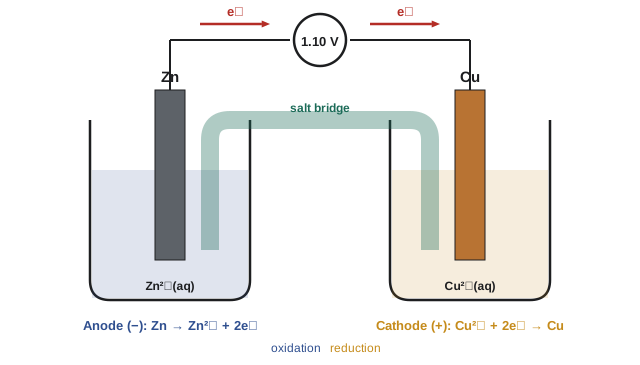
The parts of every electrochemical cell:
- The anode is where oxidation happens. In a galvanic cell it is the negative terminal.
- The cathode is where reduction happens. In a galvanic cell it is the positive terminal.
- Electrons flow through the external circuit from anode to cathode.
- The salt bridge (or a porous separator) lets ions move to keep both compartments electrically neutral, completing the circuit.
Shorthand notation lists the anode on the left and the cathode on the right, with a single line for a phase boundary and a double line for the salt bridge: Zn(s) | Zn²⁺(aq) || Cu²⁺(aq) | Cu(s).
Standard electrode potentials
Each half-reaction has a tendency to proceed as a reduction, measured by its standard reduction potential \(E^\circ\), in volts, relative to the standard hydrogen electrode (2H⁺ + 2e⁻ → H₂, defined as 0.00 V) at 25 °C, 1 M concentrations and 1 bar for gases. Some values:
- Li⁺ + e⁻ → Li: −3.04 V
- Mg²⁺ + 2e⁻ → Mg: −2.37 V
- Al³⁺ + 3e⁻ → Al: −1.66 V
- Zn²⁺ + 2e⁻ → Zn: −0.76 V
- Fe²⁺ + 2e⁻ → Fe: −0.44 V
- 2H⁺ + 2e⁻ → H₂: 0.00 V
- Cu²⁺ + 2e⁻ → Cu: +0.34 V
- O₂ + 2H₂O + 4e⁻ → 4OH⁻: +0.40 V
- Ag⁺ + e⁻ → Ag: +0.80 V
- O₂ + 4H⁺ + 4e⁻ → 2H₂O: +1.23 V
The more positive \(E^\circ\), the stronger the tendency to be reduced. Metals with very negative potentials, such as lithium, magnesium and zinc, give up electrons easily: they are active and corrode readily. Metals near the top, such as copper, silver, gold and platinum, are noble.
The standard cell voltage is the cathode potential minus the anode potential, both written as reductions:
A positive \(E^\circ_{\text{cell}}\) means the reaction is spontaneous as written.
Worked problem
The Daniell cell
Find the standard voltage of the zinc–copper cell.
Show solution
- Copper is reduced (cathode, +0.34 V); zinc is oxidized (anode, −0.76 V).
- \(E^\circ_{\text{cell}} = 0.34 - (-0.76) = 1.10\) V.
Answer: 1.10 V
Cell voltage, energy and concentration
The electrical work a cell can do is its charge times its voltage. For \(n\) moles of electrons, the charge is \(nF\), where Faraday's constant \(F = 96\,485\) C/mol is the charge on a mole of electrons. The maximum useful work equals the decrease in Gibbs free energy:
For the Daniell cell (\(n = 2\)): \(\Delta G^\circ = -2(96\,485)(1.10) = -212\) kJ per mole of zinc. A negative \(\Delta G\) means the reaction is spontaneous, consistent with the positive voltage.
Away from standard conditions, the voltage depends on concentration through the Nernst equation, which at 25 °C reads
Worked problem
A cell running down
A Daniell cell has [Zn²⁺] = 1.0 M but [Cu²⁺] has fallen to 0.010 M. Find its voltage.
Show solution
- \(Q = [\text{Zn}^{2+}]/[\text{Cu}^{2+}] = 1.0/0.010 = 100\).
- \(E = 1.10 - (0.0592/2)\log 100 = 1.10 - 0.0296 \times 2 = 1.04\) V.
Answer: About 1.04 V. The voltage falls slowly as the cell discharges, then drops sharply as a reactant runs out
Batteries and fuel cells
A battery is one or more galvanic cells packaged for use. Primary batteries (alkaline cells) are used once; secondary batteries (lead–acid, nickel–metal hydride, lithium-ion) can be recharged by driving the reaction backward with an external current. A lithium-ion cell has a nominal voltage of about 3.6 to 3.7 V because lithium has such a negative potential; a phone cell rated 3.7 V and 3 Ah stores \(3.7 \times 3 = 11.1\) Wh. Lead–acid cells give about 2.0 V each, so a 12 V car battery has six cells in series.
A fuel cell is a galvanic cell fed continuously with fuel and oxidant. A hydrogen fuel cell combines H₂ and O₂ to make water. Its theoretical voltage is \(E^\circ = 237.1 \text{ kJ}/(2 \times 96\,485) = 1.23\) V; real cells operate at about 0.6 to 0.8 V under load, which sets their efficiency.
Electrolysis
Applying an external voltage larger than the cell voltage drives a non-spontaneous reaction. This is electrolysis. In an electrolytic cell the anode is still where oxidation happens and the cathode where reduction happens, but now the anode is connected to the positive terminal of the supply.
Michael Faraday showed that the amount of substance produced is proportional to the charge passed. The mass deposited or released is
where \(I\) is current, \(t\) time, \(M\) molar mass and \(n\) the number of electrons per formula unit.
Worked problem
Electroplating copper
A part is copper-plated at 2.0 A for 1.0 hour (Cu²⁺ + 2e⁻ → Cu). What mass of copper is deposited?
Show solution
- Charge: \(Q = It = 2.0 \times 3600 = 7200\) C.
- Moles of electrons: \(7200/96\,485 = 0.0746\) mol; moles of Cu: \(0.0373\) mol.
- Mass: \(0.0373 \times 63.55 = 2.37\) g.
Answer: 2.37 g of copper
Worked problem
Smelting aluminum
An aluminum smelting cell runs at 300 kA. How much aluminum can it produce per day (Al³⁺ + 3e⁻ → Al), and how much if the current efficiency is 95%?
Show solution
- Charge per day: \(300\,000 \times 86\,400 = 2.59 \times 10^{10}\) C.
- Moles of Al: \(2.59 \times 10^{10}/(3 \times 96\,485) = 89\,500\) mol.
- Mass: \(89\,500 \times 26.98 = 2.42 \times 10^6\) g = 2.42 t; at 95%, about 2.30 t.
Answer: About 2.3 tonnes per cell per day. A smelter has hundreds of cells, which is why aluminum plants are built next to cheap hydroelectric power, as in Quebec and British Columbia
Electrolysis of water makes hydrogen: 2H₂O → 2H₂ + O₂. The minimum voltage is 1.23 V; practical electrolysers run at about 1.8 to 2.0 V. At 1.8 V, 1 kWh of electricity produces about 21 g of hydrogen, so a kilogram needs roughly 48 kWh plus losses elsewhere in the plant. That electricity cost is the main challenge for producing "green" hydrogen.
Corrosion
Corrosion of metals is an unwanted galvanic cell. Most metals occur in nature as oxides, sulphides or carbonates; refining them takes energy, and corrosion is the metal returning to its lower-energy state. For iron and steel, the overall process is rusting:
The Fe²⁺ and OH⁻ combine and oxidize further to hydrated iron(III) oxide, Fe₂O₃·xH₂O: rust. Rust is porous and flaky, so unlike the oxide on aluminum or stainless steel, it does not protect the metal beneath.
Corrosion needs four things, and preventing any one stops it: an anode, a cathode, an electrolyte (water with dissolved ions) and an electrical connection between anode and cathode. Salt speeds corrosion enormously because it makes water a far better electrolyte, which is why cars rust faster in places that salt their roads in winter.
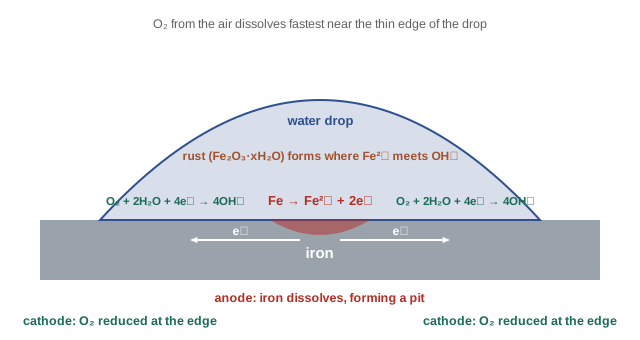
Forms of corrosion
- Uniform corrosion: even thinning over a surface. Predictable, so engineers add a corrosion allowance to wall thicknesses.
- Galvanic corrosion: two different metals in electrical contact in an electrolyte. The more active metal becomes the anode and corrodes faster. Steel bolts in an aluminum boat, or copper pipe joined directly to galvanized steel, are classic examples.
- Pitting and crevice corrosion: concentrated attack in small areas, such as under a deposit or in a gap starved of oxygen. Small and hard to spot, it can perforate a pipe or tank while most of the surface looks fine.
- Stress corrosion cracking: cracks driven by the combination of tensile stress and a corrosive environment. It has caused pipeline ruptures and is a key concern for sour (H₂S-containing) service in the oil and gas industry.
Worked problem
Measuring a corrosion rate
A steel test coupon with 20 cm² of exposed area loses 0.50 g in 30 days in a cooling water system. Find the corrosion rate in mm per year (steel density 7.87 g/cm³).
Show solution
- Volume lost: \(0.50/7.87 = 0.0635\) cm³. Thickness lost: \(0.0635/20 = 3.18 \times 10^{-3}\) cm in 30 days.
- Per year: \(3.18 \times 10^{-3} \times 365/30 = 0.0387\) cm = 0.39 mm.
Answer: About 0.39 mm per year. A pipe with a 3 mm corrosion allowance would be used up in under eight years, so this water needs better treatment
Preventing corrosion
Engineers protect metal in several complementary ways:
- Material selection: stainless steel (at least about 10.5% chromium) forms a thin, self-healing chromium oxide film; aluminum is protected by its own oxide; plastics and fibreglass avoid the problem altogether.
- Coatings: paint, epoxy and polymer wraps keep water and oxygen away from the metal. Their weakness is any defect, where corrosion can concentrate.
- Galvanizing: coating steel with zinc. The zinc is a barrier and also a sacrificial anode: where the coating is scratched, zinc corrodes instead of the exposed steel.
- Design: avoid crevices and water traps, insulate dissimilar metals from each other, and allow drainage and inspection.
- Environment control: remove oxygen from boiler feedwater, adjust pH, and add corrosion inhibitors to cooling water.
Cathodic protection
If the whole structure is made the cathode of a cell, it cannot corrode. Cathodic protection does this in two ways. A sacrificial anode of a more active metal (magnesium, zinc or aluminum) is connected to the structure and corrodes in its place. Alternatively, an impressed-current system uses a DC power supply and long-life anodes to push protective current onto the structure. Buried pipelines, storage tank bottoms, ship hulls and offshore platforms all use cathodic protection, usually together with a coating, and regulators require it for most buried steel pipelines.
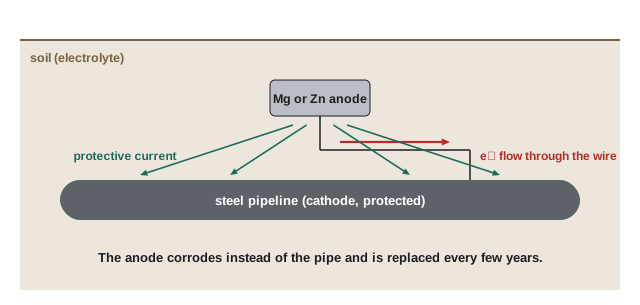
Worked problem
How long will an anode last?
A 10 kg zinc anode supplies an average protective current of 0.10 A. Estimate its life (Zn → Zn²⁺ + 2e⁻; one year is \(3.16 \times 10^7\) s).
Show solution
- Charge per year: \(0.10 \times 3.16 \times 10^7 = 3.16 \times 10^6\) C.
- Zinc consumed: \(\dfrac{3.16 \times 10^6 \times 65.38}{2 \times 96\,485} = 1070\) g per year.
- Life: \(10\,000/1070 = 9.3\) years.
Answer: About 9 years in theory. Designers apply a utilization factor (about 0.85) because an anode stops working well before it is completely consumed, giving roughly 8 years
Common mistakes
MistakeMixing up the anode and cathode, or tying them to + and − in every cell.
InsteadOxidation is always at the anode, reduction at the cathode. The sign of the anode differs between galvanic (−) and electrolytic (+) cells.
MistakeMultiplying E° by the coefficients in a balanced half-reaction.
InsteadE° does not depend on how many electrons you write. Only ΔG = −nFE scales with n.
MistakeComputing E°cell as E°anode − E°cathode, or adding the two reduction potentials.
InsteadE°cell = E°cathode − E°anode, both as reduction potentials.
MistakeForgetting n, the number of electrons, in Faraday's law.
InsteadAluminum needs 3 electrons per atom; copper needs 2. m = ItM/(nF).
MistakeJoining copper or brass fittings directly to steel or aluminum.
InsteadUse dielectric unions or insulating gaskets to break the galvanic couple.
MistakeAssuming a painted structure needs no further protection.
InsteadAny coating defect concentrates corrosion; buried and submerged steel normally gets cathodic protection as well.
Summary and key terms
- Oxidation is loss of electrons, reduction is gain; they always occur together.
- In a galvanic cell, oxidation at the anode (−) drives electrons through a wire to the cathode (+); a salt bridge carries ions.
- E°cell = E°cathode − E°anode; positive means spontaneous. Active metals have very negative E°.
- ΔG° = −nFE°; the Nernst equation E = E° − (0.0592/n) log Q corrects for concentration.
- Electrolysis uses electrical energy to drive non-spontaneous reactions; m = ItM/(nF).
- Corrosion is an unwanted galvanic cell needing an anode, cathode, electrolyte and connection.
- Forms include uniform, galvanic, pitting, crevice and stress corrosion cracking.
- Protection: material choice, coatings, galvanizing, design, environment control and cathodic protection.
- Oxidation
- Loss of electrons; increase in oxidation state.
- Reduction
- Gain of electrons; decrease in oxidation state.
- Anode
- The electrode where oxidation occurs.
- Cathode
- The electrode where reduction occurs.
- Standard reduction potential
- E°, the tendency of a half-reaction to proceed as a reduction, relative to hydrogen.
- Faraday constant
- F = 96 485 C, the charge on one mole of electrons.
- Electrolysis
- Driving a non-spontaneous reaction with an external current.
- Galvanic corrosion
- Accelerated corrosion of the more active of two connected metals.
- Cathodic protection
- Preventing corrosion by making a structure the cathode of a cell.
- Sacrificial anode
- A more active metal that corrodes in place of the protected structure.
Practice problems
Work each problem on paper first, then reveal the answer to check.
In 2 Al + 3 Cu²⁺ → 2 Al³⁺ + 3 Cu, identify the oxidizing and reducing agents.
Show answer
Al is oxidized (reducing agent); Cu²⁺ is reduced (oxidizing agent).
Find E°cell for a magnesium–copper cell.
Show answer
0.34 − (−2.37) = 2.71 V.
Will silver metal dissolve in 1 M HCl, releasing H₂? Explain with potentials.
Show answer
No. E°cell = 0.00 − 0.80 = −0.80 V, negative, so the reaction is not spontaneous.
Find ΔG° for the magnesium–copper cell per mole of Mg.
Show answer
−2 × 96 485 × 2.71 = −523 kJ.
A zinc–copper cell has [Zn²⁺] = 0.10 M and [Cu²⁺] = 1.0 M. Find its voltage.
Show answer
Q = 0.10. E = 1.10 − 0.0296 log 0.10 = 1.10 + 0.030 = 1.13 V.
How long does it take to deposit 5.0 g of silver (Ag⁺ + e⁻ → Ag) at 1.5 A?
Show answer
n = 5.0/107.87 = 0.0464 mol of electrons. t = 0.0464 × 96 485/1.5 = 2980 s ≈ 50 min.
What current is needed to produce 1.0 kg of hydrogen per hour by electrolysis?
Show answer
1000/2.016 = 496 mol H₂ = 992 mol e⁻ per hour. I = 992 × 96 485/3600 = 26 600 A.
A steel bolt holds an aluminum plate on a boat in seawater. Which corrodes faster, and why?
Show answer
Aluminum (E° −1.66 V) is more active than steel (−0.44 V), so the aluminum becomes the anode and corrodes around the bolt. Insulating washers would help.
A corrosion current density of 1 μA/cm² on steel corresponds to what corrosion rate?
Show answer
Rate = iM/(nFρ) = (10⁻⁶)(55.85)/(2 × 96 485 × 7.87) cm/s = 3.68 × 10⁻¹¹ cm/s ≈ 0.0116 mm/year.
Why does a scratch in galvanized steel not rust, while a scratch in tin-plated steel rusts quickly?
Show answer
Zinc (−0.76 V) is more active than iron and becomes the sacrificial anode. Tin (−0.14 V) is less active than iron, so at a scratch the iron becomes the anode and corrodes faster than if uncoated.
Lesson quiz · 5 questions
Score 60% or more to complete this lesson.
Create a free account to save your progress, take quizzes and earn a certificate.