
CHE-446 · Lesson 3 of 12 · 21 min
Material and energy balances for the flowsheet
Once the flowsheet is chosen, the next deliverable is the heat and material balance: a consistent set of flows, compositions, temperatures, pressures and duties for every stream and every unit. Almost everything else in FEL-3 depends on it. Equipment is sized from it, utilities are estimated from it, raw material costs come from it, and the environmental permit applications quote it. Ingrid tells Theo that a design report with an inconsistent balance loses the reader's trust on the first page, because a reviewer who finds that the flows do not add up will not believe anything else in it.
For the ester line, the balance has to tie together results Theo produced in three earlier courses. The pre-reactor conversion came from CHE-345, the decanter split and column products from CHE-350, and the control-related hold-ups from CHE-374. Each was worked out on its own. Now they have to agree with each other at the same production rate, with the recycles closed, so that what goes into the plant equals what comes out.
Overall balance first
Theo starts with the simplest possible balance: the whole plant as a single box. The inputs are fresh acetic acid and fresh ethanol. The outputs are ethyl acetate product, the water made by the reaction, and losses of acid, ethanol and ester to the water stream and the purge. The overall balance does not need to know anything about the recycles; it depends only on the product rate and the overall yields. It is the first check against which every detailed balance is compared.
With a product rate of 26.1 kmol/h, overall yields close to 99 % on acid and on ethanol mean that slightly more than 26.1 kmol/h of each must be fed. The water made equals the ester formed, about 26.2 kmol/h, which is just under half a metric ton an hour. That water is the main liquid stream leaving the line apart from the product, and where it goes is a design decision that lesson 11 discusses.
Recycle loops and tear streams
The detailed balance is harder because of the recycles. The amount of unreacted acid returned to the reactor depends on how much acid enters the reactor, which depends on how much is recycled. The equations are circular. There are two ways to solve them. The first is to write all the equations for all the units together and solve them simultaneously, which is the equation-oriented approach. The second, used by most commercial simulators by default, is the sequential modular approach: guess the flows in one or more recycle streams, called tear streams, calculate the units one after another around the loop, compare the calculated recycle with the guess, update the guess and repeat until they agree.
Theo writes a short program that does the sequential modular calculation for the ester line, treating the reaction section and the separation section as two blocks. The reaction section converts 65.2 % of the acid entering it, from CHE-345, at an ethanol to acid ratio of 1.2. The separation section sends 99.7 % of the ester to product, returns 98.5 % of the unreacted acid and 99.5 % of the unreacted ethanol to the reactor, and sends the rest to the water stream. The fresh acid is adjusted on each pass until the product rate reaches 26.1 kmol/h, and the fresh ethanol is set to keep the 1.2 ratio at the reactor inlet.
# Recycle loop for the ethyl acetate line solved by successive substitution (sequential modular idea)
X = 0.652          # acid conversion per pass in the pre-reactor and reaction zone (CHE-345)
ratio = 1.20       # ethanol to acid ratio at the reactor inlet
rec_acid, rec_eth = 0.985, 0.995       # fractions of unreacted acid and ethanol returned
rec_ester = 0.997                      # ester recovered to product
P_target = 26.1                        # kmol/h product
FA, FE = 26.0, 26.0                    # first guesses for fresh feeds
RA = RE = 0.0                          # torn recycle streams
for it in range(1, 60):
    A_in = FA + RA; E_in = ratio * A_in
    FE = E_in - RE
    react = X * A_in
    A_un, E_un = A_in - react, E_in - react
    RA_new, RE_new = rec_acid * A_un, rec_eth * E_un
    prod = rec_ester * react
    FA = FA * P_target / prod          # adjust fresh acid until product meets target
    err = abs(RA_new - RA) + abs(RE_new - RE)
    RA, RE = RA_new, RE_new
    if err < 1e-6: break
print(f"converged in {it} passes")
print(f"fresh acid   {FA:6.2f} kmol/h = {FA*60.05/1000:.3f} t/h")
print(f"fresh ethanol {FE:6.2f} kmol/h = {FE*46.07/1000:.3f} t/h")
print(f"reactor inlet acid {A_in:6.2f}, ethanol {E_in:6.2f} kmol/h")
print(f"recycle acid {RA:6.2f}, recycle ethanol {RE:6.2f} kmol/h")
print(f"water made   {react:6.2f} kmol/h = {react*18.02/1000:.3f} t/h")
loss_acid = A_un - RA; loss_eth = E_un - RE
print(f"losses to wastewater: acid {loss_acid:.2f}, ethanol {loss_eth:.2f}, ester {react-prod:.3f} kmol/h")
print(f"overall acid yield {prod/FA:.3f}, ethanol yield {prod/FE:.3f}")
mass_in = FA*60.05 + FE*46.07; mass_out = prod*88.11 + react*18.02 + loss_acid*60.05 + loss_eth*46.07 + (react-prod)*88.11
print(f"mass in {mass_in:,.0f} kg/h, mass out {mass_out:,.0f} kg/h")converged in 33 passes fresh acid 26.39 kmol/h = 1.585 t/h fresh ethanol 26.29 kmol/h = 1.211 t/h reactor inlet acid 40.15, ethanol 48.18 kmol/h recycle acid 13.76, recycle ethanol 21.89 kmol/h water made 26.18 kmol/h = 0.472 t/h losses to wastewater: acid 0.21, ethanol 0.11, ester 0.079 kmol/h overall acid yield 0.989, ethanol yield 0.993 mass in 2,796 kg/h, mass out 2,796 kg/h
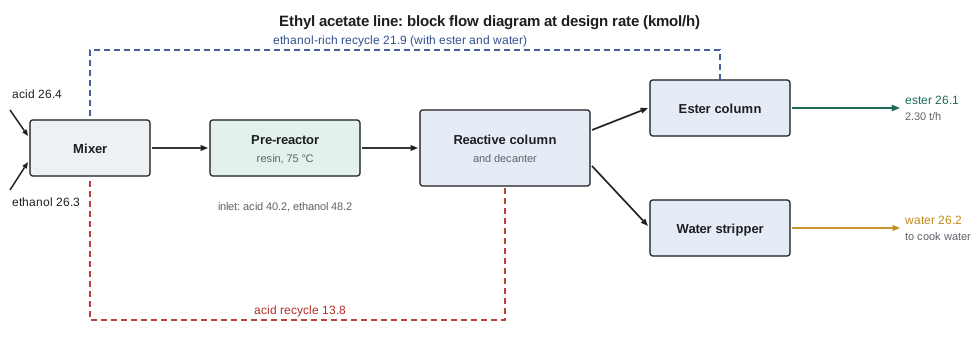
The loop converges in 33 passes. The reactor sees about 40.2 kmol/h of acid, of which 26.4 is fresh and 13.8 is recycled, and 48.2 kmol/h of ethanol, of which 26.3 is fresh and 21.9 recycled. Fresh feeds are 1.59 t/h of acid and 1.21 t/h of ethanol, the water made is 0.47 t/h, and the losses to the water stream are about 0.21 kmol/h of acid, 0.11 of ethanol and 0.08 of ester. The overall mass check closes to the kilogram: about 2,796 kg/h in and 2,796 kg/h out. That closure is not an accident. It is the test that the equations are coded correctly, and Theo would not trust a balance that missed by more than rounding.
The ratio of recycle to fresh feed is worth noticing. About a third of the acid entering the reactor and almost half of the ethanol are recycled. The equipment in the loop, from the reactor to the columns and the pumps between them, has to be sized for the total flow, not the fresh feed. A designer who sized the reactor for fresh feed alone would build one that was a third too small. The recycle also amplifies the effect of small losses: if the separation lost 1 % more of the unreacted acid on each pass, the fresh acid would rise by about 0.14 kmol/h, a little over 2 % of the plant's acid bill.
Worked problem
Recycle from conversion and recovery
The reactor converts a fraction \(X = 0.652\) of the acid entering it, and the separations return a fraction \(r = 0.985\) of the unreacted acid. If the fresh acid is \(F\), what is the acid entering the reactor, \(A\)?
Show solution
- Balance at the mixer: \(A = F + r(1 - X)A\).
- Solve: \(A = F / [1 - r(1 - X)] = F / (1 - 0.985 \times 0.348) = 1.522\,F\).
- With \(F = 26.39\) kmol/h: \(A = 40.2\) kmol/h, as the program found.
Answer: The reactor sees about 1.52 times the fresh acid; the recycle is about 0.52 times the fresh feed.
For a single loop like this, the answer can be written down directly, as the example shows. That is useful as a check on the program. In a full simulation with dozens of units, several components and nonideal thermodynamics, there is no closed form, and the sequential calculation, often accelerated by methods such as Wegstein's or Broyden's, is how the simulator finds the answer. CHE-460 covers those methods and the simulators that use them. For FEL-3, the team builds a full model in the company's simulator, but Theo's short program remains the check that the simulator's answers make sense.
Energy balances
The material balance is followed by an energy balance on each unit: the heat added in reboilers and heaters, the heat removed in condensers and coolers, and the heat released or absorbed by the reaction. Esterification is mildly exothermic, a few kJ/mol, so the reaction heat is small compared with the latent heat moved in the columns. The energy balance of the ester line is dominated by distillation. The reactive column's reboiler and the ester column's reboiler together need roughly 2.4 MW of steam, and their condensers reject about the same amount of heat to cooling water. The pumps and agitators use well under 100 kW of power.
Energy balances are where the units of the earlier courses are checked against one another. Theo finds one inconsistency. The CHE-350 estimate of the reactive column reboiler duty, 1,450 kW, assumed a feed at its bubble point, but in the flowsheet the pre-reactor effluent arrives slightly subcooled after the feed and effluent exchanger. The extra sensible heat is small, about 30 kW, but the stream table and the reboiler sizing must use the same number. He corrects the reboiler duty and notes the change in the design basis log.
| Stream | Flow kmol/h | Main components | Conditions |
|---|---|---|---|
| Fresh acetic acid | 26.4 | Acid with traces of water | 30 °C, from heated storage |
| Fresh ethanol | 26.3 | Ethanol, under 0.5 % water | Ambient, from the sieve day tank |
| Reactor inlet | 88.3 (40.2 acid, 48.2 ethanol) | Acid, ethanol, some ester and water | 75 °C |
| Ester product | 26.1 | Ethyl acetate, at least 99.7 % | Cooled to 35 °C |
| Water out | About 26.6 | Water with small amounts of acid, ethanol and ester | From the stripper bottoms |
Checking a balance
Ingrid gives Theo a checklist she has used for twenty years. The overall mass balance should close. The element balances should close too: carbon in equals carbon out, oxygen in equals oxygen out. Every component should have a way out. Recycle flows should be plausible: if a recycle is much larger than the fresh feed, ask why. Duties should match the latent heats and flows: a reboiler boiling a known vapor flow needs a known duty. Compositions should be physically possible: no stream should contain a mixture that would split into two liquid phases unless a decanter is expecting it. And the balance should be checked at more than one rate, because a design that only balances at 100 % is not a design that can be operated.
The last point matters for the ester line, because the economics in lesson 9 assume it runs at 70 % of capacity in its first year. Theo reruns his program with the product target at 18.3 kmol/h, 70 % of design. The recycle structure scales, but the columns are then running at 70 % of their design vapor rate, which is within the turndown range of the structured packing chosen in CHE-350. At 50 % the packing would start to lose efficiency, a limit he records in the design basis as the minimum continuous operating rate.
Finally, the balance has to be presented. A stream table should be complete, with every stream numbered on the PFD, with flows given both in mass and moles, and with the basis stated: design rate, feed compositions and the version of the thermodynamic model used. The team issues it as a controlled document. When anything changes later, the balance is revised, the revision is numbered and every document that used the old one is flagged for update. The discipline seems bureaucratic, but large projects have been delayed by months when two disciplines worked from different versions of the same balance.
Common mistakes
MistakeSizing recycle-loop equipment for the fresh feed.
InsteadEquipment in the loop sees fresh plus recycle flow.
MistakeAccepting a balance that does not close.
InsteadA mass balance that does not close shows an error in the equations or the data.
MistakeChecking only at design rate.
InsteadCheck turndown and start-up rates too; the plant must operate across a range.
MistakeLetting different documents use different versions of the balance.
InsteadIssue the balance as a controlled document and revise it formally.
Summary and key terms
- The heat and material balance is the foundation of every other FEL-3 document.
- Recycle loops are solved by tearing a stream and iterating, or by solving all equations together.
- The ester line feeds 26.4 kmol/h of acid and 26.3 of ethanol; the reactor sees about 1.5 times the fresh acid.
- Overall yields are about 98.9 % on acid and 99.3 % on ethanol, and the mass balance closes at about 2,796 kg/h.
- Energy use is dominated by the column reboilers, about 2.4 MW together.
- Heat and material balance
- A consistent set of flows, compositions, conditions and duties for every stream and unit.
- Tear stream
- A stream whose values are guessed to break a recycle loop for iterative calculation.
- Sequential modular
- Solving a flowsheet unit by unit, iterating on tear streams until recycles converge.
- Equation oriented
- Solving all the flowsheet equations together.
- Stream table
- The table of stream data that accompanies a process flow diagram.
- Turndown
- The lowest rate at which equipment still works properly, as a fraction of design.
Practice problems
Work each problem on paper first, then reveal the answer to check.
Why is the overall balance done first?
Show answer
It depends only on product rate and yields, and it checks the detailed balance.
How large is the acid recycle relative to fresh acid?
Show answer
About 0.52 times the fresh acid.
What does a mass balance that does not close tell you?
Show answer
There is an error in the equations or the data.
Why must the balance be checked at reduced rates?
Show answer
The plant must operate during start-up and at turndown, and equipment limits may bind there.
Which units dominate the ester line's energy use?
Show answer
The column reboilers and condensers.
Name two element balances that should close.
Show answer
Carbon and oxygen (and hydrogen).
Lesson quiz · 5 questions
Score 60% or more to complete this lesson.
Create a free account to save your progress, take quizzes and earn a certificate.