
CHE-446 · Lesson 1 of 12 · 24 min
The design process and project stages
The ethyl acetate line has been in Theo Laurent's working life for three years. In CHE-345 he sized the resin pre-reactor that starts the esterification. In CHE-350 he worked out the purification train: the reactive distillation column, the decanter, the ester column and the water stripper. In CHE-374 he wrote its control strategy, and in CHE-380 he sat on the hazard review that found an undersized relief valve and an overfill scenario on the product tanks. Every one of those studies answered a technical question. None of them answered the question that Kingfisher Bioenergy's owners care about most: should the company spend tens of millions of US dollars to build the line at all?
This course follows Theo as the line goes through its last study stage before that decision. Malik Osei, who runs process engineering at the Cedar Rapids site, has been named project sponsor. Ingrid Solheim, Theo's mentor since his first work term, leads the design team. Lucia Moreau, a cost estimator from the engineering contractor the company has hired for the front-end work, joins them, and so do the specialists Theo already knows: Nadia Brandt for process safety, Wren Halvorsen for environment and permits, Priya Venkat for industrial hygiene, Dev in the laboratory and Carla Fontaine, the senior panel operator, who will run the line if it is built. The result of the study will be a design report and a recommendation to Kingfisher's board.
Process design is the work of turning a chemical idea into a plant that can be built, operated safely and run at a profit. It draws on everything a chemical engineer has learned: thermodynamics to predict phase behavior, kinetics and reactor design to size the reaction section, separations to purify the product, heat transfer and fluid mechanics to size equipment, control and safety to make the plant operable, and economics to decide whether it is worth building. What makes design different from the courses that taught those subjects is that the problem is open. There is no single right answer, information is always incomplete, and every decision has to be made before the next piece of information arrives.
Why design is done in stages
Large capital projects are developed in stages, with a decision point, often called a gate, at the end of each. At each gate the owner decides whether to spend the money needed for the next stage, change the scope, or stop. The logic is simple. Early studies are cheap and decisions taken early have the greatest influence on the final cost and performance of the plant. Later studies are expensive, and by the time detailed design and construction begin, most of the cost has been locked in by choices made long before. A staged process lets the owner spend a little money to learn a lot before committing a lot of money.
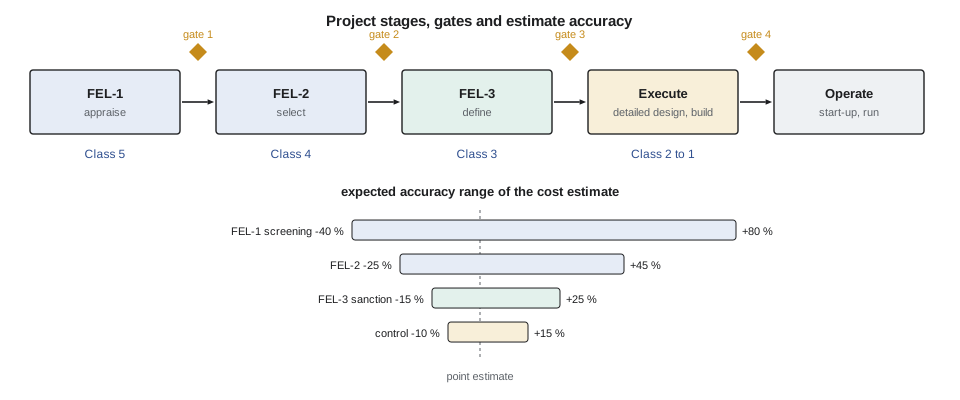
Many companies call the early stages front-end loading, or FEL. In the first stage, sometimes called appraise or FEL-1, the team checks whether the opportunity is real: is there a market, does a feasible process exist, is the order of magnitude of cost and profit attractive? In the second stage, select or FEL-2, the team compares alternative process routes, sites, capacities and technologies, and picks one. In the third stage, define or FEL-3, the chosen option is developed in enough detail to support a budget-quality cost estimate, a schedule and a funding request. After the sanction gate, the project moves into execution: detailed engineering, procurement, construction and commissioning. Other companies use different names, such as conceptual, pre-feasibility, feasibility and basic engineering, but the idea is the same.
Studies cost money. The code below uses rule-of-thumb shares of installed cost for each front-end stage, applied to the screening estimate of about 42 million US dollars that Malik's team produced last year by scaling the cost of a larger published plant. Even at FEL-3, the study cost is a few percent of the project. That is cheap insurance against building the wrong plant.
# Design basis for the ethyl acetate line and what each project stage costs to study (illustrative)
ester_kmol_h = 26.1                 # product rate from the CHE-350 purification train
M_ester = 88.11                     # kg/kmol
hours = 8400                        # on-stream hours per year (about 96 % of the year)
t_h = ester_kmol_h * M_ester / 1000
print(f"product rate     {t_h:.2f} t/h")
print(f"nameplate        {t_h*hours:,.0f} t/yr at {hours} h/yr")
print(f"at 90 % of hours {t_h*hours*0.90:,.0f} t/yr")
# AACE-style estimate classes: (stage, project definition %, low %, high %) for a point estimate
classes = [("Class 5  concept screening", "0-2", -40, 80), ("Class 4  feasibility (FEL-1)", "1-15", -25, 45),
           ("Class 3  budget / sanction (FEL-3)", "10-40", -15, 25), ("Class 2  control", "30-75", -10, 15)]
point = 42.4                        # million, the FEL-1 screening estimate scaled from a reference plant
print("\nexpected range around a point estimate of", point, "million")
for name, defn, lo, hi in classes:
    print(f"  {name:36s} definition {defn:>6s} %   {point*(1+lo/100):5.1f} to {point*(1+hi/100):5.1f} million")
# Front-end loading: study cost as a share of installed cost (rule-of-thumb ranges, illustrative mid-points)
fel = [("FEL-1 appraise", 0.005), ("FEL-2 select", 0.015), ("FEL-3 define", 0.040)]
total = 0
print("\nfront-end study cost")
for name, f in fel:
    total += f * point
print(f" {name:16s} {f*100:4.1f} % of installed cost = {f*point:5.2f} million (cumulative {total:5.2f})")product rate 2.30 t/h nameplate 19,317 t/yr at 8400 h/yr at 90 % of hours 17,386 t/yr expected range around a point estimate of 42.4 million Class 5 concept screening definition 0-2 % 25.4 to 76.3 million Class 4 feasibility (FEL-1) definition 1-15 % 31.8 to 61.5 million Class 3 budget / sanction (FEL-3) definition 10-40 % 36.0 to 53.0 million Class 2 control definition 30-75 % 38.2 to 48.8 million front-end study cost FEL-1 appraise 0.5 % of installed cost = 0.21 million (cumulative 0.21) FEL-2 select 1.5 % of installed cost = 0.64 million (cumulative 0.85) FEL-3 define 4.0 % of installed cost = 1.70 million (cumulative 2.54)
The output shows two things Theo needs to keep in mind. First, the nameplate capacity of about 19,300 t/yr assumes the line runs 8,400 hours a year, which leaves about 360 hours, or two weeks, for shutdowns and upsets. Marketing should be told whether the sales forecast is based on the nameplate or on a lower realistic figure. Second, a screening estimate of 42 million could turn out anywhere from about 25 to 76 million. Nobody would sanction a plant on that basis. The purpose of FEL-3 is to narrow the range to roughly minus 15 to plus 25 percent, which is what most companies require before they release funds.
Estimate classes
The accuracy of a cost estimate depends on how much of the project has been defined. The Association for the Advancement of Cost Engineering, AACE International, publishes a widely used classification that links the maturity of the design to the expected accuracy. A Class 5 estimate is prepared when less than about 2 % of the engineering is done, often by scaling from a similar plant, and may be off by a factor of two. A Class 3 estimate, typical of the sanction gate, is based on a complete process design with equipment sized and priced, and is expected to fall within roughly minus 10 to 20 % and plus 10 to 30 % of the final cost. The exact ranges vary with the technology and with how new the process is; a process with novel steps carries a wider range than a copy of a proven plant.
The estimate class is not just a statement of uncertainty. It is a statement of what has been done. An estimator who calls a number Class 3 should be able to show the process flow diagrams, the heat and material balances, the equipment list with sizes, the plot plan and the vendor quotations behind it. Lucia's first request to Theo is for exactly those documents. Without them, she says, any number she produces is still a Class 4 number with false precision.
| Stage | Main question | Typical deliverables | Estimate class |
|---|---|---|---|
| FEL-1 appraise | Is the opportunity worth studying? | Market note, block flow diagram, scaled cost | Class 5 |
| FEL-2 select | Which option should be developed? | Option comparison, preliminary balances, factored estimate | Class 4 |
| FEL-3 define | Should the company build it? | Design basis, PFDs, heat and material balances, equipment list, P&IDs issued for review, plot plan, Class 3 estimate, schedule | Class 3 |
| Execute | Build it on budget and on time | Detailed design, purchase orders, construction | Class 2 then 1 |
The design basis
The first document of FEL-3 is the design basis memorandum. It records the decisions and data that every other document will depend on, so that the dozens of people working on the project use the same assumptions. Theo drafts it from the earlier studies and circulates it for comment. Ingrid insists that every number in it has a source, and that numbers which are assumptions are labeled as such, so that they can be checked later.
A design basis normally covers the product and its specification, the capacity and the operating hours, the feedstocks and their specifications, the utilities available at the site and their conditions and prices, the site conditions such as ambient temperatures, elevation, wind and seismic data, the design codes and standards to be used, environmental limits, the plant's operating philosophy, and the economic basis for evaluating the project. For the ester line, the product is ethyl acetate of at least 99.7 % purity with low water and acidity, meeting the specification of the coatings and adhesives customers Marketing has lined up. The feeds are glacial acetic acid, bought from an outside supplier and delivered by rail, and anhydrous ethanol from Kingfisher Bioenergy's own molecular sieves.
The site conditions matter more than students expect. The design must allow for an Iowa winter, so acetic acid, which freezes at about 17 °C, needs heated and insulated storage and piping. Cooling water is warmer in August than in January, so condensers are sized for summer. The steam system at Cedar Rapids supplies low-pressure steam from the existing boilers, and the ethanol plant has spare capacity only up to a point. The power supply, the fire water system, the nitrogen supply and the wastewater treatment capacity all set limits that the new line has to fit within.
Worked problem
Capacity and operating hours
The ester column makes 26.1 kmol/h of ethyl acetate. The line is designed to run 8,400 h/yr. What is its nameplate capacity, and what annual output should be used for the economics if the team expects the line to run 90 % of those hours in its early years?
Show solution
- Mass rate: \(26.1 \times 88.11 / 1000 = 2.30\) t/h.
- Nameplate: \(2.30 \times 8{,}400 \approx 19{,}300\) t/yr.
- Early years: \(0.90 \times 19{,}300 \approx 17{,}400\) t/yr.
Answer: About 19,300 t/yr nameplate, and about 17,400 t/yr while the line is learning to run.
Codes, standards and the people who approve the plant
A plant is not only designed to work. It is designed to comply. The design basis lists the codes and standards that apply, and these come from law, from the company's own engineering standards and from the requirements of insurers. In Iowa, the pressure vessels and piping must meet the ASME Boiler and Pressure Vessel Code, Section VIII, as adopted by the Iowa boiler and pressure vessel program. Electrical equipment in areas where flammable vapors may be present must follow Articles 500 and 505 of the National Electrical Code, which offer both the Class and Division system and the Zone system. Process safety management follows OSHA's Process Safety Management standard, 29 CFR 1910.119, together with EPA's Risk Management Program rule where a listed chemical exceeds its threshold quantity. The project needs an air construction permit from the Iowa Department of Natural Resources followed by an update to the site's Title V operating permit, registration and inspection of the pressure vessels under the Iowa boiler and pressure vessel program, a local building permit, and a check of whether the new inventories bring any substance under EPA's Risk Management Program. Lesson 11 returns to permits, because they can set the schedule of the whole project.
Engineering documents for the line must be sealed by a licensed PE, who takes professional responsibility for them under the rules of the Iowa Engineering and Land Surveying Examining Board. As an engineer-in-training, Theo can prepare calculations and drawings, but they must be checked and sealed by a licensed engineer, in this case Ingrid. That is not a formality. The seal means the engineer has satisfied herself that the work is competent and that the public is protected. Ingrid checks Theo's work with that in mind, and she expects him to show his assumptions so that she can.
How a design team works
Design is iterative. A first pass through the flowsheet produces sizes and costs; the costs show which parts of the plant matter most; the team returns to those parts and refines them. The rule Ingrid repeats is to spend effort where it changes the answer. A pump that costs a few thousand US dollars can be sized in minutes from a rule of thumb. A distillation column that dominates the energy bill deserves careful work. Lessons 2 to 6 build the technical design, from the choice of flowsheet through balances, heat integration and equipment sizing. Lessons 7 to 9 turn the design into capital and operating costs and then into a measure of profitability. Lessons 10 and 11 bring in sustainability, safety and permits, and lesson 12 assembles the design report and the recommendation.
The most common failure in early design is not a wrong calculation. It is an unexamined assumption: a feed purity nobody confirmed, a utility that turns out to be fully used, a product specification that a key customer will not accept, or a cost basis from a different country and year. A good design basis exposes those assumptions so they can be challenged. Carla's first comment on Theo's draft is a good example. The draft assumes the line will be run from the existing control room by the current crew with no extra operators. She asks who will do the field rounds on the new equipment during a turnaround of the ethanol plant, and the answer changes the labor cost in lesson 8.
Common mistakes
MistakeTreating a screening estimate as a budget.
InsteadA Class 5 number can be off by a factor of two; it justifies a study, not a plant.
MistakeStarting design before the design basis is agreed.
InsteadEvery document depends on the basis; changes later ripple through all of them.
MistakeUsing nameplate capacity for early-year revenue.
InsteadNew plants rarely run at full rate in their first year; the economics should reflect a ramp-up.
MistakeLeaving assumptions unlabeled.
InsteadMark every assumed number so it can be checked and replaced when data arrive.
Summary and key terms
- Process design turns a chemical idea into a plant that can be built, operated safely and run at a profit.
- Projects are developed in front-end stages with decision gates, so that a little money buys information before a lot is committed.
- Cost estimates are classified by the maturity of the design; a sanction-quality Class 3 estimate needs a complete process design.
- The design basis memorandum records the product, capacity, feeds, utilities, site conditions, codes and economic basis.
- The ester line's nameplate capacity is about 19,300 t/yr of ethyl acetate at 8,400 operating hours a year.
- Front-end loading
- The early study stages of a project, before the decision to build.
- Gate
- A decision point at the end of a stage where the owner decides whether to continue.
- Estimate class
- A classification that links the maturity of the design to the expected accuracy of a cost estimate.
- Design basis memorandum
- The document that records the data and decisions every other design document depends on.
- Nameplate capacity
- The rate a plant is designed to make at full rate over its planned operating hours.
- Sanction
- The formal approval to spend the money to build a project.
Practice problems
Work each problem on paper first, then reveal the answer to check.
Why do early design decisions matter more than later ones?
Show answer
They fix the process, capacity and site, which lock in most of the final cost, while costing little to change.
What does a Class 3 estimate need behind it?
Show answer
A complete process design: balances, flow diagrams, sized equipment list, plot plan and priced equipment.
How many hours a year does an 8,400-hour design leave for shutdowns?
Show answer
About 360 hours, roughly two weeks.
Name four items in a design basis.
Show answer
Product specification, capacity and hours, feed specifications, utilities, site data, codes, environmental limits, economic basis.
Why must acetic acid storage be heated at Cedar Rapids?
Show answer
Glacial acetic acid freezes at about 17 °C.
What does an engineer's seal on a design document mean?
Show answer
That a licensed engineer takes professional responsibility for the work and has checked it.
Lesson quiz · 5 questions
Score 60% or more to complete this lesson.
Create a free account to save your progress, take quizzes and earn a certificate.