
CHE-446 · Lesson 12 of 12 · 21 min
Capstone: design report and investment decision
Eight months after FEL-3 began, the team has a design, an estimate and an economic model. What it does not yet have is a decision. FEL-3 ends at a gate where Kingfisher's board decides whether to sanction the project, that is, to commit the full capital and move into detailed engineering, procurement and construction. The design report is the document that supports that decision, and this capstone lesson puts it together. It also does the last piece of analysis: comparing the options that have come up during the course and recommending one.
The options
Through FEL-3, several ideas were set aside for a final comparison. Ingrid insists that they are compared on the same basis, with the same model, so that the differences are real. Five options go into the comparison.
| Option | Description | Change to capital | Change to annual margin |
|---|---|---|---|
| A | Base design as estimated in lesson 7 | None | None |
| B | A plus MVR on the ester column | +1.6 million | +0.30 million |
| C | A plus a five-year acid supply contract | None | -0.13 million, narrower spread |
| D | B and C together | +1.6 million | +0.17 million |
| E | A, deferred by one year | None | None, one year later |
Option B adds the MVR compressor from lesson 6. It saves about 0.35 million a year in steam and spends about 0.05 million on electricity, a net gain of about 0.30 million a year for 1.6 million of capital; the saving is smaller than it would be with a carbon price, because there is none. Option C is Malik's proposal: a five-year contract with the acid supplier that links the acid price to the ester price through a formula, so that the spread between them moves less. The supplier asks a premium for this, worth about 0.13 million a year, but the standard deviation of the margin falls from about 15 % to about 8 %. Option D combines both. Option E defers the decision by one year, to wait for better market information.
# Investment decision for the ethyl acetate line in Iowa: options compared (illustrative)
EBITDA = 6.73e6
MVR = 0.345e6 - 0.050e6              # steam saved - electricity used, per year
def DEP(capex, n): return [capex] + [0.0] * (n - 1)   # 100 % bonus depreciation
import random
tax, years, r, wc = 0.25, 15, 0.10, 2.6e6
def cashflows(capex, margin, delay=0):
    cf = [0.0] * delay + [-0.40 * capex, -0.60 * capex - wc]
    sched = DEP(capex, years)
    for y in range(1, years + 1):
        m = margin * (0.70 if y == 1 else 1.0)
        cf.append(m - tax * (m - sched[y - 1]))
    cf[-1] += wc
    return cf
def npv(cf): return sum(c / (1 + r) ** t for t, c in enumerate(cf))
def risk(capex, margin, sd, delay=0, n=5000):
    random.seed(446); out = []
    for _ in range(n):
        cap = capex * random.triangular(0.85, 1.25, 1.0)
        out.append(npv(cashflows(cap, margin + EBITDA * random.gauss(0, sd), delay)))
    out.sort(); return out[n // 2], sum(o < 0 for o in out) / n
fci = 34.8e6
cases = [("A  base design", fci, EBITDA, 0.15, 0),
         ("B  base + vapor recompression on ester column", fci + 1.6e6, EBITDA + MVR, 0.15, 0),
         ("C  base + five-year acid supply contract", fci, EBITDA - 0.13e6, 0.08, 0),
         ("D  B and C together", fci + 1.6e6, EBITDA + MVR - 0.13e6, 0.08, 0),
         ("E  defer one year, no change", fci, EBITDA, 0.15, 1)]
print("case                                                NPV M   median MC   P(NPV<0)")
for n, cap, m, sd, d in cases:
    med, p = risk(cap, m, sd, d)
print(f" {n:50s} {npv(cashflows(cap, m, d))/1e6:5.2f} {med/1e6:5.2f} {p*100:4.0f} %")case NPV M median MC P(NPV<0) A base design 6.14 5.20 16 % B base + vapor recompression on ester column 6.43 5.46 15 % C base + five-year acid supply contract 5.49 4.61 8 % D B and C together 5.78 4.86 7 % E defer one year, no change 5.58 4.72 16 %
The results are in the table the code prints. Option B has the highest NPV, about 6.4 million, because the MVR pays back its capital. Option C has a lower NPV, about 5.5 million, because of the contract premium, but its chance of a negative NPV falls from about 16 % to about 8 %. Option D sits between them on value, about 5.8 million, and has the lowest chance of loss, about 7 %. Option E, deferral, has a lower NPV, about 5.6 million, with no reduction in risk, because waiting a year discounts every cash flow by a further year.
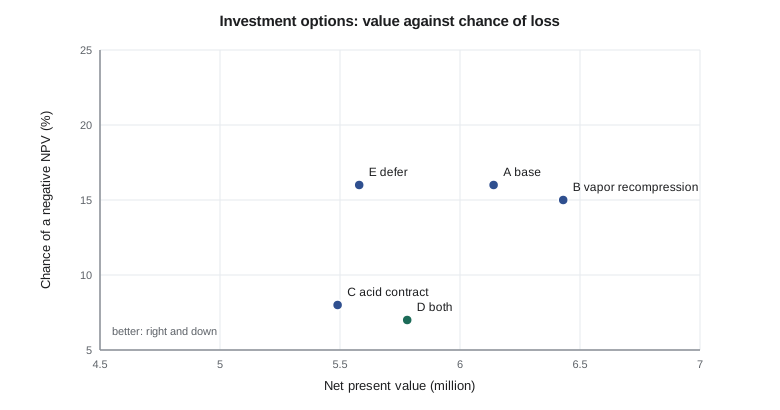
Choosing between value and risk
Finance theory says to pick the option with the highest expected NPV, because a company with many projects can diversify away the risk of any one of them. In practice, many companies, and particularly smaller ones, care about the chance of loss as well, because a failed project costs more than its NPV: management attention, credibility with lenders, and the chance to propose the next project. Kingfisher Bioenergy is a single-site company whose main business is fuel ethanol. The ester line would be its first specialty chemical, and its success or failure will shape what the board is willing to try next.
Ingrid, Malik and Theo agree on recommending option D. It gives up about 0.6 million of NPV relative to option B, and in return it cuts the chance of a negative outcome roughly in half. The MVR is kept because it is the one option that adds value and reduces carbon at the same time. The acid contract is kept because the margin is the largest sensitivity in the tornado chart, and the contract is the cheapest way to narrow it. Deferral is rejected because there is nothing a year's wait would teach that the contract does not already address, and because waiting costs value.
Worked problem
Value of the contract
The contract costs about 0.65 million of NPV (option B minus option D) and lowers the chance of a negative NPV from about 15 % to about 7 %. If a failed project is judged to cost the company an extra 10 million in lost credibility and opportunity, is the contract worth it?
Show solution
- Reduction in the chance of failure \(= 0.15 - 0.07 = 0.08\).
- Expected value of avoided failure cost \(= 0.08 \times 10 = 0.8\) million.
- This is more than the 0.65 million the contract costs.
Answer: On that judgment, the contract is worth having. The 10 million is a judgment, not a calculation, and the report says so; but it makes the trade-off explicit for the board.
The design report
The FEL-3 design report is the record of what has been decided and why. It is written for several readers: the board, who will read the summary and the economics; the detailed engineering contractor, who will use the design basis and equipment list; the regulators, who will see the parts that go into the permit applications; and the operations team, who will run the plant and need to know what assumptions were made about how it will be run. Theo drafts it under Ingrid's direction, and each specialist writes or reviews the section in their area.
| Section | Content | Main source |
|---|---|---|
| Executive summary | Recommendation, NPV, IRR, risk, capital, schedule | Lessons 9 and 12 |
| Design basis | Capacity, feeds, product, utilities, site conditions | Lesson 1 |
| Process description | Flowsheet, alternatives considered, PFD | Lessons 2 and 3 |
| Heat and material balance | Stream table, energy use, heat integration | Lessons 3 and 4 |
| Equipment list | Sizes, materials, design conditions | Lessons 5 and 6 |
| Capital estimate | Class 3 estimate, basis, contingency | Lesson 7 |
| Operating costs | Cost of production at nameplate and reduced rates | Lesson 8 |
| Economics | Cash flows, NPV, sensitivity, Monte Carlo, options | Lessons 9 and 12 |
| Sustainability | Carbon footprint, green metrics | Lesson 10 |
| Safety and environment | Inherent safety, HAZOP findings, emissions, permits | Lesson 11 |
| Schedule and execution plan | Approvals, engineering, procurement, construction | Lesson 11 |
| Risks and open items | Register of risks, assumptions to confirm | All lessons |
The executive summary is the hardest part to write, and Ingrid has Theo rewrite it four times. It must state the recommendation in the first sentence, give the key numbers in the first paragraph, and be honest about the risk. Her test is that a board member who reads only the first page should be able to vote and explain the vote. The summary Theo finally submits opens: the team recommends that the board sanction the ethyl acetate line with mechanical vapor recompression and a five-year acid supply contract, at a fixed capital of about 36.4 million and a working capital of about 2.6 million; on the base case the project returns about 12 to 13 % after tax against a 10 % cost of capital, with about a one-in-ten chance of failing to earn that cost.
Conditions and open items
A good recommendation also says what must be true for it to hold. The report lists conditions for sanction and items to close during detailed engineering. The conditions are: the acid supply contract signed on the terms assumed; the air application submitted on schedule; and a successful laboratory trial of sending the process water to the ethanol plant's cook water.
In Iowa the tax treatment is settled: the line qualifies for 100 % bonus depreciation, and the tax department confirms the assumption. The open items include the vendor's final guarantee on the reactive column packing, the final relief and flare study, and the HAZOP on the completed P&IDs.
The risk register lists the main threats to the project, each with an owner and a plan: a capital overrun, controlled by fixed-price bids for the columns and tanks; a late permit, controlled by early engagement with the department; a weak market in the first year, controlled by signing letters of intent with the three largest customers before start-up; and a catalyst or packing that underperforms, controlled by the vendor's guarantee. Each risk links to the sensitivity analysis, so the board can see how much each one could cost.
The decision
Kingfisher's board meets at the end of the eighth month. Ingrid presents the engineering; Malik presents the market and the economics; Nadia presents the safety case and confirms that the hazard reviews have found nothing that the design cannot handle. The board asks about the margin: what if the acid price rises and the ester price does not follow? Malik shows the contract formula and the tornado chart. The board asks about the capital: how confident is the team in the estimate? Lucia explains the Class 3 basis and the 15 % contingency, and shows the comparison with the FEL-1 figure. The board asks about safety: Nadia explains the inventory reduction and the overfill protection. After an hour, the board approves option D, subject to the conditions in the report.
For Theo, the approval is the end of the course and the start of the project. His design will now be taken apart and rebuilt in much greater detail by the contractor, and some of his numbers will turn out to be wrong. That is expected; the purpose of front-end design is not to be exactly right, but to be right enough, early enough, that the decision to invest is a sound one, and that the plant that is eventually built is the one the business needs. On his first day of detailed engineering he finds the equipment list on the contractor's server with his name in the revision block, and a note from Ingrid: keep the design file up to date.
One more item goes into the report at Ingrid's request: a plan for a post-investment review. Two years after start-up, the team will compare what was built and how it performs with what the FEL-3 report predicted: the capital spent against the estimate, the steam and raw material use against the balance, the margin against the model, the schedule against the plan. Most companies that do this find that their estimates are biased in a consistent direction, and the only way to correct the bias is to measure it. The review will also feed the company's own cost database, so that the next estimate, perhaps for a second specialty product, starts from real numbers from its own site.
Common mistakes
MistakeComparing options with different models or assumptions.
InsteadUse one model and change only what each option changes.
MistakeChoosing only on expected NPV for a single-site company.
InsteadConsider the chance of loss and what failure would cost beyond the NPV.
MistakeDeferring to wait for information that will not arrive.
InsteadDeferral has a cost; it is worth it only if the wait reduces risk.
MistakeBurying the recommendation in the report.
InsteadState it in the first sentence of the summary.
MistakePresenting a recommendation without conditions.
InsteadList what must be true for it to hold and who will confirm it.
Summary and key terms
- Five options are compared with one model: base, MVR, acid contract, both, and deferral.
- MVR has the highest NPV; the acid contract cuts the chance of loss the most.
- Option D, MVR plus the contract, is recommended as the best balance of value and risk.
- Deferral lowers value without reducing risk.
- The design report states the recommendation first and lists conditions and open items.
- Sanction
- The formal decision to commit capital to a project.
- Final investment decision
- Another name for sanction, used widely in industry.
- Option
- An alternative design or commercial arrangement compared at the decision gate.
- Risk register
- A list of project risks with owners, likelihoods, impacts and plans.
- Executive summary
- The opening section of a report, giving the recommendation and key numbers.
- Condition for sanction
- Something that must be confirmed before the commitment takes effect.
Practice problems
Work each problem on paper first, then reveal the answer to check.
Why are all options compared with the same model?
Show answer
So that differences come from the options, not the model.
Which option has the highest NPV?
Show answer
Option B, MVR.
Why is deferral rejected?
Show answer
It lowers NPV and does not reduce risk.
What does the acid contract do to the margin spread?
Show answer
Cuts its standard deviation from about 15 % to about 8 %.
What is the fixed capital of the recommended option?
Show answer
About 36.4 million.
What should the first sentence of the executive summary state?
Show answer
The recommendation.
Lesson quiz · 5 questions
Score 60% or more to complete this lesson.
Create a free account to save your progress, take quizzes and earn a certificate.