
CHE-446 · Lesson 11 of 12 · 21 min
Safety, environment and permitting in design
Safety and environmental protection are not added to a design at the end. The cheapest and most effective time to make a plant safe is when the flowsheet and the layout are still being drawn, because that is when the hazards themselves can be removed or reduced, rather than guarded against. By the time the plant is being built, the only options left are added protection: alarms, trips, relief valves, fire protection, procedures. These work, but they cost money every year, they can fail, and they depend on people maintaining them. This lesson follows how the ester line's design changed during FEL-3 as the team looked at it through safety, environmental and permitting eyes.
Inherent safety
Trevor Kletz, who led safety work at ICI for many years, put the idea simply: what you do not have cannot leak. His principles of inherently safer design are usually grouped under four words. Minimize: use smaller quantities of hazardous material. Substitute: use a less hazardous material or process. Moderate: use hazardous materials in a less hazardous form or at less severe conditions. Simplify: design out opportunities for error, so that the plant is forgiving when something goes wrong. Each principle is applied by asking, at each stage of design, whether a hazard could be removed rather than controlled.
The ester line handles three flammable liquids. Ethyl acetate has a flash point of about minus 4 °C and ethanol about 13 °C, so both can form flammable mixtures with air at ordinary temperatures. Acetic acid has a flash point of about 39 °C and is also corrosive. The largest inventories are in the storage tanks, not the process, and that is where the team looks first.
Reducing the inventory
Lesson 6 left a question from Carla: does the line really need 14 days of product storage? Malik looks at the shipping pattern. Most product goes by truck, several loads a week, and the larger customers take railcars. With a weekly rail loading slot agreed with the railway and the larger customers, about a week of storage is enough. The first draft allowed two 1,000 m³ product tanks, so that one can receive product while the other is tested and shipped; the revised design uses two 600 m³ tanks instead.
# Inherent safety and permitting in design for the ester line (illustrative)
# 1. Inventory: metric tons of flammable liquid on site in two storage strategies
opts = {"two 1,000 m3 product tanks (14 days)": 2 * 1000 * 0.85 * 0.90,
        "two 600 m3 product tanks + rail loading weekly": 2 * 600 * 0.85 * 0.90}
for k, v in opts.items(): print(f"{k:50s} {v:6.0f} t ester")
cut = 1 - list(opts.values())[1] / list(opts.values())[0]
print(f"inventory reduction {cut*100:.0f} %")
# 2. Wastewater organic load from losses (lesson 3), as chemical oxygen demand
cod = {"acetic acid": (0.21 * 60.05, 1.07), "ethanol": (0.11 * 46.07, 2.09), "ethyl acetate": (0.079 * 88.11, 1.82)}
tot = 0
for k, (kg_h, f) in cod.items():
    tot += kg_h * f; print(f"  COD from {k:14s} {kg_h*f:6.1f} kg/h")
flow = 0.60                                   # m3/h of process water
print(f"total COD {tot:.1f} kg/h = {tot*24:.0f} kg/d, about {tot/flow*1000:,.0f} mg/L in {flow} m3/h of process water")
# 3. Permit and approval schedule: critical path in months from FEL-3 start (illustrative durations)
tasks = [("FEL-3 design and estimate", 0, 8), ("air and wastewater applications prepared", 3, 4),
         ("regulator review and decision", 7, 9), ("pressure equipment registration", 9, 6),
         ("detailed engineering", 8, 10), ("procurement of long-lead columns", 10, 9),
         ("construction", 16, 12), ("commissioning and start-up", 28, 3)]
end = 0
print("\ntask                                         start   end (month)")
for n, s, d in tasks:
    end = max(end, s + d); print(f"  {n:42s} {s:5d}   {s+d:5d}")
print(f"start-up about month {end}")two 1,000 m3 product tanks (14 days) 1530 t ester two 600 m3 product tanks + rail loading weekly 918 t ester inventory reduction 40 % COD from acetic acid 13.5 kg/h COD from ethanol 10.6 kg/h COD from ethyl acetate 12.7 kg/h total COD 36.8 kg/h = 882 kg/d, about 61,255 mg/L in 0.6 m3/h of process water task start end (month) FEL-3 design and estimate 0 8 air and wastewater applications prepared 3 7 regulator review and decision 7 16 pressure equipment registration 9 15 detailed engineering 8 18 procurement of long-lead columns 10 19 construction 16 28 commissioning and start-up 28 31 start-up about month 31
The change cuts the maximum product inventory by about 40 %, from about 1,530 t to about 920 t. Smaller tanks mean a smaller dike, a smaller fire to plan for, and smaller separation distances from the site boundary and from other equipment. They also cost less: Lucia estimates a saving of about 0.6 million in tanks, foundations and fire protection, and less working capital tied up in product. Theo notes that in this case the safer design is also the cheaper one, which is often true when the change is made early and rarely true when it is made late.
The same thinking applies elsewhere. The acid tank stays at 21 days, because the acid comes by rail from a single supplier and running out would stop the line, but the acid is moderated: it is stored warm enough to stay liquid but well below its flash point. The ethanol day tank is small because the ethanol comes by pipe from the existing plant, which is itself a minimization: no ethanol trucks, no unloading hoses. In the process, the reactive column combines reaction and separation in one vessel, which cuts the number of vessels holding hot flammable liquid, and the decision in lesson 2 to use a solid catalyst rather than sulfuric acid removed a corrosive, hazardous liquid from the plant entirely.
| Principle | Applied on the ester line |
|---|---|
| Minimize | Product storage cut by about 40 %; ethanol by pipe, not truck |
| Substitute | Solid resin catalyst instead of sulfuric acid |
| Moderate | Acid stored warm but below its flash point; low-pressure columns |
| Simplify | Reaction and separation combined in one column; sealless acid pumps |
Hazard reviews during design
Inherent safety removes some hazards; the rest need protection, and a design team uses formal reviews to find them. In FEL-3, Nadia leads a hazard identification workshop on the PFD and a preliminary HAZOP, a hazard and operability study, on the first P&IDs. A HAZOP takes each section of the plant and applies guide words such as no flow, more pressure, less level or reverse flow to each design intention, asking what could cause the deviation, what would follow, what protects against it and whether more is needed. The full HAZOP is held during detailed engineering, when the P&IDs are complete, but holding a first pass in FEL-3 catches the issues that would change the cost.
Two findings change the estimate. The first concerns the reactive column. If cooling water to the condenser fails while steam to the reboiler continues, the column pressure rises; the relief valve and its line to the site flare must be sized for that case, and the flare header must have room for it. The second concerns tank overfill. Filling a product tank from the column with the outlet closed could overflow it into the dike. The team adds an independent high-high level trip that stops the product pump and closes the inlet valve, assessed with a layer of protection analysis and designed as a safety instrumented function under ANSI/ISA-61511-1-2018, the US adoption of IEC 61511.
The project also falls under OSHA's Process Safety Management standard, 29 CFR 1910.119, together with EPA's Risk Management Program rule where a listed chemical exceeds its threshold quantity. The team reviews the threshold quantities and confirms which parts of the new line are covered, so that the process safety information, the hazard analysis, the operating procedures, the training and the management of change are planned from the start rather than added at handover. Electrical equipment in the areas where flammable vapor may be present is classified under Articles 500 and 505 of the National Electrical Code, which offer both the Class and Division system and the Zone system, which also affects cost: motors and instruments for classified areas cost more.
Environmental design
The main environmental questions for the ester line are air emissions and wastewater. Air emissions are mostly volatile organic compounds from tank breathing and from truck and railcar loading. The design uses nitrogen blanketing on all flammable tanks, vapor balancing during loading so that the vapor displaced from the railcar returns to the tank rather than to the air, and a vent condenser on the columns. The remaining vents go to the ethanol plant's existing thermal oxidizer, which has spare capacity. Dispersion modeling of the remaining emissions forms part of the air application, which Wren prepares. Priya points out that vapor balancing helps the loading crew as much as the air: without it, the operator at the top of a railcar stands in the displaced vapor, and her exposure estimate for the loading rack drops well below the OSHA limit once it is in place.
Wastewater is the more interesting problem. The water stripper from lesson 3 sends about 0.6 m³/h of process water to treatment, carrying small amounts of acid, ethanol and ester. The code converts those losses into chemical oxygen demand, COD, the standard measure of the organic load in water. The total is about 37 kg/h, or nearly 900 kg a day, and the concentration is high, about 61,000 mg/L, because the volume is so small. Sent to the site's wastewater treatment, this would be a significant new load.
Worked problem
A better destination
The ethanol plant uses about 150 m³/h of water to cook and ferment the corn. Could the ester line's 0.6 m³/h of process water go there instead of to treatment?
Show solution
- Dilution: \(150/0.6 = 250\), so the COD in the cook water would rise by about \(61{,}000/250 \approx 245\) mg/L.
- Acetic acid and ethanol at these levels are already present in the ethanol plant's recycle water, and the yeast tolerate them.
- Ethyl acetate at about 45 mg/L after dilution would be stripped in the ethanol plant's beer column and recovered with the ethanol.
Answer: Sending the water to the cook removes most of the new treatment load, subject to a trial with the ethanol plant's fermentation team.
The ethanol plant's fermentation team agrees to a trial, with Dev running laboratory fermentations on spiked cook water first, and the design includes a line to the cook water tank with a connection to the treatment plant as a backup. This is a small example of the integration that makes the project work: the ester line uses the ethanol plant's ethanol, steam, nitrogen, thermal oxidizer, control room and wastewater system, and gives back water that the ethanol plant can use.
Permits and approvals
The line needs several approvals before construction can start or the plant can operate. In Iowa, these are an air construction permit from the Iowa Department of Natural Resources followed by an update to the site's Title V operating permit, registration and inspection of the pressure vessels under the Iowa boiler and pressure vessel program, a local building permit, and a check of whether the new inventories bring any substance under EPA's Risk Management Program. Each has its own timeline, and some cannot be applied for until the design is far enough advanced to describe the emissions and equipment. The site's emergency planning must also be reviewed against EPA's Risk Management Program rule, 40 CFR Part 68, and the new tanks against land-use guidance from guidance from the Center for Chemical Process Safety, since there are no federal numerical risk criteria in the US.
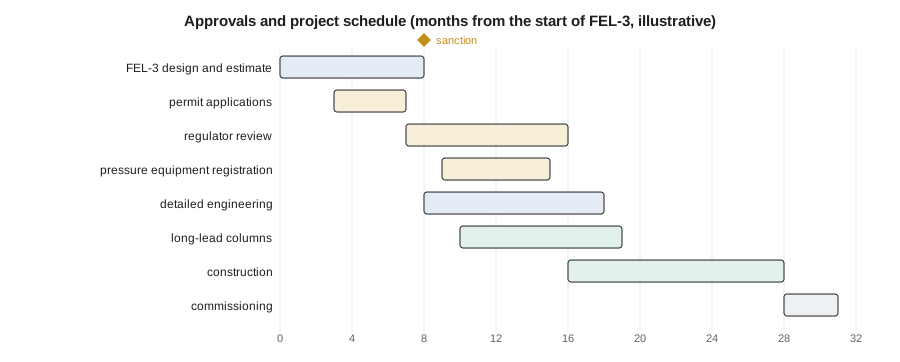
The schedule shows why permitting is part of design. The air application is prepared during FEL-3 from the emission estimates and goes in around month 7. The regulator's review may take most of a year, and construction cannot start on the emission sources until it is complete. Meanwhile, detailed engineering and procurement of the long-lead columns go ahead at risk after sanction. On this schedule, construction starts around month 16 and the line starts up around month 31. A delay of six months in the approvals would push start-up back by about the same amount.
A six-month delay would cost about half a year of margin, around 3 million US dollars before tax, which is why Wren wants the applications submitted on time even if it means fixing some design details early.
Common mistakes
MistakeTreating safety as protection added after the design.
InsteadRemove hazards first through inherently safer design.
MistakeSizing storage without asking about shipping patterns.
InsteadInventory is both a cost and a hazard; size it from logistics.
MistakeLeaving the HAZOP until the design is frozen.
InsteadA first pass in FEL-3 finds the issues that change cost.
MistakeSending small, concentrated streams to treatment by default.
InsteadLook for a use within the site, such as cook water.
MistakeStarting permits after detailed design.
InsteadApprovals are on the critical path and need FEL-3 data.
Summary and key terms
- Inherently safer design minimizes, substitutes, moderates and simplifies.
- Cutting product storage from two 1,000 m³ tanks to two 600 m³ tanks reduces inventory by about 40 % and saves money.
- A first-pass HAZOP in FEL-3 adds a relief case and a tank overfill trip.
- Process water carrying about 37 kg/h of COD can go to the ethanol plant's cook water instead of treatment.
- Approvals are on the critical path; start-up is about month 31.
- Inherently safer design
- Design that removes or reduces hazards rather than controlling them.
- HAZOP
- A structured review that applies guide words to design intentions to find deviations.
- Layer of protection analysis
- A method to decide whether the protections against a scenario are enough.
- Vapor balancing
- Returning displaced vapor from a vehicle being loaded to the source tank.
- Chemical oxygen demand
- The oxygen needed to oxidize the organic matter in water, a measure of organic load.
- Critical path
- The sequence of tasks that sets the earliest finish date.
Practice problems
Work each problem on paper first, then reveal the answer to check.
State Kletz's four principles.
Show answer
Minimize, substitute, moderate, simplify.
What is the product inventory after the change?
Show answer
About 920 t.
What case sets the reactive column's relief load?
Show answer
Cooling water failure with steam still on the reboiler.
Why is the process water's COD concentration so high?
Show answer
The flow is very small, about 0.6 m³/h.
What is the dilution of the process water in the cook water?
Show answer
About 250 times.
Why are permits on the critical path?
Show answer
Construction of emission sources cannot start until approval, and review can take most of a year.
Lesson quiz · 5 questions
Score 60% or more to complete this lesson.
Create a free account to save your progress, take quizzes and earn a certificate.