
CHE-374 · Lesson 12 of 12 · 22 min
Capstone: a control strategy for the ester column and decanter
Malik's capstone assignment for Theo is the control strategy for the ethyl acetate purification train he helped design in CHE-350: the ester column, its reflux drum, the decanter and the links to the reactive column and stripper. The deliverable is a control narrative, a set of marked-up P&IDs, a loop list with initial tuning, the safety functions and the alarm list, reviewed by Ingrid for the process and by Carla for operability, and sealed by Malik as a licensed PE. The work follows the steps that experienced control engineers use on a new unit: objectives first, then inventory, then quality, then constraints, then safety.
Step 1: objectives and degrees of freedom
Theo starts by writing down what the unit must achieve. The ester product leaving the column bottoms must meet 99.9 wt % ester, with low water and acidity. The column distillate must stay near the ternary azeotrope, so that the recycle to the decanter does not grow. The decanter must split cleanly into its two layers, which requires a steady temperature and interface. Inventories, the reflux drum level, the column sump level and the decanter interface, must stay within their working ranges. The column pressure must be held to keep the tray temperatures meaningful. And the unit must not exceed its steam supply, its condenser capacity or its flooding limit.
He then counts the manipulated variables: feed from the decanter's ester layer, reflux, distillate, bottoms, reboiler steam, condenser cooling, decanter cooling water, the decanter's ester-layer and water-layer outflows, and the nitrogen and vent valves for pressure. Each is a degree of freedom. Some are used up by inventories, which must be controlled whatever else happens; the rest are available for quality and constraints.
Step 2: inventory control
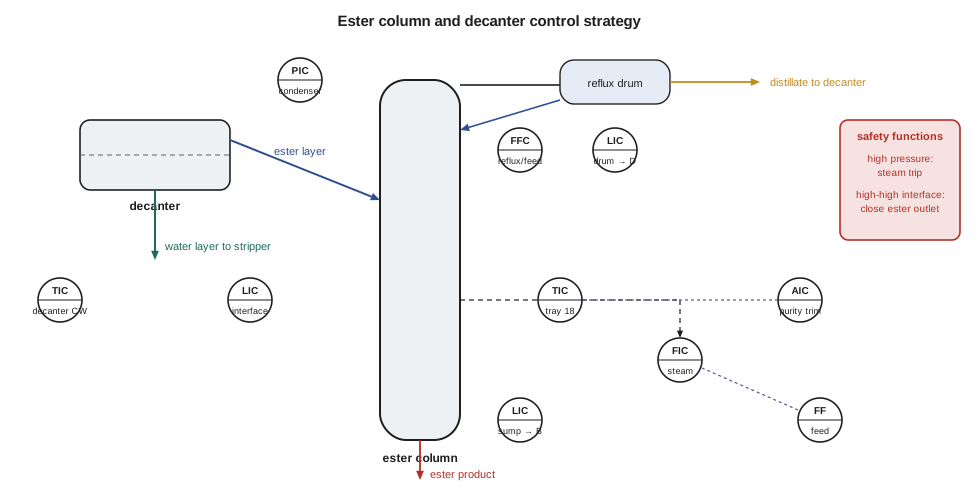
Inventory loops come first because an uncontrolled level or pressure stops a unit faster than an off-specification product. Theo decides the direction of inventory control from the throughput manipulator. The ester column's feed rate is set by the decanter, which is in turn set by the reactive column upstream, so the throughput is set at the feed, and inventories downstream are controlled in the direction of flow: the reflux drum level by distillate, the sump level by bottoms, the decanter interface by the water-layer outflow and its upper level by the ester-layer outflow to the column. The column pressure is held by the condenser cooling, with the nitrogen and vent split range of lesson 9 on the drum.
Most of these levels are surge capacity. Their job is to absorb flow upsets and pass them on gently, not to hold the level at a set point tightly. Tight level control would turn every upset into a flow upset downstream, so averaging level control is used: a slow controller that lets the level move within its range. For an integrating process with gain \(K_p\), the lambda method gives \(K_c = 2/(K_p\lambda)\) and \(T_i = 2\lambda\), where \(\lambda\) is the desired arrest time.
# Capstone calculations for the ester column and decanter control strategy
import math
# 1. Choose the temperature control tray: steady-state change for +1 % and -1 % boil-up (illustrative rigorous-model results)
up = [0.02, 0.03, 0.05, 0.08, 0.14, 0.25, 0.42, 0.61, 0.74, 0.70, 0.52, 0.31, 0.17, 0.09, 0.05]
dn = [-0.02, -0.03, -0.05, -0.08, -0.13, -0.23, -0.40, -0.66, -0.81, -0.66, -0.47, -0.28, -0.15, -0.08, -0.04]
trays = [2 * i + 2 for i in range(15)]                # every second tray, numbered from the top
best = max(range(15), key=lambda i: min(up[i], -dn[i]))
for i in range(5, 12):
    print(f"tray {trays[i]:2d}: +1 % boil-up {up[i]:+.2f} degC, -1 % {dn[i]:+.2f} degC, symmetry {min(up[i], -dn[i]) / max(up[i], -dn[i]):.2f}")
print(f"control tray chosen: tray {trays[best]} (largest gain in both directions)")
# 2. Tray temperature loop: step test gave K 0.78 degC per %, tau 9.0 min, theta 3.0 min -> SIMC PI with tau_c = theta
K, tau, th = 0.78, 9.0, 3.0
Kc, Ti = tau / (K * 2 * th), min(tau, 8 * th)
print(f"tray temperature PI: Kc = {Kc:.2f} % per degC, Ti = {Ti:.1f} min (steam flow set point, cascade)")
# 3. Averaging level control: reflux drum and decanter interface are integrating processes
for name, A, span, flow_span, lam in (("reflux drum level", 2.0, 2.0, 36.0, 8.0), ("decanter interface", 3.5, 1.2, 12.0, 20.0)):
    Kp = (flow_span / 60) / (A * span)      # fraction of level span per minute per fraction of valve span
    Kc_l = 2 / (Kp * lam); Ti_l = 2 * lam
    print(f"{name}: integrating gain {Kp:.4f} 1/min, lambda {lam:.0f} min -> Kc = {Kc_l:.2f}, Ti = {Ti_l:.0f} min")
    # a 20 % step in inflow: peak level deviation for lambda tuning is about 0.74 x (flow step) x lambda x Kp
    dev = 0.736 * 0.20 * lam * Kp
    print(f"   a 20 % flow upset moves the level by about {100 * dev:.0f} % of span at the peak")
# 4. Inventory of the strategy
loops = (("flow", 6), ("level", 4), ("pressure", 2), ("temperature", 3), ("analyzer", 2))
print("loops by type:", ", ".join(f"{k} {v}" for k, v in loops), f"-> {sum(v for k, v in loops)} loops")
print("safety functions: high column pressure trips reboiler steam (SIL 1); low-low reflux drum level trips the reflux pump; high-high decanter interface closes the ester-layer outlet")tray 12: +1 % boil-up +0.25 degC, -1 % -0.23 degC, symmetry 0.92 tray 14: +1 % boil-up +0.42 degC, -1 % -0.40 degC, symmetry 0.95 tray 16: +1 % boil-up +0.61 degC, -1 % -0.66 degC, symmetry 0.92 tray 18: +1 % boil-up +0.74 degC, -1 % -0.81 degC, symmetry 0.91 tray 20: +1 % boil-up +0.70 degC, -1 % -0.66 degC, symmetry 0.94 tray 22: +1 % boil-up +0.52 degC, -1 % -0.47 degC, symmetry 0.90 tray 24: +1 % boil-up +0.31 degC, -1 % -0.28 degC, symmetry 0.90 control tray chosen: tray 18 (largest gain in both directions) tray temperature PI: Kc = 1.92 % per degC, Ti = 9.0 min (steam flow set point, cascade) reflux drum level: integrating gain 0.1500 1/min, lambda 8 min -> Kc = 1.67, Ti = 16 min a 20 % flow upset moves the level by about 18 % of span at the peak decanter interface: integrating gain 0.0476 1/min, lambda 20 min -> Kc = 2.10, Ti = 40 min a 20 % flow upset moves the level by about 14 % of span at the peak loops by type: flow 6, level 4, pressure 2, temperature 3, analyzer 2 -> 17 loops safety functions: high column pressure trips reboiler steam (SIL 1); low-low reflux drum level trips the reflux pump; high-high decanter interface closes the ester-layer outlet
For the reflux drum, 2.0 m² in area with a 2.0 m level span and a 36 m³/h valve span, the integrating gain is 0.150 per minute in fractions of span. With an arrest time of 8 minutes, \(K_c = 1.67\) and \(T_i = 16\) min; a 20 % step in condensate flow moves the level about 18 % of its span at the peak. The decanter interface, larger and slower, gets \(\lambda = 20\) min, \(K_c = 2.10\) and \(T_i = 40\) min, and a 20 % upset moves it about 14 % of span. Carla asks for, and gets, high and low alarms at 85 % and 15 % on both.
Step 3: quality control
With the inventories assigned, the remaining degrees of freedom for the ester column are reflux and steam. One quality loop is enough for most of the time: the bottoms purity matters to the customer, while the distillate only affects the recycle. Theo uses the rigorous column model to find the tray whose temperature is most sensitive to boil-up in both directions. Tray 18 gives \(+0.74\) and \(-0.81\) °C for a 1 % change in boil-up, the largest and nearly symmetric response, so it becomes the control tray. Its temperature controller sets the steam flow controller in cascade, exactly as on the recovery column. A step test on the simulator fits \(K = 0.78\) °C per percent, \(\tau = 9\) min and \(\theta = 3\) min, and SIMC with \(\tau_c = \theta\) gives \(K_c = 1.92\) %/°C and \(T_i = 9\) min.
The reflux is set on ratio to the column feed, with the ratio adjusted slowly by the operator or by an upper loop. That avoids the two-point interaction of lesson 10, because only one composition loop is closed. The purity analyzer on the bottoms, with its 6.6-minute dead time from lesson 4, trims the tray 18 temperature set point through a slow PI controller, tuned with an arrest time of about 40 minutes so that it never fights the temperature loop. A feedforward from feed rate to steam, designed as in lesson 9, handles the larger feed changes.
Worked problem
Checking the reflux ratio station
The column feed is 63.8 kmol/h and the design reflux ratio to feed is 0.80. The feed rises to 70.0 kmol/h. What happens to the reflux set point, and why does this help?
Show solution
- Reflux set point: \(0.80 \times 63.8 = 51.0\) kmol/h at design.
- At the new feed: \(0.80 \times 70.0 = 56.0\) kmol/h, an immediate change.
- The internal flows rise in proportion to the feed before the tray temperatures move.
Answer: The reflux follows the feed at once, so the temperature loop only has to correct the remaining error.
Step 4: the decanter
The decanter's performance depends on its temperature: CHE-350 showed that warming it increases the water carried in the ester layer to the column and raises the recycle. A cooling-water temperature loop holds it, with the controller set reverse acting for a fail-open valve, as in lesson 6. Its interface level is measured by a guided-wave radar sensing the boundary between the two liquids; a second, independent interface transmitter serves the safety function. The water-layer outflow, controlled by the interface, feeds the stripper, whose own steam is ratioed to its feed.
Step 5: constraints
Two constraints matter in practice. The column's steam supply is shared with the rest of the plant, and when the header is short the steam flow controller saturates; the tray 18 controller must then hold its output without winding up, and a low-select override from column differential pressure prevents the boil-up from pushing the trays toward flooding. The condenser's capacity falls on hot summer days; when its cooling valve is wide open and pressure still rises, a selector reduces the steam to protect the column. Theo documents both overrides in the control narrative, so that an operator seeing tray 18 drift knows which constraint has taken over.
Step 6: safety functions and alarms
The process hazard analysis for the unit, reviewed under OSHA's Process Safety Management standard, 29 CFR 1910.119, together with EPA's Risk Management Program rule where a listed chemical exceeds its threshold quantity, identified three scenarios needing instrumented protection beyond the control system and relief valves. High column pressure, from loss of condenser cooling with full steam, is protected by a SIF that closes the reboiler steam block valve; LOPA set it at SIL 1. A low-low reflux drum level trips the reflux pump to protect it from running dry. A high-high decanter interface, which would send water into the ester column, closes the ester-layer outlet. Each SIF has its own sensor and final element, is implemented in the safety logic solver rather than the DCS, and has a proof-test interval that meets its target PFD. The alarm list is rationalized from the start: 31 alarms for the whole unit, each with a cause, response and priority, and state-based suppression for a column trip.
| Loop | Type | Controller | Manipulates | Notes |
|---|---|---|---|---|
| Tray 18 temperature | Quality | PI, Kc 1.92 %/°C, Ti 9 min | Steam flow set point | Cascade, feedforward from feed, analyzer trim |
| Reflux | Ratio | Flow PI | Reflux valve | Ratio 0.80 to feed |
| Reflux drum level | Inventory | PI, Kc 1.67, Ti 16 min | Distillate flow | Averaging, lambda 8 min |
| Sump level | Inventory | PI, averaging | Bottoms flow | Product to storage |
| Column pressure | Inventory | PI | Condenser cooling | Override to steam on high |
| Decanter temperature | Quality | PI, reverse acting | Cooling water | Fail-open valve |
| Decanter interface | Inventory | PI, Kc 2.10, Ti 40 min | Water-layer outflow | Averaging, lambda 20 min |
Step 7: commissioning and review
The strategy, 17 loops, three SIFs and 31 alarms, goes to a design review with Ingrid, Carla, the shift supervisor and an instrument technician. Carla's comments change two things: she wants the tray 18 controller to show the active constraint in its faceplate, and she wants the analyzer trim to drop out automatically if the analyzer's own status flag goes bad. Ingrid asks for a check of the strategy against an off-design case from CHE-350, falling conversion in the reactive column, which raises the column feed and its ethanol content; the dynamic simulator shows the feedforward and the temperature loop holding purity through a 10 % feed rise. Malik seals the control narrative.
Commissioning will follow the same order as the design: instruments and valves checked, inventory loops into automatic, then pressure, then the temperature cascade with conservative tuning, then the feedforward and analyzer trim once the column is steady, and finally the step tests that confirm the models. Each SIF is proof-tested before start-up and its test recorded.
Theo ends the course where he began. The column he designed in CHE-350 as a set of steady-state numbers is now a system that moves, with loops that hold it near those numbers, layers that protect it when they fail, and a document that tells the next engineer why each choice was made. Process control, Malik tells him, is the part of chemical engineering that keeps every other part working on the day it is needed.
Common mistakes
MistakeDesigning quality loops before inventories are assigned.
InsteadSettle inventory control and the throughput manipulator first.
MistakeTuning surge levels tightly.
InsteadUse averaging control so levels absorb upsets instead of passing them downstream.
MistakeClosing two composition loops on a column without checking interaction.
InsteadOne temperature loop with a reflux ratio often suffices; check the RGA otherwise.
MistakeImplementing safety functions in the DCS alongside the control loops.
InsteadSIFs belong in a separate safety logic solver with their own sensors and valves.
Summary and key terms
- A control strategy is built in order: objectives, inventory, quality, constraints, safety.
- Inventory follows the throughput manipulator; surge levels use averaging control.
- Tray 18 was chosen as the most sensitive tray; its loop is PI with \(K_c = 1.92\) %/°C and \(T_i = 9\) min, in cascade with steam flow.
- Reflux on ratio to feed and a slow analyzer trim avoid the interaction of two composition loops.
- Three SIFs, 17 loops and 31 rationalized alarms make up the reviewed strategy.
- Control narrative
- A written description of what each loop and safety function does and why.
- Throughput manipulator
- The variable that sets the production rate of a unit.
- Averaging level control
- Slow level control that lets the level absorb flow upsets.
- Arrest time
- The time a level controller takes to stop a level moving after a flow upset.
- Control tray
- The column tray whose temperature is used to control composition.
- Active constraint
- A limit that an override or selector is currently enforcing.
Practice problems
Work each problem on paper first, then reveal the answer to check.
Why are inventories controlled in the direction of flow here?
Show answer
The throughput is set at the column feed, upstream of the levels.
An integrating level has \(K_p = 0.05\) per minute. Give lambda PI settings for \(\lambda = 25\) min.
Show answer
\(K_c = 2/(0.05 \times 25) = 1.6\), \(T_i = 50\) min.
Tray A changes 0.6 and \(-0.2\) °C for \(\pm1\) % boil-up; tray B 0.45 and \(-0.42\). Which is the better control tray?
Show answer
Tray B: its response is larger in the weaker direction and nearly symmetric.
Why should the analyzer trim be much slower than the temperature loop?
Show answer
To avoid the two loops fighting; the trim corrects only slow drift.
What should happen to the analyzer trim if the analyzer fails?
Show answer
It should stop acting, holding the temperature set point.
Name one constraint that can take steam away from the tray 18 loop.
Show answer
High column pressure, high differential pressure or a short steam header.
Lesson quiz · 5 questions
Score 60% or more to complete this lesson.
Create a free account to save your progress, take quizzes and earn a certificate.