
CHE-374 · Lesson 1 of 12 · 26 min
Why process control
Theo Laurent has finished his degree and come back to Kingfisher Bioenergy in Cedar Rapids, this time as an engineer-in-training in the process control and automation group. Over five work terms he designed equipment on paper: the vent scrubber of CHE-314, the thermodynamic model of CHE-320, the ester pre-reactor of CHE-345 and the purification train of CHE-350. Every one of those designs assumed a steady state, with flows, temperatures and compositions sitting exactly at their design values. His new manager, Malik Osei, the group's senior control engineer and a licensed PE, starts his first week with a blunt question: what happens to the ester column on a Tuesday afternoon when the feed rises by a fifth, the steam header pressure dips and the cooling water warms up? A steady-state design says nothing about that. Process control is the discipline that keeps a plant near its design point while the world around it moves.
This course follows Theo through the control of the units he helped design. It starts with dynamic models and the mathematics of transfer functions, moves to feedback control and the tuning of PID controllers, and ends with cascade, feedforward and multivariable strategies, model predictive control, safety instrumented systems and alarm management. The capstone is a complete control strategy for the ester column and decanter. Control theory was introduced in other courses for mechanical and electrical engineers; this one concentrates on what is special about chemical processes: slow and interacting units, dead time from transport and analyzers, nonlinear behavior, and the hazards of getting it wrong.
What control is for
Malik lists the objectives in the order the plant ranks them. First comes safety: keeping pressures, temperatures, levels and compositions inside the limits the equipment and people can tolerate. Second is environmental protection: meeting the limits in the plant's permits on emissions and discharges at every moment, not just on average. Third is equipment protection: avoiding pump cavitation, compressor surge, thermal shock and tray damage. Fourth is product quality: holding the ester purity above its specification without wasting energy to beat it by a wide margin. Fifth is production rate and efficiency: running at the rate the market wants, with the least steam, power and raw material per metric ton. Finally, the plant must be operable: the panel operators must understand what the controls are doing and be able to take over when they misbehave.
These objectives conflict. Running the column closer to its purity specification saves steam but risks off-specification product; running a reactor hotter raises conversion but brings it nearer to its resin temperature limit. Control does not remove the trade-offs. What it does is reduce variability, so that the trade-off can be made closer to the limit.
A first example: the reflux drum
The ester column's overhead vapor is condensed into a reflux drum, a horizontal vessel 2.0 m² in cross-section and 2.5 m high in its working range. Liquid leaves the drum through a pump and a control valve. If the outflow valve is left at a fixed opening while the condensate flow rises from 18 to 21.6 m³/h, a 20 % increase that a modest feed change could cause, the level climbs at 3.6 m³/h over 2.0 m², about 3 cm a minute. The drum overflows in a little over forty minutes. A level is an integrating process: any imbalance between inflow and outflow accumulates without limit. Nobody runs a plant that way, and the simulation below shows why.
A proportional controller moves the outflow valve in proportion to the level error: \(F_{out} = \bar F + K_c(h - h_{sp})\). It stops the level rising, but it does so by settling at a new level where the valve opening matches the new inflow. With \(K_c = 7.2\) (m³/h)/m the level rises 0.50 m above its set point and stays there: the offset. Doubling the gain halves the offset, but cannot remove it, because a proportional controller needs an error to hold the valve away from its old position. Adding integral action, which keeps moving the valve as long as any error remains, drives the level back to its set point.
# Why control? The ester column reflux drum, and the value of a tighter product spread
A, H, sp = 2.0, 2.5, 1.25          # drum cross-section m2, height m, level setpoint m
Fin0, Fin1 = 18.0, 21.6            # inflow from the condenser m3/h, stepped +20 % at t = 5 min
def run(mode, Kc=7.2, Ti=10.0, tend=90.0, dt=0.01):
    h, I, t, hist = sp, 0.0, 0.0, []
    while t < tend:
        Fin = Fin1 if t >= 5 else Fin0
        e = h - sp                     # direct action: a high level opens the outflow valve
        if mode == 'fixed': Fout = Fin0
        elif mode == 'P': Fout = Fin0 + Kc * e
        else:
            I += Kc / Ti * e * dt; Fout = Fin0 + Kc * e + I
        Fout = min(36.0, max(0.0, Fout))   # the valve passes 0 to 36 m3/h
        h += (Fin - Fout) / 60 / A * dt    # flows in m3/h, time in minutes
        t += dt; hist.append((t, h))
        if h >= H: return hist, t
    return hist, None
for mode in ('fixed', 'P', 'PI'):
    hist, full = run(mode)
    h_end = hist[-1][1]
    if full: print(f"{mode:5s}: the drum overflows {full - 5:.1f} min after the upset")
    else: print(f"{mode:5s}: level after 90 min = {h_end:.3f} m (setpoint 1.250 m, offset {h_end - sp:+.3f} m)")
for Kc in (3.6, 7.2, 14.4, 28.8):
    hist, full = run('P', Kc=Kc, tend=300.0)
    print(f"P only, Kc = {Kc:5.1f} (m3/h)/m: steady offset {hist[-1][1] - sp:.3f} m  (theory 3.6/Kc = {3.6 / Kc:.3f} m)")
# Squeeze and shift: a smaller spread lets the purity target move closer to the specification
spec = 99.50                      # wt % ester, minimum
cost_per_tenth = 9.0              # kW of reboiler steam per 0.1 wt % of extra purity (illustrative)
for sigma in (0.15, 0.10, 0.05):
    target = spec + 2 * sigma     # keep about 97.7 % of samples above spec
    extra = (target - spec) / 0.1 * cost_per_tenth
    print(f"spread (std dev) {sigma:.2f} wt %: target {target:.2f} wt %, steam above spec about {extra:.0f} kW")
saving = (2 * 0.15 - 2 * 0.05) / 0.1 * cost_per_tenth
print(f"cutting the spread from 0.15 to 0.05 saves about {saving:.0f} kW, or {saving * 8400 / 1000:.0f} MWh a year at 8,400 h")fixed: the drum overflows 41.7 min after the upset P : level after 90 min = 1.747 m (setpoint 1.250 m, offset +0.497 m) PI : level after 90 min = 1.243 m (setpoint 1.250 m, offset -0.007 m) P only, Kc = 3.6 (m3/h)/m: steady offset 1.000 m (theory 3.6/Kc = 1.000 m) P only, Kc = 7.2 (m3/h)/m: steady offset 0.500 m (theory 3.6/Kc = 0.500 m) P only, Kc = 14.4 (m3/h)/m: steady offset 0.250 m (theory 3.6/Kc = 0.250 m) P only, Kc = 28.8 (m3/h)/m: steady offset 0.125 m (theory 3.6/Kc = 0.125 m) spread (std dev) 0.15 wt %: target 99.80 wt %, steam above spec about 27 kW spread (std dev) 0.10 wt %: target 99.70 wt %, steam above spec about 18 kW spread (std dev) 0.05 wt %: target 99.60 wt %, steam above spec about 9 kW cutting the spread from 0.15 to 0.05 saves about 18 kW, or 151 MWh a year at 8,400 h
The parts of a control loop
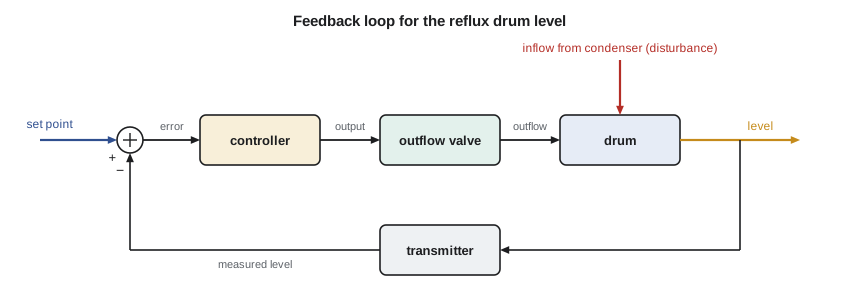
Every feedback loop has the same parts. A sensor and transmitter measure the controlled variable, here the drum level, and send a signal, traditionally 4 to 20 mA and now often a digital value on a fieldbus. A controller compares the measurement with the set point and calculates an output. A final control element, usually a control valve, sometimes a variable-speed drive on a pump or fan, changes the manipulated variable, here the outflow. The process links the manipulated variable to the controlled variable, and disturbances, such as the condensate flow, push the controlled variable away from its set point. Feedback means the controller acts on the measured result; it does not need to know what the disturbance was.
At Kingfisher Bioenergy, the controllers live in a distributed control system, or DCS: racks of processors in the control building running hundreds of control blocks, with operator stations where the panel operators watch trends and change set points. Malik shows Theo the reflux drum's level block. It has a mode switch, automatic or manual. In manual the operator sets the valve directly; in automatic the controller does. It also has a set point, a measurement, an output, tuning constants and alarm limits. Carla Fontaine, a panel operator with twenty years on the ethanol units, puts it simply: a loop that the operators keep in manual is a loop that has failed, however elegant its design.
Worked problem
Offset with proportional control
The reflux drum's inflow rises by 3.6 m³/h. The level controller is proportional only with \(K_c = 14.4\) (m³/h)/m. What is the steady offset?
Show solution
- At the new steady state the outflow must equal the inflow, so the valve must pass 3.6 m³/h more than before.
- A proportional controller changes its output by \(K_c e\), so \(K_c e = 3.6\).
- \(e = 3.6/14.4 = 0.25\) m.
Answer: The level settles 0.25 m above its set point; the simulation gives the same value.
Piping and instrumentation diagrams and tags
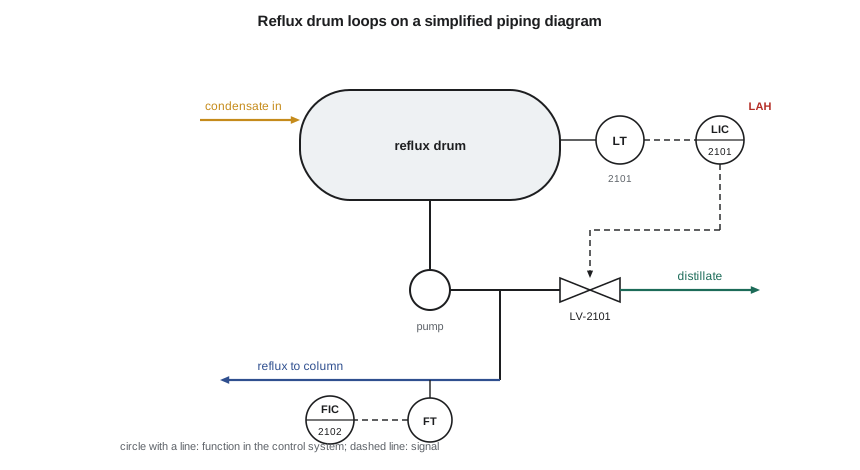
Control strategies are drawn on piping and instrumentation diagrams, P&IDs, using the symbols and identification letters of ANSI/ISA-5.1, a standard revised in 2022 and again in 2024 and used in both Canada and the US. Each instrument has a tag made of letters and a loop number. The first letter is the measured variable: L for level, F for flow, T for temperature, P for pressure, A for analysis. The following letters give the function: T transmitter, I indicator, C controller, V valve, A alarm, with H and L for high and low. LT-2101 is the level transmitter on loop 2101, LIC-2101 the indicating level controller, and LV-2101 its valve. A circle drawn with a single horizontal line marks a function in the DCS on the operator's console; a circle with no line is a field instrument. Dashed lines carry electrical signals.
| Letter | As the first letter | As a following letter |
|---|---|---|
| A | Analysis (composition) | Alarm |
| F | Flow | - |
| L | Level | Light |
| P | Pressure | Point (test connection) |
| T | Temperature | Transmitter |
| C | User choice (often conductivity) | Controller |
| V | Vibration | Valve |
| I | Current | Indicator |
Why chemical processes are hard to control
Control of a servo motor or an aircraft can rely on fast, well-known dynamics. Chemical processes present a different set of difficulties, and the rest of this course deals with each. Many units are slow: a large tank or a column with dozens of trays responds over tens of minutes. Many have dead time: a change at the bottom of the ester column reaches the top only after it has traveled up every tray, and a composition analyzer reports a result several minutes after the sample was taken. Many are nonlinear: the response of the surge tank in lesson 2 depends on its level, and a column's sensitivity changes with purity. Units interact: changing the reflux affects both the top and the bottom of a column. Measurements are noisy, and some, like composition, are slow or expensive. Constraints are everywhere: valves saturate fully open or closed, and safety limits must never be crossed.
Feedback, feedforward and the control hierarchy
Feedback alone has one weakness: it can act only after the controlled variable has already moved. If a disturbance can be measured before it upsets the process, a feedforward controller can act on it directly. The ester column's feed flow is measured; if it rises by 10 %, the steam can be raised in proportion before the tray temperatures change. Lesson 9 shows how feedforward and feedback are combined. Beyond single loops, plants arrange their controls in layers. At the bottom are the regulatory loops on flows, levels, pressures and temperatures, executed every second or faster in the DCS. Above them, advanced control such as model predictive control, lesson 10, moves the set points of those loops every minute to push the unit against its most profitable constraints. Above that, real-time optimization recalculates targets every hour or so. Alongside all of them, and independent of them, the safety instrumented system of lesson 11 watches for dangerous conditions and shuts equipment down.
The economics of variability
Malik closes the first week with the argument he uses to justify control projects. The ester product must contain at least 99.50 wt % ester. If the purity varies with a standard deviation of 0.15 wt %, operators keep the target about two standard deviations above the specification, at 99.80 %, so that only about one sample in forty fails. Every tenth of a percent of extra purity costs steam: in the column's operating region, about 9 kW per 0.1 wt % (an illustrative figure from the design model). Better control that cuts the spread to 0.05 wt % lets the target move down to 99.60 %. The product is the same in specification, but about 18 kW less steam is spent, roughly 150 MWh a year. This is the squeeze-and-shift idea: first reduce the variation, then move the average closer to the limit. It explains why plants spend money on control even when the average operation already looks good.
Worked problem
Squeeze and shift
A purity loop's standard deviation falls from 0.10 to 0.05 wt %. The target is kept two standard deviations above the 99.50 % specification, and extra purity costs 9 kW per 0.1 wt %. Estimate the steam saving.
Show solution
- Old target: \(99.50 + 2(0.10) = 99.70\) wt %.
- New target: \(99.50 + 2(0.05) = 99.60\) wt %.
- Shift: 0.10 wt %, worth about \(9 \times 0.10/0.1 = 9\) kW.
Answer: About 9 kW, or about 75 MWh a year at 8,400 operating hours.
Safety first, and who is responsible
Control systems can also cause accidents. A controller with the wrong action, a transmitter that fails at a normal-looking value or a valve that sticks can drive a process into an unsafe state while the screen looks calm. The plant's process safety management system, under OSHA's Process Safety Management standard, 29 CFR 1910.119, together with EPA's Risk Management Program rule where a listed chemical exceeds its threshold quantity, treats changes to control logic and safety settings as changes that need review, just as a new pipe would. Theo learns that every loop change at Kingfisher Bioenergy goes through a management-of-change form that Malik must approve, and that safety functions are designed and tested to ANSI/ISA-61511-1-2018, the US adoption of IEC 61511, covered in lesson 11. Controls are engineering work with consequences, and engineers who design them carry professional responsibility for them.
Common mistakes
MistakeThinking a proportional controller can hold a level at its set point after a load change.
InsteadProportional action leaves an offset; integral action removes it.
MistakeLeaving an integrating process such as a level in open loop.
InsteadAny imbalance accumulates; levels need control or an overflow path.
MistakeReading a tag's first letter as its function.
InsteadThe first letter is the measured variable; the following letters are the functions.
MistakeJudging control by the average value alone.
InsteadVariability decides how close to a limit the plant can run.
Summary and key terms
- Control keeps a plant near its design point while disturbances act; its objectives are safety, environment, equipment, quality, rate and operability.
- A feedback loop has a sensor and transmitter, a controller, a final control element and the process.
- Proportional control leaves an offset of load divided by gain; integral action removes it.
- ANSI/ISA-5.1 tags name the measured variable first and the functions after it.
- Reducing variability lets targets move toward limits: squeeze and shift.
- Controlled variable
- The process variable a loop keeps at its set point.
- Manipulated variable
- The variable the controller adjusts, usually through a valve.
- Disturbance
- An input the controller does not set that moves the controlled variable.
- Offset
- A steady difference between the set point and the controlled variable.
- Integrating process
- A process whose output keeps changing while its inputs are unbalanced, such as a level.
- Distributed control system
- The computer system that runs the plant's control loops and operator displays.
- P&ID
- A piping and instrumentation diagram showing equipment, piping and control loops.
Practice problems
Work each problem on paper first, then reveal the answer to check.
Name the measured variable and function of TIC-3305.
Show answer
Temperature; indicating controller.
The reflux drum inflow rises 3.6 m³/h. What proportional gain gives an offset of 0.10 m?
Show answer
\(K_c = 3.6/0.10 = 36\) (m³/h)/m.
Why does the drum overflow with a fixed valve but not with a proportional controller?
Show answer
With a fixed valve the imbalance persists; the controller opens the valve until outflow matches inflow.
Give one reason chemical processes are harder to control than a motor.
Show answer
Dead time, slow interacting units, nonlinearity, noisy or slow measurements, or constraints.
A purity standard deviation falls from 0.15 to 0.10 wt %. With a two-sigma margin, how far can the target move?
Show answer
\(2(0.15 - 0.10) = 0.10\) wt %.
Why must a change to a controller's action go through management of change?
Show answer
A wrong action can drive the process to an unsafe state; the change affects safety like a physical change.
Lesson quiz · 5 questions
Score 60% or more to complete this lesson.
Create a free account to save your progress, take quizzes and earn a certificate.