
CHE-312 · Lesson 9 of 12 · 28 min
Boiling and condensation
Northgate's boilers make steam by boiling water inside tubes, and its customers use that steam by condensing it on the tubes of converters, process heaters and absorption chillers. Chemical plants rely on the same two processes in reboilers at the bottom of distillation columns and condensers at the top. Boiling and condensation are convection with a phase change, and they produce the highest coefficients in engineering, commonly 2,500 to 100,000 W/m²·K, because the latent heat absorbed or released is large and the vapor or liquid motion is vigorous. They also bring a hazard that no single-phase process has: push a boiling surface past a certain heat flux and it can suddenly overheat and fail. This lesson treats pool boiling, the boiling crisis and film condensation, and introduces flow boiling and dropwise condensation.
Pool boiling and the boiling curve
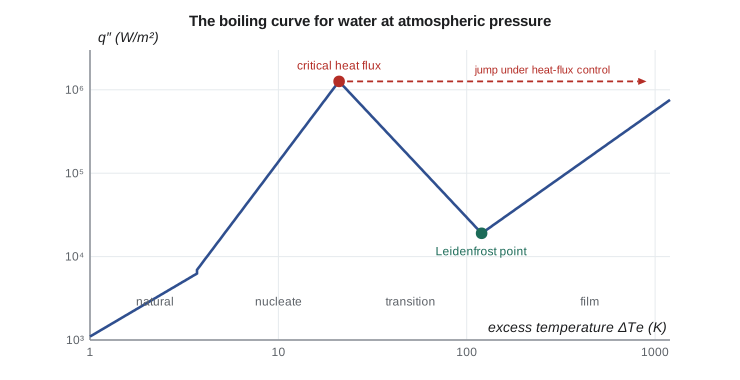
Pool boiling occurs when a heated surface is submerged in a large body of stagnant liquid at its saturation temperature. The behavior is best described by the boiling curve, which plots the surface heat flux against the excess temperature \(\Delta T_e = T_s - T_{\text{sat}}\). Classic experiments by Nukiyama in the 1930s with an electrically heated wire in water first mapped it, and its regimes are now standard.
At small excess temperatures, below about 5 K for water at atmospheric pressure, liquid near the surface is superheated slightly, but bubbles do not form; heat transfer is by natural convection and evaporation occurs at the free surface. As \(\Delta T_e\) rises, bubbles begin to form at nucleation sites, tiny cavities and scratches on the surface that trap vapor. In the nucleate boiling regime, isolated bubbles first rise and condense or burst, then merge into jets and columns. Their growth and departure stir the liquid next to the surface intensely, and the heat flux rises steeply, roughly with the cube of the excess temperature. Nucleate boiling is the regime in which boilers, reboilers and evaporators are designed to operate.
The heat flux cannot rise indefinitely. At high fluxes so much vapor leaves the surface that liquid can no longer reach it fast enough. The flux reaches a maximum, the critical heat flux, about 1.26 MW/m² for water at one atmosphere. Beyond it lies the transition regime, in which a vapor blanket forms and collapses unstably and the flux falls as the excess temperature rises. At still higher excess temperatures, a stable vapor film covers the surface. In this film boiling regime, heat passes by conduction and radiation across the vapor; the flux falls to a minimum, the Leidenfrost point, and then rises again. The Leidenfrost effect is familiar from water droplets skating on a very hot pan: they last surprisingly long, insulated by a layer of their own vapor.
The boiling crisis
The shape of the boiling curve has a serious consequence. When a surface's temperature is controlled, as by condensing steam on the other side of a tube, the operating point can move smoothly through every regime. When the heat flux is controlled, as in electric heaters, nuclear fuel rods and furnace-fired boiler tubes receiving radiation, raising the flux just past the critical value has no stable nucleate-boiling solution. The surface jumps horizontally across the curve to the film boiling branch at the same flux, which for water corresponds to an excess temperature of roughly 1000 K or more. A steel or copper tube may melt or lose so much strength that it ruptures. This is the boiling crisis, also called burnout or departure from nucleate boiling, and avoiding it is one of the central design limits of boilers, steam generators and nuclear reactor cores, which are operated with a specified margin below the critical heat flux.
Correlations for pool boiling
Nucleate boiling depends on the liquid, the pressure and the surface, particularly the size and number of its nucleation sites, so correlations are less accurate than for single-phase flow. The most widely used is Rohsenow's:
where \(\sigma\) is the surface tension, \(C_{s,f}\) and \(n\) depend on the liquid-surface combination (for water, \(n = 1\) and \(C_{s,f}\) is about 0.013 for polished copper or mechanically polished stainless steel, and lower for rougher or ground surfaces), and properties are those of saturated liquid and vapor. Because \(q''\) varies with \((\Delta T_e)^3\), an error in \(C_{s,f}\) of a factor of two changes the predicted flux by a factor of eight, or the predicted excess temperature at a given flux by about 26 percent. Errors of 100 percent in heat flux are common, so designers use these correlations with generous margins or with test data for their own surfaces.
Zuber's analysis of the hydrodynamic instabilities in the vapor columns gives the critical heat flux for a large horizontal surface:
The critical heat flux depends mainly on the liquid properties and the pressure, not the surface finish. It rises with pressure at first, as the vapor becomes denser, reaches a maximum at about one-third of the critical pressure, and falls to zero at the critical point. A similar expression with a constant of about 0.09 gives the minimum flux at the Leidenfrost point. In film boiling on a horizontal cylinder, a correlation of the Nusselt type, based on conduction through the vapor film, applies, with radiation added at high temperatures.
# Boiling and condensation of water at atmospheric pressure (approximate saturation properties at 100 C)
import math
g = 9.81
rho_l, rho_v, h_fg = 957.9, 0.5955, 2257e3
mu_l, cp_l, k_l, Pr_l, sig = 279e-6, 4217.0, 0.680, 1.76, 58.9e-3

# 1. Nucleate pool boiling (Rohsenow) on a polished surface: C_sf = 0.013, n = 1 (water-copper or polished steel)
Csf, n = 0.013, 1.0
def rohsenow(dTe):
    return mu_l * h_fg * (g * (rho_l - rho_v) / sig) ** 0.5 * (cp_l * dTe / (Csf * h_fg * Pr_l ** n)) ** 3
for dTe in (5, 10, 15, 20, 25):
    q = rohsenow(dTe)
    print(f"excess temperature {dTe:2d} K: q'' = {q/1000:7.1f} kW/m2, h = {q/dTe:7.0f} W/m2.K")

# 2. Critical and minimum heat fluxes (Zuber)
q_max = 0.149 * h_fg * rho_v * (sig * g * (rho_l - rho_v) / rho_v ** 2) ** 0.25
q_min = 0.09 * rho_v * h_fg * (g * sig * (rho_l - rho_v) / (rho_l + rho_v) ** 2) ** 0.25
dTe = 5.0
while rohsenow(dTe) < q_max: dTe += 0.01
print(f"critical heat flux {q_max/1e6:.2f} MW/m2, reached at about dTe = {dTe:.0f} K; minimum (Leidenfrost) flux {q_min/1000:.1f} kW/m2")
print("  a heater that is power-controlled and pushed past the critical flux jumps to film boiling, hundreds of kelvin hotter")

# 3. Size a pool boiler (or kettle reboiler) bundle for 400 kW at dTe = 12 K, using 80 % of the ideal Rohsenow value
q = 0.8 * rohsenow(12.0)
print(f"bundle design flux {q/1000:.0f} kW/m2 ({q/q_max:.0%} of critical), area for 400 kW = {400e3/q:.2f} m2")

# 4. Film condensation of steam at 100 C on a 19 mm tube with its wall at 85 C (properties at the film temperature)
rho_lf, mu_lf, k_lf, cp_lf = 965.3, 315e-6, 0.675, 4206.0
Tsat, Tw, D = 100.0, 85.0, 0.019
Ja = cp_lf * (Tsat - Tw) / h_fg
hfg_mod = h_fg * (1 + 0.68 * Ja)
h_tube = 0.729 * (g * rho_lf * (rho_lf - rho_v) * k_lf ** 3 * hfg_mod / (mu_lf * (Tsat - Tw) * D)) ** 0.25
print(f"\ncondensing on one horizontal tube: Ja = {Ja:.4f}, h = {h_tube:.0f} W/m2.K, flux {h_tube*(Tsat-Tw)/1000:.0f} kW/m2")
for N in (1, 4, 9, 16):
    print(f"  {N:2d} tubes in a vertical column: average h about {h_tube*N**-0.25:.0f} (Nusselt) to {h_tube*N**(-1/6):.0f} W/m2.K (Kern)")

# 5. The same steam on a 2 m vertical tube wall (laminar film check)
Lv = 2.0
h_vert = 0.943 * (g * rho_lf * (rho_lf - rho_v) * k_lf ** 3 * hfg_mod / (mu_lf * (Tsat - Tw) * Lv)) ** 0.25
m_dot = h_vert * Lv * (Tsat - Tw) / hfg_mod          # condensate leaving per 1 m of perimeter
Re_d = 4 * m_dot / mu_lf
print(f"vertical 2 m wall: Nusselt h = {h_vert:.0f} W/m2.K, film Reynolds number {Re_d:.0f}"
      f" ({'laminar, wavy' if Re_d > 30 else 'laminar'}; above about 1800 the film is turbulent)")
print(f"ratio horizontal tube to vertical wall h: {h_tube/h_vert:.1f}")excess temperature 5 K: q'' = 17.1 kW/m2, h = 3423 W/m2.K excess temperature 10 K: q'' = 136.9 kW/m2, h = 13693 W/m2.K excess temperature 15 K: q'' = 462.1 kW/m2, h = 30808 W/m2.K excess temperature 20 K: q'' = 1095.4 kW/m2, h = 54770 W/m2.K excess temperature 25 K: q'' = 2139.5 kW/m2, h = 85579 W/m2.K critical heat flux 1.26 MW/m2, reached at about dTe = 21 K; minimum (Leidenfrost) flux 18.9 kW/m2 a heater that is power-controlled and pushed past the critical flux jumps to film boiling, hundreds of kelvin hotter bundle design flux 189 kW/m2 (15% of critical), area for 400 kW = 2.11 m2 condensing on one horizontal tube: Ja = 0.0280, h = 11941 W/m2.K, flux 179 kW/m2 1 tubes in a vertical column: average h about 11941 (Nusselt) to 11941 W/m2.K (Kern) 4 tubes in a vertical column: average h about 8443 (Nusselt) to 9477 W/m2.K (Kern) 9 tubes in a vertical column: average h about 6894 (Nusselt) to 8279 W/m2.K (Kern) 16 tubes in a vertical column: average h about 5970 (Nusselt) to 7522 W/m2.K (Kern) vertical 2 m wall: Nusselt h = 4822 W/m2.K, film Reynolds number 799 (laminar, wavy; above about 1800 the film is turbulent) ratio horizontal tube to vertical wall h: 2.5
Worked problem
Sizing a kettle reboiler bundle
A small pool boiler, of the kettle reboiler type used in chemical plants and in some package steam generators, must boil water at atmospheric pressure with a duty of 400 kW. The tube surfaces will run at an excess temperature of 12 K. Using Rohsenow's correlation with \(C_{s,f} = 0.013\), and taking 80 percent of the predicted flux as a design value, find the required area and compare the flux with the critical value.
Show solution
- Saturated properties at 100 °C: \(\rho_l = 957.9\), \(\rho_v = 0.596\) kg/m³, \(h_{fg} = 2257\) kJ/kg, \(\mu_l = 2.79\times10^{-4}\) kg/m·s, \(c_{p,l} = 4217\) J/kg·K, \(\text{Pr}_l = 1.76\), \(\sigma = 0.0589\) N/m.
- Rohsenow at \(\Delta T_e = 12\) K: \(q'' = 237\) kW/m²; design value \(0.8 \times 237 = 189\) kW/m².
- Critical heat flux: \(q''_{\max} = 0.149(2.257\times10^6)(0.596)\big[0.0589(9.81)(957.3)/0.596^2\big]^{1/4} = 1.26\) MW/m².
- \[A = \frac{400\times10^3}{189\times10^3} = 2.11\ \text{m}^2, \qquad \frac{q''}{q''_{\max}} = 0.15\]
Answer: The design flux is only 15 percent of the critical value for a single surface. In a tube bundle, vapor rising from the lower tubes reduces the liquid supply to the upper ones, so the bundle critical flux is considerably lower than the single-tube value, and design methods for reboilers apply bundle correction factors. The steep cube law also means that a modest rise in the heating-medium temperature would increase the flux a great deal, which is why reboilers are usually controlled through the steam pressure on the tube side.
Flow boiling
In boiler tubes, evaporators and steam generators, liquid flows through a heated tube while it boils. The flow passes through a sequence of patterns: subcooled liquid, bubbly flow, slug flow, annular flow with a liquid film on the wall and a vapor core, and finally mist flow once the wall dries out. The heat transfer coefficient combines a nucleate boiling contribution and a forced convection contribution, which grows as the vapor accelerates the flow; correlations such as those of Chen and of Kandlikar handle this combination. The boiling crisis in flow boiling takes two forms: departure from nucleate boiling at low quality and high flux, and dryout of the annular film at high quality. Once-through supercritical boilers avoid boiling altogether, since above the critical pressure water passes from liquid-like to vapor-like without a phase change.
Film condensation
When vapor contacts a surface below its saturation temperature, it condenses. Usually the condensate wets the surface and forms a continuous film that flows down under gravity. Heat released at the film's outer surface must conduct through the film to the wall, so the film itself is the main resistance. In 1916 Nusselt analyzed laminar film condensation on a vertical plate, assuming a linear temperature profile through the film and a balance between gravity and viscous shear. His result for the average coefficient over a plate of height \(L\) is
where the modified latent heat \(h'_{fg}\) accounts for subcooling of the condensate below saturation, and liquid properties are evaluated at the film temperature. The film thickens down the plate, so the local coefficient falls with distance. Once the film Reynolds number, \(\text{Re}_\delta = 4\dot m'/\mu_l\) based on the condensate flow per unit width, exceeds about 30, waves form on the film and raise the coefficient above Nusselt's value; above about 1800, the film becomes turbulent. Correlations for the wavy and turbulent regimes are available.
For a single horizontal tube of diameter \(D\), the same analysis gives the same form with a constant of 0.729 and \(D\) in place of \(L\). Because the drainage distance around a tube is short, horizontal tubes condense far better than tall vertical surfaces, which is why most condensers are horizontal shell-and-tube units with steam on the shell side. In a vertical column of \(N\) tubes, condensate from the upper tubes drips onto the lower ones and thickens their films. Nusselt's analysis suggests the average coefficient falls as \(N^{-1/4}\); in practice the splashing of droplets disturbs the film, and Kern's milder \(N^{-1/6}\) is often used.
Worked problem
Steam condensing on converter tubes
In the hospital's backup steam-to-water converter, saturated steam at 100 °C condenses on horizontal tubes of 19 mm outside diameter whose walls are at 85 °C. Find the coefficient on a single tube and the average for columns of 4, 9 and 16 tubes. Liquid properties at the 92.5 °C film temperature (rounded to 90 °C values): ρ = 965.3 kg/m³, μ = 3.15 × 10⁻⁴ kg/m·s, k = 0.675 W/m·K, \(c_p\) = 4206 J/kg·K.
Show solution
- \(\text{Ja} = 4206(15)/2.257\times10^6 = 0.028\); \(h'_{fg} = 2.257\times10^6(1.019) = 2.30\times10^6\) J/kg.
- Single tube: \(\bar h = 0.729\big[9.81(965.3)(964.7)(0.675^3)(2.30\times10^6)/(3.15\times10^{-4}(15)(0.019))\big]^{1/4} = 11{,}900\) W/m²·K.
- Flux on a single tube: \(11{,}900 \times 15 = 179\) kW/m².
- Columns: 4 tubes, about 8,400 (Nusselt) to 9,500 (Kern) W/m²·K; 9 tubes, 6,900 to 8,300; 16 tubes, 6,000 to 7,500 W/m²·K.
Answer: The same steam on a 2 m tall vertical wall gives only about 4,800 W/m²·K by Nusselt's formula, two and a half times less than a horizontal tube, although the film Reynolds number of about 800 places it in the wavy regime, where the true value is somewhat higher. Even the lowest of these coefficients is larger than the water-side coefficient inside the tubes, so in a converter the water side and the tube-wall fouling usually control the overall U.
Dropwise condensation and noncondensable gases
On surfaces that the condensate does not wet, such as those treated with promoters or certain coatings, condensate forms droplets that grow, coalesce and roll off, leaving bare surface behind. Dropwise condensation gives coefficients ten times or more those of film condensation, but it is hard to sustain in service, because promoters wear off and surfaces foul, so condensers are designed for film condensation. A more common problem works the other way. Even a small fraction of air or another noncondensable gas in the steam accumulates at the condensing surface, where the vapor has been removed, and forms a gas layer through which vapor must diffuse. A few percent of air can cut the condensing coefficient by half or more. This is why steam systems have air vents and why condensers have continuous vent connections; a converter that suddenly underperforms often has an air-binding problem rather than a fouling problem.
In the United States, boilers and pressure vessels are built to the ASME Boiler and Pressure Vessel Code and inspected under state laws, usually through the National Board inspection system. Operator licensing varies by state and city; Minnesota requires licensed boiler operators, with license grades tied to the plant's size. In US units, the critical heat flux of water at one atmosphere is about 400,000 Btu/h·ft², and the converter's single-tube coefficient is about 2,100 Btu/h·ft²·°F.
Common mistakes
MistakeExpecting boiling correlations to be as accurate as single-phase ones.
InsteadNucleate boiling predictions can be off by 100 percent in flux; use margins or test data.
MistakeIncreasing an electrically heated surface's power past the critical heat flux.
InsteadUnder flux control, the surface jumps to film boiling and may burn out.
MistakeUsing the latent heat alone in condensation.
InsteadUse h′_fg = h_fg(1 + 0.68 Ja) to include condensate subcooling.
MistakeAssuming tubes in a column all condense like the top tube.
InsteadCondensate inundation lowers the average by N^(−1/4) to N^(−1/6).
MistakeIgnoring air in condensing steam.
InsteadNoncondensable gases can halve the coefficient; vent them.
Summary and key terms
- The boiling curve has natural convection, nucleate, transition and film boiling regimes.
- Nucleate boiling gives very high coefficients; Rohsenow's correlation gives q″ ∝ ΔT_e³.
- The critical heat flux, about 1.26 MW/m² for water at 1 atm, limits flux-controlled surfaces.
- Flow boiling passes through bubbly, slug and annular patterns; dryout is its high-quality limit.
- Nusselt's analysis gives film condensation on vertical plates (0.943) and horizontal tubes (0.729).
- Horizontal tubes condense better than tall walls; noncondensable gases degrade condensation badly.
- Pool boiling
- Boiling from a surface submerged in a stagnant liquid.
- Excess temperature
- ΔT_e = T_s − T_sat, the surface superheat above saturation.
- Nucleate boiling
- Boiling in which bubbles form at surface sites; the regime of highest useful coefficients.
- Critical heat flux
- The maximum heat flux in nucleate boiling, beyond which a vapor film forms.
- Film boiling
- Boiling with a continuous vapor film over the surface.
- Leidenfrost point
- The minimum heat flux in film boiling.
- Flow boiling
- Boiling of a liquid flowing through a heated channel.
- Film condensation
- Condensation forming a continuous liquid film on the surface.
- Jakob number
- Ja = c_p ΔT/h_fg, the ratio of sensible to latent heat.
- Noncondensable gas
- A gas such as air that does not condense and impedes condensation.
Practice problems
Work each problem on paper first, then reveal the answer to check.
In the program, find the nucleate boiling flux at ΔT_e = 8 K.
Show answer
About 70 kW/m².
If C_s,f doubles, by what factor does the predicted flux change at fixed ΔT_e?
Show answer
It falls by a factor of 8.
Why is a flux-controlled surface at risk near the critical heat flux but a temperature-controlled one is not?
Show answer
Under flux control there is no stable nucleate solution above the critical flux, so the surface jumps to film boiling.
Find the Jakob number for steam condensing with a 10 K subcooling (c_p = 4.2 kJ/kg·K, h_fg = 2257 kJ/kg).
Show answer
0.0186.
By what factor does the average coefficient of a column of 16 tubes fall by Nusselt's rule?
Show answer
16^(−1/4) = 0.5.
Why do steam condensers have vent connections?
Show answer
To remove air and other noncondensable gases that would accumulate and block condensation.
Lesson quiz · 5 questions
Score 60% or more to complete this lesson.
Create a free account to save your progress, take quizzes and earn a certificate.