
CHE-312 · Lesson 6 of 12 · 25 min
External forced convection
So far the convection coefficient has simply been given. From this lesson on, we find it. Northgate needs \(h\) for several external flows: wind across the flat roof of the boiler hall, wind across a section of steam pipe that runs outdoors on a pipe rack between buildings, and flue gas flowing across the tube bank of the planned economizer. Each is an external flow, in which the fluid flows over a body and the boundary layer on the body grows without being confined by walls. The tools are boundary layer theory, dimensionless groups and empirical correlations, and the skill is in choosing the right correlation and evaluating it with the right properties.
Velocity and thermal boundary layers
When fluid flows over a surface, the layer in contact with it is brought to rest, and a velocity boundary layer forms in which the velocity rises from zero at the wall to the free-stream value \(u_\infty\). If the surface is at a different temperature from the fluid, a thermal boundary layer also forms, across which the temperature changes from \(T_s\) to \(T_\infty\). At the wall itself, heat passes by conduction through the stationary fluid, so the local heat flux is \(q_s'' = -k_f\,\partial T/\partial y\) at \(y = 0\), and the convection coefficient is
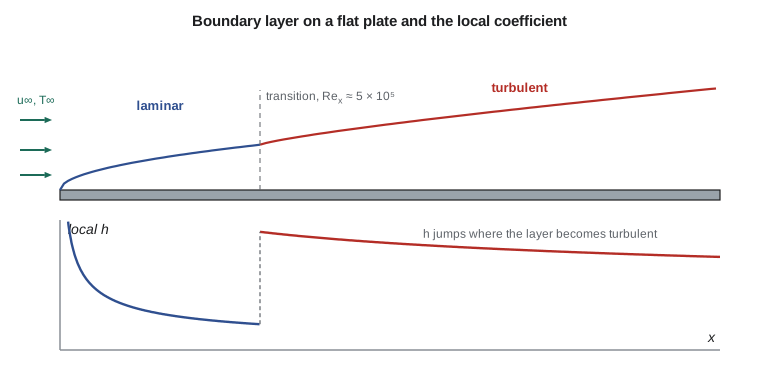
Anything that steepens the temperature gradient at the wall, such as higher velocity, a thinner boundary layer or turbulent mixing, raises \(h\). On a flat plate the boundary layer starts thin at the leading edge and thickens downstream, so the local coefficient is highest at the leading edge and falls with distance.
The flow in the boundary layer starts laminar, with smooth, orderly streamlines. At some distance it becomes unstable and passes through a transition region to turbulent flow, in which eddies mix fluid across the layer. Turbulent mixing greatly increases momentum and heat transfer near the wall, so the local coefficient jumps at transition and then falls slowly. On a smooth flat plate, transition is usually taken to occur at a critical Reynolds number of about \(5 \times 10^5\), although roughness, free-stream turbulence and vibration can trigger it earlier.
Dimensionless groups
Correlations for \(h\) are written in terms of three dimensionless groups. The Reynolds number compares inertia with viscous forces and decides whether the flow is laminar or turbulent. The Prandtl number, a fluid property, compares momentum diffusivity with thermal diffusivity and so relates the thicknesses of the velocity and thermal boundary layers: about 0.7 for gases, 1.5 to 7 for water depending on temperature, and hundreds or thousands for oils. The Nusselt number is the dimensionless convection coefficient, the ratio of convection to conduction across the fluid layer.
Dimensional analysis shows that for forced convection in a given geometry, \(\text{Nu} = f(\text{Re}, \text{Pr})\). Experiments and theory fix the function. Properties are normally evaluated at the film temperature, \(T_f = (T_s + T_\infty)/2\), which accounts approximately for their variation across the boundary layer. The Nusselt number uses the fluid's conductivity, not the solid's, which distinguishes it from the Biot number of Lesson 5.
The flat plate in parallel flow
For laminar flow over an isothermal flat plate, boundary layer theory gives exact results. The average coefficient over a laminar plate of length \(L\) is \(\overline{\text{Nu}}_L = 0.664\,\text{Re}_L^{1/2}\text{Pr}^{1/3}\), valid for Pr above about 0.6. For a fully turbulent plate, \(\overline{\text{Nu}}_L = 0.037\,\text{Re}_L^{4/5}\text{Pr}^{1/3}\). Real plates longer than the transition length have a laminar leading section followed by turbulent flow; combining the two with transition at \(5\times10^5\) gives the mixed-boundary-layer correlation
When \(\text{Re}_L\) is much larger than the critical value, the laminar section is a small fraction of the plate and the fully turbulent correlation is adequate. For a uniform surface heat flux instead of a uniform temperature, the local Nusselt number is about 36 percent higher in laminar flow and about 4 percent higher in turbulent flow.
# External forced convection: a flat roof, a steam pipe in the wind and a tube bank in flue gas
import math
# Air at atmospheric pressure (approximate table values): T (K), nu (m2/s), k (W/m.K), Pr
AIR = [(200, 7.59e-6, 0.0181, 0.737), (250, 11.44e-6, 0.0223, 0.720), (300, 15.89e-6, 0.0263, 0.707),
       (350, 20.92e-6, 0.0300, 0.700), (400, 26.41e-6, 0.0338, 0.690), (450, 32.39e-6, 0.0373, 0.686),
       (500, 38.79e-6, 0.0407, 0.684), (600, 52.69e-6, 0.0469, 0.685), (700, 68.10e-6, 0.0524, 0.695)]
def air(T):
    for a, b in zip(AIR, AIR[1:]):
        if a[0] <= T <= b[0]:
            f = (T - a[0]) / (b[0] - a[0])
            return tuple(x + f * (y - x) for x, y in zip(a[1:], b[1:]))
    raise ValueError("temperature outside table")

# 1. Flat plate: wind blowing along the 30 m flat roof of the boiler hall
U, L, Tf = 6.0, 30.0, 260.0
nu, k, Pr = air(Tf)
Re = U * L / nu
x_c = 5e5 * nu / U
Nu_lam = 0.664 * Re**0.5 * Pr**(1/3)
Nu_mix = (0.037 * Re**0.8 - 871) * Pr**(1/3)
print(f"roof: Re_L = {Re:.2e}, transition at x = {x_c:.2f} m, h(all laminar, wrong) = {Nu_lam*k/L:.2f}, h(mixed) = {Nu_mix*k/L:.2f} W/m2.K")

# 2. Cylinder in cross flow (Churchill-Bernstein): a bare DN200 pipe outdoors on a rack
def churchill_bernstein(Re, Pr):
    return 0.3 + 0.62 * Re**0.5 * Pr**(1/3) / (1 + (0.4/Pr)**(2/3))**0.25 * (1 + (Re/282000)**(5/8))**(4/5)
D, Ts = 0.2191, 175.0
for U, Tinf in ((1.0, -30.0), (8.0, -30.0), (8.0, 20.0)):
    Tf = (Ts + Tinf) / 2 + 273.15
    nu, k, Pr = air(Tf)
    Re = U * D / nu
    h = churchill_bernstein(Re, Pr) * k / D
    print(f"pipe, wind {U:3.0f} m/s, air {Tinf:4.0f} C: Re = {Re:8.0f}, h = {h:5.1f} W/m2.K, convection loss {h*math.pi*D*(Ts-Tinf):5.0f} W/m")

# 3. Bank of bare staggered tubes in flue gas (Zukauskas), properties of air used for flue gas
def zukauskas_staggered(Re, Pr, ST, SL):
    if Re < 1e3:   C, m = 0.71, 0.5
    elif Re < 2e5: C, m = (0.35 * (ST/SL)**0.2, 0.60) if ST/SL < 2 else (0.40, 0.60)
    else:          C, m = 0.031 * (ST/SL)**0.2, 0.8
    return C * Re**m * Pr**0.36
D, ST, SL, V, Tg = 0.0508, 0.100, 0.090, 8.0, 500.0     # tube OD, pitches (m), face velocity (m/s), gas (K)
SD = math.hypot(SL, ST/2)
Vmax = V * ST / (ST - D) if SD > (ST + D) / 2 else V * ST / (2 * (SD - D))
nu, k, Pr = air(Tg)
Re = Vmax * D / nu
h = zukauskas_staggered(Re, Pr, ST, SL) * k / D
print(f"tube bank: Vmax = {Vmax:.1f} m/s, Re_D,max = {Re:.0f}, h = {h:.1f} W/m2.K (20 or more rows)")
for N, Cr in ((2, 0.76), (5, 0.92), (10, 0.97)):
print(f" with {N:2d} rows the average h is about {Cr*h:.1f} W/m2.K")roof: Re_L = 1.46e+07, transition at x = 1.03 m, h(all laminar, wrong) = 1.75, h(mixed) = 13.14 W/m2.K pipe, wind 1 m/s, air -30 C: Re = 10697, h = 7.5 W/m2.K, convection loss 1058 W/m pipe, wind 8 m/s, air -30 C: Re = 85576, h = 26.2 W/m2.K, convection loss 3691 W/m pipe, wind 8 m/s, air 20 C: Re = 75593, h = 25.6 W/m2.K, convection loss 2729 W/m tube bank: Vmax = 16.3 m/s, Re_D,max = 21295, h = 98.7 W/m2.K (20 or more rows) with 2 rows the average h is about 75.0 W/m2.K with 5 rows the average h is about 90.8 W/m2.K with 10 rows the average h is about 95.8 W/m2.K
Worked problem
Wind over the boiler-hall roof
A 6 m/s wind blows along the 30 m flat roof of the boiler hall. Air properties at a film temperature of 260 K are ν = 1.23 × 10⁻⁵ m²/s, k = 0.0231 W/m·K and Pr = 0.717. Find the average coefficient.
Show solution
- \(\text{Re}_L = 6(30)/1.23\times10^{-5} = 1.46\times10^7\); transition occurs at \(x_c = 5\times10^5\,\nu/u_\infty = 1.03\) m.
- Mixed correlation: \(\overline{\text{Nu}}_L = (0.037(1.46\times10^7)^{0.8} - 871)(0.717)^{1/3} = 17{,}100\).
- \[\bar h = \frac{17{,}100(0.0231)}{30} = 13.1\ \text{W/m}^2\text{·K}\]
Answer: Assuming the whole roof were laminar would give 1.75 W/m²·K, wrong by a factor of more than seven. Almost the whole roof is in turbulent flow. In practice, parapets, rooftop units and gusts make roof flows far from ideal, and building engineers use simpler wind-speed correlations, but the flat-plate result shows the order of magnitude and the strong effect of turbulence.
Cylinders and spheres in cross flow
Flow across a cylinder is more complex. The boundary layer forms at the front stagnation point and grows around the cylinder, but the pressure rises on the rear half, and the boundary layer separates, leaving a wake of recirculating eddies. The local coefficient is highest at the front, falls toward separation and rises again in the wake. Correlations therefore average over the whole surface. The Churchill-Bernstein correlation covers the whole range of Re·Pr above about 0.2:
Simpler power-law forms, \(\overline{\text{Nu}}_D = C\,\text{Re}_D^m\text{Pr}^{1/3}\) with \(C\) and \(m\) tabulated by Reynolds number range (the Hilpert correlation), are also widely used. For spheres, the Whitaker correlation \(\overline{\text{Nu}}_D = 2 + (0.4\,\text{Re}_D^{1/2} + 0.06\,\text{Re}_D^{2/3})\text{Pr}^{0.4}(\mu/\mu_s)^{1/4}\) applies; the constant 2 is the pure conduction limit for a sphere in a stagnant fluid. Typical uncertainties of all these correlations are 15 to 25 percent, a reminder that convection coefficients are estimates, not exact values.
Worked problem
A bare steam pipe outdoors in the wind
A 3 m section of the steam main, DN200 with outside diameter 219.1 mm and surface temperature 175 °C, crosses between two buildings on an outdoor rack. Its jacket has been damaged. Find the convection coefficient and the convection loss per meter for a 1 m/s breeze at −30 °C, an 8 m/s wind at −30 °C, and an 8 m/s wind at 20 °C.
Show solution
- For 8 m/s at −30 °C: film temperature 345.6 K; \(\nu = 2.05\times10^{-5}\) m²/s, k = 0.0297 W/m·K, Pr = 0.701.
- \(\text{Re}_D = 8(0.2191)/2.05\times10^{-5} = 85{,}600\); Churchill-Bernstein gives \(\overline{\text{Nu}}_D = 193\).
- \(h = 193(0.0297)/0.2191 = 26.2\) W/m²·K; \(q' = 26.2\pi(0.2191)(205) = 3.69\) kW/m.
- For 1 m/s at −30 °C: \(h = 7.5\) W/m²·K, \(q' = 1.06\) kW/m. For 8 m/s at 20 °C: \(h = 25.6\) W/m²·K, \(q' = 2.73\) kW/m.
Answer: Wind raises the coefficient more than threefold, and the cold raises the temperature difference, so on a windy winter night the bare section loses nearly 4 kW per meter by convection alone, plus radiation to a cold sky. A 3 m gap in the jacket costs as much as several hundred meters of intact pre-insulated pipe. Graham adds the repair to the winter readiness list.
Tube banks
Heat exchangers such as economizers, air heaters and air-cooled condensers use banks of tubes across which the outside fluid flows. Tubes are arranged in line or staggered, with transverse pitch \(S_T\) and longitudinal pitch \(S_L\). The flow accelerates through the gaps between tubes, so the Reynolds number is based on the maximum velocity, which in a staggered bank occurs either in the transverse gap or in the diagonal gap, whichever is smaller. The Zukauskas correlation, \(\overline{\text{Nu}}_D = C\,\text{Re}_{D,\max}^m\,\text{Pr}^{0.36}(\text{Pr}/\text{Pr}_s)^{1/4}\), with \(C\) and \(m\) depending on Reynolds number and arrangement, applies to banks of 20 or more rows. For fewer rows, a correction factor reduces the average, because the first rows see less turbulence than the inner rows.
Worked problem
Bare tubes in the economizer gas stream
Before adding fins, Kofi checks the coefficient for bare tubes. Flue gas (approximated as air) at 500 K approaches a staggered bank of 50.8 mm tubes at 8 m/s, with \(S_T\) = 100 mm and \(S_L\) = 90 mm. Find \(V_{\max}\), \(\text{Re}_{D,\max}\) and the average coefficient for 20 rows and for 5 rows.
Show solution
- Diagonal pitch \(S_D = \sqrt{0.090^2 + 0.050^2} = 0.103\) m, which exceeds \((S_T + D)/2 = 0.0754\) m, so the maximum velocity is in the transverse gap: \(V_{\max} = 8(0.100)/(0.100 - 0.0508) = 16.3\) m/s.
- \(\text{Re}_{D,\max} = 16.3(0.0508)/3.88\times10^{-5} = 21{,}300\); with \(C = 0.35(S_T/S_L)^{0.2} = 0.357\) and \(m = 0.60\): \(\overline{\text{Nu}}_D = 123\).
- \[\bar h = 98.7\ \text{W/m}^2\text{·K} \ (20\ \text{rows}), \qquad \bar h \approx 0.92 \times 98.7 = 90.8\ \text{W/m}^2\text{·K} \ (5\ \text{rows})\]
Answer: The gas-side coefficient of about 60 to 100 W/m²·K is fifty times smaller than the water side, which is exactly why the economizer needs fins. Fins change the flow pattern, and finned-tube banks have their own correlations from manufacturers and research data; the bare-tube value is a useful upper bound for checking them. The pressure drop across the bank, found from a friction factor chart for tube banks, sets the fan power, and a good design trades heat transfer against that cost.
US design guides take wind and temperature data from ASHRAE climatic design tables for each weather station; the Minneapolis-St. Paul design conditions combine low temperatures with significant winter winds. In US units, the 8 m/s wind is about 18 mph and the coefficient of 26.2 W/m²·K is about 4.6 Btu/h·ft²·°F; the bare pipe loses about 3,800 Btu/h per foot by convection on such a night.
Common mistakes
MistakeEvaluating properties at the free-stream temperature.
InsteadUse the film temperature (T_s + T∞)/2 unless the correlation says otherwise.
MistakeUsing the laminar flat-plate correlation for a long plate.
InsteadCheck Re_L; above 5 × 10⁵, use the mixed or turbulent correlation.
MistakeUsing the approach velocity in a tube-bank Reynolds number.
InsteadUse the maximum velocity in the narrowest gap.
MistakeConfusing the Nusselt and Biot numbers.
InsteadNu uses the fluid's k; Bi uses the solid's k.
MistakeTreating correlation results as exact.
InsteadTypical uncertainties are 15 to 25 percent; design with margin.
Summary and key terms
- Convection is controlled by the velocity and thermal boundary layers; h is highest where the layer is thin or turbulent.
- Nu = f(Re, Pr) for forced convection; properties at the film temperature.
- Flat plate: laminar 0.664 Re^½ Pr^⅓; mixed (0.037 Re^⅘ − 871) Pr^⅓.
- Cylinders in cross flow: Churchill-Bernstein; spheres: Whitaker.
- Tube banks: Zukauskas with Re based on maximum velocity and a row correction.
- Wind raises the loss from a bare outdoor pipe threefold or more.
- Boundary layer
- The thin region near a surface where velocity or temperature changes from the wall value to the free-stream value.
- Transition
- The change from laminar to turbulent flow in a boundary layer.
- Reynolds number
- Re = uL/ν, the ratio of inertial to viscous forces.
- Prandtl number
- Pr = ν/α, a fluid property comparing momentum and thermal diffusivity.
- Nusselt number
- Nu = hL/k_f, the dimensionless convection coefficient.
- Film temperature
- The average of surface and free-stream temperatures, used for properties.
- Separation
- The detachment of a boundary layer from a surface, forming a wake.
- Tube bank
- An array of tubes across which a fluid flows, in line or staggered.
- Maximum velocity
- The velocity in the narrowest flow passage of a tube bank, used in its Reynolds number.
Practice problems
Work each problem on paper first, then reveal the answer to check.
Air at 300 K (ν = 1.59 × 10⁻⁵ m²/s) flows at 2 m/s over a 0.5 m plate. Is the flow laminar at the trailing edge?
Show answer
Re = 62,900; yes, laminar.
For that plate, find the average Nusselt number (Pr = 0.707).
Show answer
0.664(62,900)^½(0.707)^⅓ = 148.
In the program, find the pipe's coefficient for a 4 m/s wind at −30 °C.
Show answer
About 16.8 W/m²·K, a loss of about 2.4 kW/m.
Why is the tube-bank Reynolds number based on the maximum velocity?
Show answer
The flow accelerates through the gaps, and the heat transfer depends on the local velocity there.
Find the Nusselt number of a 1 mm sphere in still fluid.
Show answer
Nu = 2, the conduction limit.
By roughly what factor does turbulence raise h on the boiler-hall roof?
Show answer
About 7.5 compared with an all-laminar estimate.
Lesson quiz · 5 questions
Score 60% or more to complete this lesson.
Create a free account to save your progress, take quizzes and earn a certificate.