
CHE-312 · Lesson 3 of 12 · 26 min
Extended surfaces and fins
The flue gas leaving Northgate's hot-water boilers is still at about 165 °C, and Kofi wants an economizer to recover some of that heat into the district return water. The difficulty is the gas side. A gas has a low convection coefficient, perhaps 50 to 100 W/m²·K, while water inside a tube has a coefficient of several thousand. With bare tubes, the gas-side resistance would dominate and the economizer would be enormous. The standard remedy is to add fins to the gas side, increasing its area many times over. This lesson develops the theory of extended surfaces and applies it to the economizer tubes and, as a second example, to a thermowell in the steam main, where the same physics produces a measurement error.
When fins help
Newton's law, \(q = hA(T_s - T_\infty)\), offers three ways to increase heat transfer: raise \(h\), raise the temperature difference, or raise the area. When the first two are fixed by the process, extending the surface is often the cheapest option. Fins appear on car radiators, motorcycle cylinders, electronic heat sinks, air-conditioning coils, transformer tanks and the finned tubes of economizers and air-cooled condensers. They are effective when the convection coefficient on their side is low, as with gases, and nearly useless when it is high, as with boiling liquids, because the fin's own conduction resistance then limits it.
The fin equation
Consider a fin of constant cross-sectional area \(A_c\) and perimeter \(P\), attached to a wall at temperature \(T_b\) and surrounded by fluid at \(T_\infty\). If the fin is thin, its temperature varies only along its length \(x\). An energy balance on a slice of thickness \(dx\), with conduction in and out along the fin and convection from its surface, gives
The general solution is a combination of \(e^{mx}\) and \(e^{-mx}\), or equivalently of \(\cosh mx\) and \(\sinh mx\). The parameter \(m\), in 1/m, measures how quickly the fin temperature decays toward the fluid temperature: a high \(h\) or a low \(k\) makes the decay fast. The two boundary conditions are the base temperature, \(\theta(0) = \theta_b\), and a condition at the tip. Four standard tip conditions give four solutions.
| Tip condition | Temperature distribution θ/θ_b | Fin heat rate q_f |
|---|---|---|
| Convection, h at the tip | \(\frac{\cosh m(L-x) + (h/mk)\sinh m(L-x)}{\cosh mL + (h/mk)\sinh mL}\) | \(M\,\frac{\sinh mL + (h/mk)\cosh mL}{\cosh mL + (h/mk)\sinh mL}\) |
| Adiabatic tip | \(\cosh m(L-x)/\cosh mL\) | \(M\tanh mL\) |
| Prescribed tip temperature θ_L | \(\frac{(\theta_L/\theta_b)\sinh mx + \sinh m(L-x)}{\sinh mL}\) | \(M\,\frac{\cosh mL - \theta_L/\theta_b}{\sinh mL}\) |
| Infinitely long fin | \(e^{-mx}\) | \(M\) |
In practice the adiabatic-tip solution is used with a corrected length \(L_c = L + t/2\) for a rectangular fin of thickness \(t\) (or \(L + D/4\) for a pin fin), which adds the tip area to the side area and reproduces the convective-tip result closely. A fin with \(mL\) greater than about 2.5 behaves as if it were infinitely long: \(\tanh 2.5 = 0.987\), so making it longer adds almost nothing.
Fin efficiency and effectiveness
Two measures describe how well a fin performs. The fin efficiency compares the actual heat rate with the ideal rate if the whole fin were at the base temperature:
The fin effectiveness compares the heat rate with the fin to the heat rate from the base area it covers without the fin: \(\varepsilon_f = q_f/(hA_{c,b}\theta_b)\). A fin is worth adding only if its effectiveness is well above 1; designers usually look for 2 or more. For an array of fins on a base, the overall surface efficiency combines finned and unfinned area:
where \(N\) is the number of fins, \(A_f\) the area of one fin and \(A_t\) the total area, fins plus exposed base. The overall surface efficiency enters heat exchanger calculations directly: the gas-side resistance of a finned tube is \(1/(\eta_o h A_t)\).
Annular fins, the discs wrapped around economizer tubes, have a cross-section that grows with radius, so their efficiency is somewhat lower than that of a straight fin with the same height. The exact solution uses modified Bessel functions and is usually read from charts; the program below instead solves the annular fin equation numerically, which gives the same answer and shows how such charts are made.
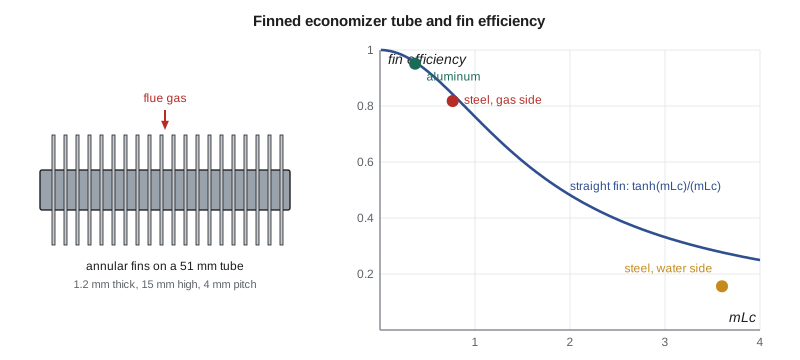
# Fins: a finned economizer tube and a thermowell in the steam main
import math

def straight_fin(h, k, t, L):
    """Straight rectangular fin per 1 m of width, corrected length for tip convection."""
    m = math.sqrt(2 * h / (k * t)); Lc = L + t / 2
    return m, math.tanh(m * Lc) / (m * Lc)

def annular_fin_eff(h, k, t, r1, r2, n=400):
    """Annular fin efficiency by finite differences on (1/r) d/dr (r dT/dr) = m^2 (T - Tinf), adiabatic corrected tip."""
    r2c = r2 + t / 2; m2 = 2 * h / (k * t); dr = (r2c - r1) / n
    r = [r1 + i * dr for i in range(n + 1)]
    a, b, c, d = [0.0]*(n+1), [0.0]*(n+1), [0.0]*(n+1), [0.0]*(n+1)
    b[0], d[0] = 1.0, 1.0                                  # theta = 1 at the base
    for i in range(1, n):
        rm, rp = r[i] - dr/2, r[i] + dr/2
        a[i], c[i] = rm / dr**2, rp / dr**2
        b[i] = -(rm + rp) / dr**2 - m2 * r[i]
    a[n], b[n] = 2 * (r[n] - dr/2) / dr**2, -2 * (r[n] - dr/2) / dr**2 - m2 * r[n]   # adiabatic tip (ghost node)
    for i in range(1, n + 1):                              # Thomas algorithm
        w = a[i] / b[i-1]; b[i] -= w * c[i-1]; d[i] -= w * d[i-1]
    th = [0.0]*(n+1); th[n] = d[n] / b[n]
    for i in range(n - 1, -1, -1): th[i] = (d[i] - c[i] * th[i+1]) / b[i]
    q = sum(((th[i] + th[i+1]) / 2) * 2 * math.pi * ((r[i] + r[i+1]) / 2) * dr for i in range(n)) * 2 * h
    q_max = h * 2 * math.pi * (r2c**2 - r1**2)
    return q / q_max

# Economizer tube in the flue gas of a hot-water boiler
D, t, H, s = 0.0508, 0.0012, 0.015, 0.004        # tube OD, fin thickness, fin height, fin pitch (m)
k, h, dT = 45.0, 60.0, 120.0                     # carbon steel; gas-side coefficient W/m2.K; gas minus tube wall (K)
r1, r2 = D/2, D/2 + H
eta_ann = annular_fin_eff(h, k, t, r1, r2)
m, eta_str = straight_fin(h, k, t, H)
print(f"m = {m:.1f} 1/m, straight-fin estimate eta = {eta_str:.3f}, annular fin (numerical) eta = {eta_ann:.3f}")

N = 1 / s                                         # fins per 1 m of tube
A_fin = N * 2 * math.pi * ((r2 + t/2)**2 - r1**2)
A_base = math.pi * D * (1 - N * t)
A_tot = A_fin + A_base
eta_o = 1 - A_fin / A_tot * (1 - eta_ann)
q_bare = h * math.pi * D * dT
q_fin = eta_o * h * A_tot * dT
print(f"per 1 m of tube: fin area {A_fin:.3f} m2, base area {A_base:.4f} m2, overall surface efficiency {eta_o:.3f}")
print(f"heat rate bare {q_bare:.0f} W/m, finned {q_fin:.0f} W/m, ratio {q_fin/q_bare:.1f}")
eps_f = eta_ann * 2*math.pi*((r2+t/2)**2 - r1**2) / (2*math.pi*r1*t)
print(f"single-fin effectiveness = {eps_f:.1f}")

# The same fins in aluminum, and in steel on the water side (h = 3000) where fins would not pay
print(f"aluminum fin (k = 200): eta = {annular_fin_eff(h, 200.0, t, r1, r2):.3f}")
print(f"steel fin on the water side (h = 3000): eta = {annular_fin_eff(3000.0, k, t, r1, r2):.3f}")

# Thermowell in the 1 MPa steam main treated as a hollow pin fin with an insulated tip
Do, Di, kw, hw = 0.012, 0.007, 16.0, 150.0       # stainless steel well, steam-side h
P, Ac = math.pi * Do, math.pi / 4 * (Do**2 - Di**2)
mw = math.sqrt(hw * P / (kw * Ac))
T_steam, T_base = 250.0, 230.0                   # well base cooled by a poorly insulated nozzle
for L in (0.040, 0.060, 0.120):
    T_tip = T_steam - (T_steam - T_base) / math.cosh(mw * L)
print(f"thermowell L = {L*1000:3.0f} mm: mL = {mw*L:.2f}, tip reads {T_tip:.1f} C, error {T_steam - T_tip:.2f} K")m = 47.1 1/m, straight-fin estimate eta = 0.852, annular fin (numerical) eta = 0.818 per 1 m of tube: fin area 1.627 m2, base area 0.1117 m2, overall surface efficiency 0.830 heat rate bare 1149 W/m, finned 10391 W/m, ratio 9.0 single-fin effectiveness = 27.8 aluminum fin (k = 200): eta = 0.951 steel fin on the water side (h = 3000): eta = 0.156 thermowell L = 40 mm: mL = 2.75, tip reads 247.5 C, error 2.54 K thermowell L = 60 mm: mL = 4.13, tip reads 249.4 C, error 0.64 K thermowell L = 120 mm: mL = 8.26, tip reads 250.0 C, error 0.01 K
Worked problem
Finned economizer tube
The economizer uses carbon steel tubes of 50.8 mm outside diameter with annular fins 1.2 mm thick and 15 mm high, at a pitch of 4 mm (250 fins per meter). Steel k = 45 W/m·K, the gas-side coefficient is 60 W/m²·K and the gas is 120 K hotter than the tube wall. Find the fin efficiency, the overall surface efficiency and the heat rate per meter of tube, finned and bare.
Show solution
- \(m = \sqrt{2h/(kt)} = \sqrt{2(60)/(45 \times 0.0012)} = 47.1\) m⁻¹; \(L_c = 15.6\) mm; \(mL_c = 0.735\).
- A straight fin would give \(\eta_f = \tanh(0.735)/0.735 = 0.852\); the annular fin, solved numerically, gives \(\eta_f = 0.818\).
- Per meter: fin area \(250 \times 2\pi(0.0410^2 - 0.0254^2) = 1.627\) m²; exposed base area 0.112 m²; \(A_t = 1.739\) m².
- \(\eta_o = 1 - (1.627/1.739)(1 - 0.818) = 0.830\).
- \[q'_{\text{finned}} = 0.830(60)(1.739)(120) = 10.4\ \text{kW/m}, \qquad q'_{\text{bare}} = 60\pi(0.0508)(120) = 1.15\ \text{kW/m}\]
Answer: The fins multiply the heat rate by about nine for a modest increase in material. Each fin has an effectiveness of about 28. The same fins in aluminum would reach 95 percent efficiency, but aluminum cannot be used where flue gas condenses acidic moisture on cool surfaces, a point that matters for the condensing economizer in Lesson 12.
The program also shows why fins are not used on the water side of the same tube. With a coefficient of 3000 W/m²·K, \(mL_c\) rises to about 5 and the fin efficiency falls to 16 percent: most of the fin sits at nearly the water temperature and does almost nothing. The water side already has a small resistance, so the right design puts all the extended surface on the gas side.
Fins in electronics and equipment
Plant equipment uses fins in many smaller ways. The variable-frequency drives on Northgate's distribution pumps dissipate several kilowatts each through aluminum heat sinks with straight plate fins, cooled by fans; their design balances fin spacing against the fan's pressure drop, because fins packed too closely choke the airflow and the boundary layers between them merge. Transformers carry finned radiators. Air-cooled condensers on the chillers use thin aluminum plate fins bonded to copper tubes, often with a wavy or louvred pattern that breaks up the boundary layer and raises h. In each case, the governing parameters are the same: \(m\), \(L_c\), the fin efficiency, and the trade-off between added area and added flow resistance.
A thermowell as a fin
Temperature sensors in pipes are mounted in thermowells, closed tubes that protrude into the flow so the sensor can be removed without draining the line. A thermowell is a fin in reverse: heat flows from the fluid into the well and along it toward a base that may be cooler than the fluid, especially if the nozzle where the well is mounted is poorly insulated. The tip, where the sensor sits, therefore reads below the true fluid temperature. With an adiabatic tip, the error is
Worked problem
Thermowell error in the steam main
A stainless steel thermowell (k = 16 W/m·K), 12 mm outside and 7 mm inside diameter, sits in steam at 250 °C with h = 150 W/m²·K. Its base, at a poorly insulated nozzle, is at 230 °C. Find the reading for immersion lengths of 40, 60 and 120 mm.
Show solution
- \(P = \pi(0.012) = 0.0377\) m; \(A_c = \tfrac{\pi}{4}(0.012^2 - 0.007^2) = 7.46\times10^{-5}\) m².
- \(m = \sqrt{150(0.0377)/(16 \times 7.46\times10^{-5})} = 68.8\) m⁻¹.
- 40 mm: \(mL = 2.75\), \(\cosh mL = 7.9\), error \(20/7.9 = 2.5\) K.
- 60 mm: \(mL = 4.13\), error 0.64 K. 120 mm: \(mL = 8.26\), error 0.01 K.
Answer: A short well in a cooled nozzle can read several kelvin low, enough to mislead a control loop. The fixes follow from the equation: longer immersion, a thinner wall or lower-conductivity material, higher velocity past the well, and, above all, insulating the nozzle so the base runs near the fluid temperature. Mechanical limits on length, set by vibration from vortex shedding, mean the well cannot simply be made very long, which is why thermowell design standards check both the thermal and the mechanical behavior.
US practice rates thermowells mechanically by ASME PTC 19.3 TW, which checks the well's natural frequency against vortex-shedding frequencies and its stresses at the design flow. In US units, the economizer's 10.4 kW per meter is about 10,800 Btu/h per foot of tube, and the gas-side coefficient of 60 W/m²·K is about 10.6 Btu/h·ft²·°F, typical of finned-tube economizers in boiler stacks.
Common mistakes
MistakeAdding fins on the side with the high coefficient.
InsteadFins pay where h is low; on a liquid side they have low efficiency and little benefit.
MistakeUsing the uncorrected length with the adiabatic-tip formula.
InsteadUse L_c = L + t/2 (or + D/4 for a pin) to account for tip convection.
MistakeAssuming fin efficiency close to 1 for any metal.
InsteadThin steel fins in moderate h can be well below 1; compute mL_c.
MistakeMaking fins longer to add heat transfer when mL > 2.5.
InsteadThe extra length is nearly at the fluid temperature and adds almost nothing.
MistakeTrusting a thermowell reading in a cold nozzle.
InsteadConduction to the base makes the tip read low; insulate the nozzle and check mL.
Summary and key terms
- Fins add area where the convection coefficient is low, typically on the gas side.
- The fin equation d²θ/dx² − m²θ = 0, with m² = hP/(kA_c), governs thin fins.
- With a corrected length, η_f = tanh(mL_c)/(mL_c); fins with mL > 2.5 act as infinitely long.
- Effectiveness should exceed about 2; overall surface efficiency η_o combines fin and base areas.
- Finned economizer tubes transfer about nine times as much heat as bare tubes.
- A thermowell reads low by (T∞ − T_b)/cosh(mL); insulating the nozzle cures most of the error.
- Extended surface
- A fin or other projection that increases the area for convection.
- Fin parameter m
- The square root of hP/(kA_c), governing the temperature decay along a fin.
- Corrected length
- L_c = L + t/2, used to account for convection at the fin tip.
- Fin efficiency
- The ratio of actual fin heat rate to the rate if the whole fin were at the base temperature.
- Fin effectiveness
- The ratio of fin heat rate to the rate from the covered base area without the fin.
- Overall surface efficiency
- The efficiency of a finned surface including the exposed base.
- Annular fin
- A disc-shaped fin around a tube.
- Economizer
- A heat exchanger that recovers heat from boiler flue gas into feed or return water.
- Thermowell
- A closed tube protruding into a pipe that holds a temperature sensor.
Practice problems
Work each problem on paper first, then reveal the answer to check.
Find m for an aluminum pin fin (k = 200 W/m·K) of 5 mm diameter with h = 40 W/m²·K.
Show answer
m = √(4h/(kD)) = 12.6 m⁻¹.
Find the efficiency of a straight fin with mL_c = 1.5.
Show answer
tanh(1.5)/1.5 = 0.603.
A finned surface has a total area of 1 m², of which 0.7 m² is fin area with an efficiency of 0.8. Find the overall surface efficiency.
Show answer
η_o = 1 − 0.7(1 − 0.8) = 0.86.
In the program, change the fin pitch to 3 mm. What happens to the heat rate per meter?
Show answer
It rises to about 13.5 kW/m (one-third more fins), but the gas-side pressure drop and the risk of fouling between fins also rise.
A thermowell has mL = 3. The base is 30 K below the fluid. Find the reading error.
Show answer
30/cosh 3 = 3.0 K.
Why are fins not useful in a boiling liquid?
Show answer
The very high h makes mL large and the fin efficiency very low.
Lesson quiz · 5 questions
Score 60% or more to complete this lesson.
Create a free account to save your progress, take quizzes and earn a certificate.