
CHE-312 · Lesson 10 of 12 · 26 min
Radiation fundamentals
Tomás's infrared survey of the boiler hall raised a puzzle in Lesson 1: surfaces at the same temperature looked very different on the camera's screen. The explanation lies in how surfaces emit, absorb and reflect thermal radiation, the subject of this lesson. Radiation dominates in Northgate's boiler furnaces, matters as much as convection for hot pipes and room heaters, sets the temperature of a sunlit roof and a clear-night windshield, and is the principle behind every infrared thermometer and camera. We start with the ideal emitter, the blackbody, and then describe how real surfaces depart from it.
The nature of thermal radiation
Thermal radiation is electromagnetic radiation emitted by matter because of its temperature. It occupies roughly the wavelength range from 0.1 to 100 μm, which includes part of the ultraviolet, all of the visible band from about 0.38 to 0.76 μm, and the infrared. Radiation travels at the speed of light, \(c = \lambda\nu\), and in a vacuum or in air it passes without loss. Unlike conduction and convection, which depend on temperature differences, emission depends on the absolute temperature of the emitter alone; net exchange between surfaces depends on the difference of their fourth powers.
Radiation from a surface goes out in all directions and at all wavelengths. To describe it completely we would need its spectral and directional distribution. For most engineering work it is enough to know the total emissive power \(E\) (W/m²), the rate of emission per unit area integrated over all wavelengths and directions, and the irradiation \(G\), the rate at which radiation arrives at a surface per unit area. Surfaces whose emission is the same in all directions are called diffuse, and most rough industrial surfaces are close to diffuse.
The blackbody
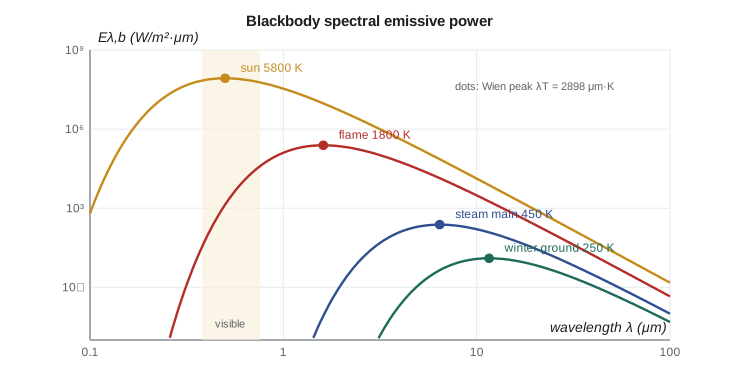
A blackbody is an ideal surface that absorbs all incident radiation, whatever its wavelength or direction, and for a given temperature and wavelength emits more than any other surface. Its emission is diffuse. A small hole in a large isothermal cavity is very nearly a blackbody, which is how calibration sources for infrared thermometers are built. Planck's law gives the blackbody's spectral emissive power:
At each temperature the spectrum rises to a peak and falls off. As temperature rises, emission increases at every wavelength and the peak shifts to shorter wavelengths, a result known as Wien's displacement law: \(\lambda_{\max}T = 2898\) μm·K. The sun, approximately a blackbody at 5800 K, peaks at 0.50 μm in the middle of the visible band; a flame at 1800 K peaks at 1.6 μm in the near infrared and looks orange because only the short-wavelength tail of its emission is visible; a steam main at 450 K peaks at 6.4 μm; the ground on a winter night peaks near 12 μm. Integrating Planck's law over all wavelengths gives the Stefan-Boltzmann law, \(E_b = \sigma T^4\).
Band emission
It is often necessary to know what fraction of a blackbody's emission falls in a band of wavelengths, for example the fraction of sunlight that is visible or the fraction of a pipe's emission that an infrared camera's detector can see. Because Planck's law depends on \(\lambda\) and \(T\) only through the product \(\lambda T\), the fraction emitted below a wavelength depends only on \(\lambda T\): \(F_{(0\to\lambda)} = \int_0^\lambda E_{\lambda,b}\,d\lambda/\sigma T^4\). This function is tabulated, and it can be computed from a rapidly converging series. The fraction in a band from \(\lambda_1\) to \(\lambda_2\) is then \(F_{(0\to\lambda_2)} - F_{(0\to\lambda_1)}\).
# Radiation fundamentals: blackbody emission, band fractions, surface properties and an infrared survey
import math
sigma, C1, C2, C3 = 5.670e-8, 3.742e8, 1.4388e4, 2897.8     # W/m2.K4; W.um4/m2; um.K; um.K

def planck(lam, T):                                           # spectral emissive power, W/m2.um
    return C1 / (lam**5 * (math.exp(C2 / (lam * T)) - 1))
def F0(lamT):                                                 # fraction of blackbody emission below lambda*T
    z = C2 / lamT
    return 15 / math.pi**4 * sum(math.exp(-n*z) / n * (z**3 + 3*z**2/n + 6*z/n**2 + 6/n**3) for n in range(1, 60))
def band(l1, l2, T): return F0(l2 * T) - F0(l1 * T)

for name, T in (("sun", 5800), ("furnace flame", 1800), ("steam main", 450), ("ground in winter", 250)):
    lmax = C3 / T
    print(f"{name:16s} T = {T:5d} K: E_b = {sigma*T**4/1000:9.3f} kW/m2, peak at {lmax:6.2f} um, "
          f"visible 0.38-0.76 um {band(0.38,0.76,T):6.1%}, beyond 3 um {1-F0(3*T):6.1%}")

# Check the band function against direct numerical integration of Planck's law for the sun
T, n = 5800.0, 4000
h = (0.76 - 0.38) / n
num = sum(planck(0.38 + (i + 0.5) * h, T) for i in range(n)) * h / (sigma * T**4)
print(f"visible fraction of sunlight by numerical integration: {num:.4f} (series: {band(0.38,0.76,T):.4f})")

# Equilibrium temperature of a sunlit plate, insulated behind, with only radiation exchange to a 270 K sky
G = 900.0
for name, a_s, eps in (("white paint", 0.20, 0.90), ("black paint", 0.95, 0.95), ("selective absorber", 0.95, 0.10)):
    Teq = (a_s * G / (eps * sigma) + 270.0**4) ** 0.25
    print(f"{name:18s} alpha_s/eps = {a_s/eps:5.2f}: no-convection equilibrium {Teq - 273.15:6.1f} C")

# Infrared survey of the steam main: camera set to emissivity 1.0 sees apparent temperatures
T_refl = 22 + 273.15
for surf, eps, T_app in (("painted pipe", 0.93, 168.0), ("bare stainless flange", 0.15, 55.0), ("aluminum jacket", 0.10, 23.5)):
    Ta = T_app + 273.15
    T_true = ((Ta**4 - (1 - eps) * T_refl**4) / eps) ** 0.25
    print(f"{surf:22s} eps = {eps:.2f}: camera shows {T_app:5.1f} C, surface is really about {T_true - 273.15:6.1f} C")
print(f"fraction of a 450 K surface's emission inside an 8-14 um camera band: {band(8, 14, 450):.1%}")sun T = 5800 K: E_b = 64164.532 kW/m2, peak at 0.50 um, visible 0.38-0.76 um 44.8%, beyond 3 um 2.1% furnace flame T = 1800 K: E_b = 595.214 kW/m2, peak at 1.61 um, visible 0.38-0.76 um 0.7%, beyond 3 um 32.0% steam main T = 450 K: E_b = 2.325 kW/m2, peak at 6.44 um, visible 0.38-0.76 um 0.0%, beyond 3 um 99.4% ground in winter T = 250 K: E_b = 0.221 kW/m2, peak at 11.59 um, visible 0.38-0.76 um 0.0%, beyond 3 um 100.0% visible fraction of sunlight by numerical integration: 0.4484 (series: 0.4484) white paint alpha_s/eps = 0.22: no-convection equilibrium 33.5 C black paint alpha_s/eps = 1.00: no-convection equilibrium 108.4 C selective absorber alpha_s/eps = 9.50: no-convection equilibrium 355.4 C painted pipe eps = 0.93: camera shows 168.0 C, surface is really about 174.5 C bare stainless flange eps = 0.15: camera shows 55.0 C, surface is really about 157.2 C aluminum jacket eps = 0.10: camera shows 23.5 C, surface is really about 36.1 C fraction of a 450 K surface's emission inside an 8-14 um camera band: 35.8%
Worked problem
How much sunlight is visible?
Treating the sun as a blackbody at 5800 K, find the fraction of its emission in the visible band from 0.38 to 0.76 μm, and the fraction beyond 3 μm.
Show solution
- \(\lambda_1 T = 0.38(5800) = 2204\) μm·K, \(F = 0.101\); \(\lambda_2 T = 0.76(5800) = 4408\) μm·K, \(F = 0.549\).
- \[F_{(0.38\to0.76)} = 0.549 - 0.101 = 0.448\]
- \(\lambda T = 3(5800) = 17{,}400\) μm·K gives \(F = 0.979\), so only about 2 percent is beyond 3 μm.
Answer: Almost half of solar energy is visible, a little under half is near infrared, and very little lies beyond 3 μm. Surfaces at ordinary temperatures, by contrast, emit almost all their energy beyond 3 μm. This separation of solar and terrestrial wavelengths is what makes selective surfaces and the greenhouse effect possible.
Real surfaces: emissivity
Real surfaces emit less than a blackbody. The total emissivity is the ratio \(\varepsilon = E/E_b\), between 0 and 1. It depends on the material, the surface finish, the temperature and, in general, the wavelength and direction. Polished metals have low emissivities, about 0.02 to 0.1, because their free electrons reflect most radiation; oxidation, roughness and dirt raise them sharply. Non-metals, including paints of any color, brick, concrete, water, skin and most plastics, have high emissivities in the infrared, about 0.85 to 0.95. Color describes behavior in the visible band only and says almost nothing about infrared emissivity: white paint and black paint both emit strongly at room temperature.
| Surface | Total emissivity (approx.) |
|---|---|
| Polished aluminum | 0.04–0.06 |
| Aluminum jacketing, weathered | 0.1–0.2 |
| Polished stainless steel | 0.1–0.2 |
| Oxidized carbon steel | 0.7–0.85 |
| Paint, any color | 0.85–0.95 |
| Brick and concrete | 0.85–0.95 |
| Water and ice | 0.95–0.97 |
| Human skin | ≈ 0.97 |
Absorption, reflection and transmission
Radiation arriving at a surface is partly absorbed, partly reflected and, if the material is semitransparent, partly transmitted. The fractions are the absorptivity \(\alpha\), reflectivity \(\rho\) and transmissivity \(\tau\), and they sum to one: \(\alpha + \rho + \tau = 1\). For opaque surfaces, \(\tau = 0\). Glass is transparent between about 0.3 and 2.5 μm but nearly opaque at longer wavelengths, so it admits sunlight and blocks the long-wave radiation emitted by the interior, which is how a greenhouse, a sunroom or a parked car heats up.
Kirchhoff's law links absorption to emission. For a surface in thermal equilibrium with its surroundings, the spectral, directional emissivity equals the spectral, directional absorptivity. For a diffuse surface whose properties do not depend on wavelength, called a gray surface, it follows that total \(\varepsilon = \alpha\). Real surfaces are rarely gray over all wavelengths, but many are close to gray over the range in which they both emit and absorb, for example a pipe exchanging radiation with room-temperature walls. Treating them as gray is the basis of the exchange calculations in Lesson 11.
Solar absorptivity and selective surfaces
The gray approximation fails when the incoming and outgoing radiation lie in different bands, as with sunlight falling on a surface near room temperature. Such a surface absorbs in the solar band, characterized by its solar absorptivity \(\alpha_s\), and emits in the infrared, characterized by \(\varepsilon\). The ratio \(\alpha_s/\varepsilon\) controls its temperature in the sun. White paint has a low \(\alpha_s\), about 0.2, and a high \(\varepsilon\), about 0.9, so it stays cool; this is the basis of cool roofs. Black paint has both near 0.95. Selective absorbers for solar collectors combine a high \(\alpha_s\), about 0.95, with a low infrared \(\varepsilon\), about 0.1, so they absorb sunlight well and lose little by re-emission.
Worked problem
Plates in the sun
A plate insulated behind receives 900 W/m² of sunshine and exchanges radiation with a sky at an effective 270 K. Ignoring convection, find its equilibrium temperature for white paint (α_s = 0.20, ε = 0.90), black paint (0.95, 0.95) and a selective absorber (0.95, 0.10).
Show solution
- Balance: \(\alpha_s G = \varepsilon\sigma(T^4 - T_{\text{sky}}^4)\), so \(T = \big(\alpha_s G/(\varepsilon\sigma) + T_{\text{sky}}^4\big)^{1/4}\).
- White: \(T = 306.6\) K, 33.5 °C. Black: 381.6 K, 108 °C.
- Selective: \(T = 628.6\) K, 355 °C.
Answer: Real plates also lose heat by convection, which lowers all three temperatures considerably; a black roof in the sun usually runs at 60 to 80 °C, as Lesson 1's roof calculation found. The comparison still shows why the ratio α_s/ε matters so much: the selective surface reaches temperatures useful for process heat, and the white roof stays near the air temperature.
Infrared thermography
An infrared camera measures the radiation reaching its detector from each point of the scene, usually in a band such as 8 to 14 μm, and converts it to a temperature using an emissivity that the operator sets. If the true emissivity is lower than the setting, the surface emits less than the camera assumes and also reflects radiation from its surroundings. The camera then reads a temperature between the true surface temperature and the reflected temperature. A simple total-radiation correction, accurate enough to show the size of the error though not a substitute for the camera's own band-based software, is
Worked problem
Correcting the boiler-hall survey
With the camera's emissivity set to 1.0 and reflected surroundings at 22 °C, Tomás recorded apparent temperatures of 168 °C on a painted steam pipe (ε ≈ 0.93), 55 °C on a bare stainless flange (ε ≈ 0.15) and 23.5 °C on an aluminum jacket (ε ≈ 0.10). Estimate the true surface temperatures.
Show solution
- Painted pipe: \(T_s = 447.7\) K, about 174 °C.
- Stainless flange: \(T_s = 430\) K, about 157 °C.
- Aluminum jacket: about 36 °C.
Answer: The painted pipe reads almost correctly; the flange, which looked nearly cold, is actually close to steam temperature; the jacket is somewhat warmer than it appeared. Thermographers handle low-emissivity surfaces by applying a patch of high-emissivity tape or paint, by measuring at a known reference, or by setting the emissivity and reflected temperature carefully. The survey's real value is in comparisons: a hot spot on a uniformly jacketed line almost always means wet or missing insulation.
In the United States, infrared thermographers are commonly trained and certified under the American Society for Nondestructive Testing practice for personnel qualification, with ASTM standards covering building envelope and electrical surveys. In US units, the blackbody emissive power at 450 K is about 740 Btu/h·ft², and the Stefan-Boltzmann constant is 0.1714 × 10⁻⁸ Btu/h·ft²·R⁴.
Common mistakes
MistakeJudging infrared emissivity by visible color.
InsteadWhite and black paints both have high infrared emissivity.
MistakeAssuming α = ε for sunlight on a room-temperature surface.
InsteadSolar absorptivity and infrared emissivity act in different bands; use α_s and ε separately.
MistakeUsing temperatures in °C in Planck's or Wien's laws.
InsteadUse kelvin.
MistakeTrusting an infrared camera on shiny metal.
InsteadLow emissivity surfaces read close to the reflected temperature; correct or apply tape.
MistakeForgetting transmission through glass and plastics.
InsteadSemitransparent materials have α + ρ + τ = 1 with τ depending on wavelength.
Summary and key terms
- Thermal radiation spans about 0.1 to 100 μm; emission depends on absolute temperature.
- A blackbody absorbs everything and emits the maximum, σT⁴; Planck's law gives its spectrum.
- Wien's law, λ_max T = 2898 μm·K, places the sun's peak in the visible and room-temperature peaks near 10 μm.
- Band fractions depend only on λT; about 45 percent of sunlight is visible.
- Real surfaces have ε < 1; α + ρ + τ = 1; Kirchhoff's law gives ε = α for gray surfaces.
- α_s/ε controls surface temperature in the sun; emissivity errors distort infrared measurements.
- Thermal radiation
- Electromagnetic radiation emitted because of a body's temperature.
- Blackbody
- An ideal surface that absorbs all incident radiation and emits the maximum possible.
- Planck's law
- The spectral distribution of blackbody emission.
- Wien's displacement law
- λ_max T = 2898 μm·K for blackbody emission.
- Emissivity
- The ratio of a surface's emission to a blackbody's at the same temperature.
- Irradiation
- The radiation incident on a surface per unit area, G.
- Gray surface
- A surface whose radiative properties do not depend on wavelength.
- Kirchhoff's law
- At equilibrium, a surface's emissivity equals its absorptivity.
- Selective surface
- A surface with different absorptivity in the solar band and emissivity in the infrared.
Practice problems
Work each problem on paper first, then reveal the answer to check.
Find the peak emission wavelength of a surface at 1000 K.
Show answer
2.90 μm.
Find the blackbody emissive power at 600 K.
Show answer
7.35 kW/m².
In the program, find the fraction of a 1800 K flame's emission that is visible.
Show answer
About 0.7 percent.
A gray opaque surface has ε = 0.3. Find its absorptivity and reflectivity.
Show answer
α = 0.3; ρ = 0.7.
A camera set to ε = 1 reads 30 °C on a surface with ε = 0.5, with surroundings at 20 °C. Estimate the true temperature.
Show answer
About 39 °C.
Why does a white roof stay cooler in the sun than a black one?
Show answer
Its low solar absorptivity limits absorbed sunlight while its high infrared emissivity sheds heat.
Lesson quiz · 5 questions
Score 60% or more to complete this lesson.
Create a free account to save your progress, take quizzes and earn a certificate.