
CHE-312 · Lesson 1 of 12 · 26 min
Heat transfer modes and the energy balance
Thermodynamics tells us how much energy moves when a system changes state. It says nothing about how fast that energy moves, or what size of equipment it takes to move it. Heat transfer answers those questions. It explains why a bare steam pipe wastes thousands of dollars of fuel a year, why a district heating pipe can be buried for fifty years with only a modest loss, how large a heat exchanger must be, and how long a stopped water line can sit in frozen ground before it freezes. This course follows the expansion study at Northgate District Energy in Minneapolis, where the team that analyzed the plant's power and refrigeration cycles in Thermodynamics II now has to size the hardware: pipe insulation, an economizer, a new substation heat exchanger for Riverside General Hospital, and the controls that keep everything safe through a prairie winter.
Elena Varga, the plant's lead engineer, has asked Tomás Reyes, the returning co-op student, to start with a walk through the boiler hall with an infrared camera. Graham Okoro, the operations manager, knows where the trouble spots are: a twelve-meter run of the 1 MPa steam main whose insulation was removed for a valve repair and never replaced, a hot boiler casing, and a wall that frosts on the inside in January. Kofi Mensah, the consultant, wants numbers for each one. The first step is to recognize which of the three modes of heat transfer is at work, and to write an energy balance that ties them together.
Heat, temperature and rate
Heat is energy in transit because of a temperature difference. It always flows from high temperature to low temperature, as the second law requires, and the rate at which it flows is measured in watts. We will use \(q\) for a heat rate (W), \(q'\) for a heat rate per unit length (W/m), useful for pipes, and \(q''\) for a heat flux, the rate per unit area (W/m²). The total energy transferred over a time is the integral of the rate, measured in joules or, for annual plant figures, gigajoules.
Every heat transfer problem has the same structure. A driving force, the temperature difference, pushes heat through a resistance that depends on the geometry, the materials and the motion of any fluids. Most of this course is about finding that resistance, or its inverse, a conductance, for real configurations. Once it is known, the rate follows directly.
Conduction
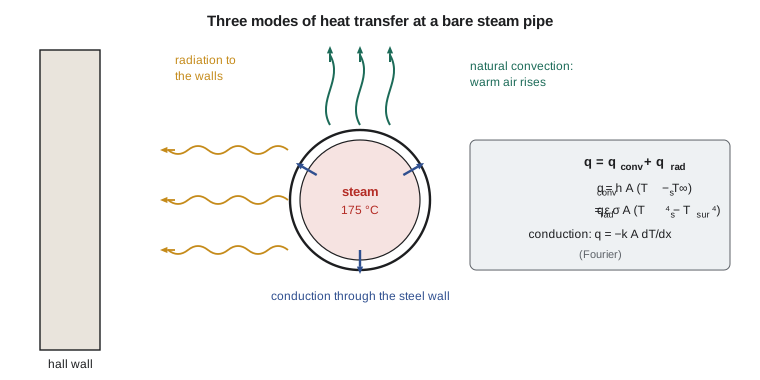
Conduction is the transfer of energy through a substance from more energetic particles to less energetic ones, by molecular collisions in gases and liquids, and by lattice vibrations and free electrons in solids. It needs no bulk motion. For steady one-dimensional conduction, the rate is given by Fourier's law:
The minus sign reflects the fact that heat flows down the temperature gradient. The property \(k\) is the thermal conductivity, in W/m·K. It ranges over five orders of magnitude: about 400 W/m·K for copper, 45 to 60 for carbon steel, 15 for stainless steel, about 1 to 1.5 for concrete and moist soil, 0.6 for water, 0.026 for still air, and roughly 0.02 to 0.03 for the polyurethane foam used in pre-insulated pipes. Insulation works by trapping gas in small cells, so the material's conductivity approaches that of the gas while the cells are too small for the gas to circulate.
| Material (near room temperature) | k (W/m·K) | Typical role at Northgate |
|---|---|---|
| Copper | ≈ 400 | Small tubing, electrical bus |
| Aluminum | ≈ 200–237 | Jacketing, fins |
| Carbon steel | ≈ 45–60 | Pipes, boiler tubes |
| Stainless steel | ≈ 15–16 | Thermowells, plate exchangers |
| Concrete | ≈ 1.0–1.8 | Walls, valve chambers |
| Moist clay soil | ≈ 1.0–1.5 | Around buried pipes |
| Water | ≈ 0.6 | Working fluid |
| Mineral wool | ≈ 0.035–0.05 | Boiler and pipe insulation |
| Polyurethane foam | ≈ 0.022–0.03 | Pre-insulated pipe |
| Still air | ≈ 0.026 | Gaps, cavities |
Convection
Convection is heat transfer between a surface and a moving fluid. At the surface itself the fluid is at rest and energy passes by conduction, but the moving fluid then carries the energy away, which makes convection far more effective than conduction through a still fluid. When the motion is driven by a fan, pump or wind, we speak of forced convection; when it is driven by buoyancy, because heated fluid is less dense and rises, we speak of natural or free convection. Boiling and condensation are convection processes with a phase change, and they produce the largest coefficients of all. Convection is described by Newton's law of cooling:
Here \(h\) is the convection heat transfer coefficient, in W/m²·K. Newton's law looks simple, but all the physics is hidden in \(h\), which depends on the fluid's properties, its velocity, the geometry and whether the flow is laminar or turbulent. Lessons 6 to 9 develop the correlations used to find it. Typical ranges are worth memorizing as a check on any calculation.
| Process | h (W/m²·K) |
|---|---|
| Natural convection, gases | 2–25 |
| Natural convection, liquids | 50–1,000 |
| Forced convection, gases | 25–250 |
| Forced convection, liquids | 100–20,000 |
| Boiling and condensation | 2,500–100,000 |
Radiation
Every surface above absolute zero emits electromagnetic radiation. Unlike conduction and convection, radiation needs no medium; it crosses a vacuum and, in practice, passes through air almost unchanged. The maximum possible emission from a surface, that of a blackbody, is given by the Stefan-Boltzmann law, \(E_b = \sigma T^4\), with \(\sigma = 5.67 \times 10^{-8}\) W/m²·K⁴ and \(T\) in kelvin. Real surfaces emit a fraction \(\varepsilon\), the emissivity, of this amount. For a small surface completely surrounded by much larger surroundings at \(T_{\text{sur}}\), such as a pipe in a large hall, the net exchange is
Because of the fourth power, radiation becomes dominant at high temperatures: it is the main mode in a boiler furnace. Even near room temperature it is rarely negligible. A dark, oxidized steel pipe at 175 °C loses roughly as much by radiation as by natural convection. A shiny aluminum jacket, with an emissivity near 0.1, radiates far less, which is one reason jacketed insulation runs cooler to the touch than painted surfaces. It is often convenient to write radiation like convection, using a radiation coefficient \(h_r = \varepsilon\sigma (T_s + T_{\text{sur}})(T_s^2 + T_{\text{sur}}^2)\), so that \(q_{\text{rad}} = h_r A (T_s - T_{\text{sur}})\) and the two can be added when the air and the surroundings are at the same temperature.
The energy balance
Heat transfer problems are solved by combining the rate equations with the first law of thermodynamics. For a control volume, the rate form of the energy balance is
where \(\dot E_g\) is energy generated inside the volume, by electrical heating, a chemical reaction or nuclear fission for example, and \(dE_{\text{st}}/dt\) is the rate of change of stored energy. At steady state the right side is zero. For a flowing stream with negligible changes in kinetic and potential energy, the energy carried is \(\dot m c_p (T_{\text{out}} - T_{\text{in}})\), which is how a heat exchanger duty or a pipe's temperature drop is linked to its heat loss.
A special case is the surface energy balance. A surface has no volume, so it can neither store energy nor generate it, and what arrives must leave. For the outside of a sunlit roof membrane, absorbed sunshine is balanced by convection to the air and radiation to the sky. Writing \(\alpha G = h(T_s - T_\infty) + \varepsilon\sigma(T_s^4 - T_{\text{sky}}^4)\) gives one equation in one unknown, the surface temperature, which must be solved by iteration because of the fourth power. Many practical problems, from thermocouple errors to frost on windows, come down to a surface energy balance like this one.
# Heat transfer modes at Northgate District Energy: a bare steam pipe in the boiler hall
import math
sigma = 5.670e-8                       # Stefan-Boltzmann constant, W/m2.K4

# 1. Conduction through the boiler-hall wall (plane wall, steady)
k_wall, L_wall, A_wall = 0.72, 0.20, 180.0          # brick-concrete wall, W/m.K, m, m2
T_in, T_out = 24.0, -30.0
q_wall = k_wall * A_wall * (T_in - T_out) / L_wall
print(f"wall conduction: q = {q_wall/1000:.1f} kW  (flux {q_wall/A_wall:.0f} W/m2)")

# 2. A bare section of the 1 MPa steam main: convection plus radiation from its surface
D, Lp = 0.2191, 12.0                   # DN200 pipe outside diameter (m), exposed length (m)
Ts, Tair, Tsurr = 175.0, 24.0, 24.0    # surface, air and wall temperatures (C)
h_conv, eps = 9.0, 0.80                # natural convection coefficient (W/m2.K), oxidized steel emissivity
A = math.pi * D * Lp
q_conv = h_conv * A * (Ts - Tair)
q_rad = eps * sigma * A * ((Ts + 273.15)**4 - (Tsurr + 273.15)**4)
h_rad = q_rad / (A * (Ts - Tsurr))
print(f"bare pipe: area {A:.2f} m2, convection {q_conv/1000:.2f} kW, radiation {q_rad/1000:.2f} kW, total {(q_conv+q_rad)/1000:.2f} kW")
print(f"           radiation coefficient h_rad = {h_rad:.1f} W/m2.K, share of radiation {q_rad/(q_conv+q_rad):.0%}")

# 3. What the loss costs over a year of operation
hours, boiler_eff, gas_price = 8000, 0.85, 4.0      # h/yr, -, currency per GJ of fuel (assumed)
E_GJ = (q_conv + q_rad) * hours * 3600 / 1e9
print(f"annual loss {E_GJ:.0f} GJ of steam -> {E_GJ/boiler_eff:.0f} GJ of fuel, cost about {E_GJ/boiler_eff*gas_price:,.0f} per year")

# 4. Surface energy balance: temperature of a sunlit, dark roof membrane on a calm summer day
alpha, eps_r, G_sun, h_out, T_amb = 0.90, 0.90, 850.0, 12.0, 30.0
T = T_amb
for _ in range(60):                    # solve alpha*G = h(T - Tamb) + eps*sigma*(T^4 - Tsky^4), sky at 10 C
    f = alpha*G_sun - h_out*(T - T_amb) - eps_r*sigma*((T+273.15)**4 - (10+273.15)**4)
    df = -h_out - 4*eps_r*sigma*(T+273.15)**3
    T -= f/df
print(f"sunlit roof membrane settles near {T:.1f} C")wall conduction: q = 35.0 kW (flux 194 W/m2)
bare pipe: area 8.26 m2, convection 11.23 kW, radiation 12.19 kW, total 23.42 kW
radiation coefficient h_rad = 9.8 W/m2.K, share of radiation 52%
annual loss 674 GJ of steam -> 793 GJ of fuel, cost about 3,174 per year
sunlit roof membrane settles near 65.3 CWorked problem
Heat loss from the bare steam pipe
The uninsulated section of the 1 MPa steam main is 12 m of DN200 pipe, outside diameter 219.1 mm, with an oxidized surface at 175 °C and an emissivity of 0.80. The hall air and walls are at 24 °C, and the natural convection coefficient is about 9 W/m²·K. Find the heat loss by convection and by radiation.
Show solution
- Surface area: \(A = \pi D L = \pi(0.2191)(12) = 8.26\) m².
- Convection: \(q_{\text{conv}} = 9(8.26)(175 - 24) = 11.2\) kW.
- Radiation: \(q_{\text{rad}} = 0.80(5.67\times10^{-8})(8.26)\big(448.15^4 - 297.15^4\big) = 12.2\) kW.
- \[q = 11.2 + 12.2 = 23.4\ \text{kW}, \qquad h_r = \frac{12.2\times10^3}{8.26(151)} = 9.8\ \text{W/m}^2\text{·K}\]
Answer: Radiation carries just over half the loss, and the radiation coefficient is as large as the convection coefficient. Ignoring radiation would halve the estimate. Over 8,000 operating hours the loss is about 674 GJ of steam, or roughly 790 GJ of boiler fuel.
Worked problem
A wall that frosts on the inside
The north wall of the boiler hall is 180 m² of brick and concrete 0.20 m thick with k = 0.72 W/m·K. On a design day the inside surface is at 24 °C and the outside surface at −30 °C. Find the conduction heat loss and the heat flux.
Show solution
- Fourier's law for a plane wall: \(q = kA\,\Delta T / L = 0.72(180)(54)/0.20\).
- \[q = 35.0\ \text{kW}, \qquad q'' = 194\ \text{W/m}^2\]
Answer: In reality the surface temperatures are not given; the inside and outside air temperatures are. Lesson 2 adds the convection resistances at each face, which lower the flux and show why the inside surface of a poorly insulated wall can fall below the dew point of the hall air.
US practice still mixes units. Heat rates are often given in Btu/h (1 W = 3.412 Btu/h), coefficients in Btu/h·ft²·°F (1 W/m²·K = 0.1761 Btu/h·ft²·°F), conductivities in Btu/h·ft·°F (1 W/m·K = 0.5778 Btu/h·ft·°F), and insulation in R-values in ft²·°F·h/Btu, where R-1 equals 0.176 m²·K/W. The bare pipe's 23.4 kW is about 80,000 Btu/h. Building energy requirements are set by state and local adoption of the International Energy Conservation Code or ASHRAE Standard 90.1.
Choosing the modes that matter
Real problems rarely involve one mode alone, and the skill lies in deciding which modes matter and which can be ignored. A useful habit is to estimate each resistance or each coefficient first. Radiation from a shiny surface at room temperature is small; radiation from a dark surface above about 100 °C is comparable to natural convection; radiation in a furnace dominates. Conduction through a thin metal wall is almost always negligible compared with convection on either side, but conduction through insulation usually controls everything. Forced convection overwhelms natural convection once the velocity exceeds a few tenths of a meter per second. These judgments are checked by calculation, but making them first keeps the calculation focused.
Tomás's camera survey turns up one more effect: the bare pipe looks hotter on the screen than the painted pipes beside it, while a stainless flange looks almost cold even though it is touching the same steam. Both effects are about emissivity, not temperature, and Lesson 10 explains how to correct for them.
Common mistakes
MistakeUsing °C in the Stefan-Boltzmann law.
InsteadRadiation uses absolute temperature: convert to kelvin before taking fourth powers.
MistakeTreating h as a property of the fluid.
Insteadh depends on velocity, geometry and flow regime as well as fluid properties.
MistakeIgnoring radiation at moderate temperatures.
InsteadFor dark surfaces above about 100 °C it is often as large as natural convection.
MistakeApplying q = hA(Ts − T∞) to radiation with a fixed h.
InsteadThe radiation coefficient changes strongly with temperature; recompute it.
MistakeForgetting that a surface stores no energy.
InsteadA surface energy balance has no storage or generation term: what arrives must leave.
Summary and key terms
- Heat transfer gives the rate of energy transfer; thermodynamics gives the amount.
- Conduction follows Fourier's law, q″ = −k dT/dx; k ranges from about 400 W/m·K (copper) to 0.02 W/m·K (foam).
- Convection follows Newton's law, q = hA(Ts − T∞); h depends on the flow and the geometry.
- Radiation from a surface to large surroundings is εσA(Ts⁴ − Tsur⁴), with T in kelvin.
- The energy balance links the modes: in − out + generated = rate of storage; a surface has no storage.
- Estimating each mode first shows which ones control the problem.
- Heat flux
- Heat transfer rate per unit area, q″, in W/m².
- Thermal conductivity
- A material property, k, giving the conduction rate per unit area per unit temperature gradient.
- Fourier's law
- q″ = −k dT/dx, the rate equation for conduction.
- Convection coefficient
- The factor h in Newton's law of cooling, in W/m²·K.
- Forced convection
- Convection with fluid motion driven by a fan, pump or wind.
- Natural convection
- Convection with fluid motion driven by buoyancy.
- Emissivity
- The ratio of a surface's emission to that of a blackbody at the same temperature.
- Stefan-Boltzmann law
- Blackbody emissive power E_b = σT⁴.
- Surface energy balance
- An energy balance on a surface, which has no storage or generation.
Practice problems
Work each problem on paper first, then reveal the answer to check.
A 3 m² steel plate 10 mm thick (k = 50 W/m·K) has faces at 120 °C and 118 °C. Find the heat rate.
Show answer
30 kW.
Find the heat flux through 50 mm of mineral wool (k = 0.04 W/m·K) with faces at 150 °C and 30 °C.
Show answer
96 W/m².
A 1 m² surface at 60 °C is cooled by air at 20 °C with h = 15 W/m²·K. Find the convection rate.
Show answer
600 W.
Find the net radiation from a 2 m² surface at 400 K with ε = 0.9 to surroundings at 300 K.
Show answer
About 1.79 kW.
In the program, change the bare pipe's emissivity to 0.10 (aluminum jacket). How does the loss change?
Show answer
Radiation falls to about 1.5 kW and the total to about 12.7 kW.
Why can a radiation coefficient be added to a convection coefficient?
Show answer
When the air and the surroundings are at the same temperature, both rates are proportional to the same temperature difference.
Lesson quiz · 5 questions
Score 60% or more to complete this lesson.
Create a free account to save your progress, take quizzes and earn a certificate.