
BLR-230 · Lesson 9 of 12 · 17 min
Structural bolting and flange bolting
A field crew bolts almost as much as it welds. On Tank 15, the spiral stairway, the top platform, the handrails and the rolling ladder track are bolted. On Riverbend's stack, the section flanges and the platform framing are bolted, and the anchor bolts hold the whole stack down. And at Northgate, in August, Ironbridge sends a crew to the refinery's turnaround to make up flange joints on exchangers and piping, where a bolted joint is the boundary between a hot hydrocarbon and the people working beside it. Desmond Pryce, who has made up more flanges than anyone else at Ironbridge, runs Kiera's bolting training. "There are two kinds of bolted joint," he tells her on the first day. "In one, the bolts hold steel together. In the other, the bolts squeeze a gasket hard enough to stop a leak. They look the same and they are not the same job."
Structural bolts and joint types
Structural steel is joined with high-strength bolts: ASTM F3125 Grade A325 and Grade A490 bolts, installed under the RCSC Specification for Structural Joints Using High-Strength Bolts, which the AISC specification references, with matching heavy hex nuts and hardened washers where required. The engineer who designs the connection chooses the joint type, and the joint type decides how tight the bolts must be.
| Joint type | How it carries load | Installation |
|---|---|---|
| Snug-tight | Bolts bear on the sides of the holes in shear | Plies drawn into firm contact; bolts snug |
| Pretensioned | Bolts are tensioned to a minimum value; used where joints see load reversal or vibration | Snug, then a pretensioning method |
| Slip-critical | Clamping force and friction between the faying surfaces carry the load without slip | Pretensioned, with faying surfaces prepared and coated as specified |
Snug-tight is the condition reached when all the plies of the joint are in firm contact, which in practice means a few impacts of an impact wrench or the full effort of a worker on an ordinary spud wrench. Most stair and platform connections on Tank 15 are snug-tight. The stack's flanged section joints and the anchor bolts are pretensioned, because the stack vibrates and its joints see reversing loads; a snug bolt in a vibrating joint loosens and then fails in fatigue. Slip-critical joints, where a slip of a few millimeters would be harmful, have their faying surfaces left uncoated or coated with a qualified slip coating, and must not be painted or greased.
Pretensioning methods
Pretension is the tension in the bolt after installation, typically about 70 percent of the bolt's minimum tensile strength. For a 3/4 in A325 bolt, the required minimum pretension is about 28 kips. There are four accepted ways to reach it. In the turn-of-nut method, the bolts are snugged, the nut and bolt end are match-marked, and the nut is turned a set rotation past snug, depending on the bolt's length relative to its diameter. In the calibrated wrench method, a torque wrench is set by testing bolts from the same lot in a tension calibrator, the instrument that measures the actual bolt tension, every day. Twist-off-type tension-control bolts have a splined end that shears off when the bolt reaches its tension. Direct tension indicators are hardened washers with bumps that flatten as the bolt tightens; a feeler gauge shows when they have compressed enough.
Whatever the method, a pre-installation verification test is done on site: a sample of bolts from each lot is installed in the tension calibrator by the crew, with the same tools and method they will use, to prove that the method actually gives at least the required tension. Desmond's crew runs the test at Riverbend before the stack flange bolts are tightened.
Bolts are a manufactured product with a lot number, and the lot traceability matters. Bolts are kept in their containers, dry and lubricated as delivered, until they are used. Bolts that have been pretensioned are not reused without the engineer's approval, and some grades, such as A490 and galvanized bolts, are never reused, because tensioning stretches the threads.
The flanged joint
A flanged joint in a pressure system is different. Its bolts must compress a gasket enough to seal it, keep enough load on the gasket when the joint is pressurized and the pressure tries to push the flanges apart, and keep that load as the joint heats, cools and relaxes. Too little bolt load, and the joint leaks. Too much, and the gasket is crushed or the flange is bent. Uneven bolt load, with some bolts tight and some loose, leaves the gasket crushed on one side and loose on the other, and the joint leaks on the loose side. Most flange leaks in refineries are not caused by bad gaskets or bad flanges but by bad assembly.
ASME PCC-1, Guidelines for Pressure Boundary Bolted Flange Joint Assembly, is the industry's guide to doing it right. It covers the training and qualification of bolting assemblers, the inspection of flange faces and fasteners, the alignment of the flanges, the lubrication of the bolts, the gasket installation, the tightening pattern and the records. Northgate requires every joint on its turnaround list to be made up by a qualified assembler to PCC-1 and recorded on a joint tag.
| Step | What the assembler does |
|---|---|
| Inspect the flange faces | Clean them; look for scratches across the serrations, dents and corrosion; measure if in doubt |
| Inspect the fasteners | Right grade and size; threads clean and undamaged; nuts run freely |
| Check alignment | Faces parallel, holes lined up, no high-low or gap beyond the limits, no force needed to bring them together |
| Lubricate | The specified lubricant on the threads and the nut faces, every time |
| Install the gasket | New gasket of the specified type, centered, never reused, no tape or grease unless specified |
| Number the bolts | Numbers marked around the flange so the pattern can be followed |
| Tighten in passes | Snug, then passes in the cross pattern, then circular passes at full value |
| Record | Joint tag with gasket, lubricant, tool, target, assembler and date |
Tightening pattern and passes
The bolts of a flange are not tightened one after another around the circle. Each bolt tightened pulls the flanges together locally and slightly loosens the bolts beside it, an effect called elastic interaction. Tightening around the circle would leave the first bolts looser than the last. Instead, bolts are tightened in a cross or star pattern, each bolt followed by the one opposite it, then the bolts halfway between, and so on, so that the flanges come together evenly. PCC-1's legacy cross pattern numbers the bolts in this order; the standard also describes alternative patterns, which tighten groups of bolts at once and can be quicker with several tools, when they are qualified for the joint.
The tightening is done in passes. The bolts are first snugged by hand. The first pass brings every bolt to about 20 to 30 percent of the final torque in the cross pattern, the second to about 50 to 70 percent, and the third to the full target. Then the assembler goes round the flange in a circle, bolt to bolt, at the full target, and repeats the circular passes until the nuts no longer turn. The circular passes pick up the load lost to elastic interaction.
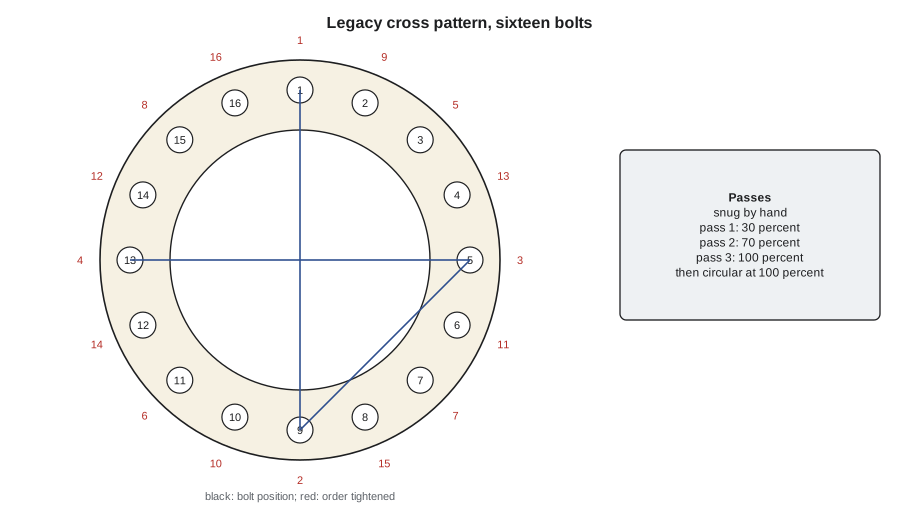
At Northgate, Desmond and Kiera make up the channel cover joint on a reboiler, an NPS 12 Class 300 flange with sixteen 1 1/8 in studs and a spiral wound gasket. The joint's target torque, from Northgate's bolting table, is 572 ft-lb, worked out in lesson 10. The code below prints the cross-pattern order for eight and sixteen bolts, the pass values for this joint, and, for comparison, the turn-of-nut rotations for structural bolts of three lengths on the stack platforms.
# Northgate flange: legacy cross-pattern tightening order and the passes (US units)
def legacy_order(n):
    """Star (cross) order for n bolts, n a power of two: bit-reversed positions."""
    bits = n.bit_length() - 1
    order = []
    for i in range(n):
        rev = int(format(i, f"0{bits}b")[::-1], 2)
        order.append(rev + 1)
    return order

for n in (8, 16):
    print(f"{n} bolts: " + "-".join(str(b) for b in legacy_order(n)))

target = 572                  # final torque, ft-lb
passes = [("Snug, by hand", 0.0), ("Pass 1", 0.3), ("Pass 2", 0.7), ("Pass 3", 1.0)]
for name, frac in passes:
    print(f"{name:14} cross pattern  {frac * target:6.0f} ft-lb")
print(f"Pass 4: circular, bolt to bolt, at {target} ft-lb until the nuts no longer turn")

# Structural joint on the stack platform: turn-of-nut rotation after snug
d = 0.75                        # bolt diameter, in
for grip_len in [2.5, 3.5, 7.0]:
    ratio = grip_len / d
    turn = "1/3" if ratio <= 4 else "1/2" if ratio <= 8 else "2/3" if ratio <= 12 else "by test"
print(f"bolt length {grip_len} in ({ratio:.1f}d): turn {turn} past snug")8 bolts: 1-5-3-7-2-6-4-8 16 bolts: 1-9-5-13-3-11-7-15-2-10-6-14-4-12-8-16 Snug, by hand cross pattern 0 ft-lb Pass 1 cross pattern 172 ft-lb Pass 2 cross pattern 400 ft-lb Pass 3 cross pattern 572 ft-lb Pass 4: circular, bolt to bolt, at 572 ft-lb until the nuts no longer turn bolt length 2.5 in (3.3d): turn 1/3 past snug bolt length 3.5 in (4.7d): turn 1/2 past snug bolt length 7.0 in (9.3d): turn 2/3 past snug
The cross-pattern order is a neat bit of arithmetic: for a flange with a power-of-two number of bolts, the order is the bolt positions counted in binary with their digits reversed, which is why each bolt is followed by the one opposite. Desmond does not expect Kiera to remember that; he expects her to number the bolts on the flange with a paint marker before she starts and to follow the numbers. On the structural side, a 2 1/2 in bolt in a 3/4 in size is under four diameters long and gets a third of a turn past snug, while the long bolts through the stack flange and its stiffener get half and two-thirds of a turn.
Inspecting a flange before assembly
Desmond spends a full morning teaching Kiera to look at a flange face. A raised face flange for a spiral wound gasket has a fine spiral or concentric serration machined into its sealing surface, and the gasket seals by biting into it. A scratch that runs across the serrations, from the bore toward the outside, is a leak path, because the gasket cannot fill it; a scratch that runs along the serrations is usually harmless. PCC-1 gives limits for the depth and width of defects that cross the sealing surface, and Desmond carries a pit gauge and a straightedge to measure them. Corrosion, old gasket material stuck to the face and paint on the sealing surface all have to go, with a brass brush or a scraper that will not cut the face, never a grinder.
The bolts get the same attention. Each stud must be the grade the line class requires, marked on its end, long enough to show at least one full thread beyond each nut, and free of damaged threads; a stud whose nut does not run freely by hand along its length is replaced. The nuts must be the matching grade, with their marked face outward. The gasket is checked against the specification for type, size, rating and materials, still in its packaging until it is fitted, and the centering ring is checked so that the gasket will sit in the middle of the faces.
Alignment is the last check. With the gasket out, the flanges should come together by hand or with light force; if it takes a come-along or heavy jacking to line up the holes, the piping is strained and the joint will not seal evenly. Desmond records the gap at four points around the flange before the bolts go in, and again after the first pass, so that an uneven gap is caught early.
Common mistakes
MistakeTightening flange bolts around the circle in order.
InsteadUse the cross pattern for the first passes, then circular passes at the final value.
MistakeReusing a gasket because it looks fine.
InsteadAlways fit a new gasket of the specified type.
MistakeForcing misaligned flanges together with the bolts.
InsteadCorrect the alignment first; bolts pulled against misalignment cannot seal the gasket evenly.
MistakeTreating snug-tight and pretensioned joints the same.
InsteadCheck the drawing for the joint type; pretensioned joints need a verified method and inspection.
Summary and key terms
- Structural joints are snug-tight, pretensioned or slip-critical, as the engineer specifies.
- Pretension is reached by turn-of-nut, calibrated wrench, twist-off bolts or direct tension indicators, verified on site with a tension calibrator.
- Pretensioned bolts are generally not reused, and some grades are never reused.
- A flanged joint's bolts must load the gasket evenly and keep it loaded in service.
- ASME PCC-1 covers inspection, alignment, lubrication, gaskets, patterns, passes and records for flange assembly.
- Bolts are tightened in a cross pattern in rising passes, then in circular passes at the final value.
- Snug-tight
- The condition in which all plies of a joint are in firm contact.
- Pretension
- The tension in a bolt after installation, set to a minimum value.
- Turn-of-nut method
- Pretensioning by turning the nut a set rotation past snug.
- Tension calibrator
- An instrument that measures actual bolt tension, used to verify installation methods.
- Elastic interaction
- The loosening of bolts already tightened when nearby bolts are tightened.
- Legacy cross pattern
- The PCC-1 star sequence in which each bolt is followed by the one opposite.
Practice problems
Work each problem on paper first, then reveal the answer to check.
Why do the stack's flange joints need pretensioned bolts while most stair connections are snug-tight?
Show answer
The stack vibrates and its joints see reversing loads, which would loosen snug bolts and cause fatigue failure.
What is a pre-installation verification test?
Show answer
A test in a tension calibrator of bolts from each lot, installed by the crew with their own tools and method, to prove the method gives the required tension.
For a flange with a target torque of 440 ft-lb, what are the three pattern passes?
Show answer
About 132 ft-lb at 30 percent, 308 ft-lb at 70 percent, and 440 ft-lb at 100 percent, then circular passes at 440 ft-lb.
Why are circular passes made at the end?
Show answer
To pick up the load lost to elastic interaction until the nuts no longer turn.
Lesson quiz · 5 questions
Score 60% or more to complete this lesson.
Create a free account to save your progress, take quizzes and earn a certificate.