
BLR-230 · Lesson 6 of 12 · 17 min
Roofs, floating roofs and seals
While Tank 15's shell rises, a second crew works inside it on the bottom, building the floating roof. At Northgate, T-31's cone roof was finished in May, at grade, before the first jacking lift. The two roofs could hardly be more different. One is a fixed cone of thin plate on a frame of rafters; the other is a great steel raft, 158 ft 8 in across, that will float on the crude oil and ride up and down the shell for the next thirty years. Kiera spends a week on each, and this lesson follows her through both and through the seals that close the gap between a floating roof and the shell.
Fixed roofs: cones and domes
A fixed roof starts at the top of the shell, where a stiffening member called the top angle, or on larger tanks a compression ring, is welded around the top edge of the top course. The roof plates rest on this ring at their outer edge. In a supported cone roof, like T-31's, rafters run from the top angle to the center, or to a ring girder carried on columns, and the roof plates are laid on the rafters. In a self-supporting cone or dome, there are no columns; the roof plate and its own stiffeners span the whole tank, and the top angle and the upper shell carry the thrust.
Roof plates are thin and are lapped, like bottom plates, and welded with a continuous fillet on the top side only. They are not welded to the rafters. That is deliberate: the plates must be free to move on the rafters, and as lesson 2 explained, the roof-to-top-angle weld of a frangible roof is kept small so that the roof will tear away first in an internal explosion. The crew sets the columns plumb, to the same 1/200 limit as the shell, because a column that leans pushes its girders sideways and loads the shell unevenly.
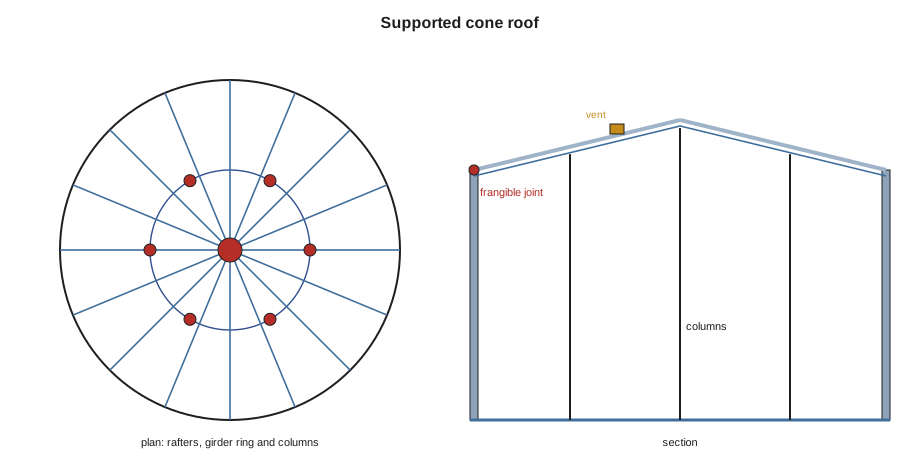
A fixed roof tank also needs vents, because the vapor space breathes as the tank is filled and emptied and as the sun heats it. Normal venting is through pressure-vacuum valves or open vents sized for the pumping rates; emergency venting is through a larger hatch or the frangible joint for fire exposure. The vents are sized by the owner's engineer to API 2000, and the erector installs them exactly as specified, with nothing blocking them.
The floating roof
Tank 15's floating roof is a single-deck pontoon roof. The outer part is a ring of pontoons, watertight compartments with a top, a bottom, an outer rim and an inner rim, divided by bulkheads so that a leak in one compartment cannot sink the roof. Inside the pontoon ring, a single deck of thin plate covers the center. The pontoons give the roof its buoyancy and its stiffness; the deck sags slightly into the product, and rain collects on it and runs to the drains. API 650 requires the roof to stay afloat with its primary drain blocked and a set depth of rainfall on it, and with two adjacent pontoon compartments and the deck punctured. Each pontoon has a manhole with a cover so that it can be inspected.
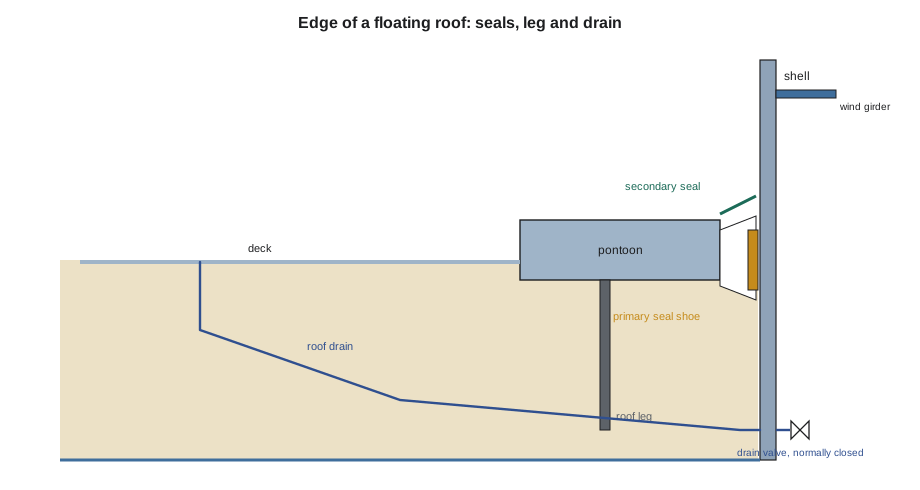
The roof stands on legs when the tank is empty. Each leg is a pipe through a sleeve in the deck or pontoon, with a pin that sets it at one of two heights: a low operating position, so that the roof can land in service without hitting the mixers and nozzles, and a high maintenance position, so that the crew can walk underneath it. When the roof lands on its legs, auto-bleeder vents open, letting air in under the roof as product is drawn out, so that the roof is not pulled down by a vacuum. Rim vents on the pontoon release vapor trapped under the seal.
Rainwater must leave the roof. The primary roof drain is a pipe system inside the tank, made of rigid pipe with swivel joints or of armored flexible hose, that runs from a sump in the center of the deck to a drain valve outside the bottom course. The valve is normally closed, so that a leaking drain line does not let crude out onto the ground; the operators open it to drain the roof after rain. An emergency drain lets water through the deck into the product if the primary drain is blocked. A guide pole, often also the gauge well where the level is measured and samples are taken, keeps the roof from rotating. A rolling ladder runs from the top platform down to the roof on a track, so that operators can reach the roof at any level.
Building the floating roof on the bottom
The floating roof is built on temporary supports on the tank bottom, at about the height of its maintenance legs, so that the crew can weld under it. The pontoon bottom plates and the deck are laid and lap-welded on top, the bulkheads and rims are fitted, and the pontoon tops go on last. Every compartment is tested before the roof is accepted: the deck welds by vacuum box or by a penetrating oil test, and each pontoon compartment by low air pressure with soap solution on the seams. The legs, drains, guide pole, ladder track and vents are installed while the roof is on its supports.
The floating roof is not finished until it floats. During the hydrotest, the roof is lifted off its supports by the water and rides up the shell with the rising level. The crew watches it all the way up and back down: it must float level, it must not bind on the guide pole, the ladder or the shell, the roof drain must flex without kinking, and no pontoon may leak. The seals are often fitted after the hydrotest, when the shell's final shape is known.
Rim seals
The rim space between a floating roof and the shell is closed by a seal. Its job is to keep vapor in and rain out while letting the roof move freely past every peak, band and out-of-round spot on the shell. The primary seal is the main barrier. A mechanical shoe seal uses steel shoes, curved to the shell and pressed against it by springs or a linkage, joined to the roof rim by a fabric vapor barrier. A resilient seal is a foam log in a fabric envelope that fills the rim space. A seal that touches the liquid is called liquid-mounted, and one with a vapor space beneath it is vapor-mounted; liquid-mounted seals lose less vapor. A secondary seal, a wiper of flexible material on a steel mounting rim, closes the gap above the primary seal and cuts emissions much further.
Seal gaps are measured with probes of standard widths: an inspector walks the roof, or works from the rim, sliding a probe between the seal and the shell all the way round, and records the width and length of every gap. The federal rule for volatile organic liquid storage, 40 CFR 60.113b, sets the limits: the accumulated area of primary seal gaps may not exceed 212 cm2 per meter of tank diameter, with no single gap wider than 3.81 cm (1.5 in), and secondary seal gaps may not exceed 21.2 cm2 per meter of diameter, with no gap wider than 1.27 cm (0.5 in). Primary seals are measured during the hydrotest or within 60 days of the first fill and then at least every five years; secondary seals within 60 days and then every year.
After the hydrotest, the seal contractor fits Tank 15's mechanical shoe primary seal and its secondary seal, and the first gap survey is done with Owen. The code below checks the gaps against the limits and also looks at the rim space: the seal must work over the full range of rim space caused by the shell's radius deviations at the level of the roof.
# Tank 15 floating roof: seal gap survey against the limits (US units)
import math

d_m = 48.77                     # tank diameter in meters (the rule is written per meter of diameter)
prim_area_lim = 212 * d_m      # primary seal, cm2
sec_area_lim = 21.2 * d_m      # secondary seal, cm2
prim_w, sec_w = 3.81, 1.27     # maximum single gap width, cm

# gaps found with the probes: (width, length) in in
primary = [(0.5, 55), (0.75, 37), (0.3125, 87), (1.25, 24)]
secondary = [(0.1875, 31), (0.375, 14), (0.1875, 47)]

def total(gaps):
    return sum(w * l for w, l in gaps) * 6.4516           # cm2

for name, gaps, alim, wlim in (("primary", primary, prim_area_lim, prim_w), ("secondary", secondary, sec_area_lim, sec_w)):
    a = total(gaps)
    widest = max(w for w, l in gaps) * 2.54
    ok = a <= alim and widest <= wlim
    print(f"{name:9} gap area {a:,.0f} cm2 (limit {alim:,.0f}), widest {widest:.2f} cm (limit {wlim}) ->", "pass" if ok else "repair")

# Rim space: the gap between the pontoon rim and the shell that the seal must bridge
r_tank = 80.000                  # nominal tank radius, ft
r_roof = 79.333                  # pontoon rim radius, ft
dev = [-1.0, 0.75, 0.875, -0.5, 0.375, -0.75]                    # shell radius deviations measured at the rim, in
print(f"Nominal rim space {(r_tank - r_roof) * 12:.1f} in; range {(r_tank - r_roof) * 12 + min(dev):.1f} to {(r_tank - r_roof) * 12 + max(dev):.1f} in")primary gap area 725 cm2 (limit 10,339), widest 3.17 cm (limit 3.81) -> pass secondary gap area 128 cm2 (limit 1,034), widest 0.95 cm (limit 1.27) -> pass Nominal rim space 8.0 in; range 7.0 to 8.9 in
Both seals pass easily on area, and the widest primary gap is close to the limit but within it. The widest gap is at one of the shell stations where the radius was over tolerance on course 1 before it was corrected; Kiera points this out, and the seal contractor adjusts the shoe hanger at that spot. The rim space ranges about ±1 in around its nominal 8 in, well inside the range the seal maker's drawing allows.
Building T-31's cone roof at grade
At Northgate, T-31's roof shows the advantage of the jacking method. With the top course standing on the bottom, the crew fits the top angle, sets the center column on a temporary support, and bolts the rafters between the center drum and the clips on the top course. Every rafter is set to the same slope with a level and a string line, because a roof with one low rafter holds a puddle that corrodes the plate. The roof plates are laid from the outside inward, each overlapping the one above it on the slope like shingles so that rain runs off the laps rather than into them, and are welded on top only. The roof manway, the vents, the gauge hatch and the platform at the roof edge are all fitted at grade. When the first lift begins, the roof is finished and painted, and nobody on the crew has worked higher than a ladder.
The frangible joint is checked twice. Kiera measures the roof-to-top-angle weld size at intervals all the way round, and Rosa checks that nobody has added stiffening at the joint or welded the roof plates to the rafters. Both checks go on the inspection record, because the joint's purpose is easy to forget and impossible to restore once someone has added metal to it.
Roof plates on a fixed roof are thin enough to be damaged by careless work, and the crew treats the finished roof as a walking surface only on the marked routes over the rafters. A dent in the plate holds water, and a boot through a corroded patch on an old roof can put a worker into the tank. On T-31 the roof is new, but Rosa sets the rule from the first day so that it becomes a habit for the crew on every roof they will ever work on.
Common mistakes
MistakeWelding roof plates to the rafters to make the roof stiffer.
InsteadRoof plates are welded only to each other and lightly to the top angle; welding them to the rafters can defeat the frangible joint.
MistakeLeaving the roof drain valve open in service.
InsteadKeep it closed except when draining rainwater, so that a leaking drain cannot release product.
MistakeAccepting a floating roof without a flotation test.
InsteadWatch the roof float the whole way up and down during the hydrotest for leaks, binding and level.
MistakeMeasuring seal gaps at a few spots.
InsteadProbe the whole circumference and record every gap's width and length.
Summary and key terms
- Fixed roofs are cones or domes; supported cones rest on rafters, girders and columns.
- Roof plates are lapped and welded only to each other; the roof-to-shell joint may be frangible by design.
- A pontoon floating roof gets buoyancy and stiffness from compartmented pontoons around a thin deck.
- Legs, auto-bleeder vents, rim vents, roof drains, the guide pole and the rolling ladder let the roof work at any level.
- The roof is built on the bottom, tested compartment by compartment, and proven by floating it during the hydrotest.
- Primary and secondary rim seals close the rim space; their gaps are measured against set area and width limits.
- Top angle
- A stiffening angle welded around the top of a tank shell.
- Pontoon roof
- A floating roof with a ring of watertight compartments around a single deck.
- Auto-bleeder vent
- A vent that opens when a floating roof lands on its legs, letting air in under the roof.
- Primary seal
- The main rim seal between a floating roof and the shell.
- Secondary seal
- A second rim seal above the primary seal.
- Rim space
- The gap between a floating roof rim and the tank shell.
Practice problems
Work each problem on paper first, then reveal the answer to check.
Why does a floating roof have bulkheads in its pontoon ring?
Show answer
So that a leak in one compartment cannot sink the roof; the standard requires flotation with compartments punctured.
What happens when a floating roof lands on its legs?
Show answer
Its auto-bleeder vents open, letting air in under the roof so that it is not pulled down by vacuum as product is drawn out.
For a 160 ft tank, what is the limit on accumulated secondary seal gap area?
Show answer
160 ft is 48.77 m, so 21.2 × 48.77 = about 1,034 cm2, about 160 in2.
Why are seals often fitted after the hydrotest?
Show answer
Because the shell's final shape, and so the rim space at every level, is known only after the tank has been filled.
Lesson quiz · 5 questions
Score 60% or more to complete this lesson.
Create a free account to save your progress, take quizzes and earn a certificate.