
BLR-230 · Lesson 12 of 12 · 17 min
Capstone: erecting Tank 15
In late September, Tank 15 stands finished on its pad: 160 ft across, 48 ft high, its floating roof resting on its legs on the bottom, its stairway climbing to the wind girder and its appurtenances in place. What is left is the part of the job that turns a finished structure into an accepted tank: the hydrotest, the settlement record, the seal survey and the handover. Bernie asks Kiera to run the test record herself, with Harjit checking her work and Owen witnessing. Before the first water goes in, she goes back over the season to make sure every earlier step is closed. This capstone follows her through that review, the test and the release.
The review before the test
Kiera works through the inspection and test plan line by line with Harjit. The foundation handover record shows the ringwall top within tolerance, with Hamid's readings attached. The bottom record shows every lap weld and every annular butt joint vacuum boxed and accepted, and the closure seam welded after the shell-to-bottom weld, as the sequence required. The shell record shows each course's survey and the corrections made: the course 1 radii at stations 4 and 6 re-set before welding, seam V1-11's peaking repaired, and the station 6 lean traced to the course 3 spacers and corrected on course 5, with Owen's acceptance of the final 2 1/4 in reading against the 2.88 in limit.
The NDE record shows every spot radiograph planned on the weld map taken and accepted, including the course 2 electrogas start that failed and the extra spots that showed the defect was local. The appurtenance record shows the fill nozzle N1 moved down 4 in on Owen's revised drawing before it was cut, the pads all tested through their telltales, and the door sheet welded back in and radiographed. The floating roof record shows every pontoon compartment tested and the deck vacuum boxed. Two items are open: the rolling ladder track has one bracket without a weld inspection signature, and the auto-bleeder vents have not been checked for free movement. Both are closed before the fill.
| Area | Key records | Status before the test |
|---|---|---|
| Foundation | Ringwall levels, pad slope, leak detection | Accepted |
| Bottom | Weld sequence, vacuum box tests, annular radiographs | Accepted |
| Shell | Course surveys, corrections, weld map, radiographs, repairs | Accepted |
| Openings | Spacing checks, pad tests, door sheet examination | Accepted |
| Floating roof | Pontoon and deck tests, legs, vents, drain | Two items closed before fill |
| Bolting | Stairway and platform bolts, nozzle flanges with blinds for the test | Accepted |
The fill
Water comes from the river through a temporary intake and filter, under the terminal's water permit, at a rate set by Owen's procedure. The fill is planned in four stages: a quarter full, half full, three-quarters full and full, with a hold at each stage for the settlement readings, and a hold of at least 24 hours at full. At each hold, Hamid levels the sixteen settlement points around the shell to the benchmark, Kiera enters the readings, and the crew walks the shell and the nozzles looking for leaks. The floating roof lifts off its legs at a little over 3 ft of water and rides up with the level; Bernie's crew watches it at the guide pole, the rolling ladder and the roof drain, and checks every pontoon manhole for water.
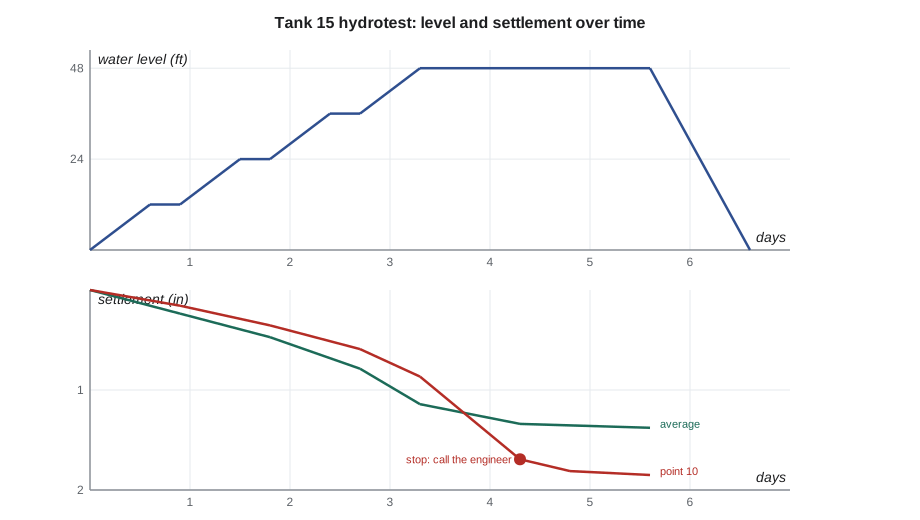
Owen's procedure sets two limits on the settlement readings, chosen by the geotechnical engineer from Tank 14's history: the difference between any two neighboring points must not exceed 3/8 in, and the planar tilt across the tank must not exceed 2 in. Kiera's code checks each stage. The tilt is found by fitting a plane to the sixteen readings, which for points equally spaced around a circle is the same as finding the first cosine term of the readings, a neat shortcut that Hamid shows her.
# Tank 15 hydrotest: fill stages, settlement readings and the hold decisions (US units)
import math
d = 160.0                          # diameter, ft
pts = 16                         # settlement points around the shell
circ = math.pi * d
arc = circ / pts                 # distance between points, ft
limit_diff = 0.375              # differential between neighboring points, in (owner's procedure)
limit_tilt = 2.0              # planar tilt across the diameter, in

stages = {
    '1/4 full':  [0.25, 0.25, 0.25, 0.25, 0.25, 0.25, 0.25, 0.25, 0.25, 0.125, 0.25, 0.125, 0.125, 0.25, 0.25, 0.375],
    '1/2 full':  [0.5, 0.5, 0.625, 0.5, 0.5, 0.5, 0.5, 0.5, 0.5, 0.375, 0.375, 0.375, 0.375, 0.375, 0.5, 0.625],
    '3/4 full':  [0.875, 0.875, 1.0, 0.875, 0.875, 0.875, 0.875, 0.75, 0.75, 0.625, 0.625, 0.625, 0.625, 0.75, 0.75, 1.0],
    'full':      [1.375, 1.375, 1.375, 1.25, 1.25, 1.25, 1.25, 1.125, 1.0, 0.875, 1.0, 0.875, 1.0, 1.0, 1.125, 1.375],
    'full 24 h': [1.5, 1.5, 1.625, 1.5, 1.375, 1.375, 1.375, 1.25, 1.125, 1.75, 1.125, 1.125, 1.125, 1.125, 1.25, 1.625],
}                # stage name -> readings at the 16 points, in (down is positive)

for name, r in stages.items():
    diffs = [abs(r[i] - r[(i + 1) % pts]) for i in range(pts)]
    worst = max(diffs)
    mean = sum(r) / pts
    # plane fit: amplitude of the first cosine term = tilt across half the diameter
    a = 2 / pts * sum(v * math.cos(2 * math.pi * i / pts) for i, v in enumerate(r))
    b = 2 / pts * sum(v * math.sin(2 * math.pi * i / pts) for i, v in enumerate(r))
    tilt = 2 * math.hypot(a, b)
    ok = worst <= limit_diff and tilt <= limit_tilt
print(f"{name:10} mean {mean:5.2f} worst neighbor difference {worst:5.2f} tilt {tilt:5.2f} in ->", "continue" if ok else "stop and call the engineer")1/4 full mean 0.23 worst neighbor difference 0.12 tilt 0.09 in -> continue 1/2 full mean 0.48 worst neighbor difference 0.12 tilt 0.17 in -> continue 3/4 full mean 0.80 worst neighbor difference 0.25 tilt 0.31 in -> continue full mean 1.16 worst neighbor difference 0.25 tilt 0.45 in -> continue full 24 h mean 1.36 worst neighbor difference 0.62 tilt 0.33 in -> stop and call the engineer
The first four stages are clean. The tank settles evenly, by about 1.16 in on average at full, with a small tilt that matches Tank 14's pattern. At the 24-hour reading at full, point 10 has settled another 7/8 in during the hold while its neighbors moved only 1/8 in, and the neighbor difference is now 0.62 in, well over the limit. Kiera stops the clock on the hold and calls Bernie, and Bernie calls Owen.
The stop and the decision
Owen brings in the geotechnical engineer, who drives out that afternoon. Point 10 is on the south side, a few meters from the water draw-off sump, where the civil contractor had to dig deeper to set the sump and backfilled the hole. The engineer's view is that the backfill around the sump was less well compacted than the rest of the pad and is consolidating under the load. The questions are whether it is still moving, and whether the shell and bottom can take what has happened.
The decision is to keep the tank full, read point 10 and its neighbors every twelve hours for two more days, and check the shell at the south side for plumbness and roundness. The extra readings show point 10 slowing: a further 1/8 in in the first twelve hours, 1/32 in in the next, then nothing measurable. The shell survey at the south side shows no change in roundness beyond the course 1 tolerance. The engineer writes a short report: the local settlement is stabilizing, the shell is within its tolerances, and the bottom near the sump should be inspected after the tank is emptied. Owen accepts the test result on that basis and adds point 10 to the terminal's monitoring program for the first year of service.
The tank is emptied at the controlled rate, with final settlement readings at empty. When the bottom is dry, Kiera and Owen walk it with a straightedge near the sump. There is a shallow depression around the sump, 1/2 in deep over about 6 ft, within what the bottom can take. The lap welds in that area are vacuum boxed again, as Owen asked, and all pass. The finding goes into the records with the engineer's report.
Seals, release and handover
With the shell's final shape known, the seal contractor fits the primary and secondary seals, and the first gap survey in lesson 6 is done with Owen. The roof drain is tested with water, the auto-bleeder vents and the guide pole are checked once more, and the test blinds come off the nozzles. The nozzle flanges are made up with new gaskets by Desmond's assemblers to PCC-1, each joint tagged. The tank is cleaned out, the manways closed, and the confined space permits closed.
Harjit assembles the handover package. API 650 requires the manufacturer's certification that the tank was built and tested to the standard, and a nameplate on the shell giving the standard and edition, the design data and the builder. The package also holds the as-built drawings, the material certificates matched to the shell layout, the weld map and the NDE reports, the survey records, the hydrotest and settlement records with the engineer's report, the seal survey and the bolting records. Owen signs the acceptance in the first week of October, and the terminal's operations staff take over the tank for its first fill with crude. Its first in-service inspection is set in the terminal's inspection program under API 653.
| Lesson learned | Change for the next tank |
|---|---|
| Root spacers a size too thick tipped course 3 plates outward | Spacer size added to the course check sheet |
| Fill nozzle pad came within 8 in of a seam after a design change | Every opening rechecked against as-built seams after any design change |
| Electrogas start slag on course 2 | Start-up check added to the morning toolbox talk |
| Soft backfill around the sump settled during the test | Compaction testing of sump backfill added to the foundation handover |
| Two floating roof items found open just before the fill | Roof checklist closed before the pre-test review, not during it |
Looking back over the season
Kiera has now seen a tank from a bare pad to an accepted structure, a fixed-roof tank jacked up course by course, a stack set in a single outage, and a turnaround's worth of flange joints. The common thread is the same one that ran through her shop work: every step is checked before the next one hides it, every record is made at the time, and when a reading is out of limits, the work stops until someone who knows why has looked at it. Bernie's last note on the job file is short: "Good tank. Point 10 to watch."
In Layout and Fitting II, the next course in the program, Kiera goes back to the shop to learn the layout of cones, transitions, intersections and nozzles, the shapes that make up hoppers, reducers and tank and vessel connections. After that, Pressure Equipment Codes takes her into the rules that govern boilers and vessels in detail.
What the owner will do next
Once Tank 15 is in service, its owner takes over the care that the erector began. The terminal's operators read the level gauges and the alarm settings set under its overfill protection program, drain rainwater from the roof after storms, and walk the tank on a routine round looking for leaks, roof tilt and seal damage. Under API 653, the tank will have routine in-service inspections by the owner's staff, external inspections by a certified inspector at intervals set by the standard and the corrosion rate, and internal inspections, with the tank emptied and cleaned, at intervals that depend on the bottom's condition and protection. The first internal inspection will compare the bottom and the lower shell with the measurements and records in Harjit's binders. Point 10 has its own line in the monitoring plan.
Common mistakes
MistakePressing on with a fill when a settlement limit is exceeded.
InsteadStop at the hold, call the owner and the engineer, and take more readings before deciding.
MistakeClosing out the pre-test review with items still open.
InsteadClose every item, or record it and agree it with the owner, before the first water goes in.
MistakeFitting seals before the hydrotest when the shell's shape is uncertain.
InsteadFit seals after the test, when the rim space at every level is known.
MistakeHanding over a tank without its records.
InsteadThe handover package is part of the tank; it is what inspectors and engineers will rely on for its whole life.
Summary and key terms
- Before a hydrotest, every record in the inspection and test plan is reviewed and every open item closed.
- The fill proceeds in stages with holds, settlement readings and leak and roof checks at each stage.
- Settlement limits on neighboring points and tilt are set by the geotechnical engineer; a reading over a limit stops the test.
- Tank 15's point 10 settled locally over soft sump backfill; extra readings showed it stabilizing and the engineer accepted it.
- After the test, the bottom is inspected, the seals fitted, flanges made up, and the handover package assembled.
- Lessons learned feed the check sheets for the next tank.
- Pre-test review
- A line-by-line check of all records before a hydrotest begins.
- Planar tilt
- The uniform tilt of a tank found by fitting a plane to its settlement readings.
- Differential settlement
- The difference in settlement between points around a tank.
- Nameplate
- The plate on a tank giving its standard, design data and builder.
- Handover package
- The records delivered to the owner with a finished tank.
- In-service inspection
- Inspection of a tank during its life, under API 653 for petroleum tanks.
Practice problems
Work each problem on paper first, then reveal the answer to check.
Why was the fill stopped at the 24-hour reading at full?
Show answer
Because the difference in settlement between point 10 and its neighbor exceeded the procedure's limit.
What evidence led the engineer to accept the test?
Show answer
Repeated readings showed point 10's settlement slowing to nothing, and the shell survey showed the south side still within its roundness tolerance.
Name four records in Tank 15's handover package.
Show answer
Any four of: certification and nameplate data, as-built drawings, material certificates and shell layout, weld map and NDE reports, survey records, hydrotest and settlement records with the engineer's report, seal survey, bolting records.
What change was made to the foundation handover for the next tank?
Show answer
Compaction testing of the backfill around sumps and other deep excavations.
Lesson quiz · 5 questions
Score 60% or more to complete this lesson.
Create a free account to save your progress, take quizzes and earn a certificate.