
BLR-220 · Lesson 6 of 12 · 19 min
Boiler erection and assembly
In early September, Northgate replaces the oldest of its three packaged boilers, B-3, with a new D-type unit. Ironbridge has the setting contract: removing the old boiler, setting the new one on its foundation, and connecting it to the stack, the steam header and the feedwater. The new boiler arrives on two trucks in three pieces: the pressure part module with its drums, tubes and casing, the burner and windbox, and the economizer. Rosa Delgado gives Kiera a week on the job with Joanne Pellerin, the layout lead from the fabrication shop, who is checking the foundation and the setting. Kiera has also been asked by Peg Lindqvist to work through the expansion movements of Riverbend's furnace for a seal replacement, which turns out to be the best way to understand why a boiler is erected the way it is.
Erecting a boiler means putting it together so that every part is where the design says and every part can move the way the design expects. A large field-erected boiler can take a crew of hundreds more than a year; a packaged boiler can be set and connected in a few weeks. The principles are the same.
Packaged boilers: setting and connecting
A packaged boiler is set on a concrete foundation, usually a slab or piers with embedded anchor bolts or sole plates. Joanne checks the foundation before the boiler arrives: the elevations of the bearing surfaces with a level, the anchor bolt positions against the drawing, and the diagonals of the bolt pattern. A boiler set out of level will have its drum out of level, and a drum that is out of level shows a false water level at the gauge glass and can starve tubes at one end.
Most packaged boilers are fixed at one end and free to slide at the other. The fixed end has anchor bolts tight in round holes; the sliding end has slotted holes, sliding plates or rollers, so the boiler can grow along its length as it heats up. The setting crew must leave the sliding end free: nuts snug but not tight, sliding surfaces clean and greased if the drawing says so, and nothing welded across the gap. A boiler whose sliding end is locked will push against its own foundation, distort its casing and strain its pipe connections.
- Set and align. Lift or skid the module onto the foundation, set it to the elevations and center lines on the drawing, and shim it level.
- Fix and free. Tighten the fixed end anchors, set the sliding end as the drawing shows, and record the cold position of the sliding end with a punch mark or pointer.
- Connect. Fit the windbox and burner, the economizer and the ductwork, with expansion joints where the drawing shows them, and connect the steam, feedwater, blowdown and drain piping.
- Close up. Install casing, seals, insulation and refractory to the drawings, and dry out the refractory slowly before firing.
At Northgate, the new boiler's drum is within the manufacturer's level tolerance, 1/16 in over its length, on the first set. Joanne shows Kiera how she checks it: a precision level on the machined pads on top of the drum, and a water tube level between the ends, which agree.
Field-erected boilers
Large boilers are too big to ship assembled. They are erected in the field from a steel structure, drums, headers and shop-built membrane wall panels, superheater and economizer sections and thousands of field welds. The sequence for a top-supported boiler like Riverbend's is typical.
| Stage | What is done | What the boilermaker watches |
|---|---|---|
| Structure | The steel frame and the top support steel are erected | Elevations and plumb of the top steel; hanger locations |
| Drum | The steam drum is lifted and hung in its slings | Drum level and position; protection of machined surfaces |
| Headers and walls | Waterwall panels are lifted and hung from the top steel, headers set | Panel alignment, tube spacing, header elevations |
| Pressure part welding | Tube field welds, header connections, drum tube attachments | Fit-up, preheat, NDE and records for every weld |
| Superheater and economizer | Sections hung and connected | Spacing, alignment, support and spacer installation |
| Buckstays and casing | Buckstays, ties and casing fitted | Clearances that let the walls grow |
| Hydrostatic test | The pressure parts are tested | Test procedure, venting, inspection of every weld |
| Closing up | Insulation, refractory, burners, ducts | Seals and expansion joints installed to the drawing |
Erection is planned around the lifts, the welds and the hydrostatic test. Every pressure part weld is made to a qualified procedure by a qualified welder and is examined and recorded, so the welding inspection alone is a major part of the work. The erector also tracks every piece on an erection drawing and a weld map, so that the manufacturer's data report, signed by the authorized inspector, can show that the whole boiler was built to the code.
Why boilers hang: thermal growth
When a large boiler goes from cold to operating, its tubes heat up by hundreds of degrees and its steel grows. A furnace wall 100 ft tall grows by more than 4 in. If the bottom of the furnace sat on a foundation and the top were tied to the building, the wall would buckle. So large boilers are hung from the top. The drum, the walls, the superheater and the economizer all hang from the top support steel on rods and hangers, and they grow downward. The bottom of the furnace is free, and the joints between the hanging boiler and the things that stay still, such as the ash hopper, the ductwork and the floor, are sealed with seal troughs, flexible expansion joints or sliding seals.
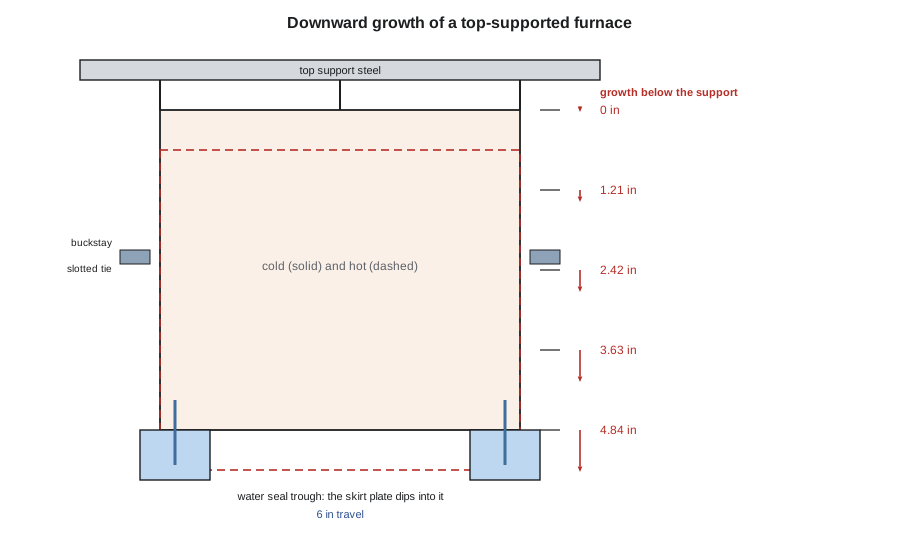
The growth is easy to estimate. Steel expands by a small, nearly constant fraction of its length for each degree of temperature rise, called the coefficient of thermal expansion. The growth at any point below the top support is that coefficient times the distance below the support times the temperature rise. Peg asks Kiera to check the travel of Riverbend's hopper seal, which is being replaced this outage, against the furnace's growth.
# Riverbend Unit 2: thermal growth of a top-supported furnace (US units)
alpha = 7.2e-6              # carbon steel expansion per degree, average over the range
dt = 620 - 60        # waterwall metal from cold to operating, °F
height = 100                 # furnace wall from the top support to the lower headers, ft
print(f"Temperature rise: {dt} °F")
print("Distance below top support    downward growth")
for e in [0, 25, 50, 75, 100]:
    g = alpha * e * dt * 12
    print(f"{e:>10} ft                 {g:>6.2f} in")

drop = alpha * height * dt * 12
side = alpha * 30 / 2 * dt * 12
print(f"Lower headers move down {drop:.2f} in; each side wall moves out {side:.2f} in from the tie line")

# The hopper seal at the bottom must take the full drop plus a margin
seal_travel = 6
need = drop + 1
print(f"Seal travel {seal_travel} in vs needed {need:.2f} in: {'OK' if seal_travel >= need else 'TOO SHORT'}")Temperature rise: 560 °F
Distance below top support downward growth
0 ft 0.00 in
25 ft 1.21 in
50 ft 2.42 in
75 ft 3.63 in
100 ft 4.84 in
Lower headers move down 4.84 in; each side wall moves out 0.73 in from the tie line
Seal travel 6 in vs needed 5.84 in: OKThe seal has just enough travel, with a margin of about 1 in once the full drop of about 4.8 in is taken. Peg asks for a seal with more travel to be specified at the next replacement, because the margin is thin and the waterwalls run hotter if they are scaled. Kiera also sees why the buckstays matter: they tie the walls together around the furnace to hold them against the furnace pressure, but each wall slides down past its buckstays and grows sideways from a tie line at its center, so the buckstay connections are slotted or pinned to allow both movements.
Expansion everywhere
Thermal growth is a theme of every boiler job, not only of erection. Pipe connected to a boiler must move with it; steam lines have hangers, guides and loops or springs so that the boiler's movement does not overload the nozzles. Ductwork has expansion joints. Hangers on superheaters and headers are variable or constant support springs set to carry the load at both the cold and hot positions, and their cold settings are marked on travel stops or pins that must be removed before start-up and set back before a hydrostatic test, when the boiler is full of water and heavier than in service. Boilermakers learn to look for anything that might stop a part moving: a scaffold tube wedged between a header and a beam, a tack weld across a sliding joint, a strap left on a seal.
Hangers and springs are a common source of trouble. A spring hanger left pinned after a start-up holds its part rigidly, and the part bends or cracks as it tries to grow. A hanger rod that has bottomed out stops carrying load and puts it onto the nozzle below. Inspectors read the hanger scales at every outage, both cold and hot if they can, and compare the readings with the design.
Tolerances and records
Erection drawings give tolerances for every important dimension: drum and header elevations, tube spacing, panel alignment, and clearances at buckstays, seals and spacers. The erector checks and records them as the work proceeds, on the same kind of travelers that track welds. At the end, the records, the material certificates, the weld maps and NDE reports and the hydrostatic test record go into the manufacturer's data report and the owner's files. When Ironbridge repairs a boiler twenty years later, those records are where the crew finds the original dimensions and materials.
Worked problem
Growth of a header
A superheater outlet header hangs 75 ft below the top steel. Its tubes rise from 60 °F to an average of 800 °F. The steel's expansion coefficient over this range is about 7.5 × 10⁻⁶ per °F. How far does the header move down?
Show solution
- Temperature rise: 800 − 60 = 740 °F.
- Growth: 7.5 × 10⁻⁶ × 900 in × 740 = 5.0 in.
Answer: About 5 in downward.
Lifting and hanging a waterwall panel
On a field-erected boiler, waterwall panels are lifted one at a time and hung from the top steel. Each panel is a shop-welded membrane wall section, sometimes 65 ft long and several tons, and it is floppy: a long, thin panel lifted by its top alone can buckle under its own weight. Erectors lift panels with a strongback, a stiff beam bolted along the panel that keeps it straight, and tail the bottom end with a second crane or a chain fall until it hangs vertically, the way BLR-120 showed for tailing vessels. Once the panel hangs, its top header is connected to the hangers, the panel is plumbed and aligned with its neighbor, and the tubes at each side are fitted to the tubes of the next panel for the field welds. The membrane bars between panels are welded after the tube welds have been made and examined, so the panel seams are gas-tight. The welding is planned so the panels do not pull out of line: welds are spread around the furnace rather than finished one wall at a time.
Kiera sees the method at work in miniature at Northgate, where the new D-type boiler's economizer module is set on top of its casing on alignment pins and bolted, then connected with two butt welds to the boiler's feedwater inlet header. Joanne has her check the pin alignment and the gap of each butt weld with a gauge before the welder starts, the same fit-up checks that BLR-210 taught for tube welds.
Common mistakes
MistakeTightening the nuts on a boiler's sliding end.
InsteadLeave the sliding end free as the drawing shows, and record its cold position.
MistakeLeaving spring hanger travel pins in at start-up.
InsteadPins come out before firing and go back before a hydrostatic test, to the plant's procedure.
MistakeTack welding a scaffold or bracket to a part that must move.
InsteadNothing is welded across a sliding joint or to a hanging part without the engineer's approval.
MistakeSetting a drum out of level.
InsteadCheck the drum's level pads; an out-of-level drum gives false gauge readings and can starve tubes.
Summary and key terms
- Packaged boilers are set level on their foundations, fixed at one end and free to slide at the other.
- Field-erected boilers go up in a sequence: structure, drum, walls and headers, welding, superheater and economizer, buckstays, test and close-up.
- Large boilers hang from the top and grow downward; seals and expansion joints take the movement.
- Growth equals the expansion coefficient times length times temperature rise.
- Hangers, springs, guides and expansion joints must be free and set to the drawing.
- Erection tolerances and records follow the boiler for its whole life.
- Top-supported boiler
- A boiler that hangs from steel at the top and grows downward.
- Sliding end
- The end of a boiler or vessel left free to move as it expands.
- Coefficient of thermal expansion
- The fraction of its length a material grows for each degree of temperature rise.
- Seal trough
- A water-filled trough that seals a hanging furnace to a fixed hopper while allowing movement.
- Spring hanger
- A support that carries a load through a range of movement using a spring.
- Manufacturer's data report
- The signed record that a boiler or vessel was built to the code.
Practice problems
Work each problem on paper first, then reveal the answer to check.
Why are large boilers hung from the top rather than set on foundations?
Show answer
So they can grow downward freely as they heat up; a boiler held at both ends would buckle.
A furnace wall hangs 65 ft and rises 540 °F. With a coefficient of 7.2 × 10⁻⁶ per °F, how much does it grow?
Show answer
7.2 × 10⁻⁶ × 780 × 540 = 3.0 in.
What must be done with spring hanger travel pins before start-up?
Show answer
They must be removed so the hangers can move, and put back before a hydrostatic test.
What does a drum out of level do to the gauge glass?
Show answer
It shows a false level, because the water surface is not parallel to the drum.
Lesson quiz · 5 questions
Score 60% or more to complete this lesson.
Create a free account to save your progress, take quizzes and earn a certificate.