
BLR-220 · Lesson 2 of 12 · 20 min
Fire-tube and packaged boilers
Larkspur Greenhouses, near Gonzales, grows tomatoes and cucumbers under 20 acres of glass. Its heat comes from two packaged boilers in a block building at the end of the range, and in winter the growers depend on them as much as on the sun. During the annual inspection in May, the state boiler inspector found leaks at the rolled tube ends in the rear tube sheet of boiler 2, and a hammer test and thickness readings showed tubes thinned by corrosion. Marisol Vega, Larkspur's facilities manager, has until the end of August to get the boiler retubed before the first cold nights. She calls Ironbridge, and Dale Whitford takes a small crew, with Kiera on it, to do the job.
Boiler 2 is a fire-tube boiler, the most common type in buildings, greenhouses, laundries, hospitals and small plants. This lesson explains how fire-tube boilers work, the parts of a packaged boiler and its controls, and how a fire-tube boiler is retubed.
Fire tubes and water tubes
Boilers are divided into two families by what goes through the tubes. In a fire-tube boiler, the hot combustion gas passes through the tubes and the water surrounds them inside a large shell. In a water-tube boiler, the water and steam pass through the tubes and the hot gas surrounds them. The difference has big consequences. A fire-tube boiler's shell must hold the full pressure across a large diameter, so its shell is thick and its pressure is limited; most run below about 300 psi, many far lower. It holds a large volume of water, which makes it steady and forgiving of sudden load changes, but slow to start. A water-tube boiler keeps the pressure inside small tubes and drums, so it can run at much higher pressures and make far more steam, as Riverbend does.
| Feature | Fire-tube boiler | Water-tube boiler |
|---|---|---|
| Inside the tubes | Hot combustion gas | Water and steam |
| Typical pressure | Low to moderate | Low to very high |
| Typical capacity | Up to about 85 MMBtu/h output | From small packaged units to the largest utility boilers |
| Water volume | Large; steady under changing load | Small; responds quickly |
| Start-up from cold | Slow; the shell must warm evenly | Faster |
| Failure consequence | Large volume of hot water released | Smaller volume, but higher pressure |
The Scotch marine boiler
Most packaged fire-tube boilers are descended from the Scotch marine boiler, first built for ships. A horizontal cylindrical shell holds the water. Near the bottom of the shell runs a large tube called the furnace, or Morison tube in older designs, where the burner fires. The flame and hot gas pass along the furnace to the rear, turn in a chamber and come forward through a bank of smaller tubes, then turn again and go back through a second bank to the stack. Each run through the boiler is a pass, so Larkspur's boiler, with its furnace and two banks of tubes, is a three-pass boiler. Four-pass designs add another bank.
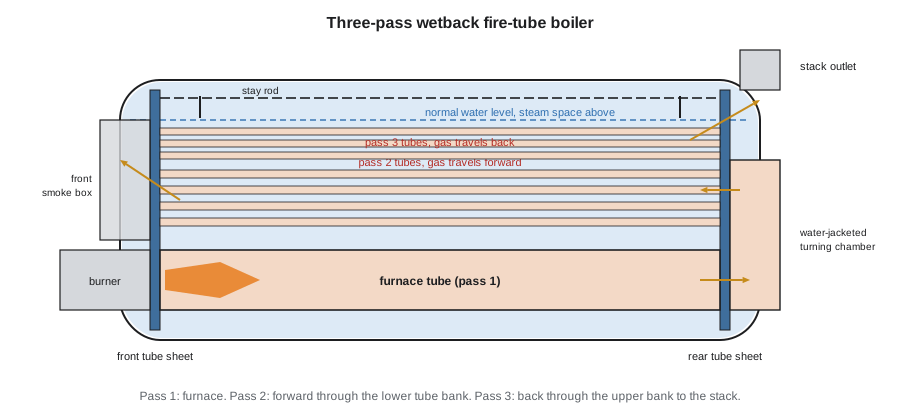
Where the gas turns at the rear of the furnace, the boiler is either drybacked or wetbacked. In a dryback boiler, the turning chamber is lined with refractory and closed by a refractory-lined rear door that swings open for access. In a wetback boiler, like Larkspur's, the turning chamber is surrounded by water, so it is cooled and needs little refractory, but getting into it means entering through a small access opening. The tubes pass through flat plates at each end of the shell called tube sheets. Flat plates under pressure want to bulge, so the areas of the tube sheets without tubes are held by stays: rods or tubes that tie the front and rear sheets together, or gusset plates that tie them to the shell. The tubes themselves help, because they are expanded into the tube sheets and hold them like stays.
The furnace tube is under external pressure: the water pushes in on it. Tubes under external pressure fail by collapsing rather than bursting, and a long plain furnace collapses at a lower pressure than a short one. That is why older furnaces were corrugated, and why newer ones are plain tubes of heavier wall with rings or limited lengths. An overheated furnace, from low water or heavy scale, can sag and collapse, which is one of the most serious fire-tube boiler failures.
Rating a packaged boiler
Packaged boilers are rated in boiler horsepower, a unit with nothing to do with engine horsepower. One boiler horsepower is the heat needed to evaporate 34.5 lb of water an hour from and at 212 °F, which is about 33,475 Btu/h. Larkspur's boilers are 500 BHP each. A rule of thumb from the days of riveted boilers is that a fire-tube boiler has about 5 ft2 of heating surface per boiler horsepower; modern boilers often have more. Dale uses the rating and the rule of thumb to check the tube count on the drawing before he orders tubes.
# Larkspur Greenhouses: three-pass fire-tube boiler rating and tube count (US units)
import math

bhp = 500                    # nameplate rating, boiler horsepower
BHP = 33_475                  # one boiler horsepower, Btu/h
output = bhp * BHP
print(f"Rated output: {bhp} BHP = {output:,.0f} Btu/h")

# Steam made at the operating pressure from returned condensate
h_steam = 1_193               # saturated steam at about 125 psig, Btu/lb
h_feed = 148                # feedwater at 180 °F, Btu/lb
steam = output * 1 / (h_steam - h_feed)
print(f"Steam from 180 °F feedwater: {steam:,.0f} lb/h")

# Heating surface: the old rule of thumb is 5 ft2 per BHP
surface = bhp * 5
furnace = 226             # furnace tube (first pass) surface, ft2
tube_od = 2.5               # in
tube_len = 192              # between tube sheets, in
per_tube = math.pi * tube_od * tube_len / 144
tubes = (surface - furnace) / per_tube
print(f"Heating surface at the rule of thumb: {surface:,.0f} ft2")
print(f"Fire side surface per tube: {per_tube:.2f} ft2")
print(f"Tubes needed in passes 2 and 3: about {tubes:.0f}")
print(f"Pass 2 / pass 3 split at 55/45: {round(tubes * 0.55)} / {round(tubes * 0.45)}")Rated output: 500 BHP = 16,737,500 Btu/h Steam from 180 °F feedwater: 16,017 lb/h Heating surface at the rule of thumb: 2,500 ft2 Fire side surface per tube: 10.47 ft2 Tubes needed in passes 2 and 3: about 217 Pass 2 / pass 3 split at 55/45: 119 / 98
The nameplate drawing for boiler 2 shows 214 tubes, 2 1/2 in outside diameter, 118 in the second pass and 96 in the third, which agrees well with the estimate. Dale orders 220 tubes, a few spares in case a tube is damaged during installation, and confirms the material, wall thickness and length with the boiler manufacturer's data before he signs the order.
Packaged boiler controls and trim
A packaged boiler arrives on a skid with its burner, fans, controls and trim already mounted and wired. The trim is the set of devices that keep the boiler safe and show its condition. Boilermakers work around them and must never disturb them without the plant's knowledge.
- Safety valve. Opens if the pressure reaches its set point; sized to relieve all the steam the boiler can make. Its discharge is piped to a safe place.
- Low-water cutoff. Shuts the burner off if the water level falls too low. Most boilers have two, a primary and an auxiliary, often of different types. They are tested regularly by blowing down their float chambers or by draining the boiler water slowly while watching for the burner to trip.
- Pressure controls. An operating control cycles the burner to hold pressure; a high-limit control with manual reset shuts the boiler down if the operating control fails.
- Gauge glass and pressure gauge. Show the water level and the steam pressure. A gauge glass that is blown down should show the water return quickly; a sluggish glass may have a blocked connection.
- Flame safeguard. Proves the flame with a sensor, purges the furnace before every light-off, and shuts off fuel if the flame is lost.
- Feedwater pump and controller, and blowdown valves. Keep the level steady and drain off sludge and dissolved solids.
Before Ironbridge can start, Larkspur's operator shuts the boiler down, cools it slowly, drains it and locks out the burner, fuel train, feedwater, steam stop valves and blowdown. Dale and the operator walk the isolation list together, as BLR-110 taught, and the boiler is ventilated and tested before entry.
Retubing a fire-tube boiler
Retubing means replacing all the tubes, which is common when many tubes have thinned or leaked. On a fire-tube boiler, the work happens at the tube sheets. The sequence the crew follows at Larkspur is typical.
- Open up. Remove the front and rear smoke box doors, the burner and the rear access cover, and protect the refractory.
- Cut the tubes free. Cut each tube just inside the tube sheet at one end with an internal tube cutter, a tool that runs inside the tube on an air motor and cuts it from the inside without touching the sheet. At the other end, the rolled end is cut or chiseled loose, or collapsed inward with a ripping chisel so it lets go of the hole.
- Pull the tubes. Drive or pull each tube out through the front tube sheet. Old tubes are often heavily scaled on the water side and may need a lot of force; the crew rigs a tube puller rather than hammering on the sheet.
- Clean and inspect the holes. Clean each tube hole to bright metal with a hole cleaning tool, check for cracks, grooves and out-of-round holes, and measure the holes. The inspector checks the tube sheets, stays and furnace while the shell is open, which is the best chance in years to see the water side.
- Install and expand. Insert the new tubes with the right projection beyond each tube sheet, expand them into the holes with a roller expander, and then bead or flare the ends on the hot tube sheet so the gas does not burn off a sharp tube end. Some designs seal weld the tube ends instead, which needs a qualified procedure and welder.
- Test. Fill the boiler and hold a hydrostatic test, then inspect every tube end for weeping. Leaking joints are re-rolled lightly, never over-rolled.
Kiera spends a day on the internal tube cutter and two days on the hole cleaning tool, and learns why Dale insists on doing both carefully. A cutter that wanders and nicks the tube sheet leaves a groove the new tube cannot seal against. A hole that is not cleaned to bright metal leaves scale and rust between the tube and the sheet, and the joint leaks. Lesson 8 explains tube expanding in detail.
What the inspector looks for
When the tubes come out, the state inspector returns to inspect the open boiler. He looks at the inside of the shell and the furnace for scale, corrosion, bulges and cracks, at the stays and their welds or threads, at the tube sheets and especially the ligaments between holes, where cracks start, and at the turning chamber. Cracks in the ligaments of the rear tube sheet of the second pass are a known problem on some designs, caused by overheating when scale or a thin water film lets the sheet run hot. At Larkspur, the inspector finds light scale but no cracks, and asks Larkspur to improve its water treatment. He also notes that the rear tube sheet's ligaments must be watched at the next inspection.
Worked problem
Rating a smaller boiler
A boiler is rated at 150 BHP. What is its output, and roughly how much heating surface would the old rule of thumb give it?
Show solution
- Output: 150 × 33,475 Btu/h = 5.02 MMBtu/h.
- Heating surface: 150 × 5 ft2 = 750 ft2.
Answer: About 5.0 MMBtu/h output and 750 ft2 of heating surface by the old rule.
Common mistakes
MistakeCutting a fire tube with a torch inside the tube sheet hole.
InsteadUse an internal tube cutter or chisel so the tube sheet hole is not burned or gouged.
MistakeLeaving scale and rust in the tube holes.
InsteadClean every hole to bright metal before the new tube goes in.
MistakeLeaving sharp, square tube ends on the hot tube sheet.
InsteadBead or flare the ends as the design requires so they do not burn off.
MistakeTightening a weeping joint by heavy re-rolling.
InsteadRe-roll lightly to the procedure; over-rolling thins the tube and stretches the hole.
MistakeWorking on a boiler whose controls you have disturbed without telling the plant.
InsteadLow-water cutoffs, limits and safety valves stay as the plant set them unless the work plan says otherwise.
Summary and key terms
- In a fire-tube boiler, gas passes through the tubes inside a water-filled shell; in a water-tube boiler, water passes through the tubes.
- The Scotch marine design has a furnace tube and two or three tube passes, with a dryback or wetback turning chamber.
- Flat tube sheets are held by stays and by the expanded tubes; the furnace is under external pressure and can collapse if overheated.
- Packaged boilers are rated in boiler horsepower, about 33,475 Btu/h each.
- Trim includes the safety valve, low-water cutoffs, pressure controls, gauge glass and flame safeguard.
- Retubing means cutting tubes free, pulling them, cleaning and inspecting the holes, expanding and beading new tubes, and testing.
- Fire-tube boiler
- A boiler in which the hot gas passes through tubes surrounded by water.
- Pass
- One run of the hot gas through the boiler, through the furnace or a bank of tubes.
- Wetback
- A design in which the rear turning chamber is surrounded by water.
- Stay
- A rod, tube or gusset that holds a flat plate against pressure.
- Boiler horsepower
- A rating of about 33,475 Btu/h, the heat to evaporate 34.5 lb an hour from and at 212 °F.
- Low-water cutoff
- A control that shuts off the burner when the water level falls too low.
Practice problems
Work each problem on paper first, then reveal the answer to check.
Why is a fire-tube boiler limited to lower pressures than a water-tube boiler?
Show answer
Its shell must hold the pressure across a large diameter, which takes very thick plate; water-tube boilers keep the pressure in small tubes and drums.
What holds the flat parts of a tube sheet that have no tubes?
Show answer
Stays: rods, tubes or gussets tied to the other tube sheet or the shell.
What is the output of a 300 BHP boiler?
Show answer
300 × 33,475 = 10.0 MMBtu/h.
Why are tube ends beaded on the hot tube sheet?
Show answer
So the end is turned over against the sheet and the hot gas does not burn off a thin, sharp tube end.
Lesson quiz · 5 questions
Score 60% or more to complete this lesson.
Create a free account to save your progress, take quizzes and earn a certificate.