
BLR-220 · Lesson 1 of 12 · 20 min
How boilers make steam
By June, the Riverbend repair is a page in Marcel Beaudry's notebook and Kiera Lafontaine is back on the Ironbridge Industrial list at Port Allen. Rosa Delgado, the general foreman, has a plan for her summer and fall. Kiera will retube a packaged boiler at Larkspur Greenhouses, help inspect the heat recovery steam generator at the Northgate cogeneration plant, spend time in the fabrication shop while V-412, the knockout drum she helped fit last winter, is finished and tested, and go back to Riverbend for the Unit 2 fall inspection. In October, Northgate's turnaround brings a heat exchanger bundle into Ironbridge's exchanger shop to be retubed, and that job is the capstone of this course. Rosa's reason for the plan is simple. "You've cut tubes and fitted shells," she tells Kiera. "Now you need to know what the equipment does when it's running, because that's what tells you why it fails and how it has to be put back together."
This course is about the equipment boilermakers build and repair: boilers of every size, the parts inside them, pressure vessels, and the heat exchangers that fill refineries and plants. It starts with the physics that every one of those pieces depends on. A boiler is a device for putting heat into water under pressure until it becomes steam, and the way water behaves when it is heated under pressure explains most of what a boiler looks like.
Heat, temperature and pressure
Heat is energy moving from something hot to something cold. Temperature is how hot something is. When heat goes into water, two different things can happen. Below the boiling point, the water gets hotter; this is called sensible heat, because a thermometer senses it. At the boiling point, the temperature stops rising and the water turns into steam; the heat that does this is called latent heat, or the heat of evaporation, and it is much larger than the sensible heat. Heating 1 lb of water from the temperature of cold tap water to the boiling point takes about a sixth of the heat needed to boil the same water away.
The boiling point depends on pressure. At sea level, water boils at 212 °F. Inside a boiler, the pressure is far higher and so is the boiling point. Water and steam that are in contact at the boiling point are called saturated; the temperature is the saturation temperature, and for each pressure there is exactly one. Riverbend's steam drum runs at about 1,565 psia, where water boils at about 601 °F. That is why a boiler can make steam hot enough to drive a turbine: the pressure lets the water get far hotter before it boils.
Engineers measure the heat content of water and steam as enthalpy, the energy carried per unit mass, in British thermal units per pound (Btu/lb). The values are listed in steam tables, which every boiler operator and engineer uses. A saturated steam table lists, for each pressure, the saturation temperature and three enthalpies: hf for saturated water, hfg for the latent heat, and hg for saturated steam, where hg equals hf plus hfg.
| Term | Meaning | Why a boilermaker cares |
|---|---|---|
| Saturation temperature | The boiling point at a given pressure | Sets the temperature of every tube in the furnace walls |
| Sensible heat | Heat that raises the water temperature | Done mainly in the economizer |
| Latent heat (hfg) | Heat that turns saturated water into steam | Done in the furnace walls and boiler bank |
| Superheat | Heat added to steam above its saturation temperature | Done in the superheater; hottest tubes in the boiler |
| Quality | The fraction of a steam and water mixture that is steam | Tells how much water a riser tube carries |
| Enthalpy | Energy content per unit mass | Used to work out heat added and efficiency |
Steam that has been heated beyond its saturation temperature is called superheated. It is dry, it carries more energy per unit mass, and it can lose some heat without condensing, which is why turbines need it. Riverbend's steam leaves the superheater at about 950 °F, nearly 350 °F above its saturation temperature. Those superheater tubes run hotter than any other tubes in the boiler, and they are made of chromium-molybdenum alloys for that reason, as BLR-210 showed when the crew welded them.
The water and steam circuit
Every boiler, from Larkspur's packaged unit to Riverbend, follows the same path for its water. Feedwater is pumped into the boiler at a pressure above the drum pressure. In a large boiler it passes first through an economizer, a bank of tubes in the cooler flue gas near the back end of the boiler, which heats it close to the boiling point. It then enters the steam drum, mixes with the water there and flows down large pipes called downcomers to the bottom of the furnace. From there it rises up through the tubes that form the furnace walls and the boiler bank, absorbing heat and partly turning to steam. The steam and water mixture returns to the drum, where separators split the steam from the water. The water goes round again; the steam leaves through the superheater to the turbine or the plant.
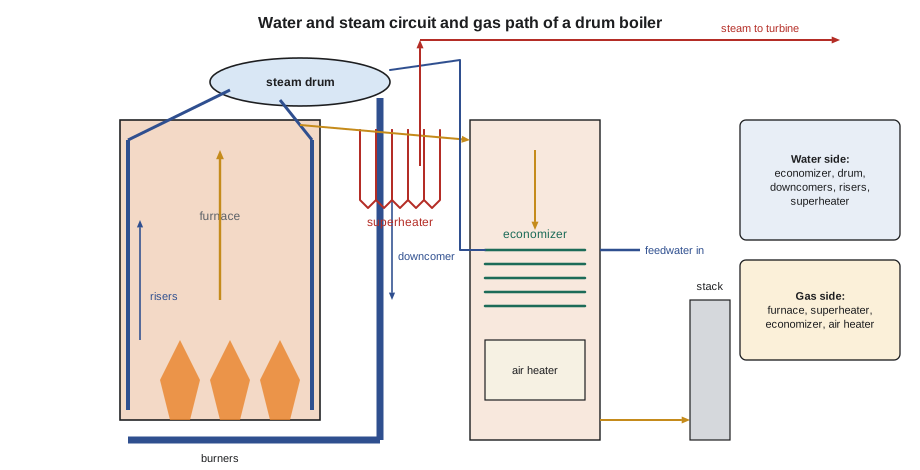
In a power plant, the steam that leaves the turbine is condensed back to water in a condenser, a large heat exchanger cooled by river or cooling tower water. The condensate is pumped through feedwater heaters and a deaerator, which removes dissolved oxygen, and back to the boiler. In a plant that uses steam for heating or for process, like Larkspur or Northgate, some steam is lost or contaminated and must be replaced with treated make-up water. Either way, the same water goes round the circuit over and over, and anything dissolved in it stays behind in the boiler when the water turns to steam.
The fire side
On the other side of the tube walls is the fire. Burners mix fuel with air and burn it in the furnace, where the flame radiates heat to the waterwall tubes. Riverbend burns natural gas. The hot products of combustion, the flue gas, leave the furnace at the top, turn and pass over the superheater, then down through the convection pass, where the boiler bank, the economizer and the air heater take more heat out of them. The air heater warms the combustion air with flue gas that would otherwise go up the stack. Fans push the air in and pull the gas out. By the time the gas reaches the stack at about 300 °F, most of its heat has gone into the water and steam.
Boilermakers work on both sides of the tube wall. On the water side, they deal with drums, headers, tubes and internals. On the fire side, they deal with tube outside surfaces, burners and wind boxes, casing, refractory, ductwork and the dampers that control the gas. Most tube failures start from one side or the other: scale and corrosion from the water side, erosion, overheating and corrosion from the fire side.
Efficiency and where the heat goes
Not all of the fuel's heat ends up in the steam. Boiler efficiency is the heat put into the water and steam divided by the heat released by the fuel. The simplest way to measure it is the input-output method: measure the steam flow, the steam and feedwater conditions and the fuel flow, then divide. The losses are what the other method, the heat-loss method, adds up: heat carried out of the stack in the flue gas, heat lost through the casing by radiation and convection, heat lost in water drained off as blowdown, unburned fuel and moisture in the fuel and air. The stack loss is by far the biggest, which is why every boiler of any size has an economizer, an air heater, or both.
Lisa Chen, Riverbend's performance engineer, gives Kiera the numbers from a recent test at full load so she can work them out for herself. The code below interpolates the drum conditions from an abridged steam table, then works out the heat put into the steam, the fuel input, the efficiency and the equivalent evaporation.
# Riverbend Unit 2: steam conditions, heat added and boiler efficiency (US units)
# Abridged saturated steam table: pressure (psia abs): (Tsat °F, hf, hfg, hg in Btu/lb)
SAT = {
    14.7: (212.0, 180.2, 970.3, 1150.5),
    150: (358.4, 330.6, 863.6, 1194.2),
    300: (417.3, 393.9, 809.4, 1203.3),
    600: (486.2, 471.7, 731.6, 1203.3),
    1_000: (544.6, 542.4, 650.0, 1192.4),
    1_400: (587.1, 598.7, 575.5, 1174.2),
    1_800: (621.2, 648.5, 506.3, 1154.8),
}

def sat(p):
    """Linear interpolation in the abridged saturated table."""
    ps = sorted(SAT)
    for lo, hi in zip(ps, ps[1:]):
        if lo <= p <= hi:
            f = (p - lo) / (hi - lo)
            return tuple(a + f * (b - a) for a, b in zip(SAT[lo], SAT[hi]))
    raise ValueError("pressure outside the table")

drum_p = 1_565          # drum pressure, psia abs
tsat, hf, hfg, hg = sat(drum_p)
print(f"Drum at {drum_p:,} psia: Tsat {tsat:.1f} °F, hf {hf:.1f}, hfg {hfg:.1f}, hg {hg:.1f} Btu/lb")

steam = 400_000          # main steam flow, lb/h
h_out = 1_460           # superheated steam at the outlet, Btu/lb (from steam tables)
h_fw = 426             # feedwater entering the economizer, Btu/lb
q_steam = steam * (h_out - h_fw)          # heat put into the steam, Btu/h
print(f"Heat added per {'lb'} of steam: {h_out - h_fw:,.0f} Btu/lb")
print(f"Heat output: {q_steam / 1e6:,.1f} MMBtu/h")

fuel = 488_000            # natural gas, scf/h
hhv = 1_010              # higher heating value, Btu per scf
q_fuel = fuel * hhv
eff = q_steam / q_fuel
print(f"Fuel input:  {q_fuel / 1e6:,.1f} MMBtu/h")
print(f"Boiler efficiency (input-output method): {eff:.1%}")

# Equivalent evaporation "from and at" 212 °F: water at boiling point to dry saturated steam
ee = q_steam / 970.3
print(f"Equivalent evaporation from and at 212 °F: {ee:,.0f} lb/h")
print(f"Factor of evaporation: {(h_out - h_fw) / 970.3:.3f}")Drum at 1,565 psia: Tsat 601.2 °F, hf 619.2, hfg 547.0, hg 1166.2 Btu/lb Heat added per lb of steam: 1,034 Btu/lb Heat output: 413.6 MMBtu/h Fuel input: 492.9 MMBtu/h Boiler efficiency (input-output method): 83.9% Equivalent evaporation from and at 212 °F: 426,260 lb/h Factor of evaporation: 1.066
The boiler turns about 84 percent of the fuel's heat into steam, which is a normal figure for a gas-fired utility boiler of its age. Equivalent evaporation is an old way to compare boilers that run at different pressures and feedwater temperatures. It converts the actual output to the steam that would be made from water at the boiling point at atmospheric pressure, turning into steam at that same temperature, a condition called "from and at 212 °F". The ratio of the two is the factor of evaporation. Boilermakers meet both terms in the trade's exams and on the nameplates of older boilers.
Water treatment and why tubes fail
Because anything dissolved in the water stays in the boiler when the water evaporates, boiler water must be treated. Hardness minerals such as calcium and magnesium form scale on the inside of tubes. Scale is a poor conductor of heat, so a tube coated with it runs hotter than a clean one; in a furnace wall, a thin layer of scale can raise the tube metal temperature enough to cause an overheating failure. Dissolved oxygen causes pitting. Caustic and acid conditions under deposits cause gouging and hydrogen damage. Operators control water quality with make-up water treatment, deaeration, chemical feed and blowdown, a controlled drain of concentrated water from the drum. When a boilermaker cuts out a failed tube, the inside surface tells the story, and the plant's chemists and inspectors want to see it.
| What the inside of a cut-out tube shows | Likely cause |
|---|---|
| Hard, layered scale | Hardness in the feedwater or poor blowdown |
| Round pits with rust-colored caps | Dissolved oxygen, often during shutdowns |
| Smooth, gouged thinning under deposits | Caustic concentrating under deposits |
| Thick-edged, brittle window-shaped break | Hydrogen damage under deposits |
| Bulged tube with a thin-edged, fish-mouth split | Short-term overheating, often from blocked flow |
Why boilers are dangerous
A boiler holds a large volume of water far above its atmospheric boiling point. If the drum or a header ruptures, the pressure drops instantly and a large part of that water flashes to steam, expanding more than a thousand times in volume. The energy released is enormous, and historically boiler explosions killed thousands of people before codes, inspection and trained operators made them rare. The low-water condition is the other classic danger: if the water level falls below the tubes or the furnace crown sheet, the metal overheats, weakens and can fail, and adding cold water to an overheated boiler can cause a violent failure. Every code rule a boilermaker follows, from the welder's qualification to the hydrostatic test, exists because of this stored energy.
Worked problem
Equivalent evaporation of a small boiler
A boiler makes 11,000 lb of steam an hour. The steam's enthalpy is 1,193 Btu/lb and the feedwater's is 148 Btu/lb. The latent heat at atmospheric pressure is 970.3 Btu/lb. What is the equivalent evaporation from and at 212 °F?
Show solution
- Heat added per pound of steam: 1,193 − 148 = 1,045 Btu/lb.
- Factor of evaporation: 1,045 ÷ 970.3 = 1.077.
- Equivalent evaporation: 11,000 × 1.077 = 11,847 lb/h.
Answer: About 11,850 lb/h from and at 212 °F.
Common mistakes
MistakeThinking all the heat in a boiler goes into raising water temperature.
InsteadMost of it is latent heat, which turns saturated water into steam at a constant temperature.
MistakeAssuming the boiling point is the same everywhere in the boiler.
InsteadThe saturation temperature rises with pressure; at drum pressure it is hundreds of degrees above 212 °F.
MistakeTreating scale on a cut-out tube as cosmetic.
InsteadScale makes tubes run hotter and causes failures; save the sample for the inspector and chemist.
MistakeForgetting the stored energy in hot water.
InsteadA ruptured drum or header releases flashing water and steam; respect pressure and isolation on every job.
Summary and key terms
- Water absorbs sensible heat until it boils, then latent heat turns it to steam at the saturation temperature.
- The saturation temperature rises with pressure, so boiler water and tubes run far hotter than 212 °F.
- Feedwater passes through the economizer, the drum, downcomers and riser tubes; steam leaves through the superheater.
- Flue gas gives up heat in the furnace, superheater, convection pass, economizer and air heater.
- Efficiency is heat into steam divided by heat from fuel; the stack loss is the largest loss.
- Water treatment prevents scale, corrosion and overheating failures; the inside of a cut-out tube shows what went wrong.
- Saturation temperature
- The boiling point of water at a given pressure.
- Latent heat
- The heat that turns saturated water into steam without changing its temperature.
- Superheated steam
- Steam heated above its saturation temperature.
- Enthalpy
- The energy content of water or steam per unit mass, read from steam tables.
- Economizer
- A tube bank in the flue gas that heats feedwater before it enters the drum.
- Blowdown
- A controlled drain of concentrated water from a boiler to limit dissolved solids.
Practice problems
Work each problem on paper first, then reveal the answer to check.
Why does water in Riverbend's drum not boil at 212 °F?
Show answer
Because the drum is at high pressure, and the saturation temperature rises with pressure; at about 1,565 psia it is about 601 °F.
Name three losses that keep boiler efficiency below 100 percent.
Show answer
Heat in the stack gas, radiation and convection from the casing, and blowdown; also unburned fuel and moisture.
A boiler takes in fuel with 475 MMBtu of heat per hour and puts 400 MMBtu into the steam. What is its efficiency?
Show answer
400 ÷ 475 = about 84 percent.
What does hard, layered scale on the inside of a furnace wall tube tell you?
Show answer
That hardness got into the boiler water or blowdown was not controlling it; scale makes the tube run hot.
Lesson quiz · 5 questions
Score 60% or more to complete this lesson.
Create a free account to save your progress, take quizzes and earn a certificate.