
AWS-103 · Lesson 10 of 12 · 18 min
Artificial intelligence and machine learning services
▶ Video coming soon A video version of this lesson is on the way.
Dr. Simone Kaur dictates her case notes into a phone after every emergency, then types them up at the end of a shift, often at four in the morning. The front desks scan paper intake forms that new clients fill in by hand. The booking team answers the same five questions on the phone a hundred times a day: what are your hours, do you see rabbits, how much is a nail trim, can I bring my dog in today, where do I park. Each of these is a job that AWS artificial intelligence services can help with, and Dr. Kaur would like to know which ones, and what the catch is.
AWS offers more AI and machine learning (ML) services than any one person uses. The exam expects you to understand the three layers in which they are offered and to recognize what the main services do from a short description. This lesson covers those layers, the ready-made AI services, Amazon Bedrock for generative AI, Amazon SageMaker AI for building custom models, and the responsibilities that come with using AI on client data.
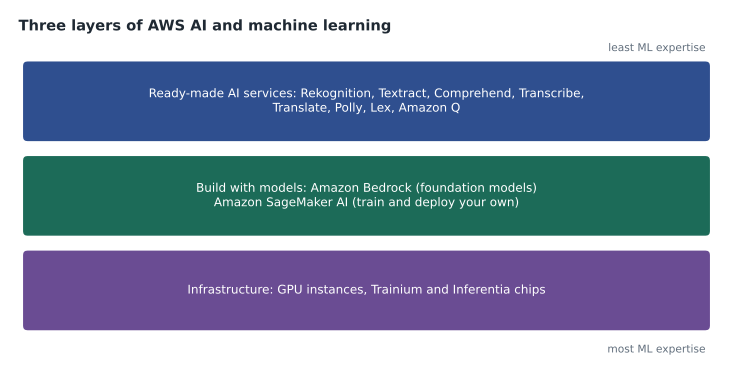
The three layers
- AI services at the top are ready-made: you send text, an image, a document or audio to an API and get a result, such as a transcript, a list of objects in a photo or the fields of a form. No ML expertise or training data is needed; AWS has trained and maintains the models.
- Model platforms in the middle let you build with models. Amazon Bedrock gives access to foundation models from AWS and other model providers through one API, for generative AI applications. Amazon SageMaker AI provides tools to build, train, tune and deploy your own ML models.
- Infrastructure at the bottom is the raw compute: EC2 instances with GPUs, and AWS-designed Trainium chips for training and Inferentia chips for running models, used by teams that build and operate models themselves.
Gwen's rule of thumb matches the exam: choose the highest layer that solves the problem. A clinic chain should not train its own speech recognition model when an AI service already transcribes speech.
Ready-made AI services
| Service | What it does | Cascade Ridge idea |
|---|---|---|
| Amazon Transcribe | Converts speech to text, with features such as speaker labels and custom vocabulary; Transcribe Medical suits clinical dictation | Turning Dr. Kaur's dictated notes into draft text |
| Amazon Textract | Extracts printed and handwritten text, forms and tables from scanned documents | Reading handwritten intake forms into structured fields |
| Amazon Comprehend | Finds meaning in text: key phrases, entities, sentiment, language and personal information; Comprehend Medical extracts medical terms | Spotting unhappy feedback in client reviews |
| Amazon Rekognition | Analyses images and video: objects, scenes, text, faces and unsafe content | Checking that uploaded photos actually show an animal |
| Amazon Translate | Translates text between languages | Offering reminders in the languages clients prefer |
| Amazon Polly | Turns text into lifelike speech | Spoken phone messages for after-hours callers |
| Amazon Lex | Builds conversational chatbots and voice bots using the same technology as Alexa | A booking and frequently-asked-questions bot |
| Amazon Kendra | Intelligent search across an organization's documents | Searching clinic policies and protocols |
| Amazon Personalize | Builds recommendations from user behavior | Not needed now |
Several services in this family have changed recently, and the exam guide tracks the current names. Amazon Fraud Detector, for example, stopped accepting new customers in late 2025. Gwen's advice is to learn the main services by job rather than by brand: speech to text is Transcribe, text to speech is Polly, documents to data is Textract, meaning in text is Comprehend, images is Rekognition, chatbots is Lex.
For Dr. Kaur's dictation, the design is a short pipeline: the phone app uploads the audio to S3, a Lambda function starts a Transcribe job, and the draft text appears in VetLedger for the vet to review and sign. The vet still reviews every note. "The machine types," Gwen says, "you decide."
Generative AI with Amazon Bedrock
Generative AI creates new content, such as text, summaries, code or images, using foundation models: very large models trained on broad data that can be adapted to many tasks. Amazon Bedrock is a fully managed service that offers a choice of foundation models from Amazon and other providers through a single API, so developers can build generative AI features without managing any model infrastructure. Bedrock adds capabilities around the models: knowledge bases that ground answers in an organization's own documents (an approach called retrieval-augmented generation), agents that can carry out multi-step tasks by calling APIs, guardrails that filter harmful content and keep answers within set topics, and model evaluation.
Bedrock keeps customer data private: prompts and documents sent to it are not used to train the underlying models, and data can stay within the chosen Region. For the booking team's five questions, Kwame could combine Amazon Lex for the conversation with a Bedrock knowledge base built from the clinics' own pages on hours, services and prices, with a guardrail that refuses to give medical advice and hands those questions to a person.
Amazon Q is AWS's generative AI assistant. Amazon Q Business answers questions and completes tasks using a company's own data and applications. Amazon Q Developer helps developers write, explain and transform code and answers questions about AWS. AWS continues to evolve these assistants and related tools, so names and packaging may change; the exam's interest is in the idea of a generative AI assistant for business users and for developers.
Building custom models with Amazon SageMaker AI
When no ready-made service fits, and an organization has its own data and ML skills, Amazon SageMaker AI provides the tools to build, train and deploy custom models. In late 2024 AWS renamed the original SageMaker service SageMaker AI and introduced a broader Amazon SageMaker platform that brings data, analytics and AI tools together; the exam guide uses the name SageMaker AI. Its features include notebooks for data scientists, managed training on chosen instance types, automatic model tuning, SageMaker Autopilot for automated model building, SageMaker Canvas for building models without code, managed endpoints that host models for predictions, and tools for monitoring models and explaining their predictions.
Cascade Ridge has one idea that might one day justify a custom model: predicting which booked appointments are likely to be missed, using three years of history from the reporting lake in lesson 9, so clinics can send an extra reminder or double-book carefully. Gwen suggests trying SageMaker Canvas first, because it needs no code, and only if the result is useful would Kwame learn more.
Responsibility when using AI
Using AI services does not remove responsibility; it shifts it. AWS is responsible for the security and operation of the services and their infrastructure. The customer is responsible for the data it sends, the permissions on that data, how results are used, and whether a person reviews them. For Cascade Ridge, Hannah writes three rules.
- Send only the data each task needs. Dictation audio contains client and pet details, so it is stored in an encrypted bucket with tight access and deleted after the note is signed.
- Keep a person in the loop for anything that affects care or money. Machine-drafted notes and extracted form fields are reviewed before they are saved. Amazon Augmented AI (A2I) can route low-confidence results to human reviewers automatically.
- Check results for errors and bias, and tell clients when they are talking to a bot.
Most AI services return a confidence score with each result. A common design is to accept high-confidence results automatically and send the rest to a person.
# Route extracted form fields by confidence: accept, or send to a person for review.
fields = [("pet_name", "Biscuit", 0.99), ("species", "dog", 0.97),
          ("owner_phone", "555-0142", 0.71), ("allergies", "penicilin", 0.64)]
THRESHOLD = 0.90

accepted = [(n, v) for n, v, c in fields if c >= THRESHOLD]
review = [(n, v, c) for n, v, c in fields if c < THRESHOLD]
print("accepted:", accepted)
for name, value, conf in review:
print(f"review needed: {name} = {value!r} (confidence {conf:.2f})")accepted: [('pet_name', 'Biscuit'), ('species', 'dog')]
review needed: owner_phone = '555-0142' (confidence 0.71)
review needed: allergies = 'penicilin' (confidence 0.64)What this code does
It takes form fields extracted from a scanned document, each with a confidence score from the extraction service, and compares them with a cut-off of 0.90. Fields at or above the cut-off are accepted automatically, and the rest are sent for a person to review. Here the phone number and the misspelled allergy are flagged for review, showing how human checks are added where the machine is unsure.
The allergy field is exactly the kind a person must check: a misread allergy could hurt an animal, and here the handwriting has produced a misspelling. Dr. Kaur nods slowly; she has seen worse handwriting than the machine has.
Trying an AI service before building anything
Gwen's approach to AI at Cascade Ridge is deliberately small. Before anyone writes code, Mateo opens the AWS console and tries each service by hand with test data: a recording of Gwen reading a made-up case note into a phone, a blank intake form filled in with invented details in deliberately messy handwriting, and a list of the booking team's five common questions. Most AI services have a console page where you can upload a file or type text and see the result immediately, which makes these experiments quick and cheap.
The results set realistic expectations. Transcribe handles the dictation well but stumbles on some drug names until a custom vocabulary of common veterinary terms is added. Textract reads most of the form, returns low confidence on two scrawled fields and gets one wrong, which confirms the need for review. The Lex prototype answers the hours and parking questions correctly but needs a careful handoff to a person when a client describes symptoms, because the bot must never appear to give medical advice.
Gwen writes up the experiment in one page for the board: what each service did well, where a person must stay involved, what data each would see, and what it would cost per month at Cascade Ridge's volumes using the public pricing pages. That page, not a demonstration, is what lets the board decide. The AI pieces are placed in phase 2, after the core migration, because the clinics need a stable practice system before they need a chatbot.
Hannah adds one more step before any real client data is used: a privacy review of each service, covering which Region processes the data, how long the service keeps it, and whether it can be deleted on request. For US clients, the answers go into the privacy notice that explains to clients how their information is used, written in plain language.
Gwen also reminds Mateo how the exam frames these services. A Cloud Practitioner question rarely asks how a model works inside. It asks what a service does, which layer it belongs to and who is responsible for what. If he can say in one sentence what each AI service is for, and explain why a person still reviews the results, he has what the exam expects from this lesson.
Worked problem
Matching AI needs to services
Choose the AWS service for each Cascade Ridge need: (1) turn recorded dictation into text; (2) read handwritten intake forms into fields; (3) a chatbot that books appointments and answers common questions; (4) answer staff questions using the clinics' own policy documents with generative AI; (5) build a custom model to predict missed appointments.
Show solution
- (1) Amazon Transcribe (Transcribe Medical for clinical vocabulary).
- (2) Amazon Textract, with human review for low-confidence fields.
- (3) Amazon Lex for the conversation.
- (4) Amazon Bedrock with a knowledge base built from the documents, or Amazon Q Business.
- (5) Amazon SageMaker AI, starting with SageMaker Canvas.
Answer: Transcribe, Textract, Lex, Bedrock or Q Business, and SageMaker AI.
Common mistakes
MistakeTraining a custom model for a task a ready-made AI service already does.
InsteadStart at the highest layer: use an AI service, then Bedrock, and build with SageMaker AI only when needed.
MistakeConfusing Polly and Transcribe.
InsteadPolly turns text into speech; Transcribe turns speech into text.
MistakeAssuming AI output needs no review.
InsteadUse confidence scores and human review, for example with Amazon A2I, for decisions that matter.
MistakeBelieving Bedrock trains shared models on your prompts.
InsteadBedrock does not use customer prompts and data to train the underlying foundation models.
MistakeSending more personal data to an AI service than the task needs.
InsteadMinimize data, encrypt it and control access; the customer remains responsible for its data.
Summary and key terms
- AWS offers AI and ML in three layers: ready-made AI services, platforms for building with models, and ML infrastructure.
- Transcribe converts speech to text, Polly text to speech, Textract documents to data, Comprehend finds meaning in text, Rekognition analyses images and video, Translate translates, Lex builds chatbots, Kendra searches documents and Personalize recommends.
- Amazon Bedrock provides managed access to foundation models with knowledge bases, agents and guardrails; Amazon Q provides generative AI assistants.
- Amazon SageMaker AI builds, trains and deploys custom models.
- Customers remain responsible for their data, its permissions and how results are used, with human review for important decisions.
- Machine learning
- Building models that learn patterns from data to make predictions.
- Foundation model
- A large model trained on broad data that can be adapted to many tasks.
- Amazon Bedrock
- A managed service providing foundation models through one API.
- Amazon SageMaker AI
- A service for building, training and deploying custom ML models.
- Amazon Transcribe
- A service that converts speech to text.
- Amazon Polly
- A service that converts text to speech.
- Amazon Textract
- A service that extracts text, forms and tables from documents.
- Amazon Comprehend
- A service that finds entities, key phrases, sentiment and more in text.
- Amazon Rekognition
- A service that analyses images and video.
- Amazon Lex
- A service for building conversational chatbots.
Practice problems
Work each problem on paper first, then reveal the answer to check.
Which service extracts data from scanned forms?
Show answer
Amazon Textract.
Which service gives access to foundation models from several providers through one API?
Show answer
Amazon Bedrock.
Which service would you use to build and train a custom model?
Show answer
Amazon SageMaker AI.
Lesson quiz · 5 questions
Score 60% or more to complete this lesson.
Create a free account to save your progress, take quizzes and earn a certificate.