
ARCH-500 · Lesson 2 of 12 · 22 min
Choosing a question
In the second week Leclerc asks each student to bring ten questions. Not one, ten. 'Your first question is almost never your best,' she says. 'It is usually the question everyone asks about your topic. The good one is underneath it, and you find it by writing the obvious ones down and asking what is wrong with each.' The students pin their lists side by side. Ingrid's begins with 'How can cities prepare for extreme cold?' and ends, ten questions later, with something much narrower. Callum's begins with 'Is timber better than concrete?' Joon-ho's begins with 'What is the future of the office?' Wren's begins with 'How should we build near rivers?'
From topic to question to claim
Leclerc draws a funnel. At the wide top is a topic, a field of interest: winter, wood, offices, rivers. Below it is a problem, a situation in the world that is unsatisfactory for someone: residents without heat in an outage, a forest whose wood is burned for pulp, empty floors in a city short of homes, buildings that turn their backs on the water. Below the problem is a question, which asks something specific that the thesis can find out. And at the narrow bottom is a claim, a provisional answer that the student will test: a hypothesis in a research-led thesis, a proposition in a design-led one. The claim is allowed to be wrong; its job is to give the work a direction and something to disprove.
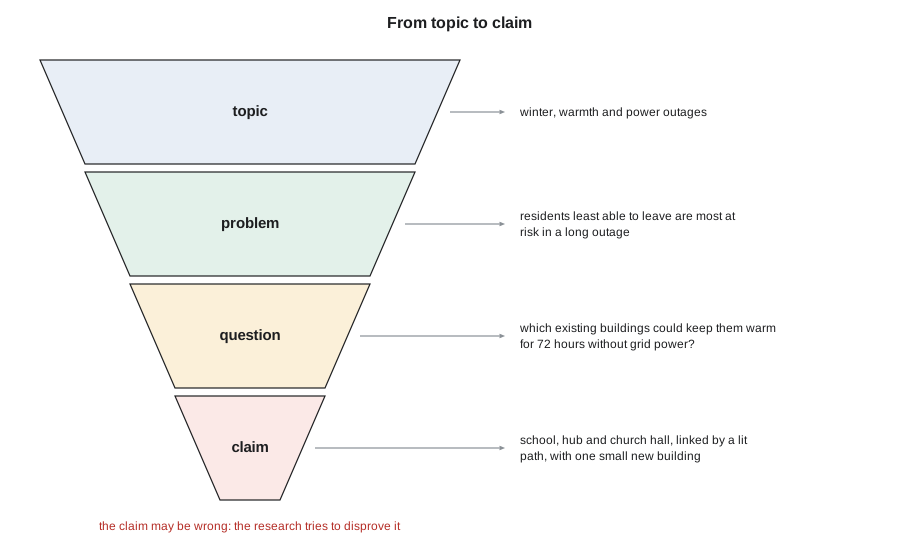
Ingrid's funnel shows how much the narrowing changes. 'Extreme cold' is a topic. 'Residents of the district may be without heat for days if the grid fails in deep winter, and the people least able to leave are the most at risk' is a problem. 'Which existing buildings in the district could, with retrofit and one new piece, keep the residents who most need it warm and safe for 72 hours without grid power, and how should they be linked?' is a question. 'The school, the community hub and the church hall, retrofitted and linked by a lit path, can do it with one small new building that stores power and water' is a claim, which her research and design will either support or overturn.
Five tests of a good question
Leclerc gives the class five tests. A good thesis question is open: it has more than one plausible answer, so that finding the answer is worth a year. 'Is timber better than concrete?' fails, not because it is unimportant but because the answer is 'it depends', and the thesis would only list the things it depends on. A good question is answerable by design: architecture, drawings, models or a built test can contribute to the answer, not only a literature review or a survey. A good question is specific to a place or a situation, which grounds it and makes it testable. A good question is important to someone beyond the student, a group of people or a part of the profession who need the answer. And a good question is doable in two terms with the student's skills, time and access.
Callum scores his ten questions against the tests and finds that the strongest is not about timber in general but about the trembling aspen and balsam poplar that grow within a few hundred kilometers of the city. 'Can low-value regional hardwood be made into a structural system for mid-rise housing, and what architecture follows from its sizes and strengths?' is open, because nobody knows yet whether the system would work or what it would look like. It is answerable by design, by testing small specimens in the school's workshop and by designing a building with the results. It is specific. It matters to the forest communities and the mills that sell aspen for pulp, and to anyone trying to cut the carbon of mid-rise housing. And it is doable, if he keeps the testing modest and borrows data from published research.
Ingrid writes a short script to score her own candidates, partly as a joke and partly to force herself to say what is weak about each. The scoring is crude, but it shows where the work is needed.
# Score candidate thesis questions on five tests (0 = fails, 1 = partly, 2 = passes)
tests = ["open", "answerable by design", "specific to a place", "important to someone", "doable in two terms"]
candidates = {
    "What is the future of the library?":                       [2, 0, 0, 2, 0],
    "How can a district stay warm in a cold snap?":        [2, 2, 1, 2, 1],
    "Which existing buildings on the district's streets could shelter residents for 72 hours without power in deep cold?": [2, 2, 2, 2, 2],
    "Is timber better than concrete?":                          [0, 1, 0, 1, 1],
}
for q, s in candidates.items():
    weak = [t for t, v in zip(tests, s) if v < 2]
    print(f"{sum(s):2d}/10  {q}")
    if weak:
print(" work on:", ", ".join(weak)) 4/10 What is the future of the library?
work on: answerable by design, specific to a place, doable in two terms
8/10 How can a district stay warm in a cold snap?
work on: specific to a place, doable in two terms
10/10 Which existing buildings on the district's streets could shelter residents for 72 hours without power in deep cold?
3/10 Is timber better than concrete?
work on: open, answerable by design, specific to a place, important to someone, doable in two termsThe first question, about the future of the library, fails three tests: it is too general to answer by design, attached to no place and far too large for two terms. Ingrid's second question is better but still floats free of a place. Only the third, which names existing buildings, a district, a duration and a condition, passes all five. Leclerc warns the class not to trust a score too much. 'The tests are a conversation, not a machine,' she says. 'But if you cannot say which test your question fails, you do not know your question well enough.'
Wren, Joon-ho and the size of a question
Wren's question needs narrowing in a different way. 'How should we build near rivers?' is a topic. Her second version, 'Can a public building on the riverbank flood every spring and return to use within days?', is a strong question, but she worries that it is too technical, a matter of waterproof materials and pumps. Her adviser, Professor Hélène Desrosiers, the landscape architect and urban designer who taught the urban design course, pushes her the other way: 'The technical part is the easy part. The hard part is what it means for a building to share its ground with the river, and whether people will love a building that is sometimes underwater.' Wren rewrites the question to include both: what kind of public building, and what kind of public life, belongs on a riverbank that floods?
Joon-ho's question is at risk of becoming too large. Downtown has dozens of office buildings, and a thesis cannot study them all in depth. Bérubé, his adviser, suggests that he study many lightly and one deeply: a short survey of thirty buildings to sort them by depth, structure, age and vacancy, and a deep study of one representative building, a vacant 1970s office tower that he can visit. His question becomes 'Which of downtown's postwar office buildings can become good homes, and what must change in a deep floor plate to make them so?' The first half is answered by the survey, the second by design.
Choosing an adviser
Each student chooses an adviser in the second week, and Leclerc gives advice on how. An adviser should know the subject well enough to point to the literature and to say when a result is wrong, but should also be someone the student can disagree with. 'You will see your adviser every week for eight months,' she says. 'Choose someone who will tell you the truth.' Ingrid asks Professor Ruth Abernathy, the building scientist who taught the first environmental systems course, because her question depends on how buildings lose heat when the power fails. She also asks Professor Tessa Morningstar, who taught the course on architecture, culture and community, to be the second reader on her committee, because her work will involve residents, some of them Indigenous elders and families, and needs a reader who knows how to do that work well. Callum asks Marta Szymańska, the structural engineer who taught both structures courses. Wren works with Desrosiers, and Joon-ho with Bérubé.
Leclerc also asks each student to name a 'reader from outside', someone who is not an architect but knows the subject from another side. Ingrid names Margaret Flett, the Elder she met in the culture and community course, who lives in the district and has volunteered in its warming room. Callum names a forester at the provincial forestry branch. Wren names a hydrologist at the city's water department. Joon-ho names a property manager who handles two of the empty office buildings. These readers are not on the committee, but their comments at reviews often change a thesis more than any professor's.
The claim and how it could fail
The last step of the week is to write a claim and the evidence that would disprove it. Leclerc insists on the second half. Ingrid's claim is that three existing buildings and one small new building can keep the district's most vulnerable residents warm for 72 hours without power. Evidence against it would be a simulation showing that even a retrofitted building cannot stay above a habitable temperature for that long with the heat from the people inside it, or a survey showing that residents would not walk to those buildings in the dark and cold, or a cost so high that no city would pay it. 'Good,' Leclerc says. 'Now you know what to look for. Most of your research this term is an attempt to prove yourself wrong.'
Callum's claim is that a glued laminated system from aspen can carry the floor loads of a six-story residential building at spans similar to spruce glulam, with deeper members; evidence against it would be strength and stiffness values too low, or glue bonds that fail. Wren's claim is that a public room raised on a flood-proof plinth, with a lower terrace and boathouse designed to flood, can return to full use within a week of the water falling; evidence against it would be the length and timing of real floods, the silt they leave, or the cost of cleaning. Joon-ho's claim is that about a third of the downtown office buildings can become good housing, and that a deep floor can be made to work by cutting a courtyard through it; evidence against it would be floor plates too deep even with a courtyard, or a structure that cannot be cut.
Worked problem
Testing a question
A student proposes the question 'How can architecture reduce loneliness?' Score it against the five tests and suggest a narrower version.
Show solution
- Open: yes, there are many plausible answers.
- Answerable by design: only partly, because loneliness has many causes outside buildings.
- Specific: no, there is no place or group.
- Important to someone: yes. Doable in two terms: no, it is far too broad.
- A narrower version: 'Can the ground floor of a seniors' apartment building be designed so that residents meet one another daily without planning to?'
Answer: The original passes two tests; a version tied to a building type, a group and an observable outcome passes all five.
Exercise 2: ten questions
- Write ten questions about your subject, from the most obvious to the most specific.
- Score each against the five tests and say which test each one fails.
- Draw your funnel: topic, problem, question and claim.
- Write what evidence would disprove your claim.
- Choose an adviser and a reader from outside, and say why.
Self-check
- Could a stranger tell from your question what you will design?
- Is your question about a place, a group of people or a kind of building, rather than about everything?
Questions that change
Leclerc ends the week by telling the class that their questions will change, probably more than once, and that this is not a failure. A question written in week two is a best guess made before the reading, the fieldwork and the first designs. The research will show where it was too broad, too narrow or aimed at the wrong thing. What matters is that each change is made for a reason and recorded: the old question, the new one, and the evidence that moved it. A thesis whose question never changed was either very lucky or never tested. She asks each student to keep the ten questions from this week in the back of their notebook, so that in December they can see how far they have come.
Common mistakes
MistakeKeeping the first question you wrote.
InsteadWrite many and look for the better question underneath.
MistakeAsking a question whose answer is 'it depends'.
InsteadAsk about the case it depends on.
MistakeChoosing a question too large for two terms.
InsteadStudy many cases lightly and one deeply.
MistakeWriting a claim without saying how it could fail.
InsteadList the evidence that would disprove it, and look for it.
MistakeChoosing an adviser who always agrees.
InsteadChoose someone who will tell you the truth.
Summary and key terms
- A thesis narrows from topic to problem to question to claim.
- A good question is open, answerable by design, specific, important to someone and doable in two terms.
- A claim is a provisional answer; most of the term's research is an attempt to disprove it.
- Ingrid's question asks which existing buildings could keep vulnerable residents warm for 72 hours without power.
- Each student has an adviser, a committee and a reader from outside the profession.
- Topic
- A field of interest, too broad to answer.
- Problem
- A situation in the world that is unsatisfactory for someone.
- Research question
- A specific question the thesis can find out.
- Claim
- A provisional answer that the work will test; a hypothesis or proposition.
- Falsifiable
- Able to be shown wrong by evidence.
- Reader from outside
- A non-architect who knows the subject and comments at reviews.
Practice problems
Work each problem on paper first, then reveal the answer to check.
What are the four steps of Leclerc's funnel?
Show answer
Topic, problem, question and claim.
Why does 'Is timber better than concrete?' fail the first test?
Show answer
Its answer is 'it depends', so it is not genuinely open.
How did Joon-ho keep his question doable?
Show answer
A light survey of thirty buildings and a deep study of one.
Who is Ingrid's reader from outside?
Show answer
Margaret Flett, an Elder who lives in the district.
What would disprove Ingrid's claim?
Show answer
A simulation showing the rooms cannot stay habitable for 72 hours, residents who would not walk there, or an impossible cost.
What did Desrosiers say was the hard part of Wren's question?
Show answer
What it means for a building to share its ground with a river, and whether people will love it.
Lesson quiz · 5 questions
Score 60% or more to complete this lesson.
Create a free account to save your progress, take quizzes and earn a certificate.