
AERO-430 · Lesson 5 of 12 · 26 min
Production approval
A type certificate shows that the design is safe. It says nothing about whether the aircraft coming off the production line match that design. The second question is answered by production approval: the authority's confidence that a manufacturer has a quality system able to produce, every time, products and parts that conform to the approved design and are in a condition for safe operation. For Prairiewind Aerospace, building the first Petrel 19 prototypes in a development shop is one thing; building three aircraft a month in a new hangar with parts from 140 suppliers is another, and it needs its own approval.
Building without and with production approval
A type certificate holder without production approval can still build aircraft, but each one must be inspected by the FAA, or by a designee, before it receives an airworthiness certificate. That is acceptable for prototypes and a handful of early aircraft. At production rates it is impractical. Under 14 CFR Part 21 Subpart G, a manufacturer that holds a production certificate can instead show each aircraft's conformity under its own approved quality system, with the FAA overseeing the system rather than inspecting every product. The production limitation record lists the products covered. Parts can be approved for production separately through parts manufacturer approval or technical standard order authorization.
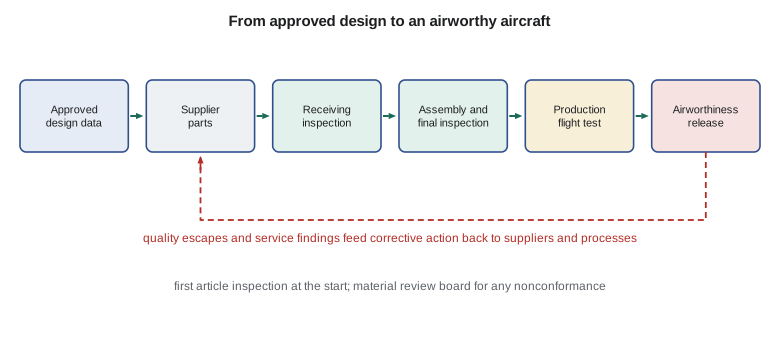
The quality system must cover the elements listed in 14 CFR 21.137: design data control, document control, supplier control, manufacturing process control, inspecting and testing, inspection, measuring and test equipment control, inspection and test status, nonconforming product and article control, corrective and preventive actions, handling and storage, control of quality records, internal audits, in-service feedback and quality escapes. These elements correspond closely to the international aerospace quality standard AS9100, which most aerospace manufacturers already hold, though the regulatory approval is separate and is granted by the FAA.
| Element | What it ensures | Petrel 19 example |
|---|---|---|
| Design data control | Production works to the current approved design | Drawing release only through the engineering change system |
| Supplier control | Bought parts conform to the design | Audits and source inspection of the battery module supplier |
| Process control | Special processes are qualified and controlled | Bonding, heat treatment, cell welding |
| Inspection and test | Each product is checked against its requirements | Production flight test and insulation resistance test |
| Nonconforming product | Defects are found, recorded and dispositioned | Material review board for deviations |
| Quality escapes | Defects that reach the customer are traced and corrected | Investigation and fleet notification |
Conformity and first article inspection
Conformity means that a part or product matches its approved design data in every detail that the data specifies: dimensions, material, finish, process, markings and tests. The most important point at which conformity is established is the first article inspection, a complete check of the first production item against every characteristic on its drawing. Aerospace practice follows the AS9102 standard, which records each characteristic with its required and measured value. A first article inspection is repeated when the design, process, manufacturing location or supplier changes.
Hélène Lavoie, who has moved from flight controls to lead manufacturing engineering for the Petrel 19, insists on first article inspection for every part, including the battery modules. The battery supplier argues that its process is already qualified for a road vehicle. Hélène's reply is that a road vehicle battery is not built to the Petrel 19 drawing, does not meet the same vibration and temperature environment and is not traced to an aircraft serial number. The supplier agrees to a full first article inspection on the first five modules.
Supplier control
Most of an aircraft is made by suppliers. The manufacturer remains responsible for the conformity of every part, whoever makes it. Supplier control therefore includes selecting suppliers on the basis of capability, flowing down the design requirements and quality requirements in purchase orders, auditing the supplier's quality system, inspecting parts on receipt or at source, and monitoring supplier performance over time. Suppliers that make safety-critical parts, or use special processes such as heat treatment or composite curing, receive closer attention.
Receiving inspection rarely checks every part. Instead it samples. Hélène's team uses a single sampling plan for standard parts: draw 50 from a batch and accept the batch if no more than one is defective. The code below shows how such a plan behaves, through its operating characteristic.
# Production conformity: accepting a batch of battery modules from a supplier.
# Single sampling plan: inspect n, accept if defects <= c. Binomial operating characteristic.
from math import comb
def p_accept(p, n, c):
    return sum(comb(n, k) * p**k * (1 - p)**(n - k) for k in range(c + 1))
n, c = 50, 1
print(f"sampling plan n = {n}, c = {c}")
for p in (0.005, 0.01, 0.02, 0.05, 0.08):
    print(f"true defect rate {p:5.1%}: probability the batch is accepted {p_accept(p, n, c):5.1%}")
found, inspected = 7, 420   # first-article and receiving inspection results this quarter
rate = found / inspected
print(f"observed nonconformance rate {rate:.2%}; parts per million {rate*1e6:,.0f}")sampling plan n = 50, c = 1 true defect rate 0.5%: probability the batch is accepted 97.4% true defect rate 1.0%: probability the batch is accepted 91.1% true defect rate 2.0%: probability the batch is accepted 73.6% true defect rate 5.0%: probability the batch is accepted 27.9% true defect rate 8.0%: probability the batch is accepted 8.3% observed nonconformance rate 1.67%; parts per million 16,667
A batch with a true defect rate of 0.5 percent is accepted 97.4 percent of the time, which is what the plan intends. But a batch with a 5 percent defect rate is still accepted 27.9 percent of the time, and an 8 percent batch 8.3 percent of the time. Sampling protects against bad batches on average but does not stop them all. The observed rate of 1.67 percent, about 16,667 parts per million, is well above what the program wants for an aircraft. The conclusion is that receiving inspection cannot carry quality alone; the supplier's own process control must be good enough that defects are rare from the start. For critical parts the program requires 100 percent inspection or, better, statistical process control at the supplier.
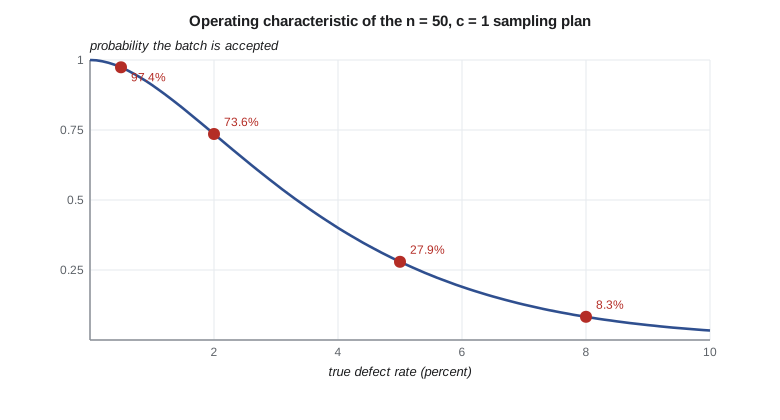
The equation gives the probability of acceptance for a plan with sample size n and acceptance number c when the true fraction defective is p. Plotting it against p gives the operating characteristic curve. A steeper curve discriminates better between good and bad batches, and requires larger samples.
Nonconforming product
Every factory produces some parts that do not conform. What matters is that they are found, identified, segregated and dispositioned by people with the authority to do so. Options include rework to the drawing, repair to an approved scheme, scrap, or acceptance as is. Acceptance as is and repairs need engineering approval, because the part no longer matches the type design; where the deviation could affect airworthiness, it may need to be approved as a design change. A material review board, with engineering and quality members, makes these decisions and records them.
Marcus Webb's structures team sits on the board for airframe parts. Early in production they find a recurring problem: fastener holes in a wing rib drilled 0.1 mm oversize by a worn tool. Accepting each part as is would be easy, since the analysis shows ample margin, but Marcus refuses to treat the symptom. He asks the factory to find out why the tool wear was not caught, and the corrective action leads to a tool life limit and a change in the in-process inspection frequency.
From the factory to the flight line
Each completed aircraft must receive an airworthiness certificate before it can operate. Under 14 CFR 21.183, the FAA or a designee issues a standard airworthiness certificate when the aircraft conforms to its type design and is in a condition for safe operation. A production certificate holder can provide the conformity evidence through its quality system, including production flight testing to an approved procedure. Parts released by an approved manufacturer carry an authorized release certificate, FAA Form 8130-3, which travels with the part.
The release certificate is the link between production and maintenance. A A&P mechanic installing a replacement battery module on the flight line in Bethel and the Yukon-Kuskokwim villages of western Alaska relies on the release certificate to know that the module was made under an approved system and conforms to the design. Counterfeit or unapproved parts break this link, which is why release documentation is checked at every step of the supply chain and why suspected unapproved parts must be reported.
Oversight of production
The authority oversees a production approval holder through audits of the quality system, product audits in which an aircraft or part is checked independently, and reviews of quality escapes. The holder must notify the authority of significant changes, such as a new manufacturing location or a change to the quality system. If the system fails, the authority can require corrective action, restrict the approval or, in extreme cases, suspend it. Production problems found in service, such as a batch of parts made with the wrong heat treatment, can lead to airworthiness directives, the subject of Lesson 9.
Hélène sets up a quality dashboard for the factory with three measures: first-pass yield at final inspection, the number of nonconformances per aircraft and the number of quality escapes reported from the field. Teresa Nakamura asks for a fourth: the time from detection of a supplier defect to its corrective action at the supplier. In her experience at the engine shop, a long delay is the clearest sign that the supply chain is not under control.
Production rate and the learning curve
Production approval is granted for a system, but the system must also work at the planned rate. The first aircraft through a new line take far longer than later ones, and they produce more nonconformances, because procedures are new, tooling is being adjusted and the workforce is learning. Planning should expect this. Prairiewind Aerospace sets its rate increase in steps: one aircraft a month for the first year, two in the second, and three only when the nonconformance rate per aircraft has fallen below an agreed level for six consecutive months. Élise Fournier resists pressure from the sales team to accelerate, pointing out that a quality escape on an early aircraft, discovered later across a growing fleet, would cost far more than a few months of delayed deliveries.
Rate also stresses suppliers. A supplier that delivered good parts for prototypes may struggle when asked for ten times the volume, especially for parts with special processes such as composite curing, cell welding or heat treatment. The supplier control program therefore includes capacity reviews and requires suppliers to tell Prairiewind Aerospace before they change a process, move production or subcontract work. An undeclared change at a sub-tier supplier is one of the most common origins of quality escapes in aerospace, because the people who know the change was made are several companies removed from the people who rely on the part.
Software and electronic parts in production
The Petrel 19 adds problems that older production systems did not face. The power management software must be loaded into each controller at the correct approved version, and the load must be verified. The battery modules contain cells whose performance depends on chemistry and manufacturing details that cannot be checked by measuring dimensions. The production approval must therefore include configuration control of loadable software, with a record of the part number and version installed on every aircraft, and acceptance testing of each battery module for capacity, internal resistance, insulation and cell balance. Each module is serialized and its test data stored, so that if a cell problem is later found in service, the affected aircraft can be identified within hours rather than weeks.
Worked problem
Who releases the aircraft?
Prairiewind Aerospace has its type certificate but is still waiting for production approval. It has built aircraft number 4. How can it receive a certificate of airworthiness?
Show solution
- Without production approval, the quality system cannot be relied on to show conformity.
- The authority or a delegate must inspect the aircraft individually against the type design.
Answer: By individual inspection for conformity by the authority or a delegate.
Worked problem
Sampling risk
Using the code output, if a supplier's true defect rate is 2 percent, what fraction of batches will the n = 50, c = 1 plan reject?
Show solution
- The probability of acceptance at 2 percent is 73.6 percent.
- The probability of rejection is 100 - 73.6 = 26.4 percent.
Answer: About 26 percent of batches are rejected; 74 percent pass despite the defect rate.
Worked problem
Disposition
A composite panel has a small resin-starved area outside the drawing's allowable defect limits. What are the options?
Show solution
- The panel is nonconforming and must be segregated.
- Options are repair to an approved scheme, acceptance as is with engineering justification, or scrap.
- The material review board decides, and records the decision against the aircraft serial number.
Answer: Material review board disposition: repair, accept with engineering approval, or scrap.
Common mistakes
MistakeAssuming a type certificate allows a company to release aircraft.
InsteadRelease under a quality system needs production approval.
MistakeRelying on sampling inspection to catch every defect.
InsteadSampling accepts some bad batches; process control must keep defects rare.
MistakeSkipping first article inspection for a supplier's established product.
InsteadEvery part built to the aircraft drawing needs first article inspection.
MistakeAccepting recurring nonconformances one by one.
InsteadRecurring defects need corrective action on the root cause.
MistakeInstalling a part without its release certificate.
InsteadThe release certificate is the evidence that the part is approved.
Summary and key terms
- Production approval shows that a manufacturer can repeatedly build products that conform to the approved design.
- Without it, each aircraft is inspected individually.
- The quality system covers design data, documents, suppliers, processes, inspection, nonconformance and feedback.
- First article inspection checks every characteristic of the first part.
- Sampling inspection has limits described by its operating characteristic.
- Nonconforming parts are dispositioned by a material review board.
- Aircraft receive certificates of airworthiness and parts carry release certificates.
- Production approval
- Authority approval of a manufacturer's quality system for a product.
- Conformity
- Agreement of a product with its approved design data.
- First article inspection
- A complete check of the first production item against its drawing.
- Operating characteristic
- The probability of accepting a batch as a function of its true defect rate.
- Nonconformance
- A departure of a part from its design data.
- Material review board
- The group that dispositions nonconforming product.
- Release certificate
- The document certifying that a part was produced under an approved system.
- Quality escape
- A defect that leaves the factory undetected.
Practice problems
Work each problem on paper first, then reveal the answer to check.
What does production approval let a manufacturer do?
Show answer
Show conformity of its products through its own approved quality system.
When is a first article inspection repeated?
Show answer
When the design, process, location or supplier changes.
At 5 percent true defects, how often does the n = 50, c = 1 plan accept a batch?
Show answer
About 27.9 percent of the time.
Who decides whether to accept a nonconforming part as is?
Show answer
The material review board with engineering approval.
What document accompanies an approved part?
Show answer
An authorized release certificate.
Why does supplier control matter so much?
Show answer
Because most of an aircraft is made by suppliers and the manufacturer remains responsible.
Lesson quiz · 5 questions
Score 60% or more to complete this lesson.
Create a free account to save your progress, take quizzes and earn a certificate.