
PLB-110 · Lesson 9 of 12 · 22 min
Valves and fittings
On the third floor of Kingsway Tower, the inspector stopped at a drain branch Maya had helped install and pointed at a fitting. "That sanitary tee is on its back," he said. The fitting had been installed to connect two horizontal pipes, where the code requires a wye. The fix took twenty minutes, but Maya never forgot the lesson: in drainage, the shape of the fitting and the direction it faces are as much a code requirement as the size of the pipe.
This lesson covers the two families of components that control and direct flow in every plumbing system. Valves start, stop, regulate and protect the flow. Fittings join pipes and change their direction and size. Pressure systems and drainage systems use different fittings for good reasons, and knowing which is which keeps both systems working.
What valves do
A valve is a device that controls flow. Valves in plumbing do five main jobs:
- Isolation: shutting off part of a system for service, such as a fixture stop or a riser shut-off.
- Throttling or balancing: regulating the amount of flow, such as a balancing valve on a hot water recirculation branch.
- Preventing reverse flow: check valves and backflow preventers.
- Controlling pressure and temperature: pressure-reducing valves, relief valves and mixing valves.
- Draining and venting: drain valves at low points and air vents at high points.
The right valve for a job depends on which of these it must do. A valve designed for isolation may be damaged if used to throttle flow, and a valve designed for throttling may not shut off tightly.
Isolation valves
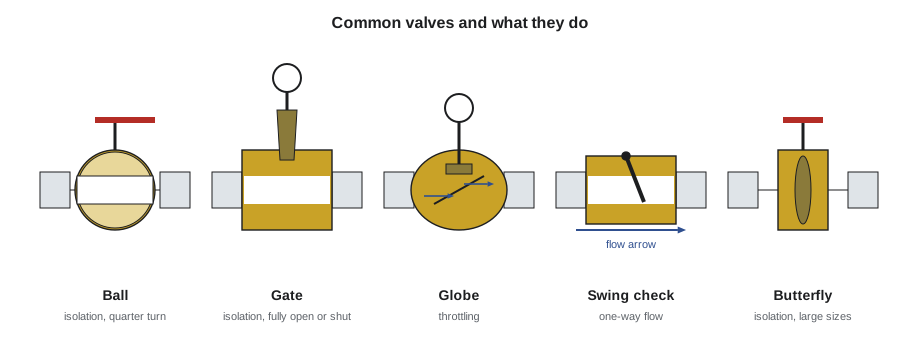
Ball valves are now the most common isolation valves in plumbing. A ball with a hole through it rotates a quarter turn between fully open and fully closed. Full-port ball valves have a hole the same size as the pipe and cause almost no restriction; standard-port valves have a smaller hole. Ball valves shut off tightly and quickly, and the handle position shows at a glance whether they are open (handle in line with the pipe) or closed (handle across it).
Gate valves raise or lower a wedge-shaped gate across the flow with several turns of a handwheel. Fully open, they offer little restriction. They are slow to operate, which helps prevent water hammer in large pipes, and they are still used in large sizes and on some water services. Gate valves should be fully open or fully closed; used partly open, the gate vibrates and the seats wear. Old gate valves often fail to close fully because of scale.
Butterfly valves use a disc that rotates a quarter turn in the pipe. They are compact and economical in large sizes and are common on mains and in mechanical rooms. Stop valves at fixtures, often called angle stops or straight stops, are small isolation valves, increasingly quarter-turn, that let a fixture be serviced without shutting down the whole suite.
Throttling, check and control valves
Globe valves move a disc onto a seat inside a rounded body; the water changes direction inside the valve, which causes more pressure loss but allows precise throttling. Balancing valves are specialized globe or ball valves with measurement ports and memory stops, used to set flows in recirculation and heating systems.
Check valves let water flow in one direction only. Swing checks use a hinged disc and must usually be installed horizontally or with upward flow. Spring-loaded checks close faster, work in any orientation and reduce the slam that causes water hammer, which is why they are used on pump discharges. Every check valve has an arrow on the body showing flow direction; installed backward, it blocks flow completely.
Pressure-reducing valves (PRVs) lower and steady the pressure downstream. On Kingsway Tower, PRV stations on the lower floors keep the boosted pressure from overwhelming fixtures there. Temperature and pressure relief valves on water heaters open to release water if the temperature or pressure becomes dangerous, and must discharge through a pipe to a safe place. Thermostatic and pressure-balancing mixing valves blend hot and cold water to protect against scalding. PLB-130 and PLB-220 cover these in detail.
Backflow prevention: an introduction
Backflow is the reverse flow of water, or anything else, into the potable water system. It happens in two ways. Backsiphonage occurs when supply pressure drops, for example during a water main break or heavy fire-fighting demand, and water is sucked backward from a fixture, tank or hose. Back pressure occurs when pressure downstream, from a pump, boiler or elevated tank, exceeds supply pressure and pushes water backward.
The simplest protection is an air gap: an open vertical space between the supply outlet and the flood level of the fixture or tank, so water cannot be drawn back. Every faucet spout above a sink is an air gap. Where an air gap is not practical, mechanical devices protect the supply, chosen according to the degree of hazard:
- Vacuum breakers, such as those on hose bibbs, admit air to break a siphon. They protect against backsiphonage only.
- Dual check valves and double check valve assemblies use two checks in series, for lower hazards.
- Reduced pressure principle assemblies (RP or RPZ) use two checks with a relief valve between them that opens to atmosphere if either check leaks. They protect against high hazards, such as boilers with chemical treatment, laboratories and irrigation with fertilizer injection.
Testable backflow assemblies must be installed where they can be tested and maintained, and certified testers test them when installed and at intervals the water authority sets. PLB-320 covers backflow prevention fully. For now, know that every connection from the potable system to anything that could contaminate it needs protection, and that the type of protection depends on the hazard.
Fittings for pressure systems
Fittings join pipes and change direction or size. For water supply and other pressure systems, fittings can be relatively compact because pressure pushes the water through any reasonable path. Common pressure fittings include:
- Couplings join two pipes in a straight line; repair couplings without a stop slide fully over the pipe for repairs.
- Elbows (ells) change direction, usually 90 or 45 degrees. A street elbow has one fitting-size end.
- Tees branch a line. A tee is described by its run and branch sizes; a reducing tee has a smaller branch or run outlet.
- Reducers and bushings change pipe size. A reducing coupling joins two sizes of pipe; a bushing fits inside a larger fitting to reduce it.
- Caps and plugs close the end of a pipe or fitting.
- Adapters change the joining method, for example from solder to male thread, or from PEX to copper.
- Unions and flanges allow a joint to be taken apart.
Every fitting adds resistance to flow, roughly equivalent to adding a length of straight pipe. Designers account for this with equivalent lengths: a 90-degree elbow might add as much friction as a metre or two of straight pipe in small sizes, and a tee branch more. The program below adds up equivalent lengths for a run, using approximate values that vary with size and fitting type.
# Total equivalent length of a 3/4 in copper run (approximate equivalent lengths in metres)
equiv = {"90 elbow": 0.6, "45 elbow": 0.3, "tee run": 0.2, "tee branch": 1.2, "ball valve": 0.1}
run_straight = 14.0
fittings = {"90 elbow": 6, "45 elbow": 2, "tee run": 3, "tee branch": 1, "ball valve": 2}
extra = sum(equiv[f] * n for f, n in fittings.items())
print(f"straight pipe {run_straight:.1f} m + fittings {extra:.1f} m = {run_straight + extra:.1f} m equivalent")
print(f"fittings add {extra / run_straight * 100:.0f} percent to the friction of the run")straight pipe 14.0 m + fittings 6.2 m = 20.2 m equivalent fittings add 44 percent to the friction of the run
Fittings for drainage systems
Drainage fittings look similar to pressure fittings but are designed for gravity flow with solids and air. They have smooth, gentle turns so solids do not catch and so flow does not back up. Their sockets are recessed so the inside of the pipe and fitting line up with no ledge to catch debris. Horizontal drainage fittings such as quarter bends are made with a slight built-in pitch so the branch slopes correctly.
The names are different too. A drainage elbow is a bend: a quarter bend turns 90 degrees, a sixth bend 60 degrees, an eighth bend 45 degrees and a sixteenth bend 22-1/2 degrees. Long-sweep and long-turn fittings have larger radii than short-sweep fittings. A wye joins a branch at 45 degrees. A combination wye and eighth bend (often called a combo) turns the branch flow through 90 degrees in a gentle curve. A sanitary tee has a curved branch inlet that directs flow downward. Closet bends connect water closets. Cleanout fittings provide access.
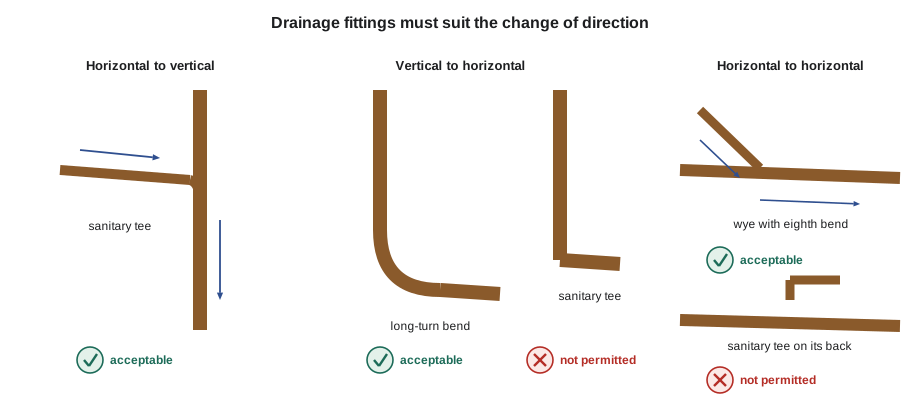
The code sets which fittings may be used for each change of direction, because the wrong fitting can cause blockages or send flow the wrong way:
- Horizontal to vertical (a branch joining a stack): a sanitary tee, wye, combination wye and eighth bend, or a quarter bend may be used.
- Vertical to horizontal (a stack turning into a building drain): use long-sweep fittings, such as a long-turn quarter bend or a wye with an eighth bend, never a sanitary tee. Waste falling down a stack carries speed, and a sharp turn at the bottom causes splashing, back pressure and blockages.
- Horizontal to horizontal: use wyes, combination wyes and eighth bends, or long-sweep bends. A sanitary tee on its back, as Maya's was, is not permitted for horizontal-to-horizontal connections in most cases.
Drainage fittings also have a direction. Wyes and sanitary tees point the flow of the branch toward the direction of flow in the main; installed backward, they send waste upstream. The code lists the exact rules and exceptions, such as sanitary tees permitted in some vent or small-size situations, and PLB-120 covers them in detail.
Reading fitting descriptions
Fittings are ordered and described in a standard way. For tees and wyes, sizes are read run first, then the other end of the run, then the branch: a 3 by 3 by 2 sanitary tee has 3-inch run openings and a 2-inch branch. For reducers, the larger size comes first. Fitting descriptions also include the material, the joining type at each end and, for drainage fittings, the pattern (long sweep, short sweep).
Worked problem
Choosing fittings for a bathroom group
A 3-inch horizontal bathroom branch carries a water closet and lavatory and joins a 4-inch vertical soil stack. A 1-1/2 inch lavatory arm joins the 3-inch branch horizontally. What fittings are needed at each connection?
Show solution
- Branch to stack (horizontal to vertical): a 4 by 4 by 3 sanitary tee, or a wye and eighth bend, installed in the stack with the branch inlet pointing downstream.
- Lavatory arm to bathroom branch (horizontal to horizontal): a 3 by 3 by 1-1/2 combination wye and eighth bend, or a wye with an eighth bend, with the branch pointing in the direction of flow.
- Base of the stack into the building drain (vertical to horizontal): a long-turn quarter bend or wye and eighth bend combination, never a sanitary tee.
Answer: Sanitary tee or combination at the stack, a combination wye at the lavatory arm, and long-sweep fittings at the base of the stack.
When you set a drainage fitting, look at it twice: is it the right pattern for the change of direction, and is it pointing the right way? That second look would have saved Maya her twenty-minute fix.
Valve and fitting materials
Valves and fittings must be compatible with the pipe and the fluid. Potable water valves are made of lead-free brass or bronze, stainless steel or approved plastics, and they carry potable water certification. Brass fittings intended for gas or drainage may not meet potable water requirements. Plastic DWV fittings must match the pipe material: PVC fittings with PVC pipe, ABS with ABS. Cast iron fittings join cast iron pipe through the same couplings or gaskets. And every valve body is marked with its pressure rating, size and often flow direction; installing a valve above its rating or backward defeats its purpose.
Common mistakes
MistakeUsing a gate valve partly open to throttle flow.
InsteadUse gate valves fully open or closed; throttle with a globe or balancing valve.
MistakeInstalling a check valve backward.
InsteadFollow the flow arrow on the valve body.
MistakeUsing a sanitary tee where a stack turns into a horizontal drain.
InsteadUse long-sweep fittings for vertical-to-horizontal changes of direction.
MistakeInstalling a wye or sanitary tee pointing upstream.
InsteadPoint the branch toward the direction of flow in the main.
MistakeLeaving a hose connection without backflow protection.
InsteadUse a vacuum breaker or other approved device for the hazard.
Summary and key terms
- Valves isolate, throttle, prevent reverse flow, control pressure and temperature, and drain or vent systems.
- Ball, gate and butterfly valves isolate; globe and balancing valves throttle; check valves prevent reverse flow.
- Backflow happens by backsiphonage or back pressure; air gaps and devices from vacuum breakers to RP assemblies protect the supply according to the hazard.
- Pressure fittings can be compact; every fitting adds friction equivalent to a length of pipe.
- Drainage fittings have gentle turns, recessed sockets and built-in pitch; the code sets which fitting suits each change of direction.
- Sanitary tees are for horizontal to vertical, long-sweep fittings for vertical to horizontal, and wyes for horizontal to horizontal, always pointing with the flow.
- Ball valve
- A quarter-turn valve with a bored ball, used mainly for isolation.
- Check valve
- A valve that allows flow in one direction only.
- Backflow
- Unwanted reverse flow into the potable water system.
- Air gap
- An open vertical space between a water outlet and the flood level of a fixture or tank.
- Sanitary tee
- A drainage tee with a curved branch that directs flow downward, used for horizontal-to-vertical connections.
- Combination wye and eighth bend
- A drainage fitting that joins a branch at 45 degrees and turns it through 90 degrees in a gentle curve.
Practice problems
Work each problem on paper first, then reveal the answer to check.
Which valve type shows open or closed by the position of its handle?
Show answer
A quarter-turn ball valve: handle in line with the pipe is open, across it is closed.
Why are spring-loaded check valves used on pump discharges?
Show answer
They close quickly and reduce slamming and water hammer.
What is the difference between backsiphonage and back pressure?
Show answer
Backsiphonage is reverse flow from low supply pressure; back pressure is reverse flow pushed by higher downstream pressure.
What fitting may connect a vertical stack to a horizontal building drain?
Show answer
A long-sweep fitting such as a long-turn quarter bend or wye and eighth bend, not a sanitary tee.
How is a 4 by 4 by 3 sanitary tee read?
Show answer
4-inch run openings and a 3-inch branch.
Using the program, what equivalent length do the fittings add to the run?
Show answer
About 6.2 m.
Lesson quiz · 5 questions
Score 60% or more to complete this lesson.
Create a free account to save your progress, take quizzes and earn a certificate.