
PLB-110 · Lesson 6 of 12 · 20 min
Plastic pipe: PVC, ABS, CPVC and PEX
Inside the suites on Kingsway Tower, most of what Maya installed was plastic. The drain branches under the bathrooms and kitchens were white PVC, joined with purple primer and solvent cement. The water lines from the corridor manifold to each fixture were red and blue PEX, pulled through holes in the steel studs and joined with expansion fittings. Plastic is light, fast and forgiving to cut, which is why it now dominates residential plumbing. It is also unforgiving of shortcuts: a dry-fitted joint left without cement, a PEX fitting made with the wrong tool, or a pipe left in the sun can fail years later behind a finished wall.
This lesson covers the plastic pipes used in plumbing, how each is joined, and the handling, safety and code limits that come with them.
The thermoplastics used in plumbing
Plumbing plastics are thermoplastics: they soften when heated and harden again when cooled. That property makes them easy to manufacture and join, but it also sets their limits. Every plastic pipe has a maximum temperature and a pressure rating that falls as temperature rises, and every plastic expands far more than metal when it warms.
- PVC (polyvinyl chloride), usually white or grey, is used for drainage, waste, vent and storm piping, and in pressure grades for water services and irrigation. Inside buildings it is used for DWV, not hot water.
- ABS (acrylonitrile butadiene styrene), usually black, is used for DWV. It is common in some regions and less so in others, and some jurisdictions restrict it.
- CPVC (chlorinated PVC), usually cream or tan, handles hot and cold water supply at normal domestic temperatures and is also made in special grades for sprinkler systems.
- PEX (cross-linked polyethylene) is flexible water supply tube, often coded red for hot and blue for cold, with white or grey also common. Cross-linking the polyethylene molecules gives it the strength and heat resistance for hot water.
- PE (polyethylene) and PE-RT are used for water services, geothermal loops and some heating; PP (polypropylene) appears in specialty and commercial water systems, joined by heat fusion.
Each plastic has its own standards, cements, fittings and tools, and they are not interchangeable. A PVC cement does not properly join ABS, PEX fittings made for one joining system may not be approved for another, and CPVC can be damaged by chemicals that do not hurt other pipes.
Solvent cement joints in PVC and ABS
PVC, ABS and CPVC are joined by solvent cement. Despite the name, a solvent cement joint is not glued. The cement contains solvents that soften the surface of the pipe and the fitting socket, and a small amount of dissolved plastic. When the pipe is pushed into the socket, the softened surfaces fuse, and as the solvents evaporate the joint becomes essentially one piece of plastic. That is why plumbers call it solvent welding.
PVC joints normally require a primer, a stronger solvent that cleans and pre-softens the surfaces before the cement goes on. Primers for plumbing are often tinted purple so that an inspector can see they were used; clear primers exist and are accepted in some places. ABS is joined with ABS cement without a separate primer. Some one-step cements are listed for use without primer on certain pipes and sizes, but only where the code and the product listing allow it.
The steps for a sound solvent-cement joint are:
- Cut the pipe square with a plastic pipe cutter, ratchet cutter or fine-tooth saw in a mitre box. An angled cut leaves part of the joint without contact.
- Remove burrs inside and out, and bevel the outside edge of the pipe slightly so it does not scrape the cement out of the socket as it goes in.
- Dry-fit the pipe into the fitting. It should enter partway and then become snug before reaching the bottom; that interference is what makes the weld. Mark the fitting alignment on both pieces.
- Apply primer, if required, to the socket and the pipe end, working it in until the surface softens.
- While the primer is still wet, apply a full, even coat of cement to the pipe end and a lighter coat in the socket, then another on the pipe end for larger sizes.
- Push the pipe fully into the socket with a quarter turn to spread the cement, align the marks, and hold it for about 30 seconds so the pipe does not push back out.
- Wipe off excess cement and leave the joint undisturbed for the set time, then wait for the full cure time before testing.
Set and cure times depend on temperature, humidity and pipe size. In cold weather the solvents evaporate slowly and joints take much longer to cure; in hot weather they evaporate fast and you must work quickly. Manufacturers publish tables of times, and testing a system before the joints have cured is a common cause of failure.
Never cement ABS to PVC except with products and in locations the code permits. ABS and PVC expand at different rates and the cements are made for one material; most codes require a mechanical transition coupling, such as a rubber sleeve with stainless steel bands, where the two materials meet.
Working with CPVC
CPVC is joined much like PVC, with its own primer and cement or with one-step CPVC cements listed for the purpose. It resists corrosion and works well with aggressive water, but it has particular weaknesses. It becomes brittle in the cold, so it must be handled gently on a winter site. It can be damaged by contact with incompatible chemicals, including some thread sealants, caulks, fire-stopping products, insect sprays and oil-based materials, so manufacturers publish lists of compatible products. And because it is rigid, it needs room to expand in long hot water runs.
CPVC fire sprinkler pipe is a separate, specialized product installed by sprinkler fitters to fire protection standards; plumbers should recognize it and leave it alone.
PEX: the flexible option
PEX has changed residential plumbing. It is flexible enough to bend around corners, so a single run can go from a manifold to a fixture with no joints in the wall. It resists scale and corrosion, it is less likely than rigid pipe to split when it freezes, and it installs quickly.
PEX is made by three main processes, called PEX-a, PEX-b and PEX-c. The differences matter mostly because they decide which joining methods a manufacturer approves. Always use the fittings, rings or sleeves and the tools listed by the pipe manufacturer; mixing systems can void the certification and warranty and make an unreliable joint.
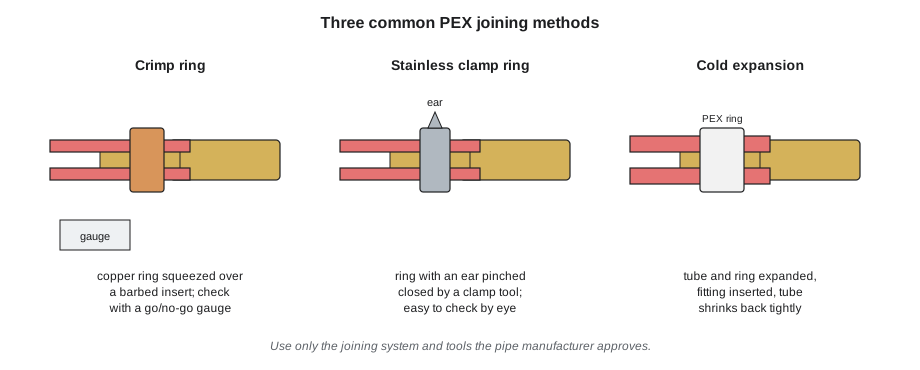
- Crimp rings: a copper ring slid over the tube and squeezed around a barbed insert fitting with a crimp tool. A go/no-go gauge checks every crimp.
- Stainless steel clamp (cinch) rings: a ring with an ear that a clamp tool pinches closed. Easier to check visually, and one tool covers several sizes.
- Cold expansion: the tube end and a PEX ring are expanded with a tool, the fitting is inserted, and the tube shrinks back onto it. Common with PEX-a; the joint gets tighter as the pipe recovers.
- Press sleeves: a stainless sleeve pressed over the tube and fitting with a press tool.
- Push-to-connect fittings, where permitted, mainly for repairs.
PEX has limits that installers must respect. Sunlight degrades it, so it must not be stored outside uncovered or left exposed in a finished installation beyond the manufacturer's limit. It must be kept a set distance from high heat sources such as water heater flues and recessed lights, and many manufacturers require a length of metal pipe at the water heater connection. It expands and contracts a great deal with temperature, so long runs need loops or slack and proper supports. It must not be used where the manufacturer or code prohibits it, for example in some fire-rated assemblies without a listed firestop. And because rodents sometimes chew it, exposed runs in crawl spaces may need protection.
PEX systems are often arranged as home-run or manifold systems: each fixture has its own line from a central manifold with individual shut-offs. That uses more tubing but fewer concealed joints, balances pressure between fixtures better and makes isolating one fixture easy. On Kingsway Tower, each suite has a manifold in the laundry closet with a shut-off for every fixture line.
Pressure and temperature ratings
Plastic pressure pipe carries a pressure rating at a stated temperature, commonly 23 °C (73 °F) for cold water ratings and 82 °C (180 °F) for hot water ratings. PEX and CPVC tubing for domestic water are typically rated for both. Ratings fall as temperature rises, so a pipe that is fine at 23 °C may be weaker at 60 °C. Ratings are printed on the pipe and should be compared with the highest temperature and pressure the system will see, including possible failure of a mixing valve or thermostat.
For DWV pipe, the issue is not internal pressure but temperature of the discharge. Most drains see only warm water, but commercial dishwashers, sterilizers and some equipment discharge water hot enough to soften plastic, and codes and specifications require cooling, indirect connections or metal piping for those.
Safety with solvents and primers
Primers and solvent cements are flammable and give off vapours that can cause headaches, dizziness and, in high concentrations, worse. The safety data sheets for each product list the hazards and controls, as TRD-101 explained. Basic precautions include:
- Work with good ventilation, and use fans or local exhaust in small rooms, trenches and pits. Solvent vapours are heavier than air and collect in low spaces.
- Keep all ignition sources away: no smoking, no torches, no sparking tools near open cans or freshly cemented joints.
- Close containers when not in use, use the applicator in the can, and do not over-apply.
- Wear gloves and eye protection; solvents irritate skin and eyes.
- Do not do hot work near freshly cemented joints. A spark or flame can ignite the vapours inside the pipe.
Disposal matters too. Partly used cans and rags soaked with solvent are flammable waste and go where the site waste plan says, not into the general bin.
Code limits on plastics in buildings
Because plastics burn, melt and give off smoke, building codes limit their use in larger and noncombustible buildings. Typical rules restrict combustible piping in exits, return air plenums and some shafts, require that it pass through fire separations only with tested firestop systems, and set flame-spread and smoke ratings for exposed pipe in some spaces. The details depend on the building's construction type and occupancy, which is why the engineer's specifications decide where plastic is permitted on a given project.
On Kingsway Tower, the specifications allow PVC drain branches and PEX water lines inside each suite but require cast iron and copper in the shafts and common areas. Every place a plastic pipe passes from a suite into a shaft or through a floor gets a listed firestop collar or device installed exactly as its listing shows.
Estimating primer and cement
Manufacturers publish rough guides for how many joints a can of primer and cement will make for each pipe size. The program below uses an invented guide to estimate cans for one suite's drainage. Real coverage varies with temperature, technique and product; use the manufacturer's numbers for a real estimate.
# Estimate cans of primer and cement from joint counts (invented coverage guide)
joints = {"1-1/2": 18, "2": 10, "3": 8}               # joints of each size in one suite
joints_per_can = {"1-1/2": 120, "2": 80, "3": 40}      # joints one can makes (illustrative)
fraction = sum(n / joints_per_can[s] for s, n in joints.items())
suites = 132
print(f"one suite uses about {fraction:.3f} cans of cement")
print(f"{suites} suites: about {fraction*suites:.1f} cans, so order {int(fraction*suites)+1}")one suite uses about 0.475 cans of cement 132 suites: about 62.7 cans, so order 63
Common mistakes
MistakeTesting a solvent-welded system before the joints have cured.
InsteadFollow the manufacturer's cure time table for the temperature and size.
MistakeSkipping primer on PVC because the joint seems tight.
InsteadUse primer wherever the code and cement listing require it.
MistakeCementing ABS directly to PVC.
InsteadUse a listed mechanical transition coupling unless the code specifically permits otherwise.
MistakeUsing crimp rings, clamps or fittings from another PEX system.
InsteadUse only the joining system the pipe manufacturer approves, with gauges to check every joint.
MistakeLeaving PEX coils in the sun on site.
InsteadStore PEX covered and indoors, and limit exposure as the manufacturer requires.
Summary and key terms
- Plumbing plastics are thermoplastics with temperature limits and large thermal expansion.
- PVC and ABS serve DWV; CPVC and PEX serve hot and cold water; PE and PP serve services and specialty systems.
- Solvent cement softens and fuses the pipe and socket; cut square, deburr, prime where required, cement, push home with a quarter turn and hold.
- Set and cure times depend on temperature, humidity and size; test only after full cure.
- PEX joins with crimp, clamp, expansion or press systems; use only the system approved for the pipe, and protect it from sunlight and heat.
- Solvents are flammable and harmful; ventilate, remove ignition sources and protect skin and eyes. Codes limit plastics in larger buildings.
- Thermoplastic
- A plastic that softens when heated and hardens again when cooled.
- Solvent cement
- A product that softens and fuses plastic pipe and fittings into a single welded joint.
- Primer
- A strong solvent applied before cement to clean and soften PVC and CPVC surfaces.
- Cure time
- The time a solvent-cement joint needs before it can be pressure tested or put in service.
- Manifold
- A fitting with several outlets that feeds individual lines to fixtures.
- Cold expansion
- A PEX joining method in which the tube is expanded, a fitting inserted and the tube allowed to shrink back.
Practice problems
Work each problem on paper first, then reveal the answer to check.
Why is a solvent-cement joint called a weld?
Show answer
The solvents soften both surfaces so they fuse into one piece of plastic.
Why is PVC primer often purple?
Show answer
So an inspector can see that primer was used.
Name three PEX joining methods.
Show answer
Any three of crimp rings, clamp rings, cold expansion, press sleeves and push-to-connect.
Why must PEX be kept out of sunlight?
Show answer
Ultraviolet light degrades it.
Why should no hot work be done near freshly cemented joints?
Show answer
Solvent vapours inside and around the pipe are flammable.
Using the program, about how many cans does one suite use?
Show answer
About 0.475 cans of cement.
Lesson quiz · 5 questions
Score 60% or more to complete this lesson.
Create a free account to save your progress, take quizzes and earn a certificate.