
PLB-110 · Lesson 5 of 12 · 20 min
Soldering and brazing copper safely
The first time Maya soldered a joint on Kingsway Tower, she did not light the torch until Luis had walked her through the hot work permit, moved a pile of cardboard packaging twenty feet away, set a fire extinguisher beside her and hung a heat shield behind the joint. The joint itself took less than a minute. The preparation took ten. Luis told her the ratio was about right: on a building site, the dangerous part of soldering is not the joint, it is the flame.
This lesson explains how soldered and brazed joints work, the materials involved, the steps to make a sound joint, and the hot work safety that surrounds every flame on a construction site. Practical skill comes from supervised practice in the shop and on site; the aim here is to understand why each step matters.
How a capillary joint works
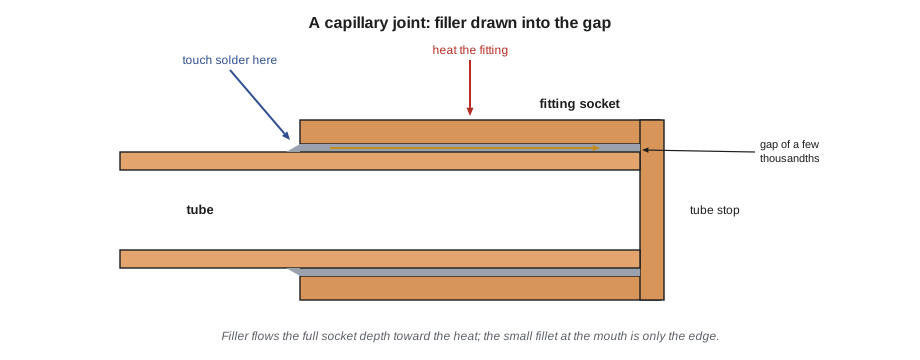
A soldered or brazed joint is a capillary joint. The tube fits into the fitting socket with a small, even gap, typically a few thousandths of an inch. When the joint is heated and the filler metal touches the edge of the gap, the molten filler is drawn into the gap by capillary action, the same force that pulls water up a narrow straw or into a paper towel. The filler flows toward the heat and fills the whole socket, even uphill, if the joint is clean, fluxed and evenly heated.
When the filler cools, it bonds to both surfaces. The strength of the joint comes from the large area of the socket filled with filler, not from a lump of solder on the outside. A neat, continuous ring of filler at the edge of the fitting shows the joint was filled; blobs and drips on the outside show too much filler or uneven heat and add nothing.
Soldering versus brazing
The difference between soldering and brazing is the temperature at which the filler melts. By convention, filler metals that melt below about 450 °C (840 °F) are solders, and those that melt above it are brazing alloys.
Soldering is used for most water supply and drainage joints in small and medium sizes. Lead-free solders for potable water are alloys of tin with small amounts of copper, silver, antimony or bismuth, and they melt at roughly 220 to 240 °C (430 to 460 °F) with a pasty range before fully liquid. Soldering uses a propane or MAPP-type fuel gas torch, or an air-acetylene torch for larger sizes.
Brazing makes stronger joints that tolerate higher temperatures and vibration. Copper-to-copper brazing commonly uses copper-phosphorus alloys, sometimes with silver, which flux themselves on copper; joints to brass or bronze need a separate brazing flux. Brazing temperatures are in the range of roughly 700 to 800 °C (1,300 to 1,500 °F), so it usually needs oxy-fuel or a high-output air-fuel torch. Brazing is required or preferred for larger pipe sizes in some specifications, for medical gas (with a nitrogen purge to prevent internal oxide scale), and for refrigeration.
Brazing anneals more of the tube, softening it, and the higher heat brings more fire risk and more fumes. Medical gas brazing in particular is a specialized skill with its own certification, covered later in the program.
| Soldering | Brazing | |
|---|---|---|
| Filler melts | Below about 450 °C (840 °F) | Above about 450 °C (840 °F) |
| Typical fillers | Lead-free tin alloys | Copper-phosphorus, silver alloys |
| Flux | Water-soluble flux approved for potable water | Often self-fluxing on copper; flux needed for brass and bronze |
| Typical torch | Air-fuel (propane, MAPP-type, air-acetylene) | Oxy-fuel or high-output air-fuel |
| Typical uses | Water supply and DWV in small and medium sizes | Larger sizes, high temperature, medical gas, refrigeration |
| Effect on tube | Anneals a small area | Anneals a larger area |
Solder, flux and potable water
Solder and flux used on potable water systems must be lead free. The plumbing code limits lead in solder and flux to no more than 0.2 percent, and both must be marked as suitable for potable water. Solder containing lead, such as 50/50 tin-lead, is prohibited on any piping that carries drinking water, and good practice is not to keep it on a plumbing truck at all.
Flux is a paste that cleans the last traces of oxide from the metal as it heats, prevents new oxide from forming, and helps the solder wet the surface. Modern plumbing fluxes are water-soluble and certified for potable water. Flux is mildly corrosive, so use only a thin coat on the cleaned areas, wipe off excess after soldering, and flush new systems thoroughly. Flux left inside a pipe, or smeared heavily on the outside, causes corrosion and pinholes over time.
A tinning flux contains powdered solder. It helps the solder flow but does not replace cleaning, and the joint still needs solder fed into it.
Making a soldered joint
The steps below describe a sound soldered joint on copper water tube. Practise them under supervision until they are automatic.
- Cut the tube square with a tube cutter and ream the inside to remove the burr.
- Clean the outside of the tube end and the inside of the fitting socket to bright metal. Do not touch the cleaned surfaces with your fingers.
- Apply a thin, even coat of potable-water flux to the tube end and the socket.
- Assemble the joint fully, with the tube against the tube stop, and support the assembly so it cannot move while the solder cools. Wipe off excess flux.
- Heat the fitting, not the solder. Play the flame over the fitting socket and the tube near it, moving to heat evenly. The flux will sizzle and then go quiet as the joint reaches temperature.
- Touch the solder to the joint at the edge of the fitting on the side away from the flame. If the joint is hot enough, the solder melts on contact and is drawn into the gap. Feed solder until a continuous ring appears around the joint; for each size there is a rough guide to how much solder a joint needs.
- Remove the heat and let the joint cool undisturbed. Moving it while the solder is pasty makes a weak, cracked joint. Wipe it with a damp rag once it has set.
Common problems and their causes are worth memorizing. Solder balls up and runs off instead of flowing in: the joint is not hot enough or not clean. Solder flows in and then the flux burns black: the joint was overheated, which burns off the flux and oxidizes the copper. Solder fills only part of the socket: uneven heating or a dirty spot. A joint leaks on test: usually poor cleaning, not enough heat on one side, movement while cooling, or water in the pipe.
Water in the pipe is a special problem. Even a small amount turns to steam and blows the solder out, and a pipe full of water absorbs heat faster than the torch can supply it. Drain the line completely, open a valve downstream to vent steam, and use a temporary pipe plug designed for the purpose if a little water keeps trickling in. Never solder a closed system: heated air and steam need somewhere to go.
Valves need care too. Soldering heat can damage the seats and seals inside ball valves and other valves. Follow the manufacturer's instructions, which usually mean opening the valve fully, heating the tube more than the valve body, and wrapping or cooling the body if needed. Many valves come with extended ends for exactly this reason.
Hot work: the bigger danger
Any open flame or spark-producing work on a construction site is hot work: soldering, brazing, cutting, welding and grinding. Hot work is one of the leading causes of fires in buildings under construction and renovation, partly because the building is full of combustible packaging, insulation, formwork and dust, and partly because a smouldering fire in a wall cavity or ceiling can break out long after the worker has left.
Ontario's construction regulation and the Ontario Fire Code both address hot work, and most general contractors run a hot work permit system based on recognized guidance such as NFPA 51B. On Kingsway Tower, Stonebridge, the general contractor, requires a written permit for every hot work task, issued by the site safety coordinator, Anika Shah, at the start of each shift.
A typical hot work permit system requires:
- A check of the area before work: combustibles moved well away (35 feet, about 11 metres, is a common distance in permit systems) or protected with fire-resistant covers, openings in floors and walls covered so sparks cannot fall through, and nothing flammable on the other side of the wall.
- A charged fire extinguisher of the right type within reach, and knowledge of how to use it.
- Heat shields or damp rags behind joints near wood framing, insulation or finishes, with special care around plastic pipe and wiring.
- A fire watch: a trained person who watches for fire during the work and for a set time after it stops, commonly 30 to 60 minutes depending on the permit system, and checks hidden spaces such as wall cavities and ceilings.
- Fire alarm and sprinkler considerations: detectors in the work area may need to be protected or temporarily isolated under a controlled procedure, never simply covered and forgotten.
- A final check and sign-off at the end of the fire watch.
Press fittings exist largely because of hot work. In occupied buildings, hospitals and finished areas, a flame-free joint avoids the permit, the fire watch and the risk. That is why Northbridge presses most joints once the building has finishes and why many owners now require flameless methods in occupied areas.
Gas cylinders, fumes and personal protection
Torch fuel cylinders must be secured upright, kept away from heat, and checked for leaks at connections with a soap solution, never a flame. Oxygen cylinders must be kept away from oil and grease, which can ignite violently in pure oxygen, and stored apart from fuel gas cylinders. Hoses and regulators need inspection before use, and flashback arrestors are required on oxy-fuel equipment by most rules and manufacturers. Turn off cylinders and bleed hoses at breaks and at the end of the day.
Soldering and brazing produce fumes from the flux and filler. Lead-free fluxes still release irritating fumes when heated, and cadmium-bearing brazing alloys, still sold for some industrial uses, give off highly toxic fumes and are not used on plumbing systems. Work with ventilation, keep your face out of the fume plume, and use local exhaust or respiratory protection in confined or poorly ventilated spaces as the safety program requires.
Personal protection for soldering includes safety glasses or goggles (shaded lenses for brazing), gloves suitable for heat, long sleeves of non-melting fabric, and care for burns: copper stays hot long after it stops glowing, and a joint can burn skin a minute after the torch is off. Cool burns with cool running water and report them.
Estimating solder and time
Plumbers estimate solder use and time for a job from the number of joints. A rule of thumb used by many shops is that a joint uses a length of wire solder roughly equal to the nominal diameter of the tube, so a 1-inch joint uses about an inch of solder. The program below applies that rule to a riser floor and converts it to spools. Treat the result as an estimate; real use depends on skill and fit-up.
# Rough solder estimate: about one nominal diameter of wire solder per joint
joints = {"1/2": 46, "3/4": 30, "1": 12, "1-1/4": 6, "2": 4}   # joints on one riser floor
inches = {"1/2": 0.5, "3/4": 0.75, "1": 1.0, "1-1/4": 1.25, "2": 2.0}
total_in = sum(n * inches[s] for s, n in joints.items())
total_m = total_in * 0.0254
spool_m = 15.0            # metres of wire on one spool (example)
print(f"joints: {sum(joints.values())}, solder about {total_m:.2f} m, spools: {total_m/spool_m:.2f}")joints: 98, solder about 1.85 m, spools: 0.12
Common mistakes
MistakeHeating the solder instead of the fitting.
InsteadHeat the fitting and let the hot joint melt the solder and draw it in.
MistakeSoldering a line that still has water in it.
InsteadDrain it, vent it through an open valve and stop any trickle before heating.
MistakeUsing heavy globs of flux.
InsteadApply a thin coat to cleaned surfaces only and wipe off the excess.
MistakeStarting hot work without a permit, extinguisher and fire watch.
InsteadFollow the hot work permit every time, including the fire watch after the work.
MistakeMoving a joint before the solder has set.
InsteadSupport the assembly and let it cool undisturbed.
Summary and key terms
- Soldered and brazed joints are capillary joints: molten filler is drawn into a narrow gap and fills the socket.
- Solders melt below about 450 °C (840 °F) and brazing alloys above it; brazing makes stronger, higher-temperature joints.
- Solder and flux on potable water systems must be lead free, with no more than 0.2 percent lead.
- A sound joint needs a square, reamed, cleaned and fluxed joint, even heat on the fitting, and no movement while cooling.
- Hot work needs a permit, cleared combustibles, covered openings, shields, an extinguisher and a fire watch during and after the work.
- Handle fuel and oxygen cylinders safely, control fumes, and protect your eyes, hands and skin.
- Capillary action
- The force that draws a liquid into a narrow gap between two surfaces.
- Solder
- A filler metal that melts below about 450 °C (840 °F).
- Brazing
- Joining with a filler metal that melts above about 450 °C (840 °F).
- Flux
- A paste that cleans and protects metal surfaces so filler metal can wet and flow.
- Hot work
- Any work with open flame, sparks or heat that could start a fire.
- Fire watch
- A trained person who watches for fire during hot work and for a set time after it ends.
Practice problems
Work each problem on paper first, then reveal the answer to check.
Why does solder flow uphill into a joint?
Show answer
Capillary action draws the molten filler into the narrow gap toward the heat.
What temperature separates soldering from brazing?
Show answer
About 450 °C (840 °F).
Give two causes of a leaking soldered joint.
Show answer
Any two of poor cleaning, uneven heat, movement while cooling, overheating and water in the pipe.
Why is a fire watch kept after soldering stops?
Show answer
A smouldering fire in a hidden space can break out after the work ends.
Why must oxygen cylinders be kept away from oil and grease?
Show answer
Oil and grease can ignite violently in pure oxygen.
Using the program's rule, about how much solder do ten 3/4-inch joints need?
Show answer
About 7.5 inches of wire solder.
Lesson quiz · 5 questions
Score 60% or more to complete this lesson.
Create a free account to save your progress, take quizzes and earn a certificate.