
PLB-110 · Lesson 3 of 12 · 22 min
Pipe materials: choosing the right pipe
On her second week, Maya helped Luis unload a delivery: bundles of copper tube in different colours of printing, black cast iron soil pipe with rubber couplings, white and black plastic drain pipe, coils of red and blue PEX, and a few lengths of threaded steel for the booster pump room. She asked why one building needed so many kinds of pipe. Luis said every material is good at something and bad at something else, and a plumber's job is to put each one where it belongs and nowhere else.
This lesson surveys the pipe materials you will meet most often and the properties that decide where each one may be used. The following lessons look closely at copper, plastics, and cast iron and steel, and at how each is joined.
What a plumber needs from a pipe
Choosing a pipe material means weighing several properties against the job:
- Approval: the code must permit the material for the use, and the pipe must carry markings for the required standard and certification. A material can be approved for drainage but not for water supply, or for water supply but not inside a return air plenum.
- Safety for potable water: anything in contact with drinking water must be certified as safe for that use, so it does not leach lead or other harmful substances.
- Pressure and temperature rating: supply pipe must hold the system pressure at the hottest water temperature it will see, with a safety margin.
- Fire performance: plastics burn and give off smoke. Building codes limit where combustible pipe may be used and require tested firestop systems where any pipe passes through a fire separation.
- Corrosion and chemical resistance: water chemistry, soil, chemicals in drainage and contact between different metals all attack some materials.
- Noise: water rushing through plastic drain pipe is louder than through cast iron, which matters in apartments and hotels.
- Expansion: plastics grow and shrink with temperature much more than metals, which affects supports and offsets.
- Cost and labour: material price, how fast it can be installed, and what tools and skills it needs.
No single material wins on every count. That is why the specifications for Kingsway Tower name a material for each system and location, and why the code tables list the materials permitted for each use.
The main materials
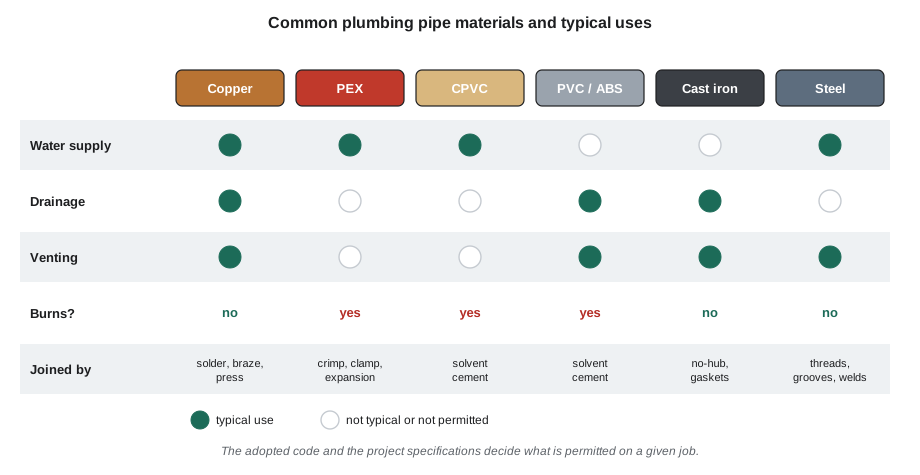
Copper has been the standard material for water supply in North America for most of a century. It resists corrosion in most water, tolerates high temperatures, does not burn, lasts for decades and can be joined by soldering, brazing, pressing or compression. It is expensive and its price swings with the metal markets, and very aggressive or acidic water can cause pinhole leaks. Copper DWV tube also exists for drainage and venting, though it is now uncommon. Lesson 4 covers copper in detail.
PEX (cross-linked polyethylene) is a flexible plastic tube used for water supply. It comes in coils, bends around corners, resists freezing damage better than rigid pipe, and joins with crimp rings, expansion fittings or press sleeves. It cannot be exposed to sunlight for long, has temperature and pressure limits, and expands a great deal with temperature. On Kingsway Tower, PEX runs from the copper risers to fixtures inside each suite.
CPVC (chlorinated polyvinyl chloride) is a rigid plastic for hot and cold water supply, joined with solvent cement. It is used in some regions and some building types, often where water is aggressive to copper. It becomes brittle in cold weather and some chemicals, such as certain fire-stopping compounds and pipe-thread sealants, can damage it, so only compatible products may touch it.
PVC (polyvinyl chloride) and ABS (acrylonitrile butadiene styrene) are rigid plastics used mainly for drainage, waste and venting, joined with solvent cement. ABS is usually black and PVC usually white. Both are light, cheap and quick to install. They are combustible, noisier than cast iron and limited in where they may be used in larger buildings. Lesson 6 covers the plastics and their joining.
Cast iron soil pipe is used for drainage and venting, especially in larger buildings. It is heavy, quiet, does not burn and lasts a very long time. Modern cast iron is joined with no-hub couplings (a rubber sleeve with a stainless steel band) or with compression gaskets in hub-and-spigot pipe. On Kingsway Tower, the main soil stacks and the building drain are cast iron because of noise, fire performance and durability. Lesson 7 covers cast iron.
Steel pipe comes as black steel, used mainly for gas and heating, and galvanized steel, once common for water supply but now rarely used for it because it corrodes inside and restricts flow over the years. Stainless steel is used for some water and specialty systems. Steel is joined by threading, grooved couplings, welding or pressing.
You will also meet materials you should recognize but not install for drinking water. Lead pipe and lead-based solder were common in older buildings; lead is a neurotoxin, and finding and replacing lead service lines is a major public health program in both countries. Polybutylene, a grey plastic water pipe used in the 1980s and 1990s, failed widely and is no longer installed. Old galvanized supply pipe is often clogged with rust. A plumber who works on older buildings learns to identify all of them.
| Material | Main uses | Joined by | Strengths | Limits |
|---|---|---|---|---|
| Copper (types K, L, M) | Water supply, some DWV | Solder, braze, press, compression, flare | Durable, heat tolerant, non-combustible | Cost, aggressive water, theft |
| PEX | Water supply | Crimp, expansion, press, clamp | Flexible, fast, freeze tolerant | Sunlight, large expansion, temperature limits |
| CPVC | Water supply | Solvent cement | Corrosion resistant, low cost | Brittle when cold, chemical compatibility |
| PVC and ABS | DWV, storm | Solvent cement | Light, cheap, quick | Combustible, noisy, use limits in larger buildings |
| Cast iron | DWV, storm | No-hub couplings, gaskets | Quiet, durable, non-combustible | Heavy, cost, needs good support |
| Steel and stainless | Gas, heating, some water, fire | Threads, grooves, welding, press | Strong, high pressure | Corrosion (galvanized), heavy, labour |
Reading pipe markings
Every length of approved pipe is printed or embossed with information. Learning to read it is one of the first habits of a good apprentice, because inspectors check it, and because the wrong pipe in the wall is very expensive to remove. Typical markings include:
- The manufacturer's name or mark and the plant or production code.
- The nominal size and, for many products, a type, schedule, standard dimension ratio (SDR) or pressure class.
The standard the product meets: for example, ASTM or CSA standards for copper tube, CSA B137 series standards for plastic pressure pipe, and CSA B181 series standards for plastic drain pipe.
A certification mark showing an accredited body has tested and certified the product, such as CSA or another certification organization recognized in Canada.
- For water pipe, a mark showing the product is certified for contact with drinking water, commonly to NSF/ANSI/CAN 61, and for plastics often a pressure and temperature rating.
- For plastics used inside buildings, sometimes a flame spread and smoke rating.
Copper tube types are also colour-coded by the printing on the tube: green for type K, blue for type L and red for type M is the common North American convention for hard-drawn tube. Colour coding helps on site, but the printed type is what counts.
Potable water and lead
Anything in contact with drinking water must be lead free and certified safe. In Canada, the plumbing code limits the lead content of solders and fluxes used on potable water systems to no more than 0.2 percent, and requires pipes, fittings and fixtures in contact with drinking water to be certified to the relevant health effects standard, commonly NSF/ANSI/CAN 61, with low-lead requirements for fittings and valves.
Plumbers protect the water supply with their choices every day. Never use leftover plumbing solder of unknown composition on water piping, never use a brass fitting meant only for gas or drainage on a potable line, and keep potable-rated materials separate from others in the truck and on site. When working on older buildings, assume solder and some brass may contain lead, and follow the safe work practices for lead dust and fumes.
Fire separations and combustible pipe
Buildings are divided into fire compartments by fire separations: floors, walls and shafts built to resist fire for a set time. Every pipe that passes through a fire separation creates a hole that fire and smoke could use. Codes require these penetrations to be sealed with a firestop system that has been tested with that pipe material, size and assembly, and installed exactly as the tested system describes.
Plastic pipe adds a complication, because it burns and melts. In larger buildings and in noncombustible construction, building codes limit where combustible piping may be used, and plastic pipe passing through a fire separation usually needs an intumescent firestop device, which swells when heated to close the opening as the pipe melts. These rules are part of the reason Kingsway Tower uses cast iron for its main stacks and copper for its risers: they simplify the firestopping and avoid the restrictions on combustible pipe in shafts.
Lesson 11 covers firestopping as part of installation. For now, remember that the choice of pipe material affects the fire safety of the building, not just the plumbing.
Dissimilar metals and corrosion
When two different metals touch in the presence of water, a small electrical current flows between them and one metal corrodes faster. This is galvanic corrosion. Copper connected directly to galvanized steel is the classic problem: the steel corrodes at the joint. Dielectric unions or fittings, which separate the metals with an insulating gasket, are used where codes or specifications call for them, and many plumbers prefer brass transition fittings between copper and steel.
Other corrosion problems include erosion corrosion, when water moves too fast through copper (common at elbows just after a pump), and pitting from aggressive water chemistry. Lesson 10 shows why keeping water velocity within limits helps prevent erosion.
Choosing materials for Kingsway Tower
Worked problem
Matching materials to systems
Using the specifications, Luis asked Maya to say which material goes where on Kingsway Tower and why.
Show solution
- Water service and risers: type L copper, because the specifications require it for durability, pressure and fire performance in shafts.
- Suite branch piping: PEX, because it is flexible, quick to install and certified for potable water; it runs from a manifold shut-off to each fixture.
- Soil and waste stacks and the building drain: cast iron with no-hub couplings, for quiet operation, fire performance in shafts and durability.
- Suite drainage branches above the slab: the specifications permit PVC within each suite, with listed firestop devices wherever it passes through a fire separation.
- Booster pump room and heating connections: steel with threaded and grooved joints, for strength and large sizes.
Answer: Each material is used where its strengths matter most and where the code and specifications permit it.
# Pick candidate materials for a use from a small permitted-use table
permitted = {
    "copper type L": {"water supply", "drainage above grade"},
    "PEX":           {"water supply"},
    "CPVC":          {"water supply"},
    "PVC":           {"drainage above grade", "drainage below grade", "vent"},
    "cast iron":     {"drainage above grade", "drainage below grade", "vent", "storm"},
}
needs = {"water supply in a shaft": ("water supply", True),
         "suite drain branch": ("drainage above grade", False),
         "building drain under slab": ("drainage below grade", True)}
combustible = {"PEX", "CPVC", "PVC"}
for job, (use, noncombustible_required) in needs.items():
    ok = [m for m, uses in permitted.items() if use in uses and not (noncombustible_required and m in combustible)]
print(f"{job:28s} -> {', '.join(ok)}")water supply in a shaft -> copper type L suite drain branch -> copper type L, PVC, cast iron building drain under slab -> cast iron
The table in the program is a teaching simplification. Real permitted-use tables in the code have many more rows and conditions, and the specifications narrow the choices further. The habit is what matters: decide what the pipe has to do, then check what the code and specifications allow for that use.
Common mistakes
MistakeAssuming a material approved for drainage is fine for water supply.
InsteadCheck the code's permitted uses and the potable water certification for each use.
MistakeInstalling pipe without reading its markings.
InsteadCheck the standard, certification and type or rating on every delivery.
MistakeConnecting copper directly to galvanized steel.
InsteadUse a dielectric or approved transition fitting where required.
MistakeUsing any firestop product on any pipe.
InsteadUse a firestop system tested for that pipe material, size and assembly, installed as listed.
MistakeLeaving PEX exposed to sunlight on site.
InsteadStore and install it protected from UV as the manufacturer requires.
Summary and key terms
- Pipe materials are chosen by approval, potable water safety, pressure and temperature rating, fire performance, corrosion resistance, noise, expansion and cost.
- Copper and PEX dominate water supply; PVC, ABS and cast iron dominate drainage; steel serves gas, heating and large systems.
- Pipe markings show size, type or rating, the standard, the certification mark and potable water certification.
- Materials in contact with drinking water must be lead free and certified safe.
- Combustible pipe is limited in larger buildings, and every penetration of a fire separation needs a tested firestop system.
- Dissimilar metals in contact cause galvanic corrosion; dielectric or transition fittings prevent it.
- PEX
- Cross-linked polyethylene, a flexible plastic tube used for water supply.
- CPVC
- Chlorinated polyvinyl chloride, a rigid plastic pipe for hot and cold water.
- ABS
- Acrylonitrile butadiene styrene, a black plastic pipe used for drainage and venting.
- Galvanic corrosion
- Accelerated corrosion of one metal when two different metals are in electrical contact in water.
- Dielectric union
- A fitting that joins two metals while insulating them from each other.
- Firestop system
- A tested combination of materials that seals a penetration through a fire separation.
Practice problems
Work each problem on paper first, then reveal the answer to check.
Name two properties that make copper a good water supply material.
Show answer
Any two of: corrosion resistance, heat tolerance, non-combustible, durable, many joining methods.
Why is cast iron often chosen for stacks in apartment buildings?
Show answer
It is quiet, non-combustible and durable.
What does galvanic corrosion require?
Show answer
Two different metals in electrical contact with water present.
What information do pipe markings give?
Show answer
Manufacturer, size, type or rating, standard, certification mark and potable water certification.
Why does plastic pipe through a fire separation usually need an intumescent device?
Show answer
The plastic melts in a fire, and the device swells to close the opening.
Name two older materials a plumber should recognize but not install for water supply.
Show answer
Any two of lead, polybutylene and galvanized steel.
Lesson quiz · 5 questions
Score 60% or more to complete this lesson.
Create a free account to save your progress, take quizzes and earn a certificate.