
PLB-110 · Lesson 11 of 12 · 21 min
Supports, hangers, expansion and protection
Walking the parking level of Kingsway Tower with the mechanical engineer's field reviewer, Luis stopped under a long run of copper hot water recirculation line and pointed out how it was hung: steel clevis hangers on threaded rod every few metres, plastic isolators where the copper met the hangers, an expansion loop in the middle of the long straight run, and a fire-stop collar where it passed through the concrete wall into the stair. "Anyone can join pipe," he told Maya. "What makes a system last fifty years is how it is held, how it moves and how it is protected."
This lesson covers the work that happens after the joints are made: supporting piping so it stays straight and sloped, allowing it to expand and contract, protecting it from damage, freezing and fire, and sealing every hole it passes through.
Why supports matter
Pipe supports carry the weight of the pipe, the water in it, insulation and fittings, and keep the pipe in the position and slope it was designed for. Poorly supported pipe sags between hangers, which in drainage creates low spots where solids settle and blockages begin. In water piping, sagging and movement stress joints and valves until they leak. Unsupported pipe vibrates and bangs, and long vertical runs without support pull fittings apart at the bottom.
Supports must also let pipe move. Pipes grow when they warm and shrink when they cool, and a pipe held rigidly at both ends can buckle, crack fittings or tear itself off its supports. Good support design holds the pipe in place against gravity and sideways movement while letting it slide lengthwise where expansion needs to happen.
Codes set maximum spacing between supports for each material and size, both horizontal and vertical, along with rules on support materials and methods. Manufacturers add their own requirements, which sometimes call for closer spacing than the code. The engineer's specifications usually include a hanger schedule. On site, follow the strictest.
Hanger and support types
Plumbers use a wide range of hangers, supports and anchors:
- Clevis hangers: a U-shaped strap with a bolt, hung on threaded rod. They allow some lengthwise movement and are adjustable for slope by turning the nut on the rod. They are the most common hanger for horizontal pipe in commercial buildings.
- Split ring and band hangers: lighter hangers for small pipe.
- Pipe clamps and strut systems: channel strut fixed to walls, ceilings or trapezes, with clamps that hold several pipes in a neat row.
- Trapeze hangers: a horizontal strut or angle hung on two rods, carrying several parallel pipes.
- Riser clamps: clamps around vertical pipe that rest on the floor structure at each level, carrying the weight of the stack.
- Pipe straps and hooks: for small pipe fastened to wood or steel framing in residential work.
- Rollers and slides: supports that let hot pipe move freely as it expands, used on long hot runs.
- Anchors and guides: anchors fix the pipe at one point so expansion is directed where the designer wants it; guides keep the pipe in line while letting it slide.
Hangers attach to the structure with anchors chosen for the material: concrete inserts cast into the slab, post-installed expansion or screw anchors in concrete, beam clamps on steel, and lag screws or brackets in wood. TRD-104 covered anchors in concrete. Never hang pipe from ductwork, conduit, ceiling grid wires or other trades' supports; each trade's supports are designed for its own loads.
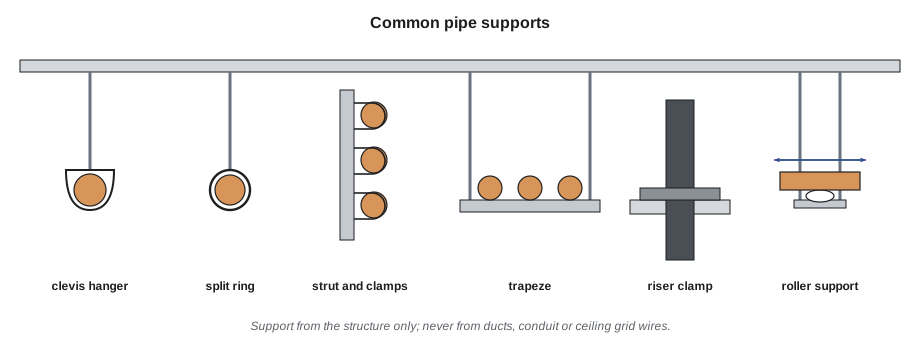
Typical support spacing
The exact spacing comes from the adopted code and the manufacturer, but typical values show the pattern: stiff, light pipe can span farther than flexible or heavy pipe, and vertical pipe is supported at each floor and at intervals between floors.
| Material | Typical horizontal spacing | Vertical |
|---|---|---|
| Copper tube 1-1/4 in and smaller | About 1.8 m | Each floor, not more than about 3 m |
| Copper tube 1-1/2 in and larger | About 3 m | Each floor, not more than about 3 m |
| PVC and ABS DWV | About 1.2 m | Base and each floor, with guides between |
| PEX | About 0.8 m | Each floor, with guides between |
| Cast iron soil pipe | At each joint, not more than about 1.5 m, or 3 m with 3 m lengths | Base and each floor, not more than about 4.5 m |
| Steel pipe | About 3.6 m | Every other floor or as specified |
Hangers must also be placed near concentrated loads such as valves, strainers and in-line pumps, and near every change of direction. For drainage piping, set hanger heights so the pipe holds its slope evenly; a string line or laser along the run helps check it.
Protecting the pipe from its supports
Where copper rests on steel hangers, the dissimilar metals can cause corrosion, and the hanger can wear through the tube as it moves. Copper-plated or plastic-coated hangers, or plastic isolators between pipe and hanger, prevent this. Insulated pipe needs insulation saddles or shields at the hangers so the hanger does not crush the insulation and break its vapour barrier, which on cold water lines would let condensation form and drip. Plastic pipe needs hangers with wide, smooth bearing surfaces that do not cut into it, and must not be clamped so tight that it cannot expand.
Pipes in steel stud walls pass through holes in the studs; plastic or rubber grommets protect the pipe from the sharp edges and quiet the noise. Pipes in wood framing need protection against nails and screws where they run close to the face of the framing: steel plates over the notch or hole are required by code where the pipe is within a set distance of the edge.
Thermal expansion
Every material grows when heated and shrinks when cooled. The change in length depends on the material, the length of pipe and the temperature change:
Here alpha is the coefficient of thermal expansion for the material, L is the length and delta T is the temperature change. Copper's coefficient is about 0.017 mm per metre per degree Celsius, PVC about 0.054, CPVC about 0.063 and PEX about 0.14 to 0.20, depending on the type. In other words, PVC expands about three times as much as copper, and PEX up to ten times as much.
Worked problem
How much does the recirculation line grow?
A straight run of copper hot water recirculation line in the parking level is 30 m long. It is installed at 10 °C and runs at 60 °C. How much does it grow? What if the same run were PVC (for a drain receiving warm water) with the same temperature change?
Show solution
- Temperature change: \(60 - 10 = 50\) °C.
- Copper: \(0.017 \times 30 \times 50 = 25.5\) mm.
- PVC: \(0.054 \times 30 \times 50 = 81\) mm.
Answer: The copper grows about 25 mm, and PVC would grow about 81 mm. Both need room to move.
# Thermal growth of a pipe run (coefficients in mm per metre per degree C)
alpha = {"copper": 0.017, "steel": 0.012, "PVC": 0.054, "CPVC": 0.063, "PEX": 0.17}
length_m, t_install, t_run = 30.0, 10.0, 60.0
dT = t_run - t_install
for m, a in alpha.items():
print(f"{m:7s}: grows {a * length_m * dT:6.1f} mm over {length_m:.0f} m for {dT:.0f} degrees")copper : grows 25.5 mm over 30 m for 50 degrees steel : grows 18.0 mm over 30 m for 50 degrees PVC : grows 81.0 mm over 30 m for 50 degrees CPVC : grows 94.5 mm over 30 m for 50 degrees PEX : grows 255.0 mm over 30 m for 50 degrees
Expansion is handled in several ways. Changes of direction give a run natural flexibility, so a pipe with a few offsets and elbows can absorb its own movement. Long straight runs need expansion loops or offsets, U-shaped or Z-shaped bends that flex, or manufactured expansion joints or compensators. Anchors fix the pipe at chosen points, and guides keep it in line so the movement goes into the loop. Hangers must let the pipe slide, and branches near a moving main need enough flexibility not to snap off at the tee. Stacks in tall buildings need allowances for expansion, especially plastic stacks.
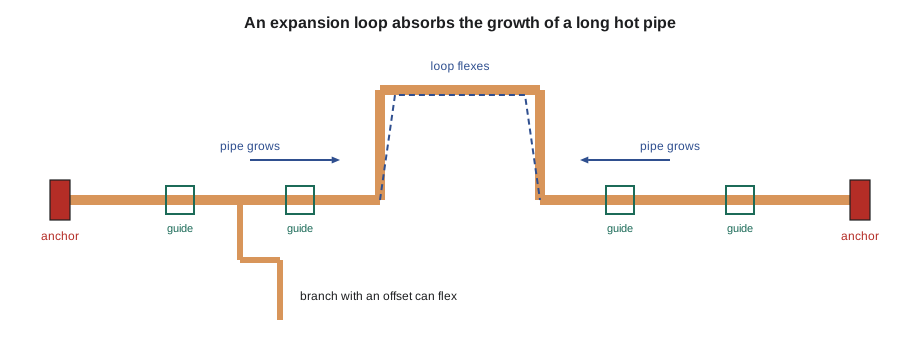
Protecting pipe from freezing, damage and corrosion
Water pipes must be protected from freezing. Codes require water piping in unheated spaces, outside walls and near openings to be protected, by locating it on the warm side of insulation, insulating it, or heat-tracing it. On Kingsway Tower, the domestic water piping in the unheated parking levels near the ramp is heat-traced and insulated, and the sprinkler contractor handles the dry systems there.
Pipe must also be protected from mechanical damage. Exposed piping in parking garages, loading docks and service areas may need guards or bollards. Buried pipe needs proper bedding and backfill so rocks do not damage it, and protection where it passes through foundation walls, usually a sleeve with space around the pipe so building settlement does not shear it. Pipe embedded in or passing through concrete may need sleeves or wrapping to allow movement and prevent corrosion from contact with the concrete.
Insulation does more than prevent freezing. On hot water lines it saves energy and keeps water hot on its way to fixtures; energy codes now require it in most places. On cold water lines it prevents condensation, which drips onto ceilings and causes mould. Insulation must be continuous and its vapour barrier sealed on cold lines.
Sleeves and firestopping
Every time a pipe passes through a floor, a fire-rated wall or a shaft wall, it creates a path for fire and smoke. Buildings are divided into fire compartments to slow the spread of fire and protect escape routes, and an unsealed pipe penetration defeats them. Codes require these penetrations to be sealed with a firestop system that has been tested, as an assembly, with that pipe material, size, insulation and wall or floor construction, and the installation must match the tested system exactly.
Firestop systems are documented in listings that show every detail: the size of the opening, the annular space around the pipe, whether a sleeve is used, the depth of packing material, the type and thickness of sealant, and for plastic pipe the collar or wrap device. Different systems are needed for metal pipe, plastic pipe and insulated pipe. Typical products include intumescent sealants and wraps that swell when heated, firestop collars for plastic pipe, mineral wool packing and cast-in devices placed before the concrete is poured.
On many projects, a specialist firestop contractor does this work; on others, each trade seals its own penetrations. Either way, plumbers must leave openings that suit the listed system: correctly sized, with the right annular space and with the pipe centred. Oversized, ragged holes cored in the wrong place make firestopping difficult or impossible. Inspectors and third-party reviewers check firestopping closely, and each penetration is often labelled with the system used.
Fire separations are not the only openings that need sealing. Exterior walls need air and water seals around pipes, and floors in some areas need water-tight seals so a leak above does not flow through to the floor below.
Common mistakes
MistakeHanging pipe from ductwork, conduit or ceiling grid wires.
InsteadSupport pipe only from the building structure or supports designed for it.
MistakeClamping hot pipe rigidly at both ends of a long straight run.
InsteadAllow for expansion with offsets, loops, anchors and guides.
MistakeLetting hangers crush insulation on cold water lines.
InsteadUse insulation shields or saddles so the vapour barrier stays sealed.
MistakeLeaving copper in direct contact with bare steel hangers.
InsteadUse copper-plated or coated hangers or isolators.
MistakeSealing a penetration with any available caulk.
InsteadUse the tested firestop system for that pipe, size and assembly, installed exactly as listed.
Summary and key terms
- Supports carry the pipe, water, insulation and fittings, keep slope and alignment, and must allow movement where needed.
- Common supports include clevis hangers, strut and clamps, trapezes, riser clamps, rollers, anchors and guides.
- Support spacing depends on material and size; use the strictest of code, manufacturer and specifications.
- Protect pipe from its supports, from framing edges, from nails and screws, from freezing and from mechanical damage.
- Thermal expansion equals the coefficient times length times temperature change; plastics expand far more than metals.
- Every penetration of a fire separation needs a tested firestop system installed exactly as listed.
- Clevis hanger
- An adjustable U-shaped hanger on threaded rod used for horizontal pipe.
- Trapeze hanger
- A horizontal member hung on two rods that supports several parallel pipes.
- Anchor
- A support that fixes a pipe at one point so expansion is directed elsewhere.
- Guide
- A support that keeps a pipe in line while letting it slide lengthwise.
- Expansion loop
- A U-shaped or offset section of pipe that flexes to absorb thermal growth.
- Firestop system
- A tested combination of materials and devices that seals a penetration through a fire separation.
Practice problems
Work each problem on paper first, then reveal the answer to check.
Why does sagging drainage pipe cause problems?
Show answer
Low spots let solids settle and start blockages.
Why are insulation shields used at hangers on cold water lines?
Show answer
So the hanger does not crush the insulation and break the vapour barrier, which would cause condensation.
A 20 m copper line warms by 40 °C. How much does it grow?
Show answer
0.017 times 20 times 40, about 13.6 mm.
About how many times more does PVC expand than copper?
Show answer
About three times.
What is the difference between an anchor and a guide?
Show answer
An anchor fixes the pipe at a point; a guide keeps it in line while letting it slide.
Why must plumbers leave correctly sized, centred openings at fire separations?
Show answer
So the listed firestop system can be installed exactly as tested.
Lesson quiz · 5 questions
Score 60% or more to complete this lesson.
Create a free account to save your progress, take quizzes and earn a certificate.