
ITIL-160 · Lesson 6 of 12 · 22 min
Practising the value system, governance and continual improvement
The ITIL value system is the largest area of the Version 5 syllabus, worth about 40 % of the exam, or sixteen questions. It includes the guiding principles (lesson 4), the value chain and value streams (lesson 7) and the practices (lessons 8 and 9). This lesson covers the rest of the system: what it is, its inputs and outputs, its components, governance and the continual improvement model. In ITIL 4 the same content is called the service value system; the components and logic are the same.
What the value system is for
The value system describes how all the components and activities of an organization work together to enable value creation. Its input is opportunity and demand; its output is value. Opportunity represents options or possibilities to add value for stakeholders or otherwise improve the organization. Demand is the need or desire for products and services among internal and external consumers. Opportunities and demand do not always become work: the organization decides which to pursue.
The purpose of the value system is to ensure that the organization continually co-creates value with all stakeholders through the use and management of products and services. ITIL also uses the value system to explain why silos are harmful. When teams work in isolation, information and resources do not flow, and value suffers. The value system is a model for breaking silos down by connecting everything to the flow from demand to value.
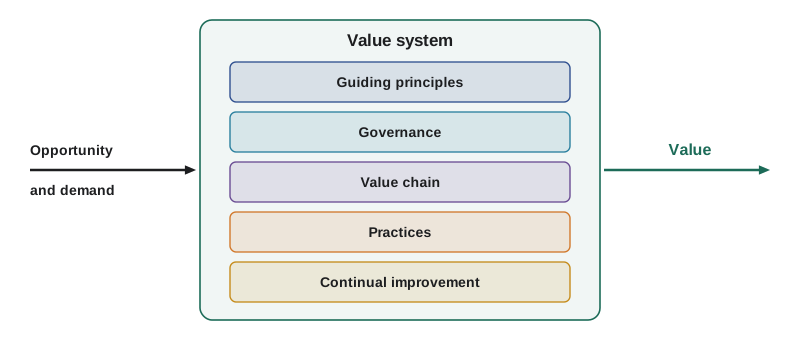
The five components
The value system has five components. Memorize them exactly: guiding principles, governance, the value chain, practices and continual improvement. In ITIL 4 the third component is called the service value chain. A favourite list question offers these components mixed with things that are not components, such as service level agreements, the service desk, configuration items or the four dimensions.
| Component | What it does | Covered in |
|---|---|---|
| Guiding principles | Recommendations that guide decisions and actions in all circumstances | Lesson 4 |
| Governance | The means by which an organization is directed and controlled | This lesson |
| Value chain | An operating model of interconnected activities that respond to demand and create value | Lesson 7 |
| Practices | Sets of organizational resources designed for performing work or accomplishing an objective | Lessons 8 and 9 |
| Continual improvement | A recurring activity at all levels to keep performance in line with stakeholder expectations | This lesson |
Two traps recur. First, the four dimensions are not a component of the value system; they apply to it. Second, a single practice is not a component; the practices as a whole are. If a question lists 'the service desk' or 'incident management' as a possible component, treat it as wrong unless the option says 'practices'.
Governance
Governance is the means by which an organization is directed and controlled. In ITIL, the governing body, such as a board of directors or an executive group, is accountable for the organization's compliance with policies and external regulations. Governance activities are often summarized by three verbs: evaluate, direct and monitor. The governing body evaluates the organization, its strategy and its portfolios; directs by assigning responsibility and setting policies; and monitors performance against those policies and directions.
ITIL stresses that governance applies across the whole value system and must align with the guiding principles and the organization's objectives. Governance is also distinct from management. Governance sets direction and oversight; management plans, builds, runs and monitors activities within that direction. A question might describe a board approving a policy on AI use and ask which component this belongs to: governance.
Worked problem
Governance or management?
Classify each Larchmont activity as governance or management: (1) the board sets a policy that customer data must stay in North America; (2) LTS chooses a cloud region in Toronto to meet the policy; (3) the audit committee reviews quarterly compliance reports; (4) the platform team configures data storage settings.
Show solution
- Governance evaluates, directs and monitors; management plans, builds and runs within that direction.
- (1) Setting policy is directing: governance.
- (2) Choosing an option within policy is management.
- (3) Reviewing compliance is monitoring by the governing body: governance.
- (4) Configuring settings is management.
Answer: Governance: 1 and 3. Management: 2 and 4.
Continual improvement as a component
Continual improvement takes place in all areas of the organization and at all levels, from strategic to operational. ITIL 4 describes it in three places: as a component of the value system, as one of the activities of the value chain (improve), and as a practice (the continual improvement practice). Version 5 guides describe the improve activity as moving up into the continual improvement component, so improvement is still everywhere, but it is no longer listed as a separate value chain activity. Questions on the ITIL 4 exam sometimes ask where continual improvement appears; there the best answer mentions all three.
As a component, continual improvement is supported by a model that guides improvement initiatives. The model has seven steps, each phrased as a question or instruction. Learning these steps in order is one of the most reliable ways to collect marks.
The continual improvement model
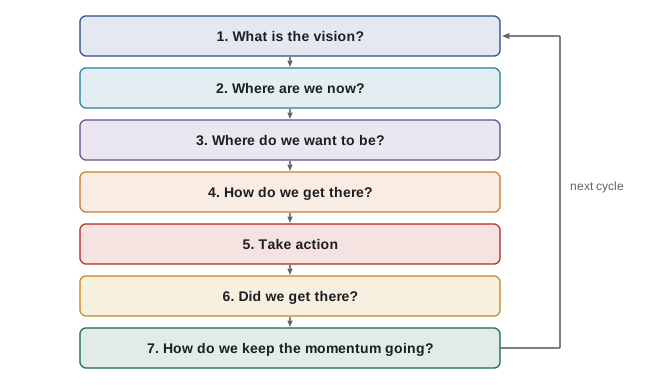
| Step | What it does | Typical clue |
|---|---|---|
| 1. What is the vision? | Link the initiative to the organization's vision and objectives | understanding business objectives, high-level direction |
| 2. Where are we now? | Assess the current state objectively, with baseline measurements | baseline, current state assessment |
| 3. Where do we want to be? | Define the target state and measurable targets | targets, KPIs, desired state, gap |
| 4. How do we get there? | Plan the route: one large step or several iterations | plan, approach, iterations |
| 5. Take action | Carry out the plan, often iteratively | execute, implement, measure progress |
| 6. Did we get there? | Check whether the targets were achieved and value created | evaluate, compare with targets |
| 7. How do we keep the momentum going? | Embed the change, communicate success, move to the next improvement | embed, reinforce, celebrate, next cycle |
Questions on the model usually test order ('Which step comes after where do we want to be?'), the content of a step ('In which step is a baseline assessment performed?') or the step a scenario describes. The commonest mistake is to place the baseline in step 3 instead of step 2. Remember: step 2 describes the current state; step 3 describes the target. Another trap is step 1: the vision step links to the organization's vision, not to the vision of a single team.
The model also connects to the guiding principles. Step 2 applies start where you are. Steps 4 and 5 often apply progress iteratively with feedback. Step 1 applies focus on value. If a question asks which principle is most relevant to a step, these pairings help.
Worked problem
Placing activities in the model
Larchmont's service desk wants to raise self-service resolution. Which step of the continual improvement model is each activity? (1) Measuring that 9 % of contacts are resolved through self-service today. (2) Agreeing a target of 25 % within a year. (3) Checking after a year whether 25 % was reached. (4) Publishing the results and training new staff on the self-service portal so the gain lasts.
Show solution
- (1) Baseline of the current state: step 2, where are we now?
- (2) Target state: step 3, where do we want to be?
- (3) Comparing results with targets: step 6, did we get there?
- (4) Embedding and reinforcing: step 7, how do we keep the momentum going?
Answer: 1 is step 2, 2 is step 3, 3 is step 6, and 4 is step 7.
The continual improvement register
ITIL recommends recording improvement ideas in a continual improvement register (CIR), a database or structured document that tracks and manages improvement ideas from identification to final action. The register lets the organization prioritize ideas, see who owns them and track progress. A missing word question might describe 'a database or structured document used to track and manage improvement ideas' and ask for its name.
ITIL also stresses that continual improvement is everyone's responsibility. Some organizations have a dedicated team that coordinates improvement and coaches others, but the work itself is spread across all teams. A distractor such as 'continual improvement is the responsibility of a dedicated improvement team only' uses extreme wording and should be rejected.
# Order drill for the continual improvement model, plus a self-check on step contents
model = [
    "What is the vision?", "Where are we now?", "Where do we want to be?",
    "How do we get there?", "Take action", "Did we get there?",
    "How do we keep the momentum going?",
]
questions = {
    "A baseline assessment of current performance is made": 2,
    "Measurable targets are agreed": 3,
    "Results are compared with the targets": 6,
    "Success is communicated and the change embedded": 7,
    "The initiative is linked to the organization's objectives": 1,
}
for activity, step in questions.items():
    print(f"Step {step}: {model[step - 1]:<36} <- {activity}")
print("Step after 'Where do we want to be?':", model[model.index("Where do we want to be?") + 1])Step 2: Where are we now? <- A baseline assessment of current performance is made Step 3: Where do we want to be? <- Measurable targets are agreed Step 6: Did we get there? <- Results are compared with the targets Step 7: How do we keep the momentum going? <- Success is communicated and the change embedded Step 1: What is the vision? <- The initiative is linked to the organization's objectives Step after 'Where do we want to be?': How do we get there?
Practice set
| Question | Answer and reasoning |
|---|---|
| What are the inputs to the value system? | Opportunity and demand. |
| Which of these is NOT a component of the value system? A) Governance. B) Practices. C) Service level management. D) Continual improvement. | C. A single practice is not a component; practices as a whole are. |
| Which governance activity involves assigning responsibility and setting policies? | Direct (from evaluate, direct and monitor). |
| In which step of the continual improvement model are measurable targets defined? | Step 3, where do we want to be? |
| In ITIL 4, where does continual improvement appear? | As a value system component, as the improve value chain activity and as a practice. |
Common question patterns for the value system
Value system questions fall into a handful of patterns. Recall questions ask for the components, the inputs or the output. Missing word questions give the definition of governance, opportunity, demand or the value system itself. Scenario questions describe a board, a policy or an improvement initiative and ask which component or which step of the continual improvement model is involved. Order questions ask which continual improvement step comes before or after another.
For each pattern, the same small set of facts decides the answer: five components, opportunity and demand in, value out, evaluate, direct and monitor for governance, and seven ordered steps for continual improvement. Kofi made a single index card with exactly these facts and read it aloud before every study session for two weeks. It sounds simple, but it lifted his value system accuracy in mock exams from about 60 % to about 80 %, because so many questions turned on one of these facts.
One more pattern is worth knowing. Some questions ask why the value system matters, and the expected answer is about integration and flexibility: the value system helps the organization work as a whole, avoid silos and respond to changing demand. Options that describe the value system as a rigid process or a reporting structure are distractors. Remember that ITIL describes it as flexible, adaptable to many working methods and organizations of any size.
Common mistakes
MistakeListing the four dimensions as a value system component.
InsteadThe five components are guiding principles, governance, value chain, practices and continual improvement.
MistakeNaming a single practice as a component.
InsteadPractices as a whole are a component; individual practices are not.
MistakePutting the baseline assessment in step 3.
InsteadThe baseline is step 2, where are we now; step 3 sets the target.
MistakeTreating governance and management as the same thing.
InsteadGovernance evaluates, directs and monitors; management works within that direction.
MistakeGiving continual improvement to one team only.
InsteadIt is everyone's responsibility, even if a team coordinates it.
Summary and key terms
- The value system turns opportunity and demand into value and helps break down silos.
- Its five components are guiding principles, governance, the value chain, practices and continual improvement.
- Governance is how the organization is directed and controlled; the governing body evaluates, directs and monitors.
- Continual improvement is a value system component and a practice; in ITIL 4 it is also the improve value chain activity.
- The continual improvement model has seven steps from "What is the vision?" to "How do we keep the momentum going?".
- Improvement ideas are tracked in a continual improvement register, and improvement is everyone's responsibility.
- Value system
- A model of how all components and activities of an organization work together to enable value creation.
- Opportunity
- Options or possibilities to add value for stakeholders or otherwise improve the organization.
- Demand
- The need or desire for products and services among internal and external consumers.
- Governance
- The means by which an organization is directed and controlled.
- Continual improvement register
- A database or structured document for tracking and managing improvement ideas from identification to final action.
Practice problems
Work each problem on paper first, then reveal the answer to check.
Name the five components of the value system.
Show answer
Guiding principles, governance, value chain, practices, continual improvement.
What is the output of the value system?
Show answer
Value.
What are the three governance activities?
Show answer
Evaluate, direct and monitor.
Recite the seven steps of the continual improvement model.
Show answer
What is the vision? Where are we now? Where do we want to be? How do we get there? Take action. Did we get there? How do we keep the momentum going?
Which step applies the principle start where you are most directly?
Show answer
Step 2, where are we now?
What is a continual improvement register used for?
Show answer
Tracking and managing improvement ideas from identification to final action.
Lesson quiz · 5 questions
Score 60% or more to complete this lesson.
Create a free account to save your progress, take quizzes and earn a certificate.