
ITIL-160 · Lesson 4 of 12 · 23 min
Practising the guiding principles
The seven guiding principles are among the most reliable sources of Foundation marks. They are part of the value system, they appear in recall questions ('Which is a guiding principle?') and in scenario questions ('Which principle does this show?'), and they are the same in ITIL 4 and Version 5. This lesson recaps each principle with its signature ideas, shows how scenario questions are built around them, and works through practice questions with Larchmont settings.
ITIL-120 covered the principles in depth: where they come from, how they interact and how to apply them in real decisions. For the exam you need something more compact: the exact names, a short description of each, the clue words that identify it in a scenario and the principles it is most often confused with.
The seven principles at a glance
Memorize the names exactly as ITIL writes them. A distractor such as 'focus on the customer' or 'start from scratch' looks almost right but is not a principle. The seven are: focus on value; start where you are; progress iteratively with feedback; collaborate and promote visibility; think and work holistically; keep it simple and practical; optimize and automate.
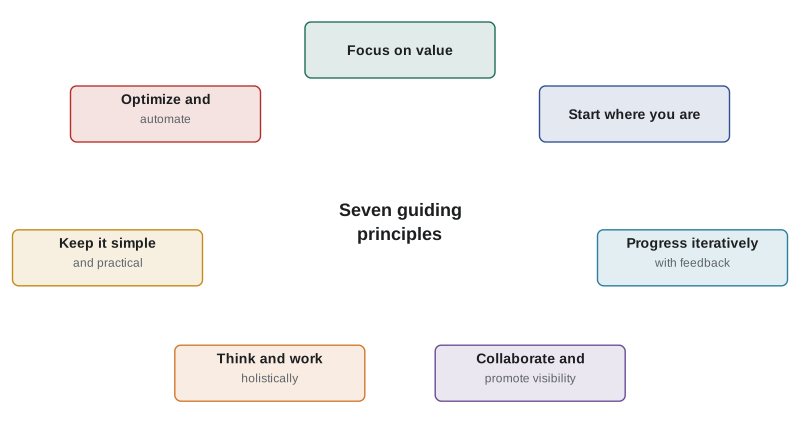
| Principle | Core idea | Clue words in a scenario |
|---|---|---|
| Focus on value | Everything should link back to value for stakeholders | customer perspective, value, outcomes, understanding who benefits |
| Start where you are | Do not start from scratch; assess and reuse what exists | assess current state, reuse, measure first, avoid discarding |
| Progress iteratively with feedback | Work in small, manageable steps with feedback loops | small steps, iterations, feedback, adjust |
| Collaborate and promote visibility | Work together across boundaries and make work and information visible | involve stakeholders, share data, transparency, cross-team |
| Think and work holistically | Consider the whole system, not isolated parts | end to end, four dimensions, whole system, interfaces |
| Keep it simple and practical | Use the minimum steps needed; remove what adds no value | remove steps, minimum, eliminate waste, outcome-based thinking |
| Optimize and automate | Optimize first, then automate where it adds value | automate, technology, after simplifying, human intervention where it adds value |
Focus on value
Everything an organization does should map, directly or indirectly, to value for itself, its customers and other stakeholders. To apply this, you must know who the service consumer is, understand what they value, and consider customer and user experience as part of value. In scenarios, look for an activity that starts by asking who benefits and what outcome they want, or that changes something because it does not contribute to value.
A common distractor pairs focus on value with keep it simple and practical, because removing a step that adds no value fits both. The difference lies in the emphasis. If the scenario is about understanding stakeholders and outcomes, choose focus on value. If it is about cutting steps, controls or complexity, choose keep it simple and practical.
Start where you are
Do not start from scratch and build something new without considering what is already available. Current services, processes, people and tools may be useful and reusable. The principle stresses observing directly, measuring where possible and being careful that measurement reflects reality. In scenarios, look for an assessment of the current state before improvement, reuse of an existing tool or process, or a warning against throwing away something that works.
Kofi's favourite example: when Larchmont planned a new knowledge base, Lena's first instinct was to buy a new tool. The service desk already had 400 articles in the old system, about half of them still accurate. Assessing and reusing those articles before deciding anything is start where you are. Note that the decision to replace the tool might still be right; the principle is about deciding from evidence, not about never replacing anything.
Progress iteratively with feedback
Do not attempt to do everything at once. Even large initiatives should be organized into smaller, manageable sections that can be completed in a timely way, with feedback gathered before, during and after each one. Feedback loops help the organization understand how its outputs are received and adjust. In scenarios, look for small increments, pilots, minimum viable products, sprints or reviews after each step.
Confusion with start where you are is common, because an iteration often begins with an assessment. If the scenario describes the very first assessment of the current state, choose start where you are. If it describes a sequence of small steps with feedback in between, choose progress iteratively with feedback.
Collaborate and promote visibility
Working together across boundaries produces results with greater buy-in, more relevance to objectives and a better chance of long-term success. Visibility matters too: when work is hidden, decisions are made on poor information and trust erodes. ITIL notes that collaboration does not mean consensus; the right people should be involved at the right time. In scenarios, look for involving stakeholders, sharing data openly, making work visible on boards, or breaking down silos between teams.
Worked problem
A collaboration scenario
Larchmont's warehouse system team and the booking product team keep blaming each other for late shipment updates. The CIO sets up a shared dashboard showing every update's journey through both systems and asks both teams to review it together each week. Which guiding principle does this best illustrate?
Show solution
- Clue words: shared dashboard, both teams, review together, blame between silos.
- Making work visible and working together across boundaries is collaborate and promote visibility.
- Think and work holistically is close, because the dashboard covers the end-to-end flow, but the emphasis is on joint review and visibility.
Answer: Collaborate and promote visibility. If the stem had stressed designing the end-to-end flow across all four dimensions, think and work holistically would fit better.
Think and work holistically
No service, practice, process or component stands alone. Outcomes suffer unless the organization works on the whole system, not just on its parts. Holistic thinking considers all four dimensions, the interfaces between activities and the end-to-end flow of value. In scenarios, look for a change that considers effects on other teams, processes or suppliers, or that looks at the full value stream rather than one step.
This principle is easy to choose wrongly, because almost every good decision is somewhat holistic. Choose it when the stem stresses the whole system, all four dimensions, end-to-end flow, or the knock-on effect of a change on other parts. If the stem stresses people working together, prefer collaborate and promote visibility; if it stresses value for a stakeholder, prefer focus on value.
Keep it simple and practical
If a process, service, action or metric fails to provide value or produce a useful outcome, eliminate it. Use the minimum number of steps to achieve an objective. ITIL describes outcome-based thinking and warns against creating a rule for every exception. In scenarios, look for removing approval steps, retiring reports nobody reads, simplifying forms, or designing a process for the common case and handling exceptions separately.
Kofi found this the easiest principle to recognize, because Larchmont had just retired eleven weekly reports that nobody had opened in six months. The clue was 'nobody used them', which shows the reports produced no value, and the action was elimination. That is keep it simple and practical, even though it also touches focus on value.
Optimize and automate
Resources of all types, particularly human resources, should be used to their best effect. Eliminate wasteful work, and use technology to do what it is capable of. Human intervention should happen only where it really contributes value. The principle has a clear order: optimize first, then automate. Automating a poor process just makes it fail faster. In scenarios, look for simplifying and standardizing a process before automating it, or using automation to remove repetitive manual work.
Worked problem
An ordering trap
Larchmont wants to automate password resets. Which action best follows the optimize and automate principle? A) Buy an automation tool and configure it to copy the current twelve-step manual process. B) Simplify and standardize the reset process, then automate it. C) Automate every service request type at once. D) Remove the service desk.
Show solution
- The principle says optimize before automating.
- A automates the existing process without optimizing it.
- C ignores the advice to automate where it adds value and in a sensible order.
- D is extreme wording and not ITIL guidance.
Answer: B. Optimizing first is the defining feature of this principle in exam questions.
How the principles interact
ITIL stresses that the principles interact and should be considered together. Focus on value runs through all of them. Progressing iteratively with feedback depends on starting where you are, because you need a baseline to compare against. Keeping things simple makes it easier to optimize and automate. Questions sometimes ask which principles support each other, or describe a decision that uses two principles and ask which one is most evident. In the second kind, look for the principle that best explains the main action in the stem.
ITIL also notes that not every principle is critical in every situation. An organization should review the principles on each occasion and decide which apply, rather than ticking all seven every time. This idea occasionally appears as a recall question: the principles are guidance that can be adopted and adapted, not mandatory rules.
# Score a scenario against principle clue words; the highest match is a sensible first guess
clues = {
    "focus on value": ["value", "customer", "outcome", "stakeholder"],
    "start where you are": ["existing", "current", "reuse", "assess"],
    "progress iteratively with feedback": ["small", "iteration", "feedback", "pilot"],
    "collaborate and promote visibility": ["together", "share", "visible", "dashboard"],
    "think and work holistically": ["end-to-end", "whole", "dimensions", "other teams"],
    "keep it simple and practical": ["remove", "eliminate", "minimum", "unnecessary"],
    "optimize and automate": ["automate", "tool", "repetitive", "standardize"],
}
scenarios = [
    "The team will reuse the existing knowledge articles after an assess of the current base",
    "Retire the approval step because it is unnecessary and remove two fields from the form",
    "Run a small pilot with five customers and gather feedback before the next iteration",
    "Standardize the reset process, then automate the repetitive steps with a tool",
]
for s in scenarios:
    text = s.lower()
    scores = {p: sum(w in text for w in words) for p, words in clues.items()}
    best = max(scores, key=scores.get)
print(f"{best:<36} <- {s[:55]}...")start where you are <- The team will reuse the existing knowledge articles aft... keep it simple and practical <- Retire the approval step because it is unnecessary and ... progress iteratively with feedback <- Run a small pilot with five customers and gather feedba... optimize and automate <- Standardize the reset process, then automate the repeti...
Clue-word matching is a starting point, not a method to trust blindly. Real questions are written so that two principles share some clue words, and the deciding factor is the main action in the scenario. Use clue words to shortlist two principles, then ask which one explains what the people in the scenario actually did.
Practice set
Try these five questions before reading the answers. Each is written in the Foundation style.
| Question | Answer and reasoning |
|---|---|
| Which is NOT one of the guiding principles? A) Focus on value. B) Keep it simple and practical. C) Design for all eventualities. D) Optimize and automate. | C. Designing for every exception contradicts keep it simple and practical. |
| Before replacing its monitoring tool, Larchmont measures how many incidents the current tool detects. Which principle is this? | Start where you are: assessing the current state by measurement before deciding. |
| A change is designed after checking its effect on suppliers, staff skills, data and processes. Which principle? | Think and work holistically: all four dimensions are considered. |
| Which principle advises that human intervention should happen only where it contributes value? | Optimize and automate. |
| Which statement about the guiding principles is correct? A) All seven must be applied to every decision. B) They are mandatory rules. C) They should be reviewed and the relevant ones applied in each situation. D) They apply only to IT. | C. The principles are adopted and adapted as relevant. |
Common mistakes
MistakeUsing approximate names such as "focus on the customer".
InsteadLearn the exact seven names; approximations are distractors.
MistakeChoosing think and work holistically for every good decision.
InsteadChoose it when the stem stresses the whole system, all four dimensions or end-to-end flow.
MistakeForgetting the order in optimize and automate.
InsteadOptimize first, then automate.
MistakeTreating start where you are as "never replace anything".
InsteadIt means assess and reuse what is useful before deciding.
MistakeBelieving all principles must be applied every time.
InsteadReview them and apply those relevant to the situation.
Summary and key terms
- The seven guiding principles are identical in ITIL 4 and Version 5 and appear in many recall and scenario questions.
- Each principle has clue words: value and stakeholders; assessing and reusing; small steps and feedback; collaboration and visibility; the whole system; removing what adds no value; optimizing before automating.
- Distractors often pair two principles with shared clue words; the main action in the scenario decides.
- Optimize and automate has a fixed order: optimize first, then automate.
- The principles interact and should be reviewed for relevance in each situation.
- Guiding principle
- A recommendation that guides an organization in all circumstances, regardless of changes in goals, strategies, type of work or management structure.
- Feedback loop
- A way of returning information about an output so that the next step can be adjusted.
- Outcome-based thinking
- Designing work around the results it should produce, not around activities.
- Holistic
- Considering the whole system and its interactions rather than isolated parts.
Practice problems
Work each problem on paper first, then reveal the answer to check.
List the seven guiding principles.
Show answer
Focus on value; start where you are; progress iteratively with feedback; collaborate and promote visibility; think and work holistically; keep it simple and practical; optimize and automate.
Which principle warns against creating a rule for every exception?
Show answer
Keep it simple and practical.
Which principle says collaboration does not mean consensus?
Show answer
Collaborate and promote visibility.
Larchmont pilots a new booking feature with ten customers before a full launch. Which principle?
Show answer
Progress iteratively with feedback.
What should happen before automating a process?
Show answer
The process should be optimized: simplified and standardized.
How do you choose between two principles that both fit a scenario?
Show answer
Ask which principle explains the main action in the stem.
Lesson quiz · 5 questions
Score 60% or more to complete this lesson.
Create a free account to save your progress, take quizzes and earn a certificate.