
ITIL-160 · Lesson 3 of 12 · 22 min
Key definitions that carry the exam
About a third of the Version 5 Foundation exam, roughly twelve questions, tests key terms and definitions, and definitions appear inside many questions in other areas too. A candidate who knows the definitions precisely has a large head start; a candidate who knows them only roughly will keep falling for distractors that use a neighbouring term. This lesson gathers the definitions most worth memorizing, shows how to tell similar terms apart and gives practice in the Foundation style.
ITIL-110 explained these concepts in depth with examples. Here the goal is narrower: to fix each definition in memory with its signature words, the two or three words that identify it in a missing word question or distinguish it from a near neighbour. The definitions below are paraphrased study versions. Your exam materials give the official wording, and it is worth comparing the two and learning the official version for the terms you find hardest.
Service management, value and co-creation
Service management is a set of specialized organizational capabilities for enabling value for customers in the form of services. The signature words are 'specialized organizational capabilities' and 'value for customers in the form of services'. Capabilities here means more than processes: it includes people, knowledge, information, technology, partners and ways of working.
Value is the perceived benefits, usefulness and importance of something. The word 'perceived' matters. Value is decided by the stakeholder who receives it, not by the provider, and two customers can value the same service differently. ITIL stresses that value is co-created: providers and consumers create it together through their relationship. A freight booking service creates value only when the customer actually uses it to move goods on time.
A service is a means of enabling value co-creation by facilitating outcomes that customers want to achieve, without the customer having to manage specific costs and risks. Three signature phrases appear here: 'enabling value co-creation', 'facilitating outcomes' and 'without having to manage specific costs and risks'. When a question asks what distinguishes a service, look for the option about outcomes and costs and risks the customer no longer manages.
Products, offerings and relationships
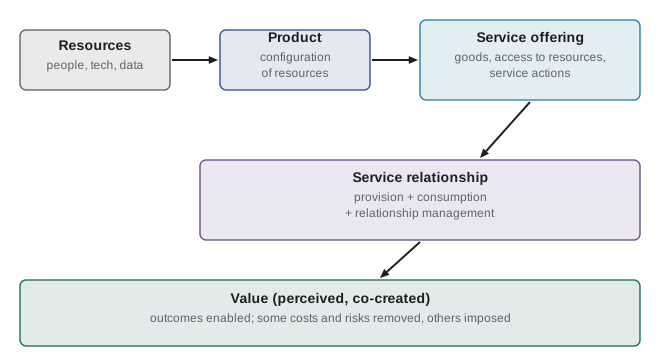
A product is a configuration of an organization's resources designed to offer value for a consumer. The signature words are 'configuration of resources'. Products are what the provider builds; customers do not usually see them whole. A service offering is a formal description of one or more services, designed to address the needs of a target consumer group. An offering may include goods, access to resources and service actions.
| Part of an offering | Meaning | Larchmont example |
|---|---|---|
| Goods | Supplied to the consumer; ownership is transferred and the consumer takes responsibility for future use | GPS tracking tags sold to a high-value shipper |
| Access to resources | Granted or licensed under agreed terms; ownership stays with the provider | Logins to the booking portal and API |
| Service actions | Performed by the provider to address a consumer need | An agent rebooking a load after a missed pickup |
A service relationship is a cooperation between a service provider and a service consumer, and it includes service provision, service consumption and service relationship management. Service provision is what the provider does to deliver services. Service consumption is what the consumer does to use them. Service relationship management is the joint work of both to ensure continual value co-creation. A frequent missing word question puts these three side by side.
Organizations, consumers and roles
An organization is a person or a group of people that has its own functions with responsibilities, authorities and relationships to achieve its objectives. Organizations act as service providers and service consumers, often both at once. Larchmont Technology Services provides services to Larchmont's business units and consumes cloud services from its suppliers.
ITIL names three consumer roles. The customer defines the requirements for a service and takes responsibility for the outcomes of service consumption. The user uses services. The sponsor authorizes the budget for service consumption. One person can hold all three roles, or they can be three different people. At a Larchmont client, the logistics manager who chose the service is the customer, the shipping clerks who book loads are users, and the finance director who signed the contract is the sponsor.
| Role | Signature words | Typical distractor confusion |
|---|---|---|
| Customer | Defines requirements, responsible for outcomes | Confused with the user who actually uses the service |
| User | Uses services | Confused with the customer who sets requirements |
| Sponsor | Authorizes budget | Confused with the customer who decides requirements |
Outputs, outcomes, costs and risks
An output is a tangible or intangible deliverable of an activity. An outcome is a result for a stakeholder enabled by one or more outputs. The difference is worth a mark or two on most exams. Larchmont's booking confirmation email is an output; the customer's goods arriving on time, with the customer free to plan around it, is the outcome. Questions often describe something and ask whether it is an output or an outcome; ask yourself whether it is a deliverable or a result for a person.
Cost is the amount of money spent on a specific activity or resource. From the consumer's point of view, a service removes some costs (such as owning trucks) and imposes others (such as the service fee and the time spent learning the portal). Risk is a possible event that could cause harm or loss, or make it more difficult to achieve objectives; it can also be defined as uncertainty of outcome. Services likewise remove some risks (vehicle breakdown) and impose others (dependence on the provider). Questions about removed and imposed costs and risks reward candidates who remember that services do both.
Utility and warranty
Utility is the functionality offered by a product or service to meet a particular need; it is often summarized as 'what the service does' and described as fit for purpose. Warranty is the assurance that a product or service will meet agreed requirements; it is summarized as 'how the service performs' and described as fit for use. Warranty usually covers availability, capacity, security and continuity, the areas often written into service level agreements.
A classic question describes a feature, such as 'the portal can print customs documents', and asks whether it is utility or warranty. Another describes a guarantee, such as 'the portal is available 99.9 % of the time during business hours', and asks the same. Features and functions are utility; performance, availability and security are warranty. Both are needed for value: a service that does the right thing unreliably, or the wrong thing reliably, does not create value.
Worked problem
Utility or warranty?
Sort these Larchmont statements into utility and warranty: (1) customers can book a load with a refrigerated trailer; (2) the booking API responds within two seconds for 95 % of requests; (3) shipment data is encrypted in transit; (4) customers can download proof of delivery.
Show solution
- Ask of each: is this something the service does (a function) or how well it performs or is protected?
- (1) booking a refrigerated trailer is a function: utility.
- (2) response time is performance: warranty.
- (3) encryption is security: warranty.
- (4) downloading proof of delivery is a function: utility.
Answer: Utility: 1 and 4. Warranty: 2 and 3.
Definitions from the rest of the syllabus
Many other definitions appear across the syllabus, and the exam can test them anywhere. The table collects those that most often turn up in Foundation-style questions, with their signature words. Several are covered in more depth in later lessons; here the point is to recognize them.
| Term | Study definition | Signature words |
|---|---|---|
| Incident | An unplanned interruption to a service or reduction in its quality | unplanned, interruption, reduction in quality |
| Problem | A cause, or potential cause, of one or more incidents | cause, potential cause |
| Known error | A problem that has been analysed but not resolved | analysed, not resolved |
| Workaround | A solution that reduces or eliminates the impact of an incident or problem for which a full resolution is not yet available | reduces impact, no full resolution yet |
| Change | The addition, modification or removal of anything that could have a direct or indirect effect on services | addition, modification, removal |
| Event | Any change of state that has significance for the management of a service or configuration item | change of state, significance |
| Configuration item | Any component that needs to be managed in order to deliver an IT service | component, needs to be managed |
| IT asset | Any financially valuable component that can contribute to delivery of an IT product or service | financially valuable |
| Service request | A request from a user or user representative that initiates a service action agreed as a normal part of service delivery | normal part of service delivery |
| Value stream | A series of steps an organization undertakes to create and deliver products and services to consumers | series of steps, create and deliver |
Look at how many pairs sit close together: incident and problem, problem and known error, configuration item and IT asset, change and event. Distractors exploit these pairs. If a question describes 'a problem that has been analysed but has no permanent fix', the answer is known error, and 'problem' will be a distractor. If it describes 'any component that needs to be managed to deliver a service', the answer is configuration item, and 'IT asset' will be a distractor because it adds financial value.
Learning definitions efficiently
Definitions are best learned by retrieval, not rereading. Research on learning consistently finds that testing yourself, by trying to recall an answer before checking it, produces better long-term memory than reading the same material again. Flashcards work well: the term on one side and the definition on the other, practised in both directions. Spacing the practice over days rather than cramming it into one evening further improves recall.
Kofi and Lena built a shared deck of 60 cards from this lesson and the practice lessons. They review it on their phones for ten minutes a day, and the app shows cards they miss more often. Lena added a third field to each card, 'nearest neighbour', naming the term most likely to be confused with it, because those confusions were costing her marks.
# Self-test on look-alike terms: which signature words point to which term?
cards = {
    "incident": ["unplanned", "interruption", "reduction in quality"],
    "problem": ["cause", "potential cause"],
    "known error": ["root cause found", "not resolved"],
    "configuration item": ["component", "needs to be managed"],
    "IT asset": ["financially valuable"],
    "change": ["addition", "modification", "removal"],
    "event": ["change of state", "significance"],
}
clues = [
    "a component that needs to be managed to deliver a service",
    "a problem whose root cause was found but not resolved",
    "an unplanned interruption to a service",
    "any financially valuable component",
    "a change of state with significance for managing a service",
]
for clue in clues:
    scores = {term: sum(w in clue for w in words) for term, words in cards.items()}
    best = max(scores, key=scores.get)
print(f"{clue:<62} -> {best}")a component that needs to be managed to deliver a service -> configuration item a problem whose root cause was found but not resolved -> problem an unplanned interruption to a service -> incident any financially valuable component -> configuration item a change of state with significance for managing a service -> event
The matcher works by counting signature words, which is a fair model of how a well-prepared candidate reads a missing word question: spot the defining phrase and map it to the term. Look at the second clue: it contains the word 'problem', yet the matcher still chooses known error, because 'root cause found' and 'not resolved' are the defining words. In the real definition the defining words are 'analysed' and 'not resolved'.
Practising definition questions
Below are five definition questions in the Foundation style, followed by the reasoning. Try each before reading the answer.
| Question | Answer and reasoning |
|---|---|
| What is defined as "the perceived benefits, usefulness and importance of something"? | Value. "Perceived" is the signature word. |
| Which role authorizes budget for service consumption? | Sponsor. The customer defines requirements; the user uses the service. |
| A customer can now track loads on a map. Is this utility or warranty? | Utility: it is a function the service provides. |
| What is "a result for a stakeholder enabled by one or more outputs"? | An outcome. An output is the deliverable itself. |
| Which term describes a configuration of resources designed to offer value for a consumer? | Product. A service offering is a description of services for a target group. |
Common mistakes
MistakeTreating value as fixed by the provider.
InsteadValue is perceived by the stakeholder and co-created through the relationship.
MistakeConfusing outputs with outcomes.
InsteadOutputs are deliverables; outcomes are results for stakeholders.
MistakeCalling availability and security utility.
InsteadAvailability, capacity, security and continuity are warranty; functions are utility.
MistakeMixing up customer, user and sponsor.
InsteadCustomer defines requirements and owns outcomes; user uses; sponsor authorizes budget.
MistakeRereading definitions as the only study method.
InsteadUse retrieval practice with spaced flashcards.
Summary and key terms
- Key terms are about 30 % of the Version 5 exam and appear in questions throughout the syllabus.
- Value is perceived and co-created; a service enables outcomes without the customer managing specific costs and risks.
- A product is a configuration of resources; a service offering describes services for a target group and includes goods, access to resources and service actions.
- Customer, user and sponsor are distinct roles that one person can hold together.
- Utility is fit for purpose (what it does); warranty is fit for use (how it performs).
- Near-neighbour pairs such as incident and problem, or configuration item and IT asset, are favourite distractor sources.
- Signature words
- The few words in a definition that identify it and distinguish it from similar terms.
- Co-creation
- The idea that value is created jointly by provider and consumer.
- Utility
- The functionality of a product or service that meets a particular need.
- Warranty
- The assurance that a product or service will meet agreed requirements.
- Retrieval practice
- Learning by recalling information from memory before checking it.
Practice problems
Work each problem on paper first, then reveal the answer to check.
Give the signature words of the definition of a service.
Show answer
Enabling value co-creation, facilitating outcomes, without managing specific costs and risks.
Name the three parts a service offering may include.
Show answer
Goods, access to resources and service actions.
Is "the portal is available 99.9 % of business hours" utility or warranty?
Show answer
Warranty.
Which term is "a cause, or potential cause, of one or more incidents"?
Show answer
Problem.
What are the three parts of a service relationship?
Show answer
Service provision, service consumption and service relationship management.
Why is flashcard practice better than rereading?
Show answer
Retrieving information from memory strengthens long-term recall more than rereading does.
Lesson quiz · 5 questions
Score 60% or more to complete this lesson.
Create a free account to save your progress, take quizzes and earn a certificate.