
ITIL-160 · Lesson 12 of 12 · 20 min
Mock exams, the final two weeks and next steps after Foundation
The last stage of preparation is the most efficient one. Full timed mock exams show where marks are being lost, an error log turns each mistake into a lesson, and a structured final two weeks closes the remaining gaps without burning you out. This lesson covers all three, then looks beyond the exam: what to do on the day you pass or fail, how to keep the certificate current, and where the ITIL scheme and other certifications can take you next.
Why full mock exams matter
Topic quizzes, like the ones in this course, build knowledge. Full mock exams build exam performance. A mock exam of 40 mixed questions in 60 minutes tests three things topic quizzes do not: switching rapidly between syllabus areas, pacing over a full hour, and staying accurate when tired. Research on learning also supports the value of practice testing itself: retrieving answers under test conditions strengthens memory more than reviewing notes.
Use mock exams written to the current syllabus for your edition. Accredited training organizations usually provide official sample papers, and the final exam in this course gives a further twenty questions in the Foundation style. Avoid any source that claims to offer real exam questions: using leaked items breaks the exam rules and can lead to a certificate being withdrawn, and such material is often inaccurate anyway.
| When | Mock exam | Purpose |
|---|---|---|
| End of week 2 | First full mock, timed | Find weak areas and check pacing |
| End of week 3 | Second full mock, timed | Confirm improvement and adjust the plan |
| Week 4, three or four days before the exam | Final full mock, timed, at the same time of day as the real exam | Build confidence and rehearse the routine |
Scoring a mock exam by syllabus area
After each mock, do not just look at the total. Break the result down by syllabus area, as the official score report does after a real attempt. A total of 27 out of 40 might hide 90 % on definitions and 45 % on the value system, which is a fragile pass. The breakdown tells you exactly what to study next.
Worked problem
Reading a mock exam breakdown
Lena's first mock exam result by Version 5 area: terms 10/12, four dimensions 4/4, lifecycle 4/4, value system 8/16, value streams 2/2, AI 1/1, frameworks 1/1. What is her total, and what should she focus on?
Show solution
- Total = 10 + 4 + 4 + 8 + 2 + 1 + 1 = 30 of 40, a pass at 75 %.
- Every area is strong except the value system at 50 %.
- The value system carries 16 questions, so raising it to 75 % would add four marks.
Answer: 30 of 40. Lena should spend most of the next week on the value system, especially the practices and the continual improvement model, where her errors clustered.
# Score a mock exam by Version 5 syllabus area and rank study priorities by marks available to gain
results = {  # area: (correct, questions)
    "Key terms": (10, 12),
    "Four dimensions": (4, 4),
    "Lifecycle": (4, 4),
    "Value system": (8, 16),
    "Value streams": (2, 2),
    "ITIL and AI": (1, 1),
    "Other frameworks": (1, 1),
}
total = sum(c for c, _ in results.values())
print(f"Total: {total}/40 ({total / 40:.0%}) - {'pass' if total >= 26 else 'not yet'}")
print("Marks still available by area:")
for area, (c, q) in sorted(results.items(), key=lambda kv: kv[1][0] - kv[1][1]):
    missed = q - c
    if missed:
print(f" {area:<18} {c:>2}/{q:<2} ({c / q:.0%}) {missed} marks to gain")Total: 30/40 (75%) - pass Marks still available by area: Value system 8/16 (50%) 8 marks to gain Key terms 10/12 (83%) 2 marks to gain
The error log
An error log is a simple list of every question you got wrong or guessed, with the reason. The reason matters more than the right answer. Most errors fall into a few types, and each type has a different fix. Keeping the log for two or three mock exams usually reveals a pattern that a single score never shows.
| Error type | Example | Fix |
|---|---|---|
| Did not know | Could not recall the purpose of supplier management | Add a flashcard; review it daily |
| Confused neighbours | Chose problem management for an incident restoration question | Add a "nearest neighbour" note to both cards |
| Misread the stem | Missed NOT in a negative question | Slow down on key words; underline them mentally |
| Answered from experience | Chose a change advisory board for a standard change | Ask "what does ITIL say?" before answering |
| Changed a right answer | Switched from correct to wrong on review without a reason | Change answers only for a specific reason |
| Ran out of time | Rushed the last five questions | Use checkpoints and the two-minute cap |
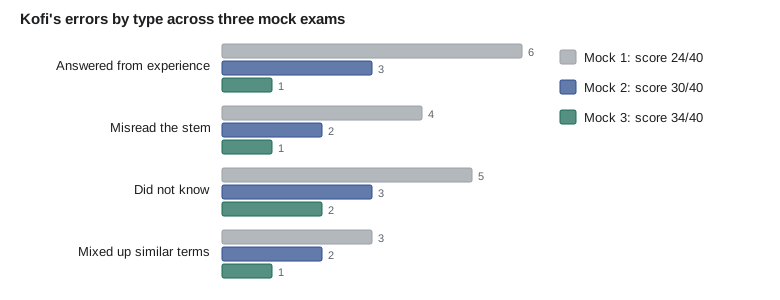
Kofi's log made his problem obvious. On his first mock he scored 24, and six of his sixteen errors were questions where he answered from Larchmont's habits rather than ITIL's guidance. Once he named the pattern, he started asking 'what does ITIL say?' before every scenario question. His second mock rose to 30 and his third to 34.
The final two weeks
The last two weeks should shift from learning new material to consolidating it. A plan that works for most candidates looks like this.
| Days before exam | Focus |
|---|---|
| 14-8 | Close gaps found by mock exams; daily flashcards; one timed mock at the end of the week |
| 7-4 | Targeted practice on weak areas; re-read the syllabus once; review the error log |
| 3 | Final full mock under exam conditions; review only the errors |
| 2 | Light review of flashcards and the error log; prepare documents and room or travel |
| 1 | Rest; a short flashcard review at most; run the system check if online; sleep normally |
| Exam day | Eat, arrive or log in early, follow the timing plan |
Resist the urge to cram the night before. Research on sleep and memory suggests that sleep helps consolidate what you have learned, and fatigue harms the careful reading Foundation demands. If you have prepared with spaced practice, the knowledge is already there; the last day is about arriving rested and calm.
On the day you get your result
If you pass, congratulations: you hold one of the most widely recognized certificates in service management. Download the digital certificate, add it to your professional profiles and tell your manager. At Larchmont, Ruth Akinyemi asked each cohort member who passed to share one idea from the course that they planned to apply, and the best ideas went into the continual improvement register.
If you do not pass, the score report breaks the result down by syllabus area. Treat it as the most accurate mock exam you will ever get. Update the error log, focus on the weakest areas, sit one or two more timed mocks and rebook when you are consistently scoring well above 26. Many successful candidates pass on a second attempt after a focused two or three weeks. Check whether your training bundle includes a free retake.
Kofi and Lena both passed on their first attempt, Kofi with 33 and Lena with 35. Across Larchmont's first cohort of 24, 21 passed first time and the remaining three passed on their second attempt within a month. Amara used the cohort's error logs, anonymized, to adjust the study guide for the second cohort, an example of continual improvement applied to the learning program itself.
Keeping the certificate current
ITIL certificates earned in the current scheme are valid for three years. PeopleCert describes several ways to renew: earning continuing professional development (CPD) points through its membership program, gaining another qualification in the scheme, or retaking the exam. The details and costs can change, so check the current rules when you pass and set a reminder well before the expiry date. Keeping a simple record of learning activities, such as courses, conferences and reading, makes CPD renewal easy.
Next steps in the ITIL scheme
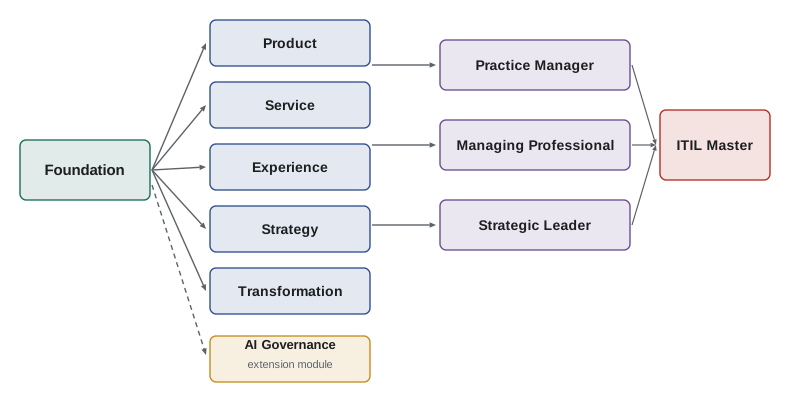
Foundation is the entry point. Published descriptions of the Version 5 scheme include five advanced modules (Product, Service, Experience, Strategy and Transformation) and an extension module on AI governance. Combinations of modules lead to designations such as Practice Manager, Managing Professional and Strategic Leader, and completing all of them leads to ITIL Master. Advanced modules usually require accredited training before the exam. ITIL 4 qualifications are recognized as prerequisites for Version 5 modules during the transition.
| Your role | A sensible next step |
|---|---|
| Service desk or support analyst | Deepen practice skills; consider the Service or Experience module |
| Developer or product team member | Product module; combine with DevOps and agile learning |
| Team lead or manager | Practice Manager or Managing Professional path |
| Senior leader or strategist | Strategy and Transformation modules; Strategic Leader designation |
| Risk, compliance or data role | AI Governance extension module |
Kofi plans to take the Service and Experience modules over the next year, aiming for the Managing Professional designation as he moves toward a service delivery manager role. Lena intends to take the Product module and continue with DevOps and site reliability engineering learning. Both found that Foundation gave them a shared vocabulary that made cross-team conversations at Larchmont noticeably easier.
Beyond ITIL
ITIL fits well with other certifications. People in project roles often add a project management qualification such as PMP or PRINCE2, both covered by other prep tracks at HSM University. People in security roles pair ITIL with security certifications such as CISSP. Those in governance and audit roles may study COBIT or ISO/IEC 20000. Agile and DevOps certifications complement ITIL for product teams. The right next step depends on where you want your career to go, not on collecting certificates for their own sake.
In Canada, many public sector job postings for IT service roles list ITIL Foundation as an asset, and federal and provincial organizations often expect familiarity with ITIL practices when they contract managed services. Professional development budgets and, in some provinces, training grants for employers can help cover advanced modules; check with your employer and provincial programs.
Looking back over the ITIL track
This course completes the ITIL track at HSM University. ITIL-101 explained how certification works; ITIL-110 the key concepts; ITIL-120 the guiding principles and governance; ITIL-130 the value system and value chain; ITIL-140 and ITIL-141 the practices; ITIL-150 digital products, AI and transformation; and ITIL-160 the exam itself. Together they cover far more than Foundation requires, which is deliberate: the exam is a milestone, but the goal is to manage services well in practice.
A last word on study habits
The candidates who pass most comfortably are rarely those who studied the most hours. They are those who studied steadily, tested themselves often, learned from each mistake and arrived rested. Short daily sessions with flashcards and practice questions, a few full mock exams and an honest error log are enough for most people who have worked through the earlier courses in this track. If a session feels unproductive, stop and return the next day; spaced practice is more effective than long sessions anyway.
Common mistakes
MistakeUsing only topic quizzes and never sitting a full timed mock.
InsteadSit at least two or three full timed mock exams before the real one.
MistakeLooking only at the total mock score.
InsteadBreak results down by syllabus area and by error type.
MistakeUsing sources that claim to offer real exam questions.
InsteadUse official sample papers and practice questions written to the syllabus; leaked items break the rules.
MistakeCramming the night before.
InsteadRest and sleep normally; light review at most.
MistakeForgetting the certificate expires.
InsteadNote the three-year expiry and plan renewal through CPD, another qualification or a retake.
Summary and key terms
- Full timed mock exams test pacing, switching between topics and accuracy under fatigue; sit two or three before the exam.
- Score mocks by syllabus area and keep an error log by error type to find patterns.
- In the final two weeks, consolidate rather than learn new material, and rest the day before.
- If you do not pass, use the score report as a precise guide and rebook when mock scores are consistently well above 26.
- Certificates in the current scheme last three years and can be renewed through CPD, another qualification or a retake.
- Foundation leads to advanced modules (Product, Service, Experience, Strategy, Transformation), an AI governance extension and designations up to ITIL Master.
- Mock exam
- A full practice exam under timed conditions matching the real format.
- Error log
- A record of wrong or guessed answers with the reason for each.
- CPD
- Continuing professional development: learning activities recorded to maintain a qualification.
- Designation
- A title awarded for completing a defined set of advanced modules, such as Managing Professional.
Practice problems
Work each problem on paper first, then reveal the answer to check.
What do full mock exams test that topic quizzes do not?
Show answer
Switching between areas, pacing over a full hour and accuracy under fatigue.
Why break a mock score down by syllabus area?
Show answer
A passing total can hide a weak heavily weighted area; the breakdown shows where to study.
Name three error types worth tracking.
Show answer
Any three of: did not know, confused neighbours, misread the stem, answered from experience, changed a right answer, ran out of time.
What should you do the day before the exam?
Show answer
Rest, do light review at most, prepare documents and equipment, and sleep normally.
How long is an ITIL certificate valid in the current scheme, and how can it be renewed?
Show answer
Three years; renew through CPD points, another qualification in the scheme or a retake.
Name the five Version 5 advanced modules.
Show answer
Product, Service, Experience, Strategy and Transformation.
Lesson quiz · 5 questions
Score 60% or more to complete this lesson.
Create a free account to save your progress, take quizzes and earn a certificate.