
ITIL-160 · Lesson 11 of 12 · 21 min
Timing, elimination and test-day logistics
Knowing the syllabus earns most of your marks. Technique on the day earns the rest, and it protects the marks you have earned from careless loss. This lesson covers three things: how to use your 60 minutes, how to eliminate wrong options systematically when you are unsure, and how to prepare for the practical side of exam day, whether you sit online or at a test centre.
A timing plan
Forty questions in sixty minutes allows ninety seconds each. Most Foundation questions take far less: a recall question you know takes fifteen to thirty seconds, and a scenario question perhaps a minute. A well-prepared candidate typically finishes a first pass in 35 to 45 minutes, leaving time to review flagged questions. The plan below is a sensible default; adjust it after your first timed mock exam.
| Minutes | What to do |
|---|---|
| 0-1 | Settle in, read the instructions, note the end time |
| 1-40 | First pass: answer every question, flag any you are unsure of, never leave a blank |
| 40-55 | Second pass: return to flagged questions only, re-read stems carefully |
| 55-60 | Final check: confirm every question has an answer; do not start re-reading everything |
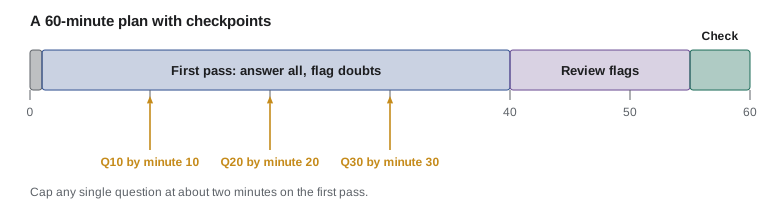
Checkpoints help. Aim to have finished about ten questions every ten minutes. If you reach minute 20 with only twelve questions done, speed up by flagging hard questions instead of wrestling with them. If you reach minute 20 with 25 done, slow down slightly and read more carefully; most Foundation errors come from misreading, not from lack of time.
The first pass: answer, flag, move on
On the first pass, answer every question, even the ones you are unsure of. Give each one your best answer and flag it for review. Never leave a blank intending to come back; if something goes wrong later, such as a connection problem or a lost sense of time, blank questions are certain zeros while guesses have a one-in-four chance at worst. Because there is no penalty for wrong answers, a guess always has positive expected value.
Do not spend more than about two minutes on any question in the first pass. A hard question is worth exactly as much as an easy one. Spending four minutes on one question can cost you two easy questions at the end if time runs short. Flag it, pick your best guess and move on; often a later question jogs your memory.
Worked problem
The value of a guess
Lena reaches a question she cannot answer. She is sure option D is wrong but cannot choose between A, B and C. What is her chance of scoring the mark if she guesses among the three, compared with leaving it blank?
Show solution
- A blank scores zero with certainty.
- A random guess among the three remaining options is correct with probability 1/3, about 33 %.
- Eliminating one more option would raise the chance to 1/2.
Answer: Guessing gives about a one-in-three chance of a mark versus none for a blank, and every option eliminated raises the odds.
Systematic elimination
When you do not know the answer outright, elimination usually gets you most of the way. The techniques below come from lessons 2 to 10, gathered as a checklist. Use them in order: each removes options that are clearly wrong and leaves you choosing between fewer.
| Check | What it eliminates |
|---|---|
| Does the option answer the question asked? | True statements that are irrelevant to the stem |
| Is it an ITIL term or idea? | Common workplace practice and terms ITIL does not use |
| Does it belong to a different practice, principle or component? | Correct statements about the wrong thing |
| Does it use absolute words such as always, never, only, all? | Extreme statements that ITIL rarely makes |
| Is any part of it false? | Half-right options with a false clause |
| Does it contradict a guiding principle? | Options that add needless complexity, ignore value or skip feedback |
Kofi practised elimination by covering the options and writing down his own answer first, then going through the checklist for each option before deciding. After two weeks he found he could usually eliminate two options in a few seconds, which turned many uncertain questions into a choice between two.
The second pass: reviewing flagged questions
On the second pass, look only at flagged questions. For each one, re-read the stem slowly, especially any words such as NOT, BEST, FIRST or PURPOSE. Then apply the elimination checklist again. Change an answer only when you can name the specific reason: a word in the stem you missed, a definition you now remember, or a principle the option contradicts. If you cannot name a reason, keep your first answer.
Do not use the second pass to re-read questions you were confident about. Confidence is not perfect, but re-reading confident answers under time pressure tends to plant doubt without improving accuracy. The exception is if you realize, from a later question, that you misunderstood a concept; then revisit questions that depended on it.
# Simulate first-pass pacing against the checkpoint plan (10 questions per 10 minutes)
import random
random.seed(7)
seconds = []
for q in range(40):
    kind = random.choices(["recall", "scenario", "hard"], weights=[50, 40, 10])[0]
    base = {"recall": 30, "scenario": 60, "hard": 110}[kind]
    seconds.append(min(base + random.randint(-10, 20), 120))  # cap: flag and move on at 2 minutes
elapsed = 0
for q, s in enumerate(seconds, start=1):
    elapsed += s
    if q % 10 == 0:
        status = "ahead" if elapsed <= q * 60 else "behind"
        print(f"After question {q:>2}: {elapsed / 60:5.1f} min ({status} of checkpoint {q} min)")
print(f"First pass done at {elapsed / 60:.1f} min, leaving {60 - elapsed / 60:.1f} min for review")After question 10: 6.0 min (ahead of checkpoint 10 min) After question 20: 13.4 min (ahead of checkpoint 20 min) After question 30: 22.3 min (ahead of checkpoint 30 min) After question 40: 30.7 min (ahead of checkpoint 40 min) First pass done at 30.7 min, leaving 29.3 min for review
The simulation uses invented timings, but its shape matches what most candidates see in mock exams: a mix of quick recall questions and slower scenarios finishes the first pass well inside the hour, provided no single question is allowed to eat several minutes. The two-minute cap in the code is the rule that makes the plan work.
Managing stress
Some anxiety before an exam is normal and can even sharpen attention. Too much harms recall. Practical steps help: sit at least two full timed mock exams so the format feels familiar, sleep normally the night before rather than cramming, eat beforehand and arrive or log in early. During the exam, if your mind goes blank, flag the question, take two slow breaths and move on; the answer often returns later.
Remember the arithmetic: you can miss 14 questions and still pass. A run of three hard questions does not mean you are failing. Foundation question order is not arranged from easy to hard, and every candidate meets questions they find difficult.
Online proctored exams
Many candidates now sit Foundation online, supervised by a remote proctor through webcam and microphone. The provider publishes technical and room requirements, and failing them can cost you the attempt, so preparation matters.
| Before exam day | On exam day |
|---|---|
| Run the provider's system check on the computer you will use | Log in early to allow time for identity and room checks |
| Use a wired connection or a strong, stable Wi-Fi signal | Have your government photo ID ready; the name must match your booking |
| Choose a quiet private room you can close | Clear the desk completely; remove notes, phones and extra screens |
| Tell others in the household not to enter during the exam | Stay in view of the camera; avoid reading questions aloud |
| Close other applications and disable notifications | If something goes wrong, contact the proctor through the exam software |
Proctors watch for behaviour that might suggest cheating, such as looking away from the screen for long periods, talking or another person entering the room. Most candidates never have a problem, but knowing the rules removes a source of worry. If your connection fails, follow the provider's instructions; rules on resuming vary, and your evidence of what happened helps if you need to request a review.
Test centre exams
At a test centre, the technical risks disappear, but travel and timing add their own. Plan the journey, allow extra time, bring the required identification and expect to store personal belongings in a locker. The centre provides the computer and supervises the room. Some candidates find the controlled environment calmer than their own home; others prefer the comfort of home. Choose the setting in which you expect to concentrate best.
For Larchmont's cohort in Winnipeg, most people chose the online option because the nearest test centres had limited dates. Two staff who share apartments with roommates booked a meeting room at the Larchmont office, cleared of everything but a desk and a computer, and checked with the provider that this met the room rules.
Accessibility and accommodations
Candidates with disabilities or medical conditions can usually request accommodations, such as extra time, breaks or assistive technology. These requests are separate from the language allowance and normally need supporting documentation and advance notice. Ask early, ideally when you first plan the exam, because approval can take time and may affect which dates are available.
Rehearsing the routine
Exam technique is a habit, and habits come from rehearsal. Use every timed mock exam to practise the full routine: note the end time, run the first pass with checkpoints, flag doubtful questions, review flagged questions only and check for blanks at the end. After each mock, write down one thing that went wrong in the routine, such as overrunning on a hard question or forgetting to check a flag, and fix that one thing next time.
Lena discovered in her first mock that she read scenario questions too fast and missed the word FIRST twice. In her second mock she mentally underlined key words before reading the options and made no reading errors. Kofi found that he spent too long on list questions; he switched to judging the statement that appeared in the most options first, which usually eliminated two options at once, and his pace improved.
Sit at least one mock at the same time of day as your real exam, in the same room and on the same computer if you are testing online. Familiar conditions reduce anxiety and reveal practical problems, such as a noisy time of day or a webcam that needs adjusting, while there is still time to fix them.
Rehearsal also includes the practical side. For an online exam, practise sitting for a full hour without getting up, with the phone in another room and the desk clear. For a test centre, find out how long the journey takes at that time of day. Small rehearsals like these remove surprises that would otherwise cost attention on the day.
Finally, decide your personal rules in advance and write them on the first page of your study notes: two-minute cap, ten questions every ten minutes, never leave a blank, change answers only for a reason. Decisions made calmly before the exam are better than decisions made under pressure during it.
Common mistakes
MistakeSpending four minutes on one hard question in the first pass.
InsteadCap each question at about two minutes, flag it and move on.
MistakeLeaving blanks to return to later.
InsteadAnswer every question on the first pass and flag doubtful ones.
MistakeRe-reading every answer in the final minutes.
InsteadReview flagged questions only, and change answers only for a specific reason.
MistakeSkipping the system check for an online exam.
InsteadRun it days ahead on the same computer and network.
MistakeRequesting accommodations close to the exam date.
InsteadRequest them early, with documentation.
Summary and key terms
- Forty questions in sixty minutes is ninety seconds each; most candidates finish the first pass in 35 to 45 minutes.
- Use checkpoints of about ten questions every ten minutes, cap hard questions at two minutes, and never leave a blank.
- Eliminate options that do not answer the question, are not ITIL, belong to something else, use absolute words or contain a false clause.
- On the second pass, review flagged questions only and change answers only for a specific reason.
- For online exams, run the system check, prepare a clear private room and have matching ID ready; for test centres, plan travel and timing.
- Request language allowances and other accommodations at booking or earlier.
- First pass
- Answering every question once, flagging those to review.
- Flag
- A marker the exam software lets you place on a question to return to it.
- Elimination
- Removing options that are clearly wrong to improve the odds among those left.
- Accommodation
- An adjustment to exam conditions for a candidate with a disability or medical condition.
Practice problems
Work each problem on paper first, then reveal the answer to check.
How long should a first pass usually take for a well-prepared candidate?
Show answer
About 35 to 45 minutes.
What checkpoint pace keeps you on track?
Show answer
About ten questions every ten minutes.
Why should you never leave a blank?
Show answer
There is no penalty for wrong answers, so any guess has a chance of scoring.
Name three elimination checks.
Show answer
Any three of: does it answer the question, is it ITIL, does it belong to something else, does it use absolute words, is part of it false, does it contradict a principle.
When should you change an answer on review?
Show answer
Only when you can name a specific reason the new answer is better.
Name two things to do before an online proctored exam.
Show answer
Run the system check, prepare a quiet private room, use a stable connection, check your ID matches.
Lesson quiz · 5 questions
Score 60% or more to complete this lesson.
Create a free account to save your progress, take quizzes and earn a certificate.